


The RoHS Pack 29 exemption consultation is a short, high-consequence window that most affected manufacturers will find out about too late. The European Commission, through the Öko-Institut, opened Pack 29 to review ten Annex III mercury-in-lamps renewal requests and, more importantly, three Annex IV revocation requests filed by a competitor. Stakeholder submissions close on 1 August 2026. If your products rely on the Annex IV exemptions under challenge, this is the only structured opportunity to put user-side evidence on the record before the technical assessment concludes.
If you are unsure whether your bill of materials touches these entries, a quick way to scope exposure is to book a compliance risk assessment and map your affected products against the specific exemption numbers rather than the general material description.
Key Takeaways
📌 The RoHS Pack 29 exemption consultation covers ten Annex III mercury lamp renewals and three Annex IV revocation requests under Directive 2011/65/EU.
⏳ The stakeholder submission deadline is 1 August 2026, an eight-week window that opened on 6 June 2026.
⚠️ The three Annex IV revocations were filed by Arradiance, LLC, a supplier of the substitute technology, making this a competitor-initiated challenge rather than a routine sunset review.
🏭 Medical devices, radiation detectors, analytical instrumentation, pH and ion-selective electrodes, and micro-channel plate devices are the products most exposed.
📄 No new compliance obligation arises today. This is evidence-gathering, and existing exemptions remain valid under Article 5(5) while renewals are pending.
📊 Annex IV entry 3 (micro-channel and capillary plates) is the entry most at risk, based on the tone of the consultants' own questionnaire.
🤖 Manufacturers that maintain BOM-level compliance intelligence and continuous audit-ready documentation can identify affected parts and assemble substitution evidence in days rather than weeks.
Executive Regulatory Overview
RoHS Pack 29 is a stakeholder consultation under Directive 2011/65/EU (RoHS 2), run by the Öko-Institut on behalf of the European Commission's DG Environment. It is not a rule and imposes no new obligation. It is the evidence-gathering stage that precedes any recommendation to amend Annex III or Annex IV. The composition matters: ten of the thirteen requests are renewals or amendments of Annex III mercury-in-lamps exemptions, while three are requests to revoke Annex IV exemptions that medical device and instrument makers depend on today. You can review the underlying framework on Certivo's RoHS compliance page, and the mechanics of how these reviews cascade into product design are covered in our EU RoHS update analysis.
The strategic point for executives is straightforward. A consultation that reads like routine administrative housekeeping is, in one part, a direct attempt to strip exemptions your engineers currently rely on. Affected users who do not respond leave the evidence base to the party seeking removal. Treating regulatory intelligence and horizon scanning as a live discipline, not a quarterly review, is what separates the companies that see this coming from the ones that learn about it after a decision is drafted.
RoHS Pack 29 exemption consultation 2026 showing Annex III renewals and Annex IV revocations
Click on image to view full

What RoHS Pack 29 Actually Covers
The official title of the consultation is a review of "ten exemption requests and three revocation requests." Both the "thirteen" count and the "ten plus three" count are correct, because the three Annex III 4(c) power-band variants are handled as a single dossier. The consultation opened on 6 June 2026 and runs for eight weeks, closing on 1 August 2026. This is the operative date. Everything else in the process, from technical assessment to a possible delegated directive, follows later.
The ten Annex III items concern mercury in special-purpose gas discharge lamps: ultraviolet lamps, emergency lamps, high-pressure sodium and mercury vapour lamps, projector lamps, and horticulture lighting. These are renewal requests submitted largely by Lighting Europe, with Crystal IS, the UV SAFE Alliance, and VDMA co-applying on the UV entries. For the lamp entries, the mechanics are familiar and are best managed through BOM-level compliance tracking so you can confirm quickly whether a specific product falls inside the renewal scope.
Why the Annex IV Revocation Requests Are Different
The three Annex IV revocations are the reason compliance leaders should pay attention. They were filed by Arradiance, LLC, a Massachusetts supplier of atomic layer deposition (ALD) coating technology. Arradiance is not a user of these exemptions. It sells the substitute. Its argument, in summary, is that a viable alternative has existed for over a decade and that continued reliance on the exemptions has slowed adoption of its technology.
This is a competitor-initiated challenge, not a routine expiry review, and that changes the calculus for every downstream user. When a supplier of the alternative drives the evidence process, the burden effectively shifts to the manufacturers who still need the exemption to demonstrate why substitution is not yet feasible in their specific application. Supplier-driven regulatory pressure is exactly the scenario where supplier risk scoring and due diligence and multi-tier supply chain visibility pay for themselves, and where a centralized materials and environmental compliance backbone lets you assemble a response without a fire drill.
What Is Under Review, Entry by Entry
Annex III — Mercury in lamps (ten renewal requests)
Entry | Scope (summary) | Request | Applicant(s) |
|---|---|---|---|
1(f)-I | Lamps emitting mainly UV light: 5 mg Hg | Renewal | LightingEurope |
2(b)(4)-II | Lamps emitting mainly UV light: 15 mg | Renewal | LightingEurope |
2(b)(4)-III | Emergency lamps: 15 mg | Renewal | LightingEurope |
4(a)-I | Low-pressure non-phosphor discharge lamps, UV output, up to 15 mg | Renewal | LightingEurope, Crystal IS, UV SAFE Alliance |
4(c) I / II / III | Other high-pressure sodium vapour lamps (three power bands) | Renewal | LightingEurope |
4(f)-II | High-pressure mercury vapour lamps used in projectors | Renewal | LightingEurope |
4(f)-III | High-pressure mercury vapour lamps used for horticulture lighting | Renewal | LightingEurope |
4(f)-IV | Mercury UV lamps | Renewal | LightingEurope, Crystal IS, UV SAFE Alliance, VDMA |
Annex IV — Revocation requests (three)
Entry | Current exemption wording | Request |
|---|---|---|
IV 1 | Lead, cadmium and mercury in detectors for ionising radiation | Revoke (Arradiance) |
IV 1(a) | Lead and cadmium in ion selective electrodes including glass of pH electrodes | Revoke (Arradiance) |
IV 3 | Lead in electromagnetic radiation amplification devices: micro-channel plate and capillary plate | Revoke (Arradiance) |
The consultants' questionnaires are not uniformly sympathetic to the applicant, and this detail is decision-useful. For IV-1 and IV-1(a), the consultants note that the applicant did not provide information on the successful use of ALD in those specific applications. For IV-3, the questionnaire leans the other way, asking stakeholders whether they agree that ALD enables the elimination of lead in micro-channel plates. Annex IV entry 3 is therefore the entry most at risk, and it should be your first priority. Certivo's semiconductor and high-tech compliance resources are relevant here, since MCP-based detectors sit across scientific and photonics equipment.
RoHS Pack 29 Annex IV revocation risk ranking for micro-channel plate and electrode exemptions
Click on image to view full

Industries and Product Categories Affected
The Annex III mercury entries affect lighting manufacturers and importers, UV disinfection, curing and water-treatment equipment makers, horticulture lighting, and projection and AV equipment. The Annex IV revocations reach further into regulated, safety-critical sectors:
🏭 Medical devices including in vitro diagnostics, radiation detection, and analytical instrumentation
🏭 Monitoring and control instruments, including industrial monitoring and control
🏭 Scientific and analytical instrumentation such as mass spectrometry, electron multipliers, night vision, and photon counting
🏭 Nuclear, radiation safety, and security screening
🏭 Laboratory and process instrumentation using pH and ion-selective electrodes
🏭 Semiconductor and photonics equipment using MCP-based detectors
For medical device makers in particular, the stakes are higher than a materials swap. Any substitution triggers regulatory revalidation, and that cost and timeline is precisely the kind of substitution-feasibility evidence the consultation needs to hear. Managing that across a portfolio is a BOM substance and threshold management problem, and it is where proactive compliance risk management turns a reactive scramble into a defensible submission.
Your Compliance Obligation Right Now
There is no new obligation today. Pack 29 is a consultation, not a rule, so nothing changes for manufacturers, importers, or distributors on the basis of this step alone. Two points protect you in the meantime.
First, under Article 5(5) of Directive 2011/65/EU, an existing exemption for which a timely renewal request has been submitted remains valid until the Commission takes a decision. Based on currently available regulatory guidance, the existing expiry dates on the Annex III mercury entries are therefore suspended while Pack 29 is pending. Second, Annex IV entries 1, 1(a), and 3 carry no expiry date in the current consolidated Annex IV. They would only fall away if the Commission adopts a delegated directive revoking them, which is 18 to 24 months of process away at minimum.
One procedural detail carries real weight. Responses are published, and confidential and non-confidential material must be submitted separately, because the Commission cannot maintain an exemption on the basis of confidential information alone. Your non-confidential submission has to stand on its own. Structuring evidence so that the defensible, shareable version is complete is a continuous audit-ready documentation discipline, and it is the same capability you rely on for audit readiness across frameworks.
Documentation and Evidence Challenges
The practical problem is speed and specificity. You have weeks, and the target is precise. The revocations concern detectors for ionising radiation, ion-selective and pH electrodes, and micro-channel or capillary plate amplification devices. They do not concern "leaded glass" as a material category, so a keyword scan of your material master will either miss affected parts or flag hundreds of irrelevant ones. You need to screen the portfolio against the specific entries, and that is a BOM-level material mapping exercise, not a spreadsheet filter.
The evidence you assemble should cover the qualification and requalification burden, performance under the relevant operating conditions, medical-device revalidation where it applies, supply availability, and realistic transition timescales. For a $10B manufacturer with thousands of SKUs, pulling this together from email threads and supplier PDFs by 1 August is not realistic without automation. This is where AI document parsing and certificate validation and automated supplier data collection change the timeline, and it connects directly to the broader lesson in our RoHS and REACH compliance guide.
If assembling substitution-feasibility evidence in the time available looks difficult, request a compliance review to see how affected parts, suppliers, and documentation can be pulled into one defensible pack quickly.
Compliance Risk and Enforcement Outlook
No enforcement flows from a consultation. The risk is downstream and strategic. If the Commission ultimately narrows or revokes an Annex IV entry, the manufacturers relying on it face a mandated redesign, revalidation, and a transition period rather than open-ended availability. That is a multi-year program that begins, quietly, with the questionnaire you may not answer this summer.
The distinction between audit types matters when you plan for that future. Customer audits, driven by OEMs, and regulatory market-surveillance inspections by national authorities will both eventually ask you to demonstrate current, correct exemption reliance. Certification audits under ISO 9001, IATF 16949, and ISO 14001 add another layer. No platform makes a company "audit-proof," and no honest vendor should claim it. The realistic objective is audit-ready: reducing surprises and cutting the hours-to-audit-pack response time. Historic state tracking, immutable audit logs, and time-stamped declarations let you retrieve point-in-time evidence showing who submitted what, when, and under what authority. That evidence-chain integrity is the backbone of a credible response, whether to a customer trust center request or an ECHA-style market-surveillance query.
Strategic Preparation Checklist
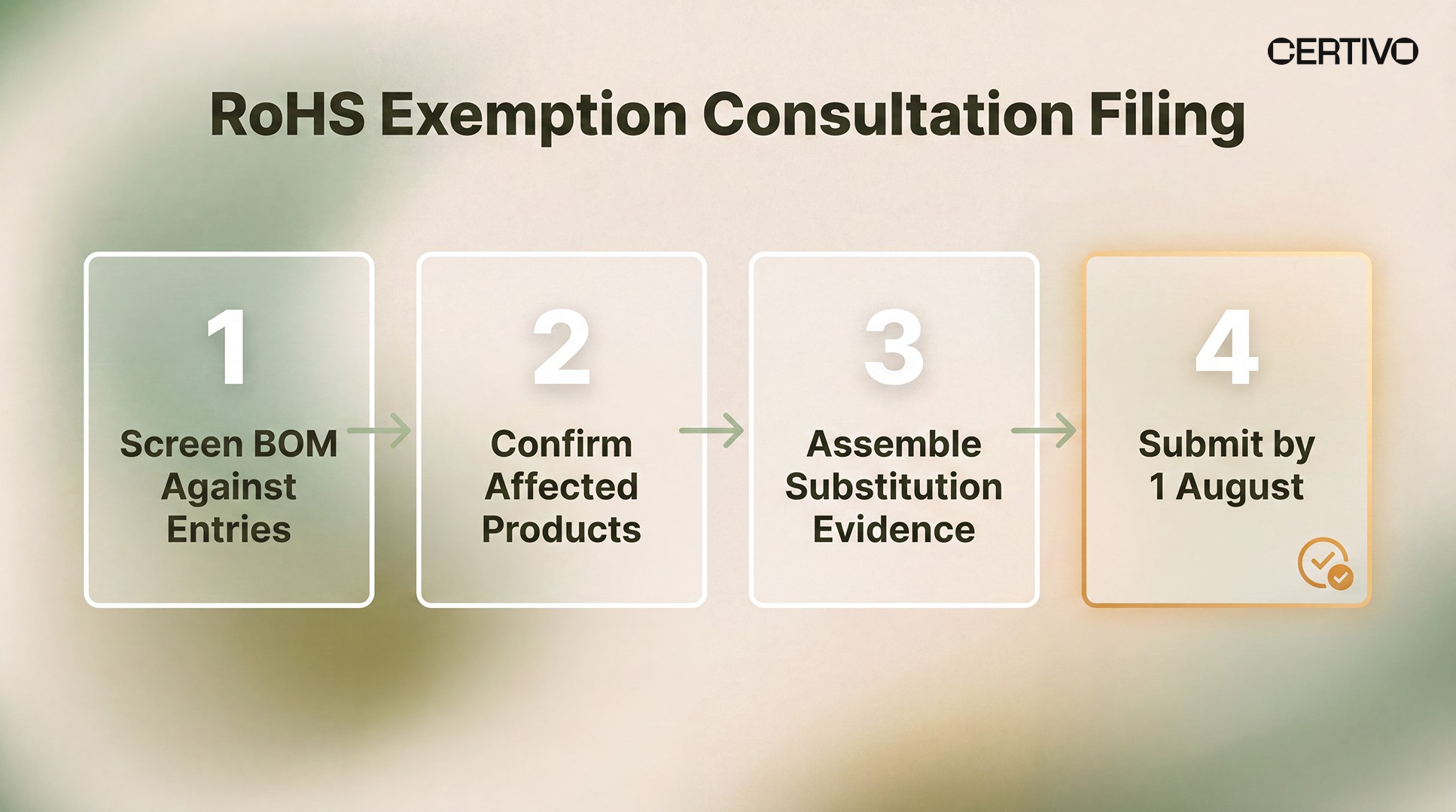
✓ Screen the BOM against the specific entries, not the general "leaded glass" description. Target detectors for ionising radiation, ion-selective and pH electrodes, and MCP or capillary plate devices.
✓ Prioritise Annex IV entry 3. The questionnaire language is more favourable to the applicant there, and it is the entry most likely to move.
✓ Assemble substitution-feasibility evidence where ALD is not a viable drop-in, covering qualification burden, performance, medical revalidation, supply, and transition timelines.
✓ Separate confidential from non-confidential material, and make sure the non-confidential submission stands alone.
✓ Confirm lighting scope. For the ten Annex III mercury entries, verify whether your products fall inside LightingEurope's renewal request and note that applicants are seeking maximum durations, up to 5 years for categories 1–7, 10 and 11, and 7 years for categories 8 and 9.
✓ Register on the Öko-Institut RoHS exemptions site to receive notice of follow-up exchanges and future consultation rounds.
✓ Flag the wider list for forward monitoring. Based on currently available regulatory guidance, additional Annex III and Annex IV entries raised in the original challenge sit outside Pack 29 but should be treated as live risk in later packs, and confirmed with the compliance team.
RoHS Pack 29 exemption consultation response workflow for affected manufacturers
Click on image to view full
How AI-Native Compliance Automation Reduces the Burden
Short-window consultations expose the weakness of manual compliance. Spreadsheets and inboxes cannot tell you in an afternoon which of 4,000 products contain a micro-channel plate detector, nor pull the matching supplier declarations into one place. AI-native compliance automation closes that gap.
BOM-level compliance intelligence
Certivo maps declarations to specific products and BOM structures, so a query like "which finished products contain a component under Annex IV entry 3" returns an answer in minutes. That BOM-level compliance intelligence is the difference between a targeted submission and a missed deadline.
CORA-powered regulatory intelligence
CORA-powered regulatory intelligence monitors RoHS exemption packs, consultation openings, and delegated directives, so consultations like Pack 29 surface before the window is half gone rather than after a draft recommendation lands. CORA-enabled analysis also flags which of your parts become exposed when a specific entry is challenged, turning regulatory intelligence and horizon scanning into a standing capability rather than a manual monitoring task.
Automated evidence and supplier data
AI document parsing extracts and validates data from supplier declarations and certificates, and automated supplier portals collect the missing pieces without a chain of chase emails. Combined with immutable, time-stamped audit logs, this is what makes a submission defensible and keeps you continuously audit-ready across RoHS, REACH, and the wider framework set. You can see how this fits together across the platform on Certivo's features page and supplier and contractor management solution.
Certivo is built as the system of record for product compliance, with CORA as the embedded intelligence layer. The value here is not a claim that findings disappear. It is that a competitor-initiated challenge with a hard August deadline becomes a manageable, evidence-backed response instead of a scramble, which is exactly the shift from reactive compliance to continuous readiness that manufacturers need.
Executive Conclusion
The RoHS Pack 29 exemption consultation is a small procedural event with an outsized strategic tail for medical device, instrumentation, and photonics manufacturers. The ten Annex III mercury renewals are largely routine. The three Annex IV revocations, driven by a supplier of the substitute, are not. With submissions closing on 1 August 2026 and Annex IV entry 3 the most exposed, the manufacturers who respond with specific, non-confidential substitution-feasibility evidence will shape the outcome. Those who stay silent hand the record to the challenger.
The operational lesson generalises well beyond this one pack. Manufacturers that hold BOM-level compliance intelligence, continuous audit-ready documentation, and CORA-driven regulatory intelligence can identify affected parts, gather evidence, and file inside a tight window without disruption.
To scope your exposure to Pack 29 and future exemption reviews, speak with a compliance specialist and get a clear read on which products and suppliers are affected before the deadline closes.
External references:
Öko-Institut, RoHS Pack 29 stakeholder consultation
European Commission, RoHS Directive implementation and exemption procedure
Lavanya
Lavanya is an accomplished Product Compliance Engineer with over four years of expertise in global environmental and regulatory frameworks, including REACH, RoHS, Proposition 65, POPs, TSCA, PFAS, CMRT, FMD, and IMDS. A graduate in Chemical Engineering from the KLE Institute, she combines strong technical knowledge with practical compliance management skills across diverse and complex product portfolios.
She has extensive experience in product compliance engineering, ensuring that materials, components, and finished goods consistently meet evolving international regulatory requirements. Her expertise spans BOM analysis, material risk assessments, supplier declaration management, and test report validation to guarantee conformity. Lavanya also plays a key role in design-for-compliance initiatives, guiding engineering teams on regulatory considerations early in the product lifecycle to reduce risks and streamline market access.