


The U.S. Environmental Protection Agency has begun retiring the first wave of Confidential Business Information claims filed under the modernized Toxic Substances Control Act. Starting June 22, 2026, TSCA CBI claims submitted after the 2016 Lautenberg Act amendments reach their 10-year statutory limit. Companies that want to keep this information confidential must file a substantiated extension request through EPA's Central Data Exchange, or the data may become public without further notice.
For chemical manufacturers, importers, and any company that has filed TSCA submissions with confidentiality claims, this is an operational deadline with real competitive consequences. Missing it does not trigger a fine. It triggers something arguably worse: the potential public release of information a company previously determined was commercially sensitive.
This guide explains what is expiring, when, who is affected, and how to build a defensible re-substantiation process. It is written for compliance engineers, regulatory directors, and supply chain leaders who need to act before their claims lapse.
Not sure whether your organization has expiring TSCA CBI claims? Request a compliance review to map your TSCA submission exposure.
Key Takeaways
📌 Most TSCA CBI claims expire 10 years after the claim was asserted, under TSCA section 14(e). The first claims filed after the June 22, 2016 Lautenberg amendments begin expiring in June 2026.
⏳ Extension requests must be filed through EPA's Central Data Exchange (CDX) no later than 30 days before each claim's expiration date. This is a firm statutory deadline, not a target.
⚠️ If no timely extension request is received, EPA is no longer required to protect the information and may disclose it publicly without additional notice to the submitter.
📊 EPA publishes a monthly refreshed list of expiring claims and sends direct notice through CDX. Companies must keep CDX contact details and passphrases current to receive these notices.
🏭 Chemical, petrochemical, plastics, electronics, semiconductor, automotive, and specialty chemical manufacturers are most exposed, along with any importer that filed TSCA notifications since 2016.
📄 Substantiation is not a formality. Companies must certify competitive harm, reasonable protection measures, and non-discoverability under 40 CFR 703.5, with supporting documentation.
🤖 Managing expiration dates across hundreds of historical TSCA filings is a data traceability problem. Centralized tracking and automated monitoring reduce the risk of a claim lapsing unnoticed.
Executive Regulatory Overview
TSCA section 14(e), added by the 2016 Frank R. Lautenberg Chemical Safety for the 21st Century Act, limits most confidentiality claims to 10 years from the date the claim was asserted. This was a deliberate policy shift. Before 2016, CBI claims could persist indefinitely. The amended statute forces a periodic re-justification of secrecy.
The clock on the first post-Lautenberg claims has now run out. EPA confirms that the first group of CBI claims filed after the 2016 amendments will expire in June 2026 unless companies submit and substantiate extension requests within the required timeframes. This is not a one-time event. Claims will continue expiring on a rolling basis according to each individual claim's original submission date.
For regulatory teams, the practical takeaway is direct. Any TSCA submission your company made from mid-2016 onward that carried a confidentiality claim now sits on a 10-year timer. Some of those timers are already running out.
Framework Background and Legal Scope
The Toxic Substances Control Act governs how chemical substances are reviewed, reported, and managed in U.S. commerce. When companies submit information to EPA under TSCA, they can claim portions as confidential to protect competitively sensitive data such as specific chemical identities.
Section 14(e) of the amended statute (26 USC 2613) caps the duration of most of these claims at 10 years. To keep protection in place beyond that window, a company must request an extension and demonstrate why continued confidentiality is warranted. EPA reviews each request and grants or denies it by the claim's expiration date. Approved extensions last up to another 10 years.
Companies managing chemical data across large product portfolios often struggle to keep TSCA obligations connected to the underlying substances and submissions. A chemical and hazmat compliance approach that treats TSCA filings as living records, rather than static one-time submissions, is what makes rolling expiration manageable.
What Is Actually Expiring and When
There are two distinct expiration rules, and confusing them is a common and costly error.
Most information: For the majority of TSCA submissions, the confidentiality claim expires 10 years from the date of the filing in which the information was submitted. Later amendments to that original submission do not reset the clock.
Specific chemical identity: For claims covering the specific chemical identity of a substance, the expiration is calculated as 10 years from the first approved CBI claim for that chemical identity made by any TSCA submitter after June 22, 2016. This is the critical trap. Because the date is tied to the first submitter for that substance, a company that filed more recently may find its claim expires in less than 10 years from its own actual submission date.
EPA has published a list of TSCA CBI claims expiring between June 22, 2026 and July 31, 2026, and refreshes that list monthly as more claims approach expiration. For specific chemical identities, expiration dates appear in the "EXP" column of the TSCA Chemical Inventory.
TSCA CBI claim expiration rules comparing filing date versus chemical identity date
Click on image to view full

For compliance teams tracking substances across a bill of materials, connecting each TSCA claim to its specific substance and its correct expiration date is essential. This is where BOM-level compliance intelligence becomes practical rather than theoretical, because the expiration date may not match the date you filed.
Which Information Is Exempt from Expiration
Not every confidentiality claim is subject to the 10-year limit. Under TSCA section 14(c)(2), certain categories are exempt from substantiation and EPA review, and therefore also exempt from expiration under section 14(e)(1)(B). Broadly, these include:
✓ Specific information describing manufacturing or processing methods
✓ Marketing and sales information
✓ Information identifying a supplier or customer
✓ For a mixture, the full composition and percentages of constituents
✓ Specific information on the use, function, or application of a substance in a process, mixture, or article
✓ Specific production or import volumes
✓ Specific chemical identity prior to first commercial distribution, if claimed confidential in a TSCA section 5 notice
These exemptions are described at 40 CFR 703.5(b)(5). If a submitter is uncertain whether particular information qualifies for an exemption, EPA's guidance is clear: file an extension request to be safe. If no request is filed and the information is not clearly exempt, EPA will treat the claim as abandoned and may release the information.
⚠️ The safe operating assumption for regulatory teams is this. If you cannot confirm an exemption applies, treat the claim as expiring and evaluate it for extension.
Industries and Filers Affected
The rolling expiration touches any organization that filed TSCA submissions with confidentiality claims after June 22, 2016. The most exposed sectors include:
Industry | Typical TSCA Exposure |
|---|---|
Chemical manufacturing | New chemical notices, CDR reporting, substance identities |
Petrochemical | Process chemicals, intermediates, formulation data |
Plastics and polymers | Polymer identities, additive substances |
Electronics and semiconductors | Specialty substances, process chemicals |
Automotive and industrial | Coatings, adhesives, treated articles |
Specialty chemicals | Proprietary formulations and identities |
Importers | Substances in imported articles and mixtures |
Electronics and semiconductor manufacturers frequently face overlapping obligations across TSCA, RoHS, and REACH, which is why a single materials and environmental compliance view across frameworks reduces the chance of a TSCA claim slipping through an otherwise well-run program.
The Extension and Substantiation Process
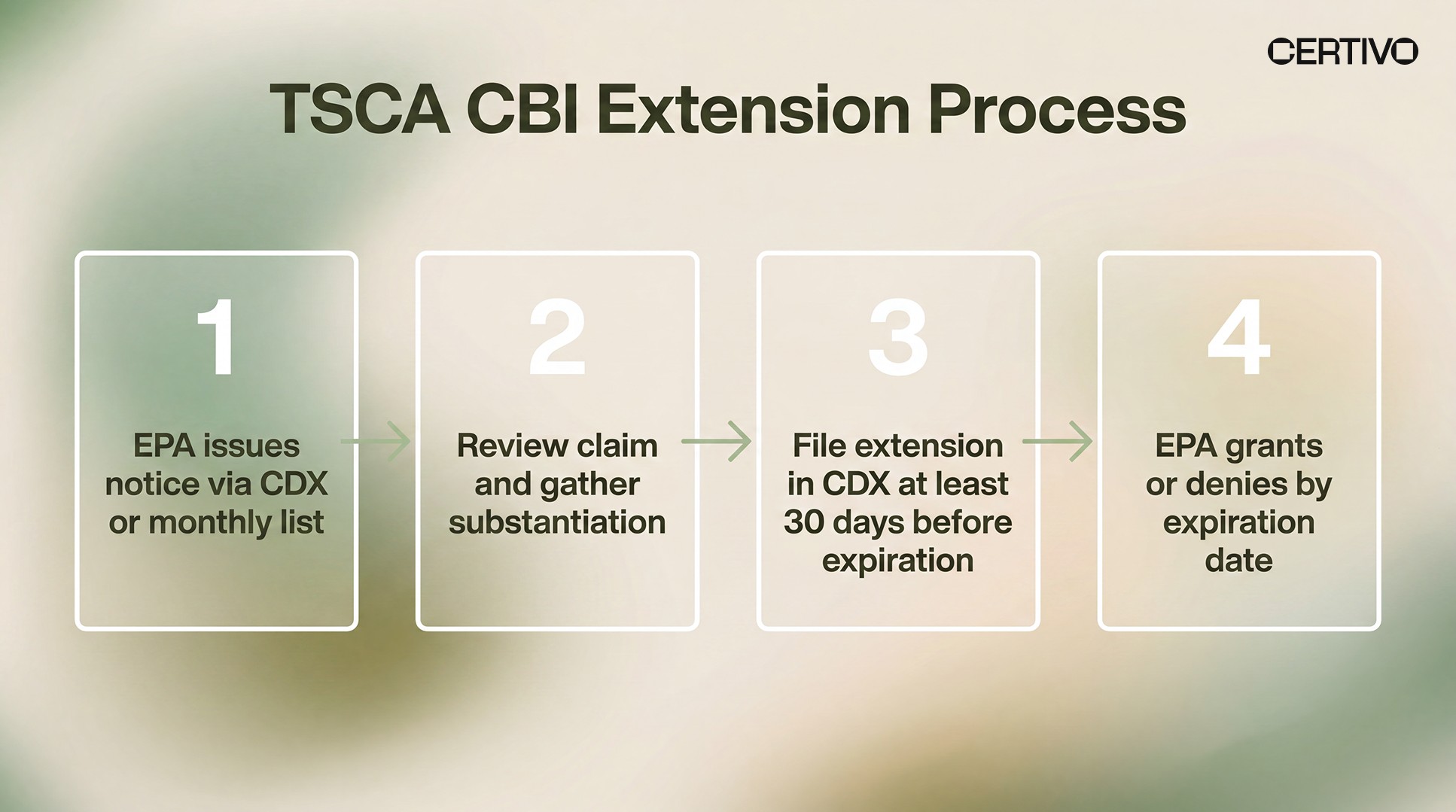
Extension requests are filed electronically through EPA's Central Data Exchange. Paper submissions are not accepted. The process requires more than checking a box. Under 40 CFR 703.5(a) and (b), the submitter must provide a supporting statement and certify each of the following:
The company has taken reasonable measures to protect the information.
The information is not required to be disclosed under other federal law.
Disclosure would cause substantial harm to the company's competitive position.
The information is not readily discoverable through reverse engineering.
Requests for chemical identity claims must be submitted separately from other information types. Extension requests cannot be filed before EPA has issued notice of expiration, either directly through CDX or through the published lists.
A critical constraint: companies cannot modify original claims or add new claims through the extension process. Any information previously denied confidential treatment by EPA, or withdrawn by the submitter, cannot be revived. The extension applies only to information that is valid CBI at the time of the request
TSCA CBI extension request workflow through EPA Central Data Exchange for manufacturers
Click on image to view full
Struggling to track which submissions carry confidentiality claims and when they expire? Speak with a compliance specialist about centralizing your TSCA records.
Documentation and Data Traceability Challenges
The operational difficulty here is not filing a single extension. It is knowing, across a decade of submissions, which claims exist, which are expiring, and where the substantiating evidence lives.
Large manufacturers commonly face several problems at once:
Fragmented records. TSCA submissions may be spread across business units, legacy CDX accounts, and personnel who have since left the company.
Lost CDX access. EPA specifically warns that companies with lapsed passphrases or inaccessible accounts must re-establish access through the CDX help desk. A lost passphrase cannot be reset.
Mismatched dates. As noted, chemical identity expiration dates are tied to the first submitter, not your filing date.
Substantiation evidence. The competitive-harm justification made years ago must still hold and be documentable today.
This is fundamentally a data versioning and traceability challenge. A centralized compliance data backbone that maintains time-stamped submission records, links each claim to its substance and expiration date, and preserves the original substantiation basis is what separates a controlled renewal process from a last-minute scramble. Maintaining continuous audit-ready documentation means the evidence is retrievable when EPA notice arrives, not reconstructed under deadline pressure.
Compliance Risks and Disclosure Exposure
The consequence of inaction under this rule is unusual. There is no monetary penalty for letting a CBI claim expire. The risk is disclosure itself.
⚠️ Public release of sensitive data. If EPA does not receive a timely extension request, it is no longer required to protect the information and may make it public without further notice. For a proprietary chemical identity or formulation-related data, that exposure can be permanent and irreversible.
⚠️ Competitive intelligence loss. Once information is public, competitors, customers, and the broader market can access it. The commercial harm the original claim was meant to prevent simply occurs.
⚠️ No revival mechanism. Expired or withdrawn claims cannot be reinstated through a later extension. There is no second chance for a claim that lapses.
The defensible posture is proactive compliance risk management: identify expiring claims early, evaluate each against the exemption categories, and file substantiated extensions well before the 30-day cutoff.
Audit and Evidence Readiness Considerations
TSCA CBI management intersects with several audit contexts that compliance engineers deal with routinely. A regulatory inspection by EPA, an internal audit of confidential data handling, or a customer audit touching chemical disclosures can all surface the question: can you demonstrate that your CBI claims are current and properly substantiated?
Answering that question requires evidence chain integrity. For any given claim, a well-run program can show:
Who submitted the original claim and the extension request
When it was submitted and when it expires
What substantiation supported it and under what authority EPA approved it
This is where immutable, time-stamped records matter. Point-in-time retrieval, the ability to reconstruct exactly what a claim's status was on a given date, turns an audit question into a lookup rather than an investigation. No software makes an organization audit-proof. The realistic and correct objective is audit-ready: fewer surprises and faster response when a regulator or customer asks.
Companies that operate customer trust center models, similar to those used by large technology and automotive OEMs, apply the same principle to product compliance data. The goal is retrievable, verifiable evidence on demand.
Strategic Preparation Checklist
Regulatory and compliance teams should prioritize the following actions now:
How AI and Automation Support TSCA CBI Management
Manual tracking of CBI expiration dates across a decade of filings, multiple business units, and thousands of substances does not scale. The failure mode is predictable: a claim expires because no one was watching the right date.
AI-native compliance automation addresses the structural weaknesses directly.
Centralized submission records. Certivo maintains TSCA filings as structured, time-stamped records rather than scattered documents, connecting each confidentiality claim to its substance, submission date, and correct expiration date.
CORA-powered regulatory intelligence monitors EPA's monthly expiring-claims lists and regulatory notices, surfacing claims that require attention before the 30-day extension window closes rather than after.
AI document parsing and certificate validation extracts and organizes data from historical submissions and supporting evidence, reducing the manual effort of reconstructing what was filed and why.
BOM-level material mapping links substances in your products to their TSCA obligations, so a chemical identity expiration tied to another submitter's earlier filing does not catch your team by surprise.
For manufacturers managing chemical data across many frameworks at once, see the AI Tools for Compliance Management: The Complete Guide for a broader view of how automation shifts compliance from reactive to continuous.
Executive Conclusion
The 2026 TSCA CBI claim expirations mark the first real test of the confidentiality provisions Congress built into the Lautenberg amendments. The mechanism is straightforward, but the operational demands are not. Claims expire on a rolling basis, the dating rules differ for chemical identities, extension requests carry a firm 30-day-before-expiration deadline, and the penalty for inaction is the permanent loss of confidentiality.
For compliance leaders, the message is to treat this as an ongoing program, not a single filing. Build a current inventory of post-2016 claims, verify CDX access, evaluate exemptions, and establish continuous monitoring of EPA's published lists. Organizations that manage TSCA submissions as living records within a centralized compliance system will absorb rolling expirations without disruption. Those relying on scattered records and institutional memory face a real risk of watching sensitive data become public.
To understand your organization's TSCA CBI exposure and build a defensible re-substantiation process, book a compliance risk assessment with Certivo.
Lavanya
Lavanya is an accomplished Product Compliance Engineer with over four years of expertise in global environmental and regulatory frameworks, including REACH, RoHS, Proposition 65, POPs, TSCA, PFAS, CMRT, FMD, and IMDS. A graduate in Chemical Engineering from the KLE Institute, she combines strong technical knowledge with practical compliance management skills across diverse and complex product portfolios.
She has extensive experience in product compliance engineering, ensuring that materials, components, and finished goods consistently meet evolving international regulatory requirements. Her expertise spans BOM analysis, material risk assessments, supplier declaration management, and test report validation to guarantee conformity. Lavanya also plays a key role in design-for-compliance initiatives, guiding engineering teams on regulatory considerations early in the product lifecycle to reduce risks and streamline market access.