Climate & Carbon Reporting
Jurisdictions adopting ISSB-aligned climate disclosure standards
GHG emissions (Scope 1, 2, 3) required under IFRS S2
Mandatory jurisdictions with reporting active by January 2026
The ISSB standards (IFRS S1 and IFRS S2) are the global baseline for climate financial disclosures, replacing the TCFD recommendations after the Task Force disbanded in October 2023. For supply chain and compliance teams, this means collecting, validating, and reporting greenhouse gas emissions data and climate risk information from across your value chain.
IFRS S2 requires companies to disclose climate-related risks and opportunities across four pillars—Governance, Strategy, Risk Management, and Metrics & Targets. This includes Scope 1, Scope 2, and Scope 3 GHG emissions, climate-related scenario analysis, and transition planning. In December 2025, the ISSB issued amendments to reduce GHG disclosure complexity, effective for reporting periods beginning January 2027.
ISSB compliance requires supplier-level emissions data—activity data, emission factors, and allocation methodologies—from across your value chain. Scope 3 emissions typically represent 70–90% of a company's total footprint. When new jurisdictions mandate reporting, your entire supplier data readiness requires reassessment.

Listed companies in jurisdictions mandating ISSB-aligned standards (UK, Japan, Australia, Singapore, Hong Kong, Brazil, Turkey, and expanding)
Companies with $1B+ revenue doing business in California (SB 219 / SB 253)
Financial institutions disclosing financed emissions under ISSB or jurisdictional mandates
Non-listed companies where ISSB standards are extended by local regulators
Companies responding to investor-driven CDP questionnaires aligned with ISSB
Supply chain participants providing emissions data to customers subject to Scope 3 disclosure
Key Thresholds
Scope 3 emissions represent 70–90% of your total GHG footprint. IFRS S2 requires their disclosure. But your Scope 3 data depends on emissions information from hundreds of suppliers—most of whom have never measured their own footprint. You resort to industry-average emission factors, producing numbers that are directionally correct but assurance-resistant.
Your company is listed in the UK, has operations in Australia, and sells into California. Each jurisdiction mandates ISSB-aligned disclosures on different timelines, with different entity scope, and jurisdiction-specific additions. One set of emissions data, three disclosure formats, three assurance requirements. Your sustainability team runs three parallel reporting workstreams.
California requires limited assurance on Scope 1 and 2 from 2026, transitioning to reasonable assurance by 2030. Other jurisdictions are following. Your emissions data is built on spreadsheets, supplier estimates, and manually applied emission factors. Auditors request granular activity data, allocation methodologies, and data quality assessments. You cannot get assurance on data you cannot trace.
You send 500 suppliers a climate questionnaire. 12% respond. Half of those provide revenue-based estimates, not activity data. A quarter use different reporting boundaries. You spend months cleaning, standardizing, and gap-filling—producing a Scope 3 inventory that is impossible to replicate next year without the same manual effort.
Certivo In Action
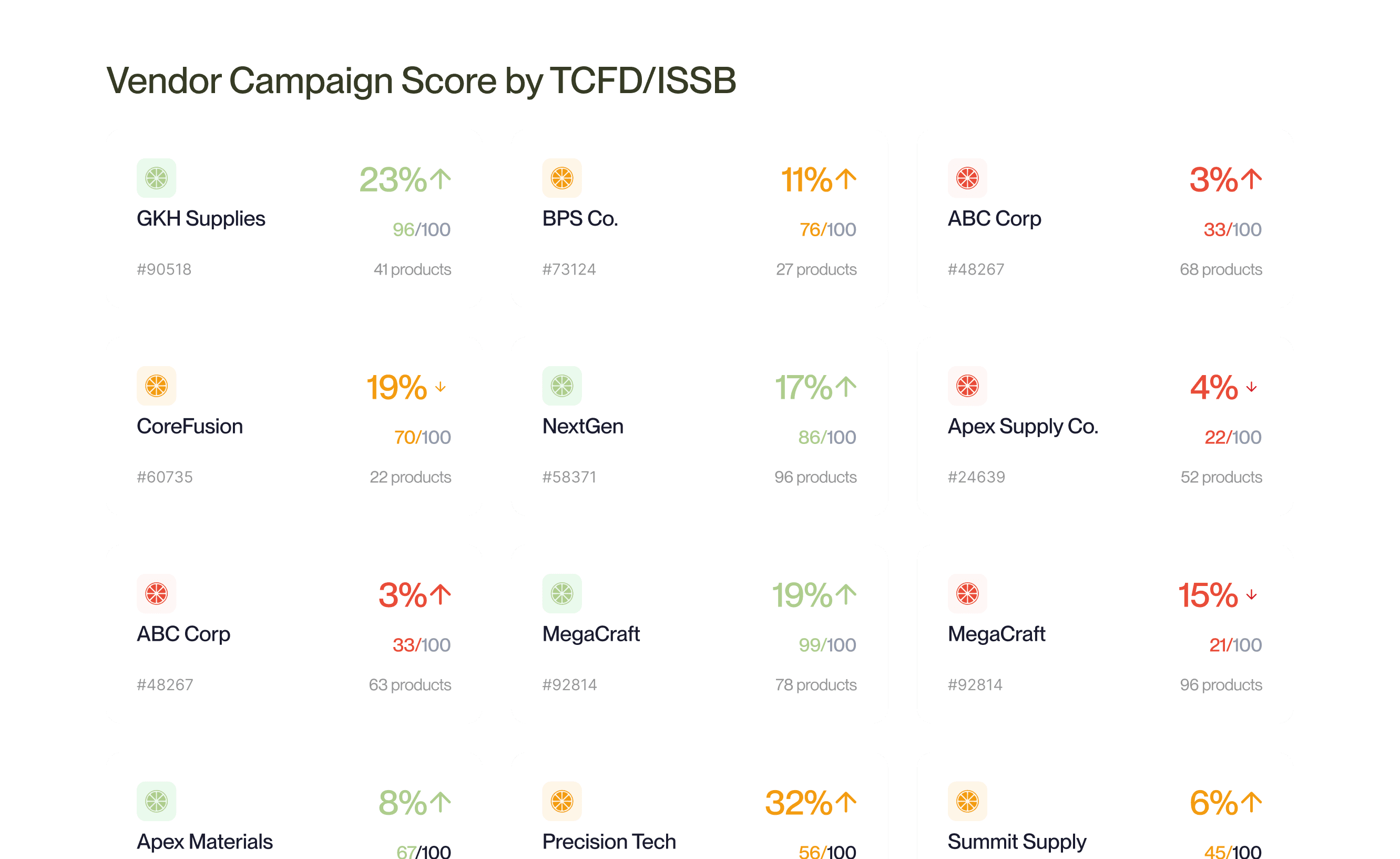
Certivo in Action — TCFD/ISSB Workflow

Features Tabs

Electronics Manufacturing
Your Pain Point
Complex supply chains; high Scope 3 from purchased goods and upstream transport

Automotive Manufacturing
Your Pain Point
EV transition risks; Scope 3 from steel, aluminum, battery materials

Industrial & Heavy Equipment
Your Pain Point
Energy-intensive operations; Scope 1 and 2 measurement complexity

Aerospace & Defense
Your Pain Point
Transition risk disclosure; sustainable aviation fuel commitments; prime contractor flowdown

Energy & Infrastructure
Your Pain Point
Direct emissions reporting; financed emissions for project finance; physical risk disclosure

Construction Materials
Your Pain Point
Cement, steel, and concrete emissions; embodied carbon disclosure

Chemical Manufacturing
Your Pain Point
Process emissions; Scope 1 intensity metrics; transition risk exposure

Medical Devices & Equipment
Your Pain Point
Increasing investor and customer pressure for Scope 3 transparency
From Manual Data Assembly to Automated Climate Reporting
CORA collects, parses, and validates supplier emissions data automatically. Your sustainability team focuses on strategy and scenario analysis—not chasing spreadsheets and cleaning data.
Climate Reporting Acceleration
Generate complete, assurance-ready IFRS S2 disclosure packages in hours—not the 3–6 months of manual compilation across suppliers and consultants.
Proactive Climate Disclosure Compliance
When new jurisdictions mandate ISSB-aligned reporting or assurance requirements change, Certivo reassesses your data readiness instantly. Know your reporting obligations before deadlines arrive.
Frequently Asked Questions
Which companies are required to report under ISSB standards?
Scope depends on jurisdiction. As of 2026, 21 jurisdictions have mandatory ISSB-aligned reporting, including the UK (expected from 2026), Japan, Australia, Singapore, Hong Kong, Brazil, Turkey, Chile, Mexico, and Qatar. California's SB 219 requires GHG reporting for companies with $1B+ revenue. Even where not mandated, investor-driven CDP questionnaires now fully align with ISSB. Certivo maps your entity profile against each jurisdiction's requirements automatically.
What are the penalties for non-compliance with climate disclosure requirements?
Penalties vary by jurisdiction. California's SB 219 allows fines up to $500,000 per year for emissions reporting violations and $50,000 for climate risk disclosure failures. The UK can impose regulatory sanctions through the FRC. Other jurisdictions enforce through securities regulators, stock exchange listing requirements, or market surveillance authorities. Non-disclosure also carries investor, customer, and reputational consequences.
How does Certivo handle Scope 3 emissions data collection from suppliers?
Certivo collects emissions data directly from suppliers through automated campaigns—requesting activity data, emission factors, GHG inventories, and methodology documentation. CORA parses submissions in any format, validates calculation approaches against GHG Protocol methodology, and produces category-level Scope 3 inventories with full traceability. This replaces industry-average estimates with verifiable, assurance-ready supplier data.
Does Certivo support multi-jurisdiction ISSB reporting?
Yes. Certivo maintains a continuously updated mapping of ISSB adoption across all 36+ mandating and adopting jurisdictions. One set of supplier emissions data generates disclosure packages formatted for UK SRS, Australian AASB, California SB 219, CDP, and other jurisdiction-specific templates. Multi-jurisdiction ESG management is handled from a single evidence base.
How does ISSB relate to EU CSRD and other climate frameworks?
IFRS S2 and EU ESRS E1 both address climate disclosures but differ in scope—ISSB uses financial materiality, while CSRD requires double materiality. The IFRS Foundation and GRI have published interoperability guidance. CDP is fully aligned with ISSB from 2024. Certivo validates supplier data against ISSB, CSRD, CDP, and California requirements simultaneously, providing continuous audit-ready documentation from a single supplier submission.