


Brazil has formally entered the global hazardous substance restriction landscape. On June 10, 2026, the Brazilian National Environment Council (CONAMA) approved Brazil RoHS, a regulation restricting hazardous substances in electrical and electronic equipment (EEE) placed on the Brazilian market. For manufacturers, importers, and distributors selling into Brazil, this introduces both familiar substance restrictions and new market access obligations that do not exist under the EU model.
Companies already managing EU RoHS will recognize the restricted substances and concentration limits. However, Brazil RoHS adds mandatory product registration, Brazil-specific declarations of conformity, and local compliance responsibilities. Treating this as a simple extension of existing EU RoHS compliance is a mistake. The market access layer is where most organizations will face exposure.
Based on currently available regulatory guidance, companies should begin assessing both material compliance and local regulatory requirements now, before enforcement timelines are confirmed through publication in Brazil's Official Gazette.
Key Takeaways
📌 CONAMA approved Brazil RoHS on June 10, 2026, restricting hazardous substances in electrical and electronic equipment sold in Brazil.
📊 Substance restrictions align with EU RoHS, covering lead, mercury, cadmium, hexavalent chromium, PBB, PBDE, and four phthalates.
⚠️ Brazil RoHS adds market access requirements absent from the EU model, including mandatory product registration and Brazil-specific declarations of conformity.
🔗 Importers and distributors may assume manufacturer compliance responsibilities, shifting accountability across the supply chain.
📄 Labeling, traceability, and technical documentation must be maintained and made available for regulatory inspections.
⏳ The effective date and transition timeline will be confirmed upon publication in Brazil's Official Gazette.
🏭 Electronics, consumer goods, industrial equipment, telecom, automotive electronics, and medical device suppliers are all in scope.
Executive Regulatory Overview
Brazil RoHS establishes restrictions on hazardous substances in electrical and electronic equipment placed on the Brazilian market. The regulation was approved by CONAMA on June 10, 2026. It restricts the same hazardous substances and concentration limits found in the European Union RoHS Directive, while adding national market access requirements specific to Brazil.
The regulation reflects a broader pattern. National governments are adopting RoHS-style substance restrictions but layering local registration, conformity, and traceability obligations on top. For global manufacturers, this means substance compliance alone no longer guarantees market access. Companies need a centralized compliance data backbone that manages both material restrictions and jurisdiction-specific documentation in one system.
For organizations already tracking RoHS compliance across multiple regions, Brazil represents another jurisdiction requiring distinct evidence and registration workflows.
Why Brazil RoHS Matters Now
Brazil is one of the largest electronics markets in Latin America. A formal RoHS regulation changes the compliance calculus for any company shipping EEE into the country. The substance restrictions are predictable, but the registration and conformity obligations require local processes that most foreign manufacturers do not currently have in place.
Based on currently available regulatory guidance, the transition timeline will be set when the regulation is published in Brazil's Official Gazette. Companies should not wait for that confirmation to begin readiness work, since registration and documentation processes take time to establish.
What Brazil RoHS Restricts
Brazil RoHS restricts the same hazardous substances as the EU RoHS Directive, applying established concentration limits to electrical and electronic equipment. The restricted substances are listed below.
Restricted Substances Under Brazil RoHS
Substance | CAS Number | Common Use |
|---|---|---|
Lead (Pb) | 7439-92-1 | Solders and components |
Mercury (Hg) | 7439-97-6 | Certain electrical applications |
Cadmium (Cd) | 7440-43-9 | Batteries, pigments, coatings |
Hexavalent Chromium (Cr VI) | 18540-29-9 | Corrosion-resistant treatments |
Polybrominated Biphenyls (PBB) | Various | Brominated flame retardants |
Polybrominated Diphenyl Ethers (PBDE) | Various | Brominated flame retardants |
DEHP, BBP, DBP, DIBP | Various | Phthalate plasticizers |
For compliance teams, the critical task is verifying that Bills of Materials and Full Material Declarations account for each restricted substance at the homogeneous material level. This is where substance-level data quality determines compliance, and where supplier declarations must be validated rather than assumed.
Manufacturers managing REACH and EU RoHS substance data already hold much of the underlying material information. The work is mapping that existing data to Brazil's specific requirements and confirming completeness.
Brazil RoHS restricted substances list with CAS numbers for manufacturer
Click on image to view full

How Brazil RoHS Differs From EU RoHS
The substance restrictions are familiar. The market access requirements are not. This distinction is the single most important point for compliance leaders to understand.
Market Access Requirements Unique to Brazil
✓ Mandatory product registration in a national database before market placement
✓ Brazil-specific Declaration of Conformity, distinct from the EU Declaration of Conformity
✓ Labeling and traceability obligations that must be implemented on products
✓ Local compliance responsibilities for importers and distributors
✓ Technical documentation maintained for regulatory inspections
Under the EU model, a manufacturer self-declares conformity and maintains technical documentation, but there is no central pre-market product registration database of this kind. Brazil's registration requirement means products cannot reach the market until the registration step is complete. This is a gating requirement, not a post-market obligation.
For companies operating across multiple jurisdictions, this reinforces the need for multi-jurisdiction compliance management rather than treating each market as a one-off project.
Declaration of Conformity Differences
The Brazil-specific Declaration of Conformity must reflect local regulatory language and requirements. Reusing an EU Declaration of Conformity will not satisfy Brazilian authorities. Compliance teams should plan to generate market-specific conformity documentation, ideally from a single source of validated substance data, to avoid inconsistencies between declarations issued for different markets.
Industries Affected
Brazil RoHS applies broadly across electrical and electronic equipment categories. The following industries are directly affected.
🏭 Electronics and electrical equipment manufacturers
🏭 Consumer electronics companies
🏭 Industrial equipment manufacturers
🏭 Telecommunications equipment suppliers
🏭 Automotive electronics manufacturers
🏭 Medical device electronics suppliers
🏭 Importers and distributors of EEE
🏭 Contract manufacturers and OEMs
Each of these sectors faces a different version of the same core challenge: confirming substance compliance across complex, multi-tier supply chains while also meeting Brazil's registration and documentation requirements. Electronics manufacturers and semiconductor and high-tech companies typically carry the highest part counts and supplier complexity, which raises the data management burden.
Automotive electronics suppliers face an added layer, since they must reconcile Brazil RoHS with OEM-specific material requirements. For these companies, BOM-level compliance intelligence is essential to manage overlapping obligations without duplicating effort.
Compliance Responsibilities Across the Supply Chain
One of the most consequential features of Brazil RoHS is the allocation of responsibility. Importers and distributors may assume manufacturer compliance responsibilities. This changes the risk profile for any company that places products on the Brazilian market, even if it did not manufacture them.
What This Means in Practice
If you import EEE into Brazil, you may be treated as the responsible party for substance compliance, registration, and documentation. This is similar in spirit to obligations seen in other jurisdictions, where the entity placing the product on the market carries the compliance burden. Distributors should not assume that an overseas manufacturer's compliance automatically transfers.
This makes supplier compliance verification and documentation a priority. Importers need defensible evidence that the products they place on the market meet Brazil RoHS substance limits, supported by validated supplier declarations rather than verbal assurances.
Strengthening Supplier Data Collection
Collecting and validating supplier material data at scale is the central operational challenge. Automated supplier data collection through structured portals reduces the manual burden of chasing declarations and improves data consistency. Standardized supplier questionnaire frameworks help ensure that the substance data you collect maps cleanly to Brazil RoHS requirements.
For organizations with limited regulatory headcount, supplier self-service portals allow suppliers to submit and update compliance documentation directly, reducing email-driven follow-up and version confusion.
Brazil RoHS compliance responsibility flow across manufacturers importers distributors
Click on image to view full

Documentation and Audit Readiness
Brazil RoHS requires technical documentation to be maintained for regulatory inspections. For compliance engineers, this is a data integrity and retrievability problem as much as a regulatory one.
Audit Types to Prepare For
Different audit scenarios place different demands on your documentation:
Regulatory inspections by Brazilian authorities, focused on substance compliance, registration, and conformity evidence
Customer audits, often OEM-driven, requiring product-level substance documentation
Internal audits, verifying that your own records are complete and current
Certification audits tied to quality systems such as ISO 9001 or IATF 16949
Each audit type expects evidence that is complete, current, and traceable to source. The objective is not to become "audit-proof," which no system can deliver, but to be audit-ready, reducing surprises and shortening response time when authorities or customers request evidence.
Historic State Tracking as a Data Problem
A recurring weakness in compliance programs is the inability to reconstruct what a product's compliance status was at a specific point in time. When a regulatory inspection asks about a product shipped 18 months ago, you need point-in-time evidence, not just current data.
This requires treating compliance records as versioned data: time-stamped declarations, immutable audit logs, and the ability to run point-in-time queries. Strong continuous audit-ready documentation practices capture not only the data, but who submitted each piece of evidence, when it was submitted, and under what authority it was approved.
Evidence Chain Integrity
For each compliance declaration, three questions must be answerable: who provided the evidence, when it was provided, and with what authority. Customer trust center models used by large technology companies such as Apple and Microsoft, and by major automotive OEMs, demonstrate the value of being able to surface validated evidence on demand. A centralized compliance data backbone makes this practical at scale.
Compliance Risks and Enforcement Exposure
The risks of inadequate Brazil RoHS readiness fall into several categories.
⚠️ Market access denial. Without completed product registration, products cannot be legally placed on the Brazilian market. This is a direct revenue risk, not a paperwork inconvenience.
⚠️ Importer and distributor liability. Because responsibility can shift to the party placing the product on the market, importers and distributors face exposure they may not have anticipated.
⚠️ Inspection findings. Incomplete or inconsistent technical documentation creates findings during regulatory inspections, which can trigger corrective actions and delays.
⚠️ Supply chain data gaps. Missing or unvalidated supplier declarations leave compliance teams unable to demonstrate substance conformity.
Based on currently available regulatory guidance, specific penalty structures and enforcement mechanisms will be clarified upon publication in Brazil's Official Gazette. Companies should monitor the official CONAMA and Ministry of Environment guidance for the confirmed timeline and enforcement details.
Maintaining proactive compliance risk management positions organizations to absorb these requirements before enforcement begins, rather than reacting under deadline pressure.
Compliance Preparation Checklist
Compliance and regulatory teams should prioritize the following actions:
✅ Review BOMs and Full Material Declarations for all EEE sold or planned for the Brazilian market against the restricted substance list.
✅ Map existing EU RoHS and REACH data to Brazil RoHS requirements, identifying gaps in substance coverage.
✅ Establish product registration processes for the Brazilian national database before market placement.
✅ Prepare Brazil-specific Declarations of Conformity rather than reusing EU documentation.
✅ Implement labeling and traceability in line with Brazil RoHS obligations.
✅ Strengthen supplier compliance verification, validating declarations rather than accepting them at face value.
✅ Clarify importer and distributor responsibilities for products placed on the Brazilian market.
✅ Organize technical documentation for fast retrieval during regulatory inspections.
✅ Establish point-in-time evidence retrieval so historic compliance states can be reconstructed.
To benchmark your current state, a Customer Audit Readiness Scorecard covering documentation completeness across RoHS, REACH, Prop 65, PFAS, and conflict minerals, along with historic state retrievability and hours-to-audit-pack response time, is a practical starting point.
The Role of AI in Managing Brazil RoHS
Manual compliance processes do not scale to multi-jurisdiction substance restrictions layered with market-specific registration and documentation. This is where AI-native compliance automation changes the operating model.
Substance Data at Scale
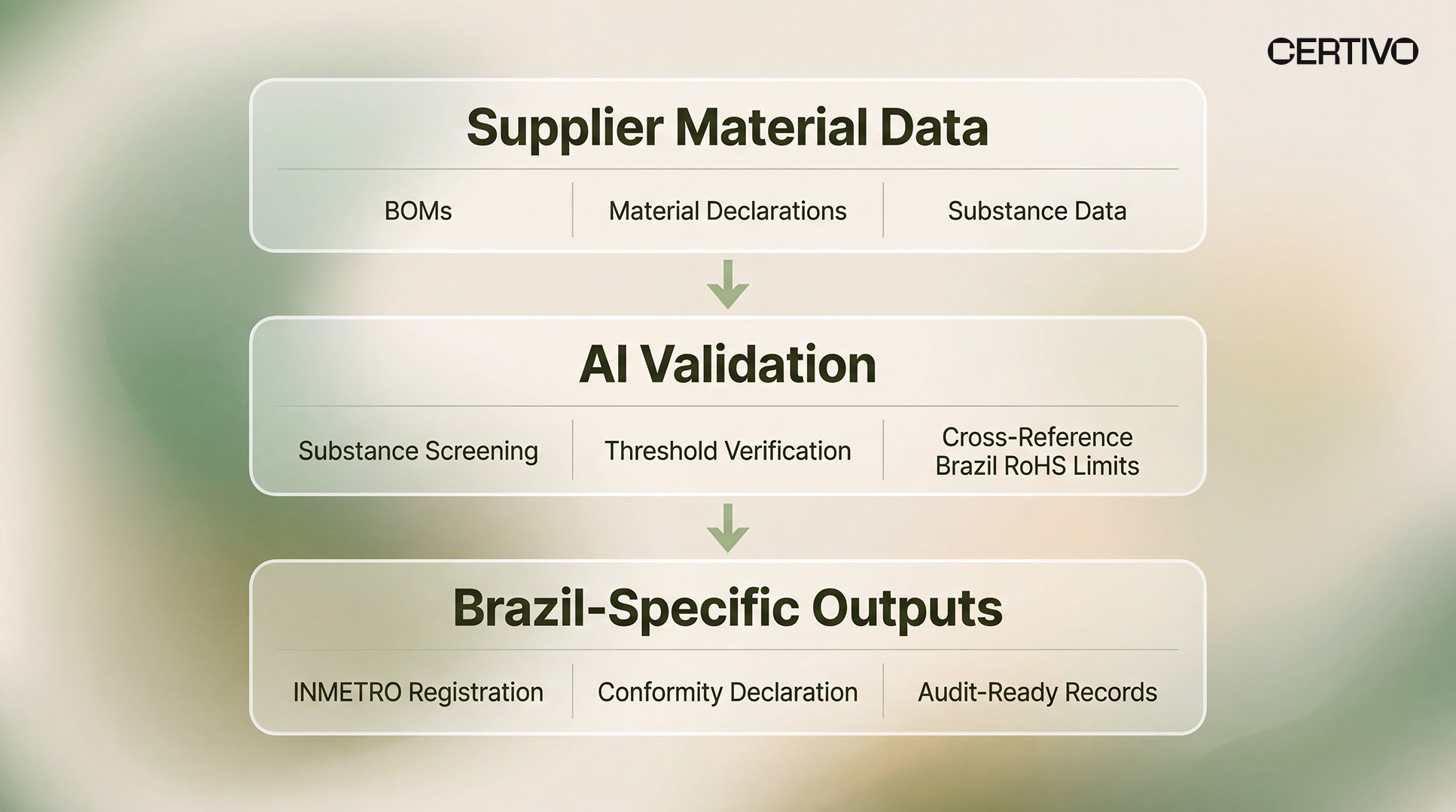
CORA-powered regulatory intelligence enables automated parsing of supplier declarations, certificates, and material data, extracting substance information and validating it against Brazil RoHS limits. Rather than manually reviewing thousands of declarations, compliance teams can focus on exceptions and high-risk items. This AI document parsing and certificate validation capability directly addresses the data quality challenges that determine RoHS compliance.
Mapping Existing Data to New Requirements
Most manufacturers already hold substantial substance data from EU RoHS and REACH programs. CORA compliance intelligence helps map that existing data to Brazil's specific requirements, identifying where coverage is complete and where supplier follow-up is needed. This avoids re-collecting data the organization already has.
Continuous Readiness Over Reactive Compliance
The shift from reactive compliance to continuous readiness is the strategic objective. With continuous compliance monitoring, regulatory changes, supplier updates, and documentation gaps surface continuously rather than during an audit. CORA regulatory insights help teams track jurisdiction-specific developments, including the eventual publication of Brazil RoHS in the Official Gazette and any associated transition timelines.
AI-powered Brazil RoHS compliance workflow from supplier data to market readiness
Click on image to view full
Executive Conclusion
Brazil RoHS marks Brazil's formal entry into hazardous substance restriction for electrical and electronic equipment. For compliance leaders, the substance restrictions are manageable extensions of existing EU RoHS and REACH programs. The real work lies in the market access layer: product registration, Brazil-specific declarations of conformity, labeling, traceability, and the reallocation of responsibility to importers and distributors.
Organizations that treat Brazil RoHS as a documentation and registration challenge, not just a substance challenge, will be best positioned when enforcement timelines are confirmed. The companies that struggle will be those relying on spreadsheets and manual supplier follow-up to manage substance data across yet another jurisdiction.
Building compliance readiness now, with validated supplier data, retrievable documentation, and a centralized system of record, converts Brazil RoHS from a market access risk into a routine extension of an existing program.
To assess your current readiness across RoHS and related substance frameworks, request a compliance review with a Certivo compliance specialist.
Lavanya
Lavanya is an accomplished Product Compliance Engineer with over four years of expertise in global environmental and regulatory frameworks, including REACH, RoHS, Proposition 65, POPs, TSCA, PFAS, CMRT, FMD, and IMDS. A graduate in Chemical Engineering from the KLE Institute, she combines strong technical knowledge with practical compliance management skills across diverse and complex product portfolios.
She has extensive experience in product compliance engineering, ensuring that materials, components, and finished goods consistently meet evolving international regulatory requirements. Her expertise spans BOM analysis, material risk assessments, supplier declaration management, and test report validation to guarantee conformity. Lavanya also plays a key role in design-for-compliance initiatives, guiding engineering teams on regulatory considerations early in the product lifecycle to reduce risks and streamline market access.