


The EU AI Act is the first comprehensive AI regulation globally, and its most consequential obligations for manufacturers take effect on August 2, 2026. Any company embedding AI into safety components of regulated products, from machinery and medical devices to automotive systems and toys, faces a new layer of compliance that sits on top of existing product safety frameworks.
This is not a standalone regulation. The AI Act intersects directly with the Machinery Regulation, Medical Devices Regulation (MDR), Radio Equipment Directive (RED), and other sector-specific laws already governing product compliance. For manufacturers managing materials and environmental compliance alongside product safety, August 2026 adds a parallel documentation and conformity assessment burden that requires immediate planning.
📌 Book a free compliance assessment to map your AI-integrated product portfolio against EU AI Act obligations before the August 2026 deadline.
Key Takeaways
📌 EU AI Act high-risk AI system obligations become enforceable August 2, 2026.
📌 AI embedded in safety components of machinery, medical devices, automotive, and toys is classified high-risk under Annex III.
📌 Penalties reach up to €35 million or 7% of global annual turnover for prohibited practices.
📌 Conformity assessment may require notified body involvement depending on the product sector.
📌 Documentation requirements span risk management, data governance, cybersecurity, human oversight, and accuracy testing.
📌 Post-market monitoring is mandatory, not optional, for all high-risk AI systems.
📌 Manufacturers already subject to product safety regulations face compound compliance obligations.
EU AI Act Phased Timeline: What Applies When
The AI Act does not activate all at once. Obligations phase in over a 30-month period:
✓ February 2, 2025 — Prohibitions on unacceptable-risk AI practices (social scoring, real-time biometric surveillance) take effect.
✓ August 2, 2025 — General-purpose AI (GPAI) model obligations begin, including transparency and copyright compliance for foundation model providers.
✓ August 2, 2026 — High-risk AI system obligations become enforceable. This is the deadline that directly impacts manufacturers integrating AI into regulated products.
✓ August 2, 2027 — Full application across all remaining AI system categories.
For manufacturers in electronics, automotive, medical devices, and industrial machinery, August 2, 2026 is the operative deadline.
What Makes an AI System "High-Risk" Under Annex III
Not every AI system falls under high-risk classification. The AI Act uses two primary pathways to classify high-risk systems:
Pathway 1: AI as a safety component of a regulated product. If the AI system is embedded in, or acts as a safety component of, a product already covered by EU harmonized legislation (Machinery Regulation, MDR, Toy Safety Directive, RED, automotive type-approval), it is automatically high-risk.
Pathway 2: Standalone high-risk categories listed in Annex III. These include AI used in biometric identification, critical infrastructure management, employment decisions, credit scoring, law enforcement, and border control.
Manufacturer-Specific Examples
⚠ An AI-powered predictive maintenance system embedded in industrial machinery that influences safety shutdowns qualifies as high-risk.
⚠ An AI diagnostic algorithm in a Class IIa or higher medical device falls under both MDR and AI Act obligations simultaneously.
⚠ An AI-based driver assistance module in an automotive ECU triggers high-risk classification under both vehicle type-approval and the AI Act.
⚠ An AI content-filtering system in a connected toy that interacts with children is high-risk under both the Toy Safety Directive and Annex III.
Organizations using regulatory intelligence and horizon scanning capabilities can map which products in their portfolio trigger Annex III classification before the deadline.
How the AI Act Intersects With Existing Product Safety Regulations
The AI Act does not replace existing product safety frameworks. It layers on top of them. This creates compound compliance obligations for manufacturers already managing conformity under:
Product Sector | Existing Regulation | AI Act Overlay |
|---|---|---|
Machinery | Machinery Regulation (EU) 2023/1230 | High-risk AI documentation + conformity assessment |
Medical Devices | MDR (EU) 2017/745 | Notified body assessment required for AI components |
Automotive | UNECE WP.29, EU Type-Approval | AI system risk management + post-market monitoring |
Radio Equipment | RED 2014/53/EU | Cybersecurity + AI transparency obligations |
Toys | Toy Safety Directive 2009/48/EC | AI safety + child interaction safeguards |
For compliance teams already managing cybersecurity and digital compliance and product safety certification, the AI Act adds a parallel documentation thread that must be maintained alongside existing technical files.
Conformity Assessment Routes for AI in Regulated Products
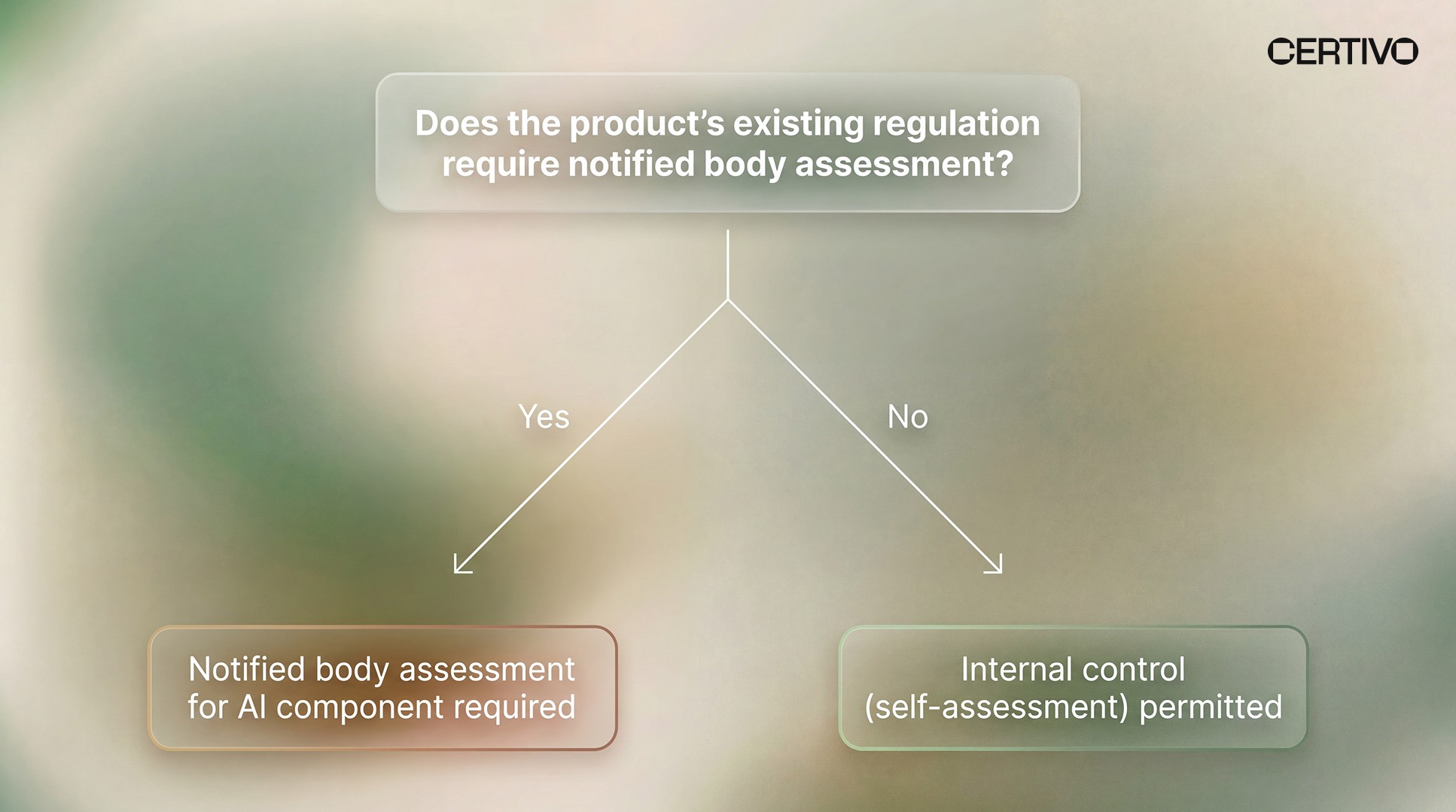
The AI Act provides two conformity assessment pathways for high-risk systems:
1. Internal control (self-assessment) — Applicable when the high-risk AI system is not subject to third-party assessment under existing sector legislation. The manufacturer conducts its own conformity assessment against Annex VI requirements.
2. Notified body assessment — Required when the underlying product regulation already mandates third-party conformity assessment. For example, if a medical device requires notified body review under MDR, the AI component embedded in that device also requires notified body involvement under the AI Act.
⚠ This means manufacturers cannot default to self-assessment for AI components in products that already require third-party certification. The conformity route follows the strictest applicable requirement.
EU AI Act manufacturer compliance conformity assessment decision flow
Click on image to view full
Documentation and Technical Requirements for High-Risk AI
Article 9 through Article 15 of the AI Act define six core documentation and system requirements for high-risk AI:
✓ Risk management system — A continuous, iterative process covering identification, analysis, estimation, and evaluation of risks throughout the AI system lifecycle.
✓ Data governance — Requirements for training, validation, and testing datasets, including relevance, representativeness, and bias mitigation.
✓ Technical documentation — Comprehensive records demonstrating compliance before the system is placed on the market. Must be kept updated.
✓ Human oversight — Design measures enabling human operators to understand, monitor, and intervene in the AI system's operation.
✓ Accuracy, robustness, and cybersecurity — Documented performance metrics and resilience against errors, adversarial attacks, and security threats.
✓ Record-keeping and logging — Automatic logging of events for traceability during the system's operation.
These documentation obligations create a significant data management challenge. Manufacturers already maintaining technical files for CE marking under product safety directives must now maintain a parallel AI-specific documentation set. CORA-powered regulatory intelligence can map these overlapping requirements and flag gaps before audit exposure materializes.
For teams managing continuous audit-ready documentation across multiple frameworks, the AI Act adds another layer that must be version-controlled and retrievable on demand.
Post-Market Monitoring Obligations
High-risk AI system providers must establish a post-market monitoring system proportionate to the nature and risks of the AI system. This includes:
Systematic collection and analysis of performance data after deployment
Reporting serious incidents to market surveillance authorities
Updating technical documentation based on post-market findings
Cooperation with national competent authorities during investigations
This is not a one-time filing. Post-market monitoring is an ongoing obligation that requires continuous compliance monitoring infrastructure, not periodic manual reviews.
Penalties and Enforcement Exposure
The AI Act carries the steepest penalty structure of any EU regulation affecting manufacturers:
📊 Prohibited AI practices — Up to €35 million or 7% of global annual turnover, whichever is higher.
📊 Non-compliance with high-risk AI obligations — Up to €15 million or 3% of global annual turnover.
📊 Supplying incorrect information to authorities — Up to €7.5 million or 1.5% of global annual turnover.
For context, GDPR penalties cap at 4% of turnover. The AI Act exceeds this ceiling for prohibited practices. The enforcement mechanism relies on national market surveillance authorities in each EU member state, meaning multi-jurisdiction enforcement exposure is a real operational risk.
📌 Managing AI-integrated products across multiple EU markets? See how Certivo maps compliance obligations across frameworks. Get a compliance risk assessment →
How AI Compliance Platforms Reduce Documentation Burden
The operational challenge of AI Act compliance is not understanding the regulation. It is managing the intersection of AI-specific documentation with existing product safety technical files across multiple products, markets, and regulatory frameworks simultaneously.
Certivo's centralized compliance data backbone enables manufacturers to:
Map AI system classifications to existing product portfolios
Maintain version-controlled technical documentation across both product safety and AI Act requirements
Track post-market monitoring data alongside existing quality management systems workflows
Use CORA-driven compliance intelligence to identify documentation gaps before they become audit findings
No software eliminates audit findings. The objective is to reduce surprises and compress response time when regulators, customers, or notified bodies request evidence. Organizations that build this infrastructure before August 2026 will absorb the AI Act's requirements without proportional increases in manual effort.
For a broader view of how AI transforms compliance operations, see AI Tools for Compliance Management: The Complete Guide.
Strategic Compliance Preparation Checklist
Executive Conclusion
The EU AI Act's August 2, 2026 deadline marks a structural shift in how manufacturers must document, assess, and monitor AI systems embedded in regulated products. This is not a standalone compliance exercise. It compounds existing obligations under the Machinery Regulation, MDR, RED, automotive type-approval, and other sector-specific frameworks.
Organizations that wait until 2026 to begin preparation face a documentation backlog that manual processes cannot absorb within the enforcement timeline. The penalty structure, reaching up to €35 million or 7% of global turnover, makes this one of the highest-exposure regulatory frameworks any manufacturer will face.
Investing in EU AI Act manufacturer compliance infrastructure now, specifically centralized documentation systems, regulatory mapping tools, and post-market monitoring workflows, is the most effective way to absorb these obligations without proportional increases in headcount or audit risk.
📌 Book a demo to see how Certivo maps AI Act obligations alongside your existing product compliance frameworks, or get a free compliance risk assessment to evaluate your current readiness across AI-integrated product lines.
FAQs
1. Which manufacturers are most affected by the EU AI Act August 2026 deadline?
Manufacturers embedding AI into safety components of products regulated under EU harmonized legislation are directly affected. This includes machinery, medical devices, automotive systems, connected toys, and radio equipment. Certivo's CORA intelligence helps map which product lines trigger high-risk classification.
2. How does the AI Act interact with the EU Machinery Regulation for AI-enabled equipment?
AI systems that serve as safety components in machinery covered by the Machinery Regulation (EU) 2023/1230 must comply with both frameworks simultaneously. This means maintaining technical documentation for both product safety and AI-specific requirements. Certivo enables continuous audit-ready documentation across intersecting frameworks.
3. Can manufacturers self-assess AI systems under the EU AI Act?
Self-assessment (internal control) is only permitted when the underlying product regulation does not require third-party conformity assessment. If a notified body is already required for the product, the AI component must also go through notified body assessment.
4. What documentation must manufacturers prepare for high-risk AI systems by August 2026?
Manufacturers must prepare a risk management system, data governance records, technical documentation, human oversight design measures, accuracy and robustness testing results, and automatic logging capabilities. These must be maintained and updated throughout the AI system's lifecycle.
5. How do AI Act penalties compare to GDPR fines for manufacturers?
AI Act penalties exceed GDPR. Prohibited AI practices carry fines up to €35 million or 7% of global turnover, compared to GDPR's maximum of 4%. Non-compliance with high-risk AI obligations carries fines up to €15 million or 3% of turnover.
Vasanth
Vasanth is a skilled Compliance Engineer with over five years of experience specializing in global environmental regulations, including REACH, RoHS, Proposition 65, POPs, TSCA, PFAS, CMRT, EMRT, FMD, and IMDS. With a strong academic foundation in Chemical Engineering from Anna University, he brings a deep technical understanding to compliance processes across complex product lines.
Vasanth excels in analyzing Bills of Materials (BOMs), evaluating supplier declarations, and ensuring regulatory conformity through meticulous review and risk assessment. He is highly proficient in supplier engagement, adept at interpreting material disclosures, and experienced in preparing customer-ready compliance documentation tailored to diverse global standards.