

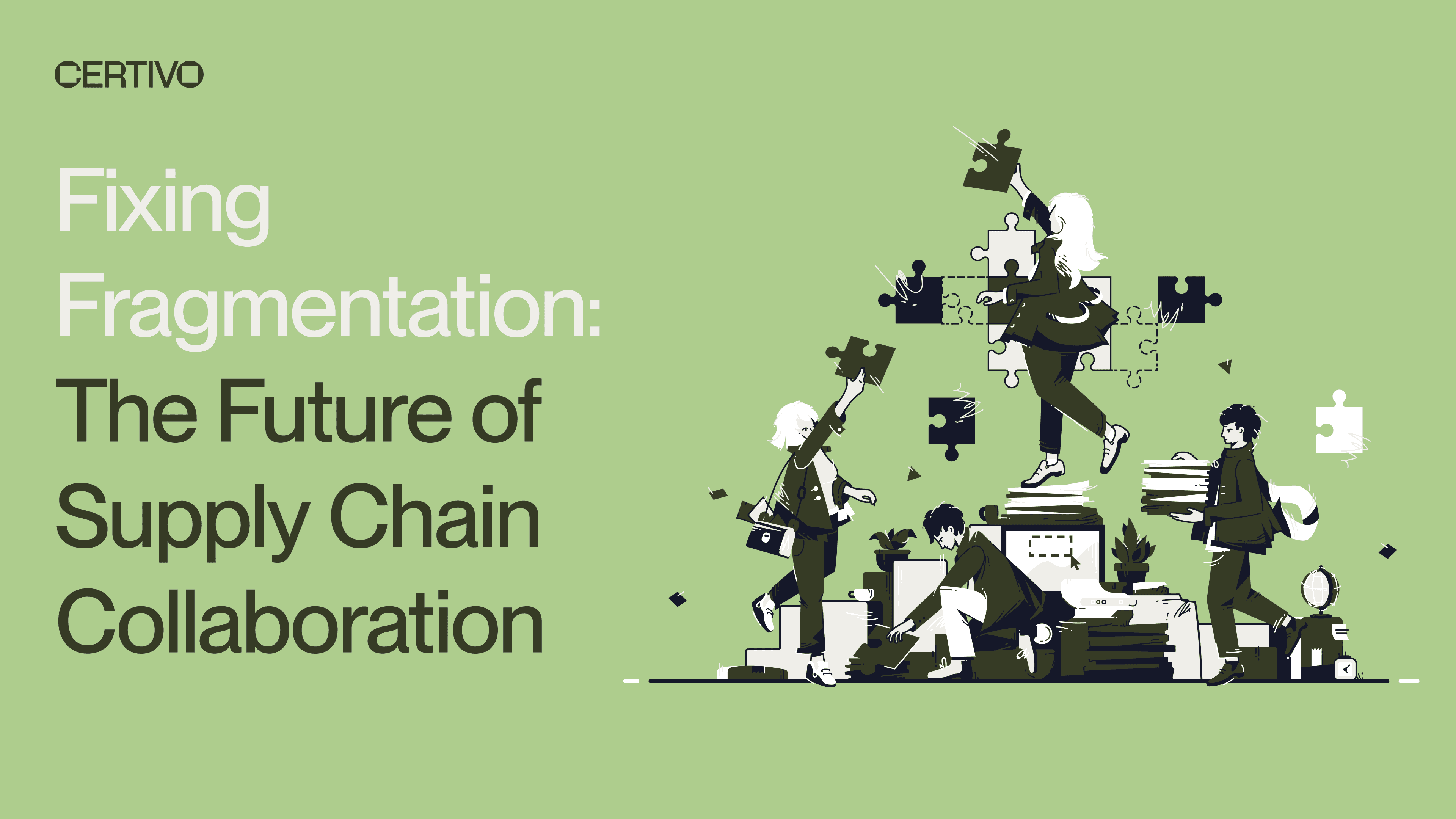
The supply chain today faces a fundamental challenge: fragmented data. Information is scattered across different nodes—suppliers, manufacturers, distributors—and even within individual facilities. Adding to this complexity, the data often exists in multiple formats, each requiring a different process to interpret and use.
In 2026, fragmentation is no longer just an efficiency problem — it is a compliance liability. With PFAS deadlines tightening across the US and EU, the EU Cyber Resilience Act enforcement, Digital Product Passport mandates, and new RMI reporting templates (CMRT 6.6, EMRT 2.11, AMRT 1.31), manufacturers can no longer afford disconnected supplier data, spreadsheets, or email-driven workflows.
Traditionally, the solution has been centralization: bring all the data into one place, standardize it, and then operate on it. While this sounds logical, it's a costly, time-consuming approach that introduces its own inefficiencies — and most centralization projects fail before they deliver value.
Enter AI agents and CORA-powered regulatory intelligence — a smarter, distributed solution that could revolutionize how supply chains operate. Instead of forcing centralization, agents can be deployed across different nodes of the supply chain. These agents don't just process data locally — they collaborate with each other, translating, validating, and synchronizing information in real time.
Why Supply Chain Fragmentation Has Become a 2026 Compliance Crisis
Fragmentation used to mean late shipments and inventory mismatches. Today it means missed regulatory deadlines, blocked shipments, and audit failures.
📊 The compliance cost of fragmentation:
⚠ Fragmentation Symptom | 📌 2026 Compliance Impact |
|---|---|
Supplier declarations in PDFs, emails, spreadsheets | Missed TSCA Section 8(a)(7) PFAS reporting windows |
Material data scattered across PLM, ERP, QMS | Inability to map BOMs to RoHS, REACH, PFAS thresholds |
Manual certificate validation | Expired certificates triggering customs holds |
Tier-2 and Tier-3 supplier blind spots | UFLPA, EUDR, conflict minerals exposure |
No common data foundation for ESG | CSRD, EU Taxonomy, and CBAM reporting gaps |
When data lives in silos, continuous compliance monitoring is impossible. Compliance teams are stuck in reactive mode — chasing certificates, retyping declarations, and scrambling before audits.
👉 Map your global regulatory exposure in 60 seconds with Certivo's Rapid Risk Assessment
How AI Agents and CORA Intelligence Work in Practice
Imagine a global supply chain: a supplier tracks raw material availability in their system, a manufacturer plans production schedules, and a logistics provider ensures timely delivery. Each operates in its own silo with separate data formats, making seamless collaboration nearly impossible.
Now picture this with Certivo and CORA-driven compliance intelligence:
✓ An agent at the supplier's node translates raw material data and material declarations into IPC-1752, CMRT, or REACH-compatible formats — without forcing suppliers to learn new templates.
✓ A CORA-powered agent verifies certificates of conformance, mill test reports, and SDS authenticity before materials leave the supplier.
✓ At the manufacturer's end, agents align BOM-level compliance data with production schedules, flagging non-compliant parts before they enter the build.
✓ Downstream, logistics agents update delivery timelines and trade-compliance documentation (HTS codes, country-of-origin, USMCA qualification) dynamically.
Together, these agents create a system of intelligence, where each node works in unison rather than in isolation. No forced centralization. No spreadsheet rework. No email chaos.
How AI Agents Replace Manual Supplier Workflows
Compliance engineers today spend up to 70% of their time on data collection, validation, and chasing missing documents. Agent-based automation eliminates this through:
📌 AI document parsing of CoCs, MTRs, REACH declarations, and SDS files
📌 Automated supplier follow-ups when certificates near expiration
📌 Real-time validation against the latest SVHC, RoHS, and PFAS lists
📌 Multi-language supplier communication for Tier-2/Tier-3 outreach
Learn more about how Certivo automates this in our guide to AI tools for compliance management.
The Benefits of an AI-Native, Agent-Based Compliance System
1. Real-Time Collaboration Across Nodes
Agents communicate and act on data instantly, reducing delays caused by manual processing or siloed systems. Compliance becomes continuous instead of periodic.
2. Data Translation and Standardization at Scale
CORA's regulatory intelligence layer handles multiple formats — IPC-1752A, CMRT 6.6, EMRT 2.11, AMRT 1.31, custom OEM templates — removing the burden of standardization and making fragmented data instantly usable.
3. Predictive Compliance Insights
By analyzing historical and real-time data, agents:
✓ Estimate time-to-compliance for new product launches
✓ Identify potential bottlenecks (expiring certificates, single-source suppliers)
✓ Recommend actionable solutions — switching suppliers, replacing non-compliant parts, or filing exemptions
4. BOM-Level Compliance Intelligence
Every part, sub-assembly, and finished good is traceable against multiple regulations simultaneously — RoHS, REACH SVHC, PFAS, Prop 65, conflict minerals, and country-specific bans. Engineering changes are instantly assessed for compliance impact.
5. Multi-Tier Supply Chain Transparency
Agents reach beyond Tier-1 to surface risks at Tier-2 and Tier-3 — critical for UFLPA, EUDR, conflict minerals, and forced-labor due diligence. See how this works in electronics supply chains in 2026.
6. Unlocking Hidden Revenue
Supply chains leave significant revenue on the table due to compliance-driven inefficiencies — blocked shipments, recalls, RFQ delays, and missed market entries. By bringing nodes closer together, agents reduce waste, accelerate time-to-market, and unlock revenue tied up in compliance bottlenecks.
Scalability and Feasibility for Mid-Sized to Enterprise Manufacturers
One of the most exciting aspects of agent-based systems is their scalability. Unlike traditional approaches that require massive investment in centralizing data, agents work within existing PLM, ERP, and QMS systems and expand as needed.
Whether you're a mid-sized industrial manufacturer or a Fortune 500 enterprise, Certivo's agent-based architecture offers an accessible and adaptable solution. It integrates with:
📌 PLM systems (Windchill, Teamcenter, Arena, Enovia)
📌 ERP platforms (SAP, Oracle, Microsoft Dynamics)
📌 QMS and EHS tools
📌 Supplier portals and customer trust centers
This is design-for-compliance in action — compliance data flowing alongside engineering decisions, not bolted on afterward. Explore how this fits into building a future-ready compliance infrastructure.
From Fragmentation to a Centralized Compliance Data Backbone
Even though agents operate in a distributed model, manufacturers still need a single source of truth — a centralized compliance data backbone that consolidates evidence, supplier declarations, audit trails, and regulatory mappings.
What a Centralized Compliance Data Backbone Looks Like
✓ Capability | What It Solves |
|---|---|
BOM substance & threshold management | Track every substance against regulatory limits across all SKUs |
Centralized supplier self-service portals | Eliminate email chaos; suppliers upload once, reuse everywhere |
AI document parsing & certificate validation | Auto-extract data from MTRs, CoCs, SDS, declarations |
Regulatory intelligence & horizon scanning | Track 2026 PFAS, CRA, DPP, CBAM updates mapped to your products |
Continuous audit-ready documentation | Always-on technical files instead of audit fire drills |
Digital passports & traceability IDs | Meet ESPR and DPP mandates by 2027 |
This is what Certivo delivers — the system of record for compliance with CORA as the embedded AI intelligence that keeps it continuously updated.
The Bigger Picture: Trust, Resilience, and Strategic Advantage
This is more than just fixing inefficiencies — it's about fostering trust and collaboration across the supply chain. When data flows seamlessly between nodes:
📊 Relationships between suppliers, manufacturers, and distributors improve
📊 RFQ response times shrink from weeks to days
📊 Customer trust centers become a sales asset, not a support burden
📊 Supply chains become not just faster, but more resilient and audit-ready
The road ahead won't be simple. But manufacturers who shift from reactive, spreadsheet-driven compliance to AI-native continuous compliance will out-compete those who don't.
👉 See how Certivo can transform your compliance operations — book a demo today
Frequently Asked Questions
How can companies reduce reliance on email for managing supplier compliance workflows?
By replacing email-driven processes with a centralized supplier self-service portal where suppliers upload declarations, certificates, and material data once. Certivo's CORA-powered platform automates follow-ups, validates documents, and triggers alerts for expirations — eliminating spreadsheet chaos and missed certifications.
What platforms support multi-tier supply chain transparency for material content?
Modern AI-native compliance platforms like Certivo extend visibility beyond Tier-1 by deploying intelligent agents that collect, translate, and validate material declarations across Tier-2 and Tier-3 suppliers. This is critical for UFLPA, EUDR, PFAS, and conflict minerals compliance in 2026.
How can AI predict compliance risk based on BOM, materials, and supplier history?
CORA-driven compliance intelligence analyzes BOM data, supplier responsiveness, certificate validity, and historical regulatory changes to forecast risk before it materializes. It flags non-compliant parts, expiring exemptions, and suppliers likely to miss documentation deadlines — enabling proactive remediation.
What solutions help maintain a single source of truth for all product compliance data?
Certivo serves as the system of record for compliance — consolidating BOM-level material data, supplier declarations, test reports, and regulatory mappings into one continuously updated platform. This eliminates duplicate data, conflicting versions, and audit blind spots across global plants and product lines.
How can manufacturers automate RoHS and REACH compliance for thousands of parts and suppliers?
Through AI-native compliance automation, Certivo parses BOMs, validates supplier declarations against the latest REACH SVHC and RoHS exemption lists, and continuously monitors threshold breaches. CORA's regulatory intelligence layer auto-updates when ECHA publishes new substances — eliminating manual list maintenance.
Closing Thought
By leveraging AI agents and CORA-powered regulatory intelligence to address fragmentation and inefficiencies, manufacturers can transform supply chains from disjointed networks into intelligent, collaborative, continuously compliant systems.
And when we do, the entire industry stands to benefit.
👉 Ready to fix fragmentation in your supply chain? Talk to a Certivo compliance expert
Kunal Chopra
Kunal Chopra is the CEO of Certivo, an AI-driven compliance management platform revolutionizing how manufacturers navigate regulatory challenges. With a career spanning over two decades, Kunal is a seasoned technology leader, 3x tech CEO, product innovator, and board member with a passion for driving transformative growth and innovation.
Before leading Certivo, Kunal spearheaded successful transformations at renowned companies like Beckett Collectibles, Kaspien, Amazon, and Microsoft. His strategic vision and operational excellence have led to achievements such as a 25x EBITDA valuation increase at Beckett Collectibles and a 450% shareholder return at Kaspien. He has a track record of turning challenges into opportunities, delivering operational efficiencies, and driving market expansions.
Kunal’s deep expertise lies in blending technology and business strategy to create scalable solutions. At Certivo, he applies this expertise to empower manufacturers, using AI to turn product compliance from an operational burden into a strategic advantage.
Kunal holds an MBA from The University of Chicago Booth School of Business, an MS in Computer Science from Clemson University, and a BE in Computer Engineering from The University of Mumbai. When he’s not transforming businesses, Kunal is an advocate for innovation, growth, and building cultures that inspire excellence.
Stay tuned for insights from Kunal on how technology can redefine compliance, drive efficiency, and create opportunities for growth in the manufacturing sector.