

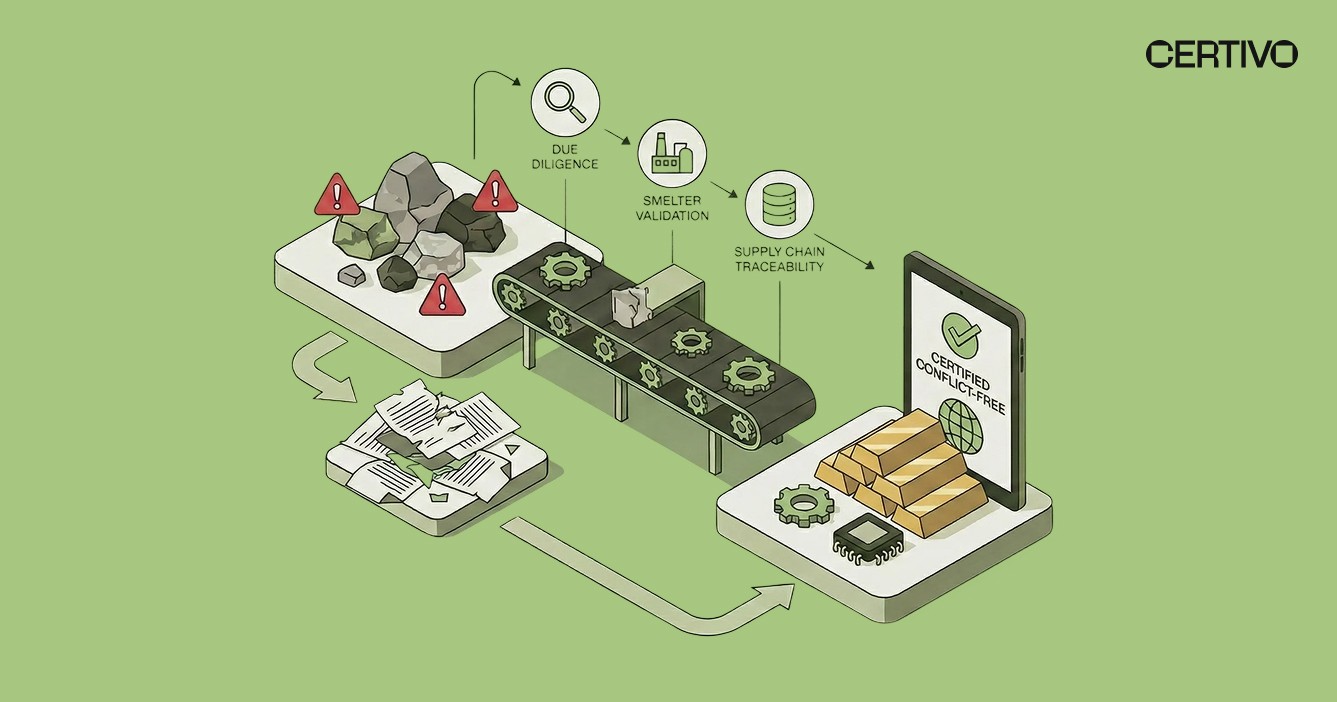
Conflict minerals compliance isn't just a regulatory checkbox—it's a business-critical function that protects your organization from financial penalties, reputational damage, supply chain disruptions, and complicity in human rights abuses. Companies that fail to establish defensible due diligence programs face SEC enforcement actions, customer contract losses, investor scrutiny, and potential exclusion from major supply chains. Beyond regulatory risk, inadequate conflict minerals programs expose organizations to supply chain opacity, making it impossible to trace 3TG minerals (tantalum, tin, tungsten, and gold) back to their sources in conflict-affected and high-risk areas (CAHRAs). This lack of visibility creates legal liability, undermines ESG commitments, and—most critically—perpetuates the extraction practices that fund armed conflict and human rights violations in source regions. For manufacturers, automotive companies, electronics producers, and any organization with complex global supply chains, conflict minerals compliance is a governance imperative that requires systematic processes, continuous supplier engagement, and auditable evidence. This guide walks through the entire program—from the regulatory frameworks and mineral traceability requirements to the exact workflow organizations need to move from reactive firefighting to proactive, defensible compliance.
For organizations asking how to manage conflict minerals reporting across a complex supply network, the answer lies in combining automated CMRT collection, centralized smelter validation, and continuous supplier engagement—supported by conflict minerals compliance software that scales with your supply chain's complexity.
This guide walks through the whole program—from the mineral list and the regulatory frameworks to the exact workflow Certivo uses to simplify operations—so you can stop reacting and start managing with confidence.
What Are the Minerals at Issue?
When people say “conflict minerals,” they most often mean the four metals known as 3TG minerals: tantalum, tin, tungsten, and gold. These four minerals frequently appear in small but critical parts across electronics, medical devices, automotive components, and jewelry. Their extraction in Conflict-affected and high-risk areas (CAHRAs) creates risks tied to human rights abuses and armed conflict, which is why traceability matters so much.
Understanding where these minerals hide in your supply chain is the first step toward compliance:
Tin: Solder for circuit boards, tin-plated components, and protective coatings in electronics
Tantalum: Capacitors in smartphones, laptops, medical devices, and automotive electronics
Tungsten: Vibration motors, lighting filaments, cutting tools, and aerospace alloys
Gold: Electrical contacts, wire bonding, connector plating, and semiconductor packaging.
Effective conflict minerals management best practices start with BOM-level material mapping—identifying exactly which components in your bill of materials contain 3TG minerals so you can target supplier outreach precisely rather than sending blanket requests across your entire supply base.
Key Regulatory Frameworks You Need to Know
Understanding what is conflict minerals reporting requires familiarity with the regulatory frameworks that define disclosure obligations, due diligence standards, and enforcement mechanisms across different jurisdictions.
Regulation landscapes differ by market, but a handful of frameworks drive compliance expectations worldwide. The most consequential include:
Dodd-Frank Act (Section 1502) in the U.S., which spawned SEC Form SD filing obligations for certain issuers;
EU Conflict Minerals Regulation, which creates traceability and supply-chain obligations for actors in the European market; and
Global OECD Due Diligence Guidance, which provides practical steps for responsible sourcing and is treated as a worldwide standard for due diligence.
Together, these conflict minerals regulations create a layered compliance landscape where manufacturers selling into both U.S. and EU markets must satisfy overlapping—but not identical—requirements for due diligence, reporting, and smelter verification.
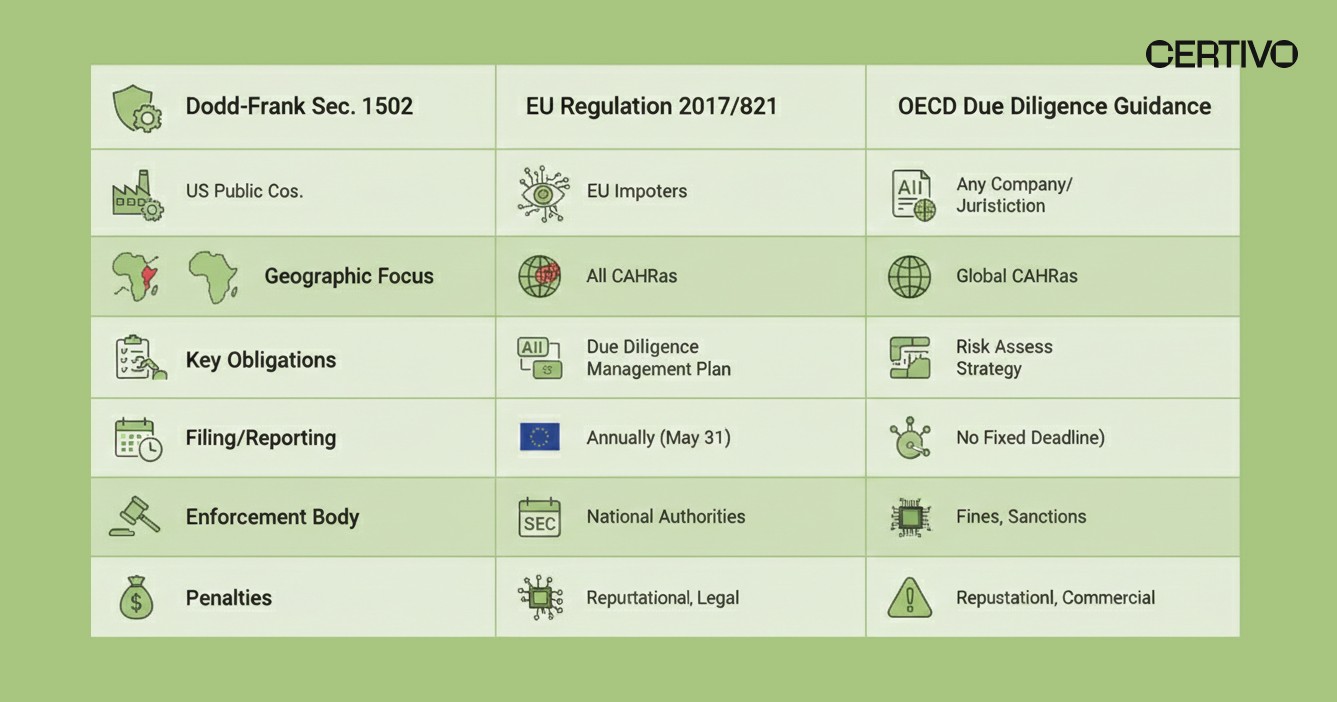
Dodd-Frank Act Section 1502 (United States)
Enacted in 2010, Section 1502 requires SEC-registered companies to disclose their use of conflict minerals originating from the Democratic Republic of Congo (DRC) or adjoining countries. The regulation applies if 3TG minerals are "necessary to the functionality or production" of products manufactured or contracted to be manufactured by the company.
Key Requirements:
Conduct a Reasonable Country of Origin Inquiry (RCOI) to determine if 3TG minerals may originate from covered countries.
Perform due diligence on the source and chain of custody using a nationally or internationally recognized framework.
File the annual Form SD with the SEC by May 31, including a Conflict Minerals Report if products are not found to be DRC conflict-free
Categorize products as "DRC Conflict Free," "Not Found to Be DRC Conflict Free," or "DRC Conflict Undeterminable."
Conflict minerals reporting under Dodd-Frank requires defensible documentation at every stage—from initial RCOI through final Form SD submission. Organizations that maintain continuous audit-ready documentation throughout the year reduce last-minute scramble and strengthen their position if the SEC requests supporting evidence.
EU Conflict Minerals Regulation (European Union)
The EU Regulation 2017/821 took effect on January 1, 2021, targeting EU-based importers of 3TG minerals and metals from conflict-affected and high-risk areas worldwide—not just the DRC region. The regulation aims to break the link between conflict and illegal mineral exploitation while supporting local communities.
Key Requirements:
Applies to importers bringing 3TG minerals or metals into the EU above the specified volume thresholds
Implement supply chain due diligence aligned with OECD Due Diligence Guidance for Responsible Supply Chains.
Document and publicly report due diligence processes annually
Engage with suppliers and smelters to verify conflict-free status
Maintain detailed records of risk management and mitigation strategies
The EU regulation's emphasis on multi-tier supply chain transparency means importers cannot simply rely on direct supplier declarations—they must demonstrate visibility into smelter-level sourcing practices and maintain documented evidence of risk assessment across multiple supply chain tiers.
OECD Due Diligence Guidance (Global Standard)
The OECD Due Diligence Guidance for Responsible Supply Chains of Minerals from Conflict-Affected and High-Risk Areas is the global benchmark framework that underpins both U.S. and EU conflict minerals rules. It does not create binding law by itself, but regulators, industry schemes, and customers treat it as the standard for what “good” due diligence looks like across any region or sector.
Key Characteristics:
Applies to all companies in the mineral supply chain, from mine to final product, regardless of where they are located.
Focuses on conflict-affected and high-risk areas (CAHRAs) broadly, not just the DRC or a fixed list of countries.
Provides a risk-based, stepwise approach rather than a rigid checklist, allowing companies to tailor due diligence to their size, risk profile, and leverage.
The OECD's five specific steps:
Establish Strong Company Management Systems
Identify and Assess Risks
Design Risk Response Strategy
Carry Out Third-Party Audits
Report Annually
Each framework overlaps in spirit—requiring transparency, reasonable investigation, and documentation—even when the exact paperwork differs. You’ll need to align your program to the frameworks relevant to your markets and customers.
Staying ahead of evolving conflict minerals regulations also requires regulatory intelligence and horizon scanning—monitoring proposed amendments to existing rules, tracking new CAHRA designations, and anticipating emerging requirements like cobalt and mica due diligence that may expand the scope of responsible sourcing obligations. For a broader view of how regulatory landscapes are shifting, Certivo's guide on the future of supply chain due diligence covers the key EU regulations manufacturers should be watching.
How Certivo Simplifies Conflict Minerals Compliance
Staying ahead of evolving conflict minerals regulations also requires CORA-powered regulatory intelligence—continuously monitoring proposed amendments to existing rules, tracking new CAHRA designations, and anticipating emerging requirements like cobalt and mica due diligence that may expand the scope of responsible sourcing obligations. For a broader view of how regulatory landscapes are shifting, Certivo's guide on the future of supply chain due diligence covers the key EU regulations manufacturers should be watching. The platform centers around a few distinct capabilities:
Supplier Due Diligence: CORA-driven compliance intelligence automates engagement and assesses supplier compliance with recognized standards while aligning to the OECD Due Diligence Guidance and Dodd-Frank expectations.
Centralized Data Management: Consolidate supplier declarations, smelter certifications, and supporting documents in a single, secure location to avoid lost spreadsheets and undocumented conversations.
Conflict Minerals Reporting Template (CMRT): CORA intelligence automates the generation, collection, and validation of CMRT submissions, treating the CMRT as a living file rather than an annual chore.
Smelter Validation: CORA-enabled analysis cross-checks smelter lists against the Responsible Minerals Initiative (RMI) and other validated sources to confirm smelter conformance.
Custom Reporting: Create tailored outputs for audits, customers, and regulators so you can demonstrate how your due diligence meets expectations.
Risk Alerts & Assessments: CORA's regulatory intelligence layer identifies high-risk suppliers, delivers real-time alerts on smelter or supplier status changes, and triggers escalation workflows automatically.
Certivo's conflict minerals automation workflows replace the manual, error-prone processes that plague most compliance programs—automating CMRT distribution, validation, smelter cross-referencing, and escalation in a single platform built for conflict minerals compliance at scale.
These functions map directly to the recurring pain points companies tell us about: data fragmentation, supplier non-responsiveness, and the smelter verification bottleneck. By anchoring the program in automation and repeatable workflows, Certivo as the compliance system of record—with CORA embedded as the intelligence engine—reduces manual effort while increasing credibility. Unlike spreadsheet-based tracking—where CMRT data gets scattered across email threads, version control breaks down, and supplier response rates stall below 60%—Certivo centralizes all supplier communications, declarations, and smelter validations in a single system accessible to compliance, procurement, and quality teams. Compared to email-based CMRT collection, which requires manual follow-ups, lacks automated validation, and creates audit trail gaps, CORA automates supplier outreach at scale, flags incomplete submissions in real time, and maintains a complete compliance history across every framework and jurisdiction. Legacy compliance tools often lack integration with RMI databases, require manual smelter cross-referencing, and operate on annual cycles rather than continuous monitoring. Certivo eliminates these bottlenecks through CORA-driven automated RMI smelter checks, real-time status alerts, and continuous data updates—reducing audit preparation time by 60-80% and enabling organizations to scale compliance programs without proportionally increasing headcount. The platform transforms conflict minerals compliance from a manual, annual scramble into a continuous, defensible process that supports business growth rather than constraining it.
Conflict Minerals Compliance Workflow (Practical Steps)
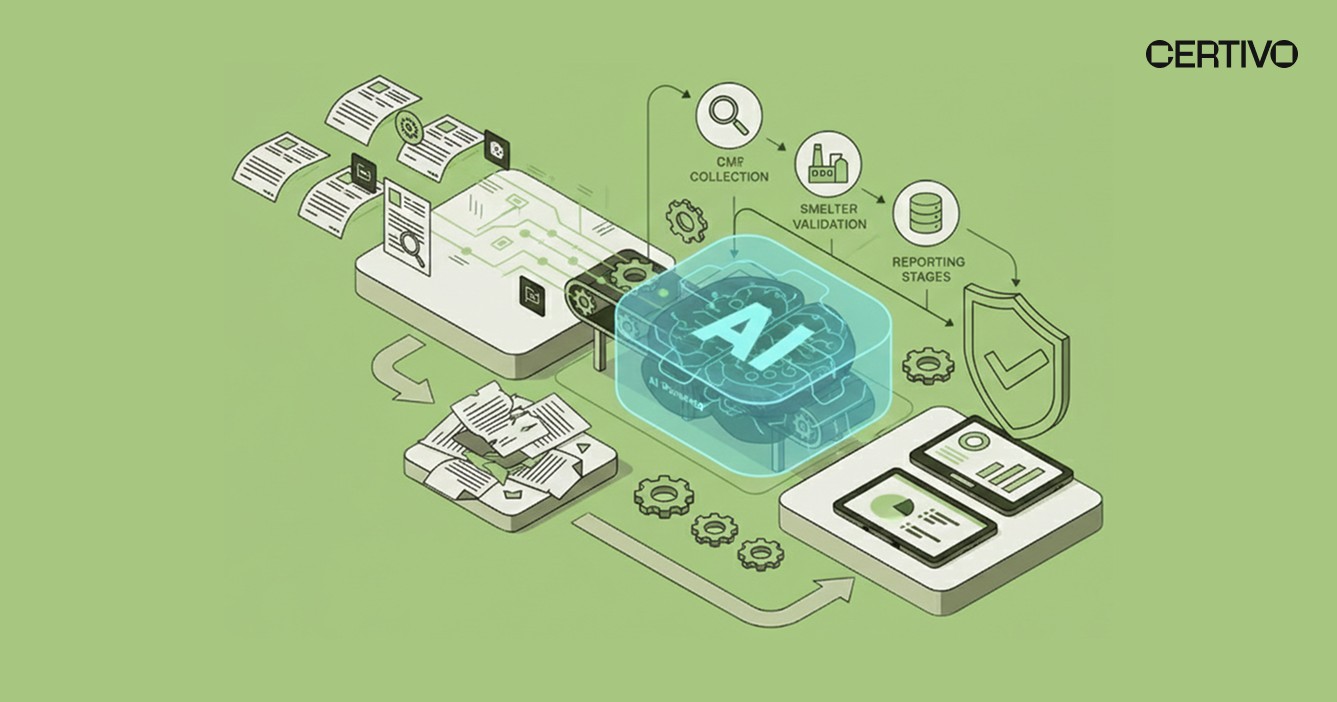
Certivo’s recommended workflow reduces chaos into four core stages—each stage builds evidence and reduces last-minute scramble:
Upload Supplier Data. Map your supply chain, identify components containing 3TG minerals, and gather supplier contacts.
Collect & Validate CMRT Submissions. CORA automates CMRT collection across your entire supplier base and applies validation checks to flag missing or inconsistent data early.
Monitor Smelter Lists. Maintain live alignment with RMI and similar verification sources so you know which smelters are validated or high-risk.
Generate Compliance Reports. Produce custom reports for audits, customers, and internal decision-makers to demonstrate a defensible due diligence process.
Treat this as continuous work, not a once-a-year project. Suppliers move, smelters change status, and regulations evolve—so the program that survives is the one that keeps running. Certivo's platform, powered by CORA intelligence, shifts your conflict minerals program from reactive annual compliance to continuous readiness—ensuring your due diligence posture is always current, always defensible, and always audit-ready.
Effective conflict minerals training for procurement, quality, and compliance teams is essential to sustaining this workflow—ensuring that every team member understands CMRT requirements, knows how to escalate non-responsive suppliers, and can interpret smelter validation results within the platform.
Conflict minerals compliance best practices
These are not theoretical. They are actions that reduce the odds of surprises:
Use short, clear supplier questionnaires tied to the CMRT.
Keep the CMRT live; refresh it on supplier updates.
Verify smelters against RMI before finalizing reports.
Link due diligence milestones to purchasing approvals.
Store documentation centrally and back it up.
Use automated reminders and escalation paths to reduce supplier lag.
Track risk trends for suppliers rather than addressing issues only when they reach a crisis.
Implementing these steps makes your Conflict minerals compliance best practices demonstrable, repeatable, and auditable.
Standardized supplier questionnaire frameworks ensure that every supplier—regardless of size, region, or tier—receives consistent CMRT requests with clear instructions, reducing confusion and improving response rates across your entire supply base.
Incorporating supplier risk scoring and ESG ratings into your conflict minerals program allows you to prioritize engagement with high-risk suppliers, allocate audit resources more effectively, and demonstrate to regulators that your due diligence effort is proportionate to actual risk exposure. For deeper insights on integrating ESG into supply chain governance, explore Certivo's analysis of why ESG failure is a supply chain risk.
Supply Chain Due Diligence for Conflict Minerals
If you still rely on spreadsheets, expect stress and errors when deadlines hit. Digital tools—like automated CMRT collection and centralized supplier portals—cut response time and improve traceability. Combine software with onsite or third-party audits when required, particularly when dealing with high-risk suppliers or smelters. Doing so strengthens your ability to show real Supply chain due diligence for conflict minerals.
AI-native compliance automation transforms supply chain due diligence from a periodic reporting exercise into a continuous monitoring capability—flagging smelter status changes, identifying new high-risk suppliers, and auto-generating audit-ready documentation without manual intervention. Organizations ready to replace spreadsheets with a scalable system can significantly reduce compliance cycle times while improving data accuracy.
Industries Most Impacted
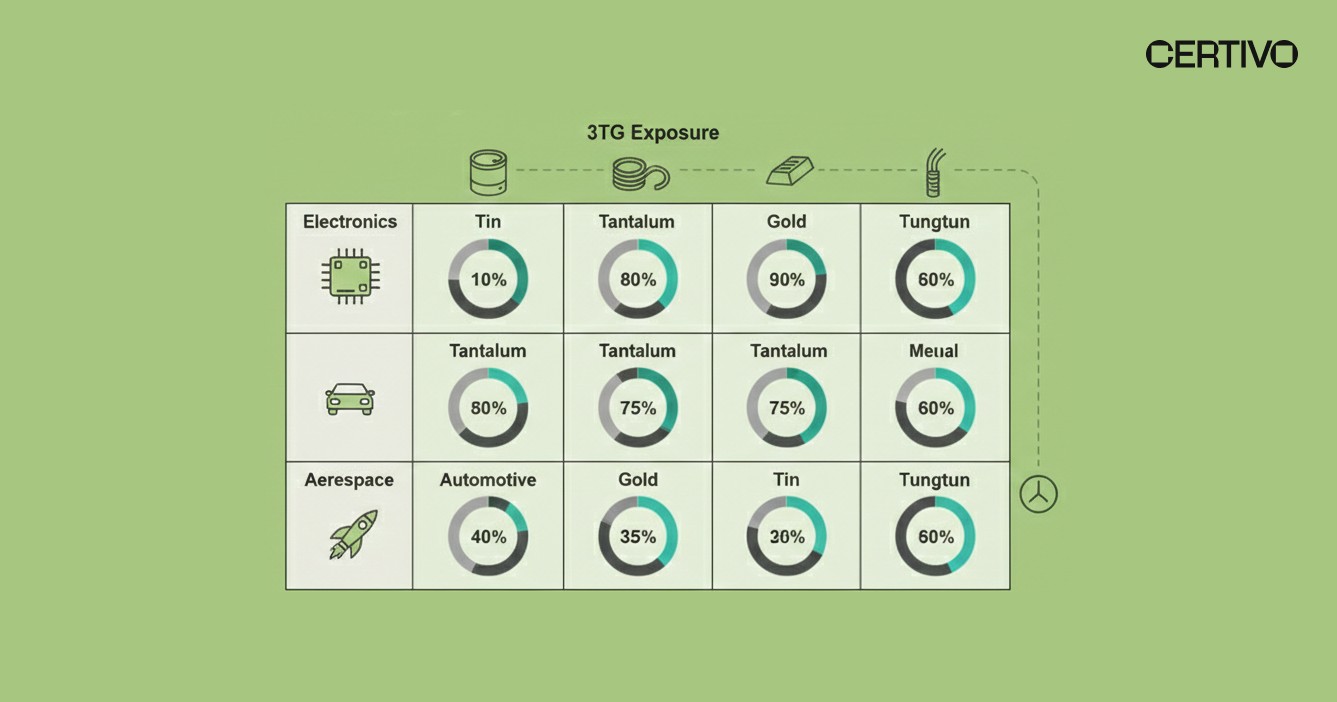
While the focus often lands on electronics, Certivo’s framework highlights the broader exposure across sectors:
Jewelry: Precious metals are direct inputs, and visibility into origin matters critically.
Industrial Equipment: Tools and heavy machinery include metallic components that trace back to supply chains.
Automotive: Vehicles rely on metal parts and electronic systems, creating multi-tier exposure.
Consumer Electronics: Phones, laptops, and peripherals remain central to CMRT cycles.
Aerospace & Defense: High-purity metals and components trigger careful scrutiny and require robust documentation.
If your industry appears here, don’t assume compliance is optional—treat it as a supply-chain governance priority.
Semiconductor and PCB manufacturers face particularly concentrated 3TG exposure due to gold wire bonding, tin solder, and tantalum capacitors embedded throughout their product lines. For sector-specific guidance, explore Certivo's guide to semiconductor compliance and complex global regulations.
Common Compliance Challenges & Solutions
Even with clear regulations and frameworks, conflict minerals compliance presents persistent operational obstacles. Understanding these challenges upfront helps you build resilience into your program from day one.
Challenge 1: Low Supplier Response Rates
The most frequently cited frustration in conflict minerals programs is supplier non-responsiveness. Companies often struggle to achieve even 75% supplier response rates, leaving critical gaps in supply chain visibility.
Solutions:
Automate Initial Outreach: Use software platforms to contact all suppliers simultaneously with clear instructions and deadlines.
Tie Compliance to Purchasing Decisions: Make CMRT submission a requirement for ongoing business relationships and new purchase orders.
Provide Templates and Training: Suppliers often delay responses because they don't understand what's required—offer webinars, FAQs, and completed CMRT examples.
Escalate Through Multiple Channels: If emails fail, follow up via procurement teams, phone calls, and account managers.
Track and Visualize Response Rates: Use dashboards showing response status by supplier to identify laggards quickly and trigger escalation workflows.
Centralized supplier self-service portals dramatically improve response rates by giving suppliers a single destination to upload CMRTs, check submission status, and access guidance—eliminating the confusion of managing compliance through scattered email threads.
Challenge 2: Supply Chain Complexity and Multi-Tier Visibility
Global supply chains for electronics, automotive, and industrial products involve multiple tiers of suppliers, with 3TG minerals often appearing several layers deep. Tracing materials back to the smelter becomes exponentially harder with each tier.
Solutions:
Focus on Smelter Identification: Rather than mapping every supply chain tier, concentrate on identifying the smelters where ore becomes metal—this is where OECD guidance and RMI validation focus.
Prioritize by Risk and Spend: Don't treat all suppliers equally—allocate resources based on component criticality, spend volume, and known CAHRA exposure.
Standardize Data Collection: Use the CMRT as your universal data format so information flows consistently regardless of supplier size or location.
Challenge 3: Inconsistent or Incomplete Data
Suppliers frequently submit CMRTs with missing smelter names, vague country-of-origin information, or conflicting declarations between direct suppliers and sub-tier sources.
Solutions:
Implement Automated Validation: Use built-in CMRT checkers and compliance software validation rules to flag incomplete submissions before acceptance.
Cross-Reference Against RMI Data: Compare supplier-reported smelter names with the RMI conformant list to catch spelling errors and identify unknown facilities.
Establish Data Quality Metrics: Track metrics like "percentage of CMRTs with validated smelters" and "percentage with complete country-of-origin data" to measure improvement over time.
Challenge 4: Identifying High-Risk and Non-Compliant Smelters
Even when suppliers provide smelter lists, determining which facilities pose compliance risks requires ongoing monitoring and expertise.
Solutions:
Leverage RMI Conformance Lists: Prioritize working with RMI-conformant smelters, and flag non-conformant facilities for supplier engagement.
Monitor Smelter Status Changes: Smelters can gain or lose conformant status—automated alerts notify you when a smelter in your supply chain changes status.
Develop Supplier Remediation Plans: When high-risk smelters appear, work with suppliers to transition to validated alternatives within defined timeframes.
Challenge 5: Manual Processes and Operational Burden
Companies relying on spreadsheets, email chains, and manual data entry face massive time investments during annual reporting cycles.
Solutions:
Adopt Conflict Minerals Compliance Software: Platforms that automate data collection, validation, smelter checks, and report generation reduce manual effort by 60-80%.
Centralize Documentation: Store all supplier communications, CMRTs, smelter validation records, and audit trails in a single system accessible to compliance, procurement, and quality teams.
Transition from Annual to Continuous Compliance: Update CMRTs when supplier relationships change, not just once per year, to avoid last-minute data gaps
For teams still relying on manual processes, Certivo's guide on how to smartly save time on compliance management with AI solutions outlines practical steps for transitioning from reactive firefighting to continuous, CORA-powered compliance readiness.
Final Thoughts
Conflict minerals compliance becomes manageable once you accept that it is continuous work, not a one-time project. Focus on FMD clarity, CMRT upkeep, validated smelter lists, and consistent supplier engagement. Combine those practices with a centralized platform that automates the heavy lifting, and you’ll find compliance requires less firefighting and more strategic value.
Customer trust centers and self-service reporting capabilities also play an increasingly important role—enabling your downstream customers to access conflict minerals documentation, smelter lists, and due diligence summaries on demand, reducing the volume of ad-hoc compliance requests your team must handle manually.
Certivo, as the system of record for conflict minerals compliance, paired with CORA's embedded intelligence for automated CMRT validation, RMI smelter checks, and multi-framework reporting, helps teams maintain continuous compliance readiness while freeing them to focus on supplier development and risk mitigation. If your aim is to protect people in source countries while meeting customer and regulator demands, book a demo today.
Vasanth
Vasanth is a skilled Compliance Engineer with over five years of experience specializing in global environmental regulations, including REACH, RoHS, Proposition 65, POPs, TSCA, PFAS, CMRT, EMRT, FMD, and IMDS. With a strong academic foundation in Chemical Engineering from Anna University, he brings a deep technical understanding to compliance processes across complex product lines.
Vasanth excels in analyzing Bills of Materials (BOMs), evaluating supplier declarations, and ensuring regulatory conformity through meticulous review and risk assessment. He is highly proficient in supplier engagement, adept at interpreting material disclosures, and experienced in preparing customer-ready compliance documentation tailored to diverse global standards.
Known for his attention to detail, up-to-date regulatory knowledge, and proactive communication style, Vasanth plays a critical role in maintaining product compliance and advancing sustainability goals within fast-paced, globally integrated manufacturing environments.