

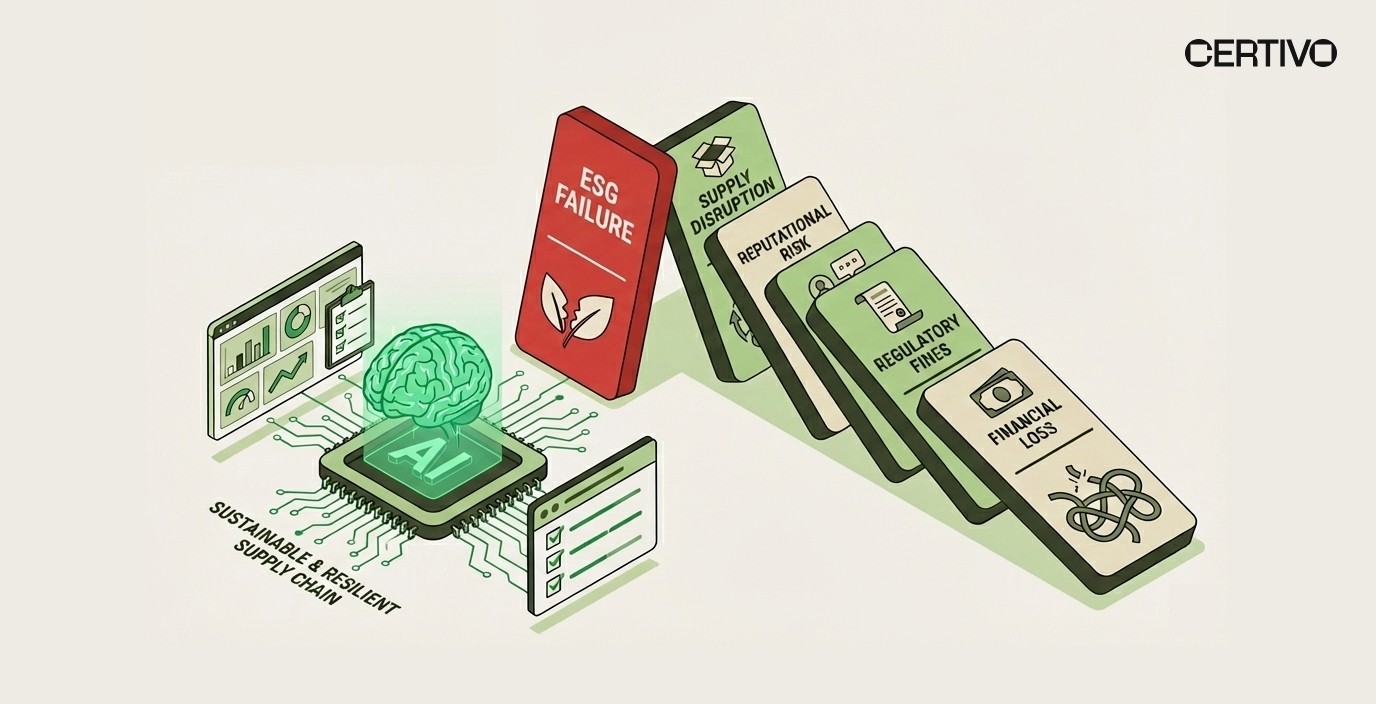
Most companies still treat ESG as a disclosure project—something that lives in sustainability reports, investor decks, and annual filings. But the reality is very different. ESG compliance risk is no longer confined to what gets reported; it directly shapes who you can buy from, who will buy from you, and how resilient your operations really are.
When a supplier is caught in a labor violation, when a Tier 2 partner triggers sanctions, or when a key vendor fails environmental inspections, the damage does not show up first in your ESG report. It shows up on your factory floor as missed shipments, halted production, and cancelled contracts. This is where ESG failure impact on suppliers becomes a direct supply chain risk, not a theoretical reputational issue.
Here, we try to explain the basics of ESG, the difference between “reporting ESG” and “operating ESG,” and why treating ESG as a supply chain and operational priority—not just a reporting obligation—is now critical to managing ESG compliance risk. It also explores ESG enforcement trends, the future of ESG compliance, and how modern ESG compliance software turns ESG from a reactive reporting burden into a proactive supply chain control.
ESG Basics You Can’t Skip
Before unpacking why ESG failure is an operational threat, it is useful to ground the conversation in what ESG actually covers.
What ESG Really Means
ESG stands for:
Environmental (E) – Emissions, energy use, waste, water, pollution, biodiversity, circularity. In supply chains, this includes factory emissions, resource extraction practices, and lifecycle impacts.
Social (S) – Labor practices, human rights, health and safety, diversity, community impact, grievance mechanisms, and worker protections across all tiers of suppliers.
Governance (G) – Board oversight, anti-corruption, executive accountability, policies, internal controls, whistleblower protections, and how decisions are made and documented.
ESG began as a way for investors to evaluate non-financial risks, but it now anchors how regulators, customers, and civil society assess corporate behavior. That is why ESG beyond reporting requirements is now the real battlefield: it is not enough to describe your values; you must prove how they are enforced across your supply chain.
Reporting vs Reality: ESG Beyond Reporting Requirements
For many organizations, ESG still equals “the annual report.” Data is gathered once a year, polished into a narrative, and shared with investors and regulators. But the risks are created, not reduced, when ESG is treated as a static snapshot rather than a living risk domain.
ESG Reporting
ESG reporting frameworks like CSRD, GRI, SASB, TCFD, or ISSB define what has to be disclosed and how it should be structured. This layer is about transparency, comparability, and investor decision‑making. It is necessary, but it is backward-looking and periodic by design.
ESG Operations: Where ESG Compliance Risk Really Lives
Beneath that visible layer sits the actual behavior of your suppliers, plants, logistics partners, and contractors. This is where operational risks of ESG non-compliance emerge:
A supplier falsifies safety data to win a contract.
A subcontractor in a high‑risk region uses forced labor.
A chemical supplier illegally dumps waste, attracting regulatory investigations.
All of these are ESG failures—but they are operational failures first. They disrupt continuity, invite fines, and break customer trust long before they show up in a sustainability report. Understanding ESG beyond reporting requirements means recognizing that the real control point is not the PDF you publish; it is the processes, data, and systems that govern your supplier ecosystem every day.
How ESG Failure Becomes Supply Chain Risk
ESG failures rarely stay isolated. Because modern supply chains are tightly coupled and globally distributed, one weak node can trigger cascading disruption. That is why ESG failure impact on suppliers is so dangerous: when a supplier fails, you inherit the risk.
Environmental Failures
Think of a key Tier 1 supplier whose plant is shut down for breaching emissions rules. You may be fully compliant in your own operations, but if your production depends on that supplier, your output stalls. You now face missed deliveries, penalties from your customers, and the cost of emergency re‑sourcing.
Social Failures
Social issues—forced labor, unsafe working conditions, discrimination—carry enormous regulatory and reputational risk. Laws like the German Supply Chain Act and EU due diligence directives explicitly hold companies responsible for human rights violations deep in their supply chains. If a Tier 3 supplier is exposed, the headline will carry your brand, not theirs. This is the most direct expression of ESG compliance risk turning into brand risk and contract loss.
Governance Failures
Poor governance in supplier organizations—corruption, fraud, opaque ownership structures—can trigger sanctions, disqualify you from public tenders, or invalidate certifications. Once again, the operational consequences (blocked payments, seized shipments, legal fees) are immediate and tangible.
In all three categories, the pattern is the same: ESG failure impact on suppliers becomes your supply chain risk—and your customers will treat it as your responsibility, not an unfortunate externality.
Operational Risks of ESG Non-Compliance: The Real Cost
When ESG is treated as a superficial reporting obligation, the underlying operational risks of ESG non-compliance accumulate silently. They show up in five main ways:
Production Delays and Line Stops
Failed audits, surprise inspections, or license suspensions at supplier sites can halt production. Recovery is slow because compliant alternatives must be identified, validated, and integrated into existing workflows.
Supplier Disqualification and RFQ Losses
OEMs and large enterprises increasingly require documented ESG due diligence as part of RFQs. Fail to demonstrate robust controls, and you are excluded before the pricing discussion even begins.
Regulatory Fines and Legal Exposure
Under emerging regulations, ESG breaches are not “soft compliance” issues. They come with hard numbers: percentage‑of‑turnover fines, civil liability, exclusion from public procurement, and in some regimes, personal exposure for directors.
Investor and Lender Pullback
Investors that have integrated ESG factors into their models may exit positions when they see unmanaged ESG compliance risk—especially where supply chain scandals expose weak due diligence.
Permanent Brand and Relationship Damage
A single, widely publicized ESG failure linked to your supply chain can undo years of brand‑building and destroy trust with key customers. Re‑entry into their supplier base then becomes exponentially harder.
In each case, the real problem is not lack of reporting—it is lack of continuous, systematic control.
ESG Enforcement Trends: From Guidance to Penalties
Regulators are steadily moving from encouragement to enforcement. Understanding ESG enforcement trends is essential to anticipating where ESG compliance risk will spike next.
Europe is tightening the screws.
CSRD is making ESG reporting mandatory and subject to audit. CSDDD pushes due diligence deep into the supply chain, making “we didn’t know” an unacceptable defense. Fines as a percentage of global turnover are becoming the norm.
Greenwashing enforcement is rising.
Authorities in the EU and UK are gaining powers to penalize misleading environmental or social claims with fines up to 10% of global revenue. The message is clear: you cannot say what you cannot prove.
National supply chain laws are proliferating.
Germany’s LkSG, France’s Loi de Vigilance, and similar laws extend company responsibility beyond Tier 1 into deeper tiers. Documentation of risk mapping, remediation, and monitoring is now a legal requirement, not a best practice.
These ESG enforcement trends confirm that ESG is now a hard‑law risk domain. Companies that still handle ESG via ad‑hoc spreadsheets and static questionnaires are effectively running mission‑critical compliance on tools designed for a simpler era.
The Future of ESG Compliance: Continuous, Data‑Driven, Supply‑Chain Centric
Looking ahead, the future of ESG compliance is defined by three shifts:
From Periodic to Continuous
Annual or quarterly reviews are being replaced by ongoing monitoring. Regulators expect companies to know, not guess, what is happening in their value chains. Supply chains that cannot support continuous visibility are structurally exposed to ESG compliance risk.
From Corporate Boundary to Value Chain
ESG obligations increasingly apply to “chain of activities,” not just your own legal entity. That means suppliers, subcontractors, logistics providers, and in some sectors, downstream partners.
From Reporting-Centric to Control-Centric
The future of ESG compliance will be judged less on how elegant your report is, and more on whether you can show that ESG risks were identified, prioritized, mitigated, and tracked—and that you acted when things went wrong.
In this world, ESG beyond reporting requirements becomes the default expectation. Companies that structure ESG as a continuous, integrated risk program will experience fewer disruptions, lower compliance costs, and stronger competitive positioning.
Why ESG Compliance Software Is Now Essential
Given this complexity, manually tracking supplier performance, regulations, and remediation status is simply not viable. This is where modern ESG compliance software comes in.
What ESG Compliance Software Enables
Best‑in‑class ESG compliance software transforms ESG from a static reporting burden into a dynamic risk management capability by:
Centralizing supplier ESG data, assessments, and evidence in one platform
Automating questionnaires, document collection, and follow‑ups across multiple languages and tiers
Tracking real‑time status of suppliers against defined ESG criteria
Linking risk scores to procurement, sourcing, and vendor management decisions
Maintaining an audit‑ready trail for regulators, customers, and third‑party auditors
Instead of juggling disconnected spreadsheets and emails, teams get a single, continuously updated view of ESG compliance risk across their supplier base.
Certivo: Operationalizing ESG Compliance Risk Management
Certivo is designed precisely for this new reality: where ESG failure is a supply chain risk, and where ESG needs to be embedded into everyday operations rather than bolted onto annual reporting.
How Certivo Helps
Certivo’s AI‑driven compliance platform and CORA agent enable you to:
Monitor evolving ESG regulations and ESG enforcement trends across jurisdictions
Map which regulations apply to which suppliers, products, and regions
Automate supplier outreach, ESG data collection, and evidence gathering
Score suppliers on ESG performance and prioritize remediation
Generate audit‑ready documentation to demonstrate due diligence to regulators and customers
In other words, Certivo is not just another reporting tool; it is an AI-based operational control layer that reduces ESG compliance risk at the supplier and supply chain level.
Because Certivo was built for complex, regulated industries and multi‑tier supply chains, it can also support your transition into the future of ESG compliance—where customers and regulators will expect real‑time answers about supplier practices, not generic policy statements.
Book a demo today and experience what smooth ESG compliance reporting feels like.
Conclusion
ESG is no longer an isolated sustainability function producing glossy reports. It is a cross‑functional risk domain that directly affects who you can work with, which markets you can serve, and how reliable your operations are.
ESG failures at the supplier level quickly become your failures.
ESG compliance risk now attracts regulatory fines, legal liability, and contract loss.
Operational risks of ESG non-compliance show up as production delays, supplier exits, and lost RFQs—not just as bad press.
ESG beyond reporting requirements is where resilience is built: in how you select, monitor, and remediate suppliers every day.
The future of ESG compliance will reward companies that have real-time visibility, auditable controls, and integrated supplier governance.
To succeed, organizations must stop treating ESG as a reporting project and start treating it as a supply chain and operational discipline—supported by the right technology.
With a platform like Certivo, powered by intelligent ESG compliance software, you can move from reactive ESG reporting to proactive ESG risk management. That is how you de‑risk your supply chain, satisfy regulators and customers, and turn ESG from an exposure into a competitive advantage.
Kunal Chopra
Kunal Chopra is the CEO of Certivo, an AI-driven compliance management platform revolutionizing how manufacturers navigate regulatory challenges. With a career spanning over two decades, Kunal is a seasoned technology leader, 3x tech CEO, product innovator, and board member with a passion for driving transformative growth and innovation.
Before leading Certivo, Kunal spearheaded successful transformations at renowned companies like Beckett Collectibles, Kaspien, Amazon, and Microsoft. His strategic vision and operational excellence have led to achievements such as a 25x EBITDA valuation increase at Beckett Collectibles and a 450% shareholder return at Kaspien. He has a track record of turning challenges into opportunities, delivering operational efficiencies, and driving market expansions.
Kunal’s deep expertise lies in blending technology and business strategy to create scalable solutions. At Certivo, he applies this expertise to empower manufacturers, using AI to turn product compliance from an operational burden into a strategic advantage.
Kunal holds an MBA from The University of Chicago Booth School of Business, an MS in Computer Science from Clemson University, and a BE in Computer Engineering from The University of Mumbai. When he’s not transforming businesses, Kunal is an advocate for innovation, growth, and building cultures that inspire excellence.
Stay tuned for insights from Kunal on how technology can redefine compliance, drive efficiency, and create opportunities for growth in the manufacturing sector.