


On 1 June 2026 the European Commission adopted Commission Regulation (EU) 2026/1168, amending the EU microplastics restriction under REACH Annex XVII, Entry 78. Published in the Official Journal on 2 June 2026, it does not create a new microplastics regime. It refines three existing derogations: it broadens the exemptions for medicinal products and research and development, and it narrows the "solid matrix" exemption from 22 June 2028. For manufacturers, the practical trigger is that specific product categories will need to be reassessed well before that date.
If synthetic polymer microparticles appear anywhere in your product portfolio, a compliance risk review can map your exposure across products and supply chains before the 2028 provision applies.
Key Takeaways
📌 Regulation (EU) 2026/1168 amends REACH Annex XVII Entry 78. It clarifies derogations rather than changing the core microplastics restriction.
⏳ The medicinal products and PPORD derogations apply retroactively from 17 October 2023. The narrowed solid matrix exemption applies from 22 June 2028.
⚠️ Products relying on the solid matrix exemption for uses shorter than one year lose that derogation in 2028 and may require reformulation.
📊 The 0.01% concentration threshold, annual ECHA emission reporting, and labelling obligations are unchanged.
🏭 Cosmetics, construction, electronics, automotive, toys, PPE, consumer goods, pharmaceuticals, and public research bodies are within scope.
🔗 The change is difficult to assess without knowing where synthetic polymer microparticles sit inside your bill of materials and how long each end use lasts.
🤖 BOM-level substance mapping and regulatory horizon scanning turn a one-line legal change into a defined, product-specific action list.
What Commission Regulation (EU) 2026/1168 Actually Does
The EU microplastics restriction was introduced by Commission Regulation (EU) 2023/2055, which added Entry 78 to REACH Annex XVII and took effect on 17 October 2023. Entry 78 restricts placing synthetic polymer microparticles on the market, either on their own or intentionally added to products at or above a 0.01% concentration by weight.
Regulation (EU) 2026/1168 is an amendment, not a replacement. According to the official EUR-Lex text, it adjusts three derogations under Entry 78 to reflect the original intent of the Commission and Member States. Manufacturers already tracking REACH obligations should treat this as a scope clarification with one future deadline attached, not a new reporting burden.
The Three Amendments to Entry 78
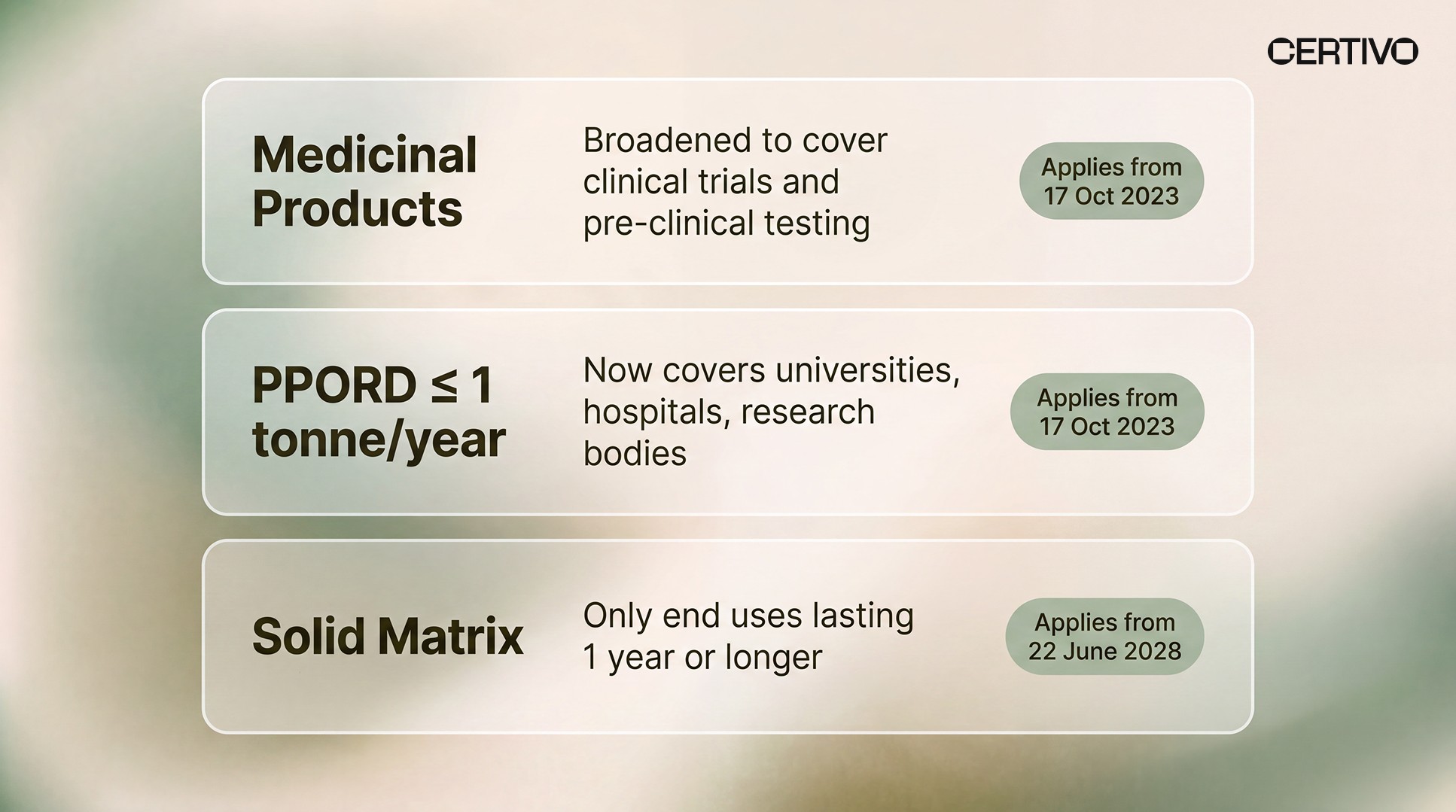
The amendment changes two paragraphs of Entry 78. Paragraph 4 (derogations) gains clarified and new points. Paragraph 5(c) (the solid matrix condition) is narrowed. Each change carries a different application date, which is the detail most compliance teams need to get right.
Expanded Medicinal Products Exemption
The derogation in paragraph 4(b) previously covered medicinal products for human and veterinary use, but its wording did not clearly capture products used in clinical trials or in the pre-clinical safety testing that precedes them, such as analytical, toxicological, stability, and batch-release testing. The amendment aligns the wording with the original intent so that all medicinal products used in clinical trials and related pre-clinical testing fall within the derogation. This point applies retroactively from 17 October 2023.
New PPORD Derogation
The Commission had intended to exempt synthetic polymer microparticles used in Product and Process Orientated Research and Development (PPORD), as defined in Article 3(22) of REACH, in quantities of one tonne per year or less. The original Entry 78 assumed PPORD would always occur at industrial sites. In practice it also takes place in hospitals, universities, and public research institutions, which the existing industrial-site derogation did not cover. A new point 4(g) closes that gap. This derogation also applies retroactively from 17 October 2023.
Narrowed Solid Matrix Exemption
Paragraph 5(c) exempted synthetic polymer microparticles permanently enclosed in a solid matrix during end use, on the basis that releases are minimised. The amendment clarifies that this only applies where the intended end use lasts one year or longer. Short-lived uses, where the matrix is frequently removed or replaced, no longer qualify. This is the only change with a future deadline: it applies from 22 June 2028, giving stakeholders two years to reformulate products or dispose of existing stock.
REACH microplastics restriction 2026 three amendments to Annex XVII Entry 78
Click on image to view full
What Has Not Changed
It is as important to confirm what the amendment leaves untouched. Manufacturers can avoid unnecessary rework by noting that the following remain in force exactly as before.
Element | Status |
|---|---|
0.01% concentration threshold (by weight) | ✓ Unchanged |
Core microplastics restriction under Entry 78 | ✓ Unchanged |
Annual ECHA emission reporting | ✓ Unchanged |
Information and labelling obligations | ✓ Unchanged |
Other Entry 78 derogations and transitional deferrals (4 to 12 years by product) | ✓ Unchanged |
The base restriction and its phased bans on categories such as rinse-off cosmetics, detergents, and agricultural products continue on their original timelines. For the wider reporting picture, our companion analysis on the EU microplastics reporting and reformulation requirements covers the annual ECHA obligations in detail.
Compliance Timeline and Key Dates
Milestone | Date |
|---|---|
Regulation adopted | 1 June 2026 |
Published in Official Journal | 2 June 2026 |
Entry into force (20th day after publication) | 22 June 2026 |
Medicinal products and PPORD derogations apply (retroactive) | 17 October 2023 |
Narrowed solid matrix exemption applies | 22 June 2028 |
The retroactive dates give pharmaceutical and research organisations legal certainty backdated to the start of the restriction. The one date that requires forward action is 22 June 2028.
EU microplastics restriction 2026 REACH Entry 78 compliance timeline for manufacturers
Click on image to view full

Which Industries and Products Are Affected
Entry 78 is a horizontal restriction, so any product intentionally containing synthetic polymer microparticles is potentially in scope. Based on the sectors that most commonly rely on the affected derogations, the following industries should review their portfolios:
🏭 Cosmetics and personal care — historically the highest-profile category under the microplastics restriction.
🏭 Construction and building materials — infill, coatings, and matrix-bound polymer applications.
🏭 Electronics and electrical equipment — encapsulants and polymer composites.
🏭 Automotive — coatings, sealants, and composite components.
🏭 Toys, juvenile products, and PPE — consumer-facing articles with polymer content.
🏭 Pharmaceutical and life sciences — direct beneficiaries of the broadened medicinal products derogation.
🏭 Universities, hospitals, and public research bodies — now explicitly covered by the PPORD derogation.
Teams managing multiple sectors can consolidate this analysis through a single materials and environmental compliance workflow rather than assessing each product line in isolation.
Why the Solid Matrix Exemption Is the Real Compliance Trigger
For most manufacturers, the medicinal and PPORD changes are favourable and require no action. The solid matrix narrowing is different. To know whether a product is affected, a compliance team has to answer two questions for every affected SKU: does the product contain synthetic polymer microparticles permanently incorporated into a solid matrix, and is the intended end use foreseen to last one year or longer.
That is a bill-of-materials and product-lifecycle question, not a legal one. Answering it at portfolio scale is where the chemical and hazmat compliance burden actually falls. Reliable BOM-level material mapping lets teams filter thousands of parts down to the specific items where a short intended end use removes the derogation after 22 June 2028.
This is also a classic exemption and sunset-date management problem. The derogation you rely on today expires for certain uses on a fixed future date, and that dependency has to be tracked against each product until reformulation is confirmed.
Compliance Risks and Enforcement Exposure
REACH restrictions are enforced by Member State authorities through market surveillance, supported by ECHA. Placing a non-compliant product on the EU market after an applicable date can lead to withdrawal from the market, corrective action, and penalties defined at national level. The practical risks for this amendment are concentrated in a few areas.
⚠️ Loss of a relied-upon derogation. Products using the solid matrix exemption for short-duration uses lose it in 2028 without a reformulation plan.
⚠️ Undetected exposure. Synthetic polymer microparticles sitting in sub-tier components may not be visible without supplier declarations mapped to the BOM.
📄 Weak evidence trails. During a customer audit or an ECHA-supported market surveillance inspection, teams need point-in-time evidence of which derogation applied to which product and when.
No software makes a company audit-proof. The realistic objective is audit readiness: reducing surprises and shortening the time it takes to assemble an evidence pack. Distinguishing customer audits (OEM-driven), regulatory inspections, and certification audits under schemes such as ISO 14001 helps teams prepare the right documentation for each. Continuous audit-ready documentation with time-stamped declarations and historic state tracking is what turns a surveillance request into a routine retrieval.
How to Prepare Before 22 June 2028
The action list is short and specific. Two years is enough time if the work starts from an accurate BOM inventory rather than a blank page.
📌 Review BOMs for products containing synthetic polymer microparticles at or above 0.01% by weight.
⚠️ Identify which of those products currently rely on the solid matrix exemption.
⏳ For each, assess whether the intended end use lasts one year or longer.
🔗 Confirm supplier data supports each determination, closing gaps through supplier outreach.
📄 Continue meeting existing ECHA reporting and labelling obligations without interruption.
🤖 Verify that clinical trial, pre-clinical, and PPORD activities qualify under the broadened derogations.
📌 Update internal compliance records to reference Regulation (EU) 2026/1168 and the 22 June 2028 application date.
REACH microplastics solid matrix exemption compliance decision flow for manufacturers
Click on image to view full

Managing REACH Microplastics Compliance With AI
A one-line legal change like "one year or longer" is easy to read and hard to action across a global product portfolio. The gap between the two is where AI-native compliance automation earns its place. The work is less about interpreting the regulation and more about connecting it to the right products and suppliers, then keeping that connection current as regulations shift.
Certivo functions as the compliance data backbone for this. CORA-powered regulatory intelligence maps a change such as Regulation (EU) 2026/1168 to the specific substances and product categories it touches, so teams see which SKUs are implicated rather than reading a legal notice in isolation. CORA-enabled analysis of supplier declarations, certificates, and mill test reports extracts substance data and flags where evidence is missing, reducing manual data entry when working through hundreds of supplier documents.
For teams asking how to track substance thresholds across BOMs, monitor global chemical regulations, and manage exemption sunset dates in one system, this is the core value. Automated supplier data collection and structured supplier portals replace email chains, while proactive compliance risk management shifts the posture from reactive filing toward continuous readiness across REACH, RoHS, PFAS, and POPs.
Executive Conclusion
Commission Regulation (EU) 2026/1168 is a targeted clarification of the EU microplastics restriction, not a new framework. Two of its three changes are favourable and retroactive. The one that demands attention is the narrowed solid matrix exemption applying from 22 June 2028. The manufacturers who manage this well will be those who already know where synthetic polymer microparticles sit in their bill of materials and how long each end use lasts, because that inventory converts a single sentence of legal text into a finite, product-specific action list.
The reliable path is a centralised compliance data backbone that maps regulatory change to products, automates supplier evidence collection, and keeps audit-ready records against each SKU. That is how a change like this becomes a scheduled task rather than a scramble.
To understand your exposure to the REACH microplastics restriction across products and jurisdictions, request a compliance risk assessment or speak with a compliance specialist about mapping Entry 78 obligations to your BOMs.
Lavanya
Lavanya is an accomplished Product Compliance Engineer with over four years of expertise in global environmental and regulatory frameworks, including REACH, RoHS, Proposition 65, POPs, TSCA, PFAS, CMRT, FMD, and IMDS. A graduate in Chemical Engineering from the KLE Institute, she combines strong technical knowledge with practical compliance management skills across diverse and complex product portfolios.
She has extensive experience in product compliance engineering, ensuring that materials, components, and finished goods consistently meet evolving international regulatory requirements. Her expertise spans BOM analysis, material risk assessments, supplier declaration management, and test report validation to guarantee conformity. Lavanya also plays a key role in design-for-compliance initiatives, guiding engineering teams on regulatory considerations early in the product lifecycle to reduce risks and streamline market access.