


The EU PFHxA restriction is one of the first legally fixed PFAS deadlines that manufacturers must meet, and it arrives well ahead of the broader universal PFAS proposal. Adopted as Commission Regulation (EU) 2024/2462, it adds entry 79 to REACH Annex XVII and sets enforceable concentration limits on PFHxA, its salts, and PFHxA-related substances. The first consumer-product deadline lands on 10 October 2026. For any company placing textiles, footwear, food-contact packaging, cosmetics, or consumer mixtures on the EU market, this is a near-term obligation, not a future signal.
This guide explains what entry 79 requires, the exact thresholds, the staggered deadlines, and the supply-chain evidence you need to demonstrate conformity.
Key Takeaways
📌 The EU PFHxA restriction (Regulation (EU) 2024/2462) adds entry 79 to REACH Annex XVII and is already in force.
⏳ The first major consumer deadline is 10 October 2026; the full timeline runs from 10 April 2026 to 10 October 2029.
📊 Limits are 25 ppb for PFHxA and its salts (summed) and 1,000 ppb for PFHxA-related substances (summed), measured in homogeneous material.
🏭 Textiles, footwear, food-contact paper and board, cosmetics, consumer mixtures, and firefighting foams are directly affected.
🔗 PFHxA is a short-chain "C6" substance often used to replace banned PFOA, so a prior C6 switch is not evidence of compliance.
📄 Conformity depends on supplier declarations, test evidence, and BOM-level traceability at the homogeneous-material level.
What Regulation (EU) 2024/2462 Restricts
The European Commission adopted Regulation (EU) 2024/2462 on 19 September 2024. It was published in the Official Journal on 20 September 2024 and entered into force on 10 October 2024. The regulation creates entry 79 of REACH Annex XVII, restricting undecafluorohexanoic acid (PFHxA), its salts, and PFHxA-related substances. You can confirm the full legal text on EUR-Lex.
PFHxA is a short-chain per- and polyfluoroalkyl substance. Regulators restricted it because it is highly persistent, moves readily through water, and breaks down very slowly in the environment. PFHxA-related substances are covered because they degrade into PFHxA over time.
For manufacturers already tracking obligations under the broader REACH framework, entry 79 is a new restriction line that must be added to substance and threshold controls.
PFHxA Restriction Thresholds Explained
Entry 79 sets two concentration limits. A product in a restricted category may not be placed on the EU market, or used, at or above these levels.
Substance group | Limit | Measurement basis | Reason for inclusion |
|---|---|---|---|
PFHxA and its salts (summed) | ≥ 25 ppb prohibited | Homogeneous material | Highly persistent, mobile in water; risk to health and environment |
PFHxA-related substances (summed) | ≥ 1,000 ppb prohibited | Homogeneous material | Degrade into PFHxA in the environment |
Reference values: 25 ppb equals 0.025 mg/kg, and 1,000 ppb equals 1 mg/kg.
The measurement basis matters. Limits apply to homogeneous material, meaning the smallest individually separable material within a component, not the finished article as a whole. A coating, a lining, a laminate layer, or a printed surface is each assessed on its own. Teams that test at the article level rather than the homogeneous-material level can reach the wrong conclusion. This is exactly the kind of substance-level control that BOM substance and threshold management is built to handle.
PFHxA Compliance Deadlines: 2026 to 2029
Entry 79 phases in across four dates. Each date applies to specific product categories.
Effective date | Products covered |
|---|---|
10 April 2026 | Firefighting foams for training, testing, and public fire services |
10 October 2026 | Consumer clothing and related accessories, footwear, food-contact paper and board, consumer mixtures, cosmetics |
10 October 2027 | Consumer textiles, leather, furs, and hides in products other than clothing |
10 October 2029 | Firefighting foams and foam concentrates for civil aviation |
The 10 October 2026 date is the one most manufacturers of consumer goods need to plan for now. Because supplier testing, reformulation, and re-declaration cycles can take many months, the practical lead time is already short. Tracking these dates against your own product portfolio is a core use case for continuous compliance monitoring.
PFHxA restriction compliance deadlines timeline from 2026 to 2029 for manufacturers
Click on image to view full

Which Products and Industries Are in Scope
The restriction reaches a wide set of consumer-facing sectors. Based on the regulation's product categories, the most directly affected are:
🏭 Textiles, apparel, and footwear: Consumer clothing and accessories made of textiles, leather, fur, or hides, and footwear. Other consumer textiles follow from October 2027.
🏭 Food packaging: Paper and cardboard that contacts food.
🏭 Consumer products and chemicals: Mixtures sold to the public, such as cleaning, waterproofing, and care products.
🏭 Cosmetics and personal care: All cosmetic products.
🏭 Firefighting and aviation: Firefighting foams for training, testing, public fire services, and civil aviation.
Manufacturers in consumer goods and electronics manufacturing should note that PFHxA chemistry is used as a water and stain repellent across many component types, so scope often extends deeper into the bill of materials than expected. This connects entry 79 to the wider set of PFAS obligations manufacturers now face across jurisdictions.
Exemptions Under Entry 79
The regulation provides derogations for defined categories. Based on currently available regulatory guidance, the main product exemptions are:
Category III personal protective equipment (PPE) governed by Regulation (EU) 2016/425
Medical devices, including in-vitro diagnostic and implantable devices, under the applicable EU device regulations
Construction textiles
A derogation is not automatic. To rely on one, a manufacturer needs documented evidence that the product genuinely falls within the exempt category. Teams should confirm eligibility against the legal text on EUR-Lex and retain that determination as part of their audit-ready documentation.
Why a Prior "C6" Switch Is Not Compliance
Many manufacturers moved from long-chain PFAS such as PFOA to shorter-chain "C6" chemistry years ago, believing it resolved their PFAS exposure. Entry 79 targets exactly that C6 substitute. PFHxA is frequently used as a replacement for already-banned PFOA, which is why the Commission acted.
The practical implication for leadership is direct. A past reformulation does not demonstrate conformity with the 25 ppb limit. Only current, substance-level evidence tied to the specific materials in each product does. Compliance, quality, and sourcing teams should treat "we already switched to C6" as a prompt to test and verify, not as a closed question. This is where PFAS and chemical risk management at the material level replaces assumptions with evidence.
Supply Chain and Documentation Impact
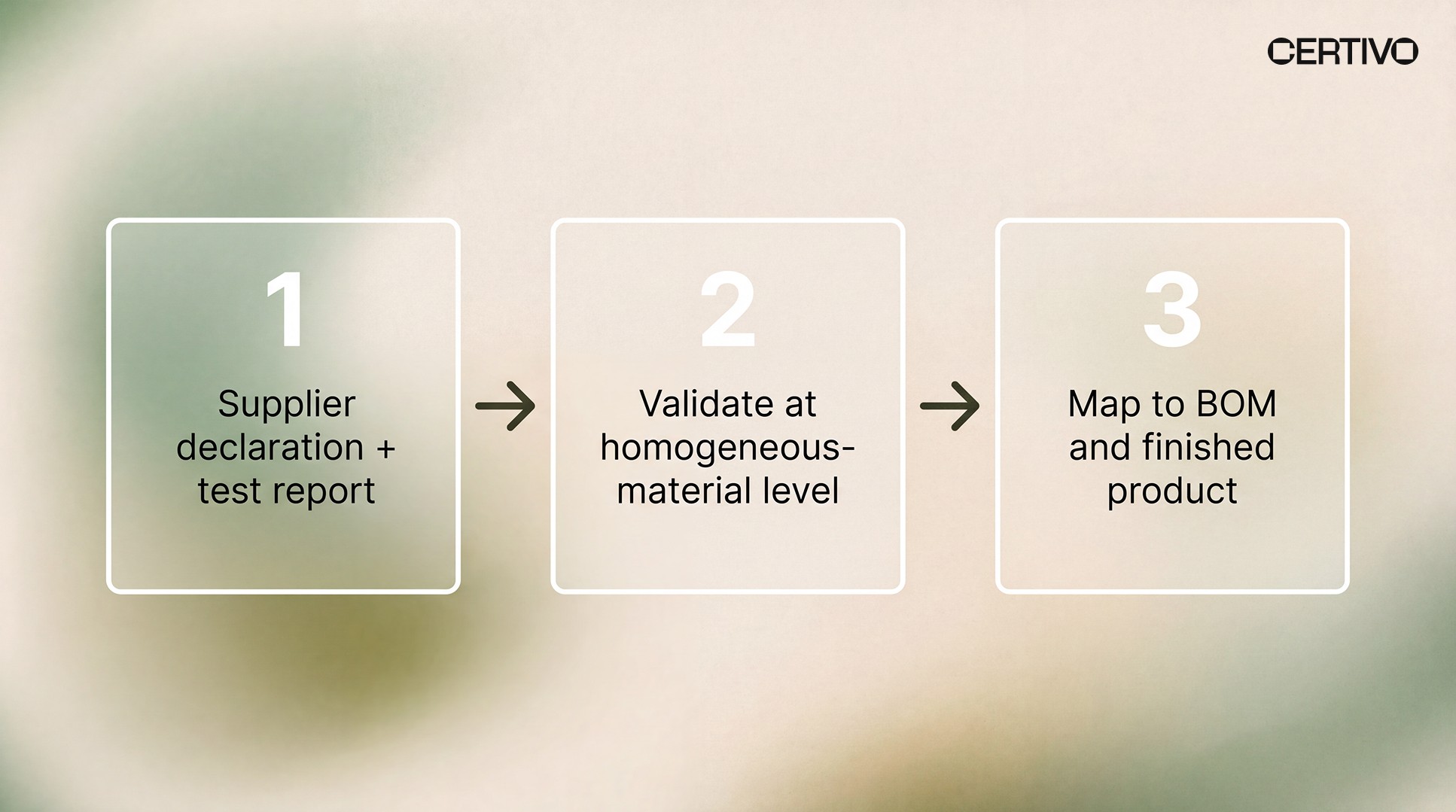
Demonstrating conformity with the EU PFHxA restriction is fundamentally a data problem. The obligation sits with the company placing the product on the market, but the evidence lives across many suppliers and tiers.
For most manufacturers this means:
Collecting updated material declarations and test reports from suppliers
Confirming results are reported against the correct homogeneous material
Mapping PFHxA and PFHxA-related substances to specific parts and finished products
Maintaining time-stamped evidence for market surveillance and customer audits
Manual spreadsheet and email workflows struggle at this scale, especially across multi-tier suppliers. Automated supplier data collection and multi-tier supply-chain transparency are what make the evidence trail defensible. A centralized supplier and contractor management approach keeps declarations current as the 2026 and 2027 dates approach.
PFHxA restriction supplier evidence and BOM traceability workflow for compliance teams
Click on image to view full
Enforcement and Compliance Risk Exposure
REACH restrictions are enforced by member-state authorities through market surveillance. A restricted product placed on the EU market at or above the entry 79 limits can face withdrawal, recall, and penalties defined under national law, alongside customer-driven consequences such as delisting and blocked shipments.
The executive risk is broader than fines. For a CFO, the exposure includes reformulation cost, inventory write-offs, and delayed launches. For supply-chain and quality leaders, it includes shipment holds when a customer requests PFHxA evidence that cannot be produced quickly. Reducing that exposure depends on visibility into which finished products contain a restricted substance and on the ability to retrieve evidence on demand. That is the core value of a centralized compliance data backbone and consistent REACH SVHC and Annex XVII change tracking.
PFHxA Compliance Checklist
Compliance and regulatory teams can use the following steps to prepare for the entry 79 deadlines:
Confirm scope. Identify which of your product lines fall into the categories restricted on 10 April 2026, 10 October 2026, 10 October 2027, and 10 October 2029.
Build the substance profile. Add PFHxA, its salts, and PFHxA-related substances to your restricted-substance list with the 25 ppb and 1,000 ppb thresholds.
Test at the right level. Ensure supplier and laboratory data reports concentrations in homogeneous material.
Re-verify past C6 switches. Request current evidence rather than relying on historical reformulation claims.
Collect supplier declarations. Issue updated data requests and validate returned documents for completeness and authenticity.
Map to the BOM. Link substance data to parts, sub-assemblies, and finished goods for BOM-level compliance intelligence.
Confirm exemptions. Document eligibility for any Category III PPE, medical device, or construction-textile derogation.
Retain audit evidence. Keep time-stamped declarations and test reports ready for market surveillance and customer audits.
Request a compliance risk assessment to map your PFHxA exposure across products and suppliers before the October 2026 deadline.
How AI Automates PFHxA Compliance
The volume of PFHxA evidence, combined with the homogeneous-material testing requirement and multi-tier sourcing, makes manual management difficult to sustain. This is where AI-native compliance automation changes the workload.
Certivo acts as the system of record for product compliance, holding supplier declarations, test reports, and substance data in one place. CORA, its embedded regulatory intelligence, supports this work in three ways:
AI document parsing and certificate validation: CORA-enabled analysis extracts substance and concentration data from supplier documents and flags gaps or inconsistencies.
CORA-powered regulatory intelligence: Entry 79 thresholds and dates are tracked against your product portfolio, so changes surface early rather than at audit.
BOM-level material mapping: Substance data is connected to specific products, so teams can answer "which products contain PFHxA above the limit" quickly.
The goal is not to eliminate compliance risk. It is to reduce surprises, shorten evidence-retrieval time, and move from reactive checks toward continuous, audit-ready readiness.
Conclusion
The EU PFHxA restriction is an early, firm PFAS deadline with real commercial consequences. Entry 79 of REACH Annex XVII sets a 25 ppb limit for PFHxA and its salts, applies across textiles, footwear, food-contact packaging, cosmetics, and consumer mixtures, and begins to bite on 10 October 2026. Manufacturers that treat it as a data and evidence problem, and that verify rather than assume, will be positioned to keep products on the EU market without disruption.
Certivo helps global manufacturers manage the PFHxA restriction alongside the wider PFAS and REACH landscape, from supplier data collection to BOM-level traceability and audit-ready evidence.
Request a Compliance Review to see how Certivo automates PFHxA and REACH compliance across your product portfolio and supply chain.
Lavanya
Lavanya is an accomplished Product Compliance Engineer with over four years of expertise in global environmental and regulatory frameworks, including REACH, RoHS, Proposition 65, POPs, TSCA, PFAS, CMRT, FMD, and IMDS. A graduate in Chemical Engineering from the KLE Institute, she combines strong technical knowledge with practical compliance management skills across diverse and complex product portfolios.
She has extensive experience in product compliance engineering, ensuring that materials, components, and finished goods consistently meet evolving international regulatory requirements. Her expertise spans BOM analysis, material risk assessments, supplier declaration management, and test report validation to guarantee conformity. Lavanya also plays a key role in design-for-compliance initiatives, guiding engineering teams on regulatory considerations early in the product lifecycle to reduce risks and streamline market access.
Her contributions further extend to compliance documentation, certification readiness, and preparation of customer deliverables, ensuring transparency and accuracy for global stakeholders. She is adept at leveraging compliance tools and databases to efficiently track regulatory changes and implement proactive risk mitigation strategies.