

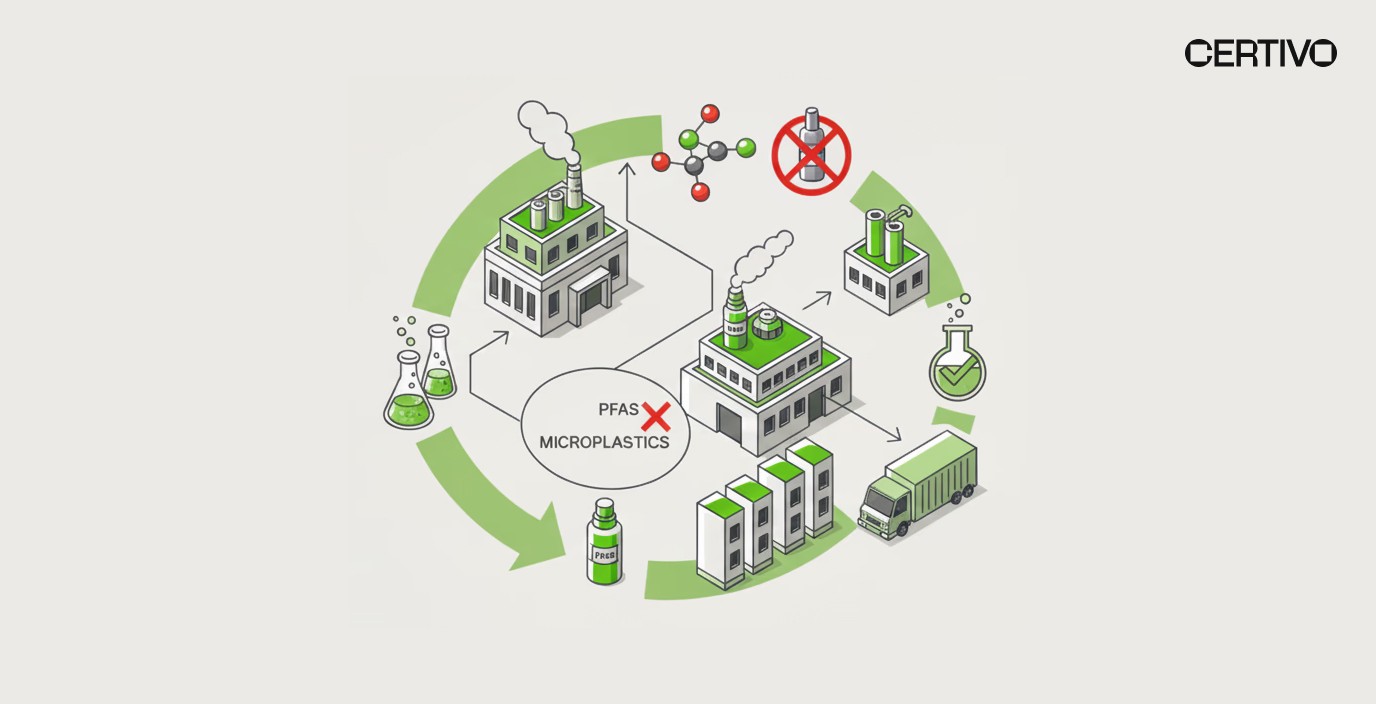
The global cosmetic regulations have never been static, but right now, they’re going through one of the most dramatic regulatory transitions in their history. Around the world, governments are rewriting safety rules that dictate what can or cannot appear in your favourite skincare, makeup, and personal-care products. Between PFAS bans, microplastic phaseouts, and sweeping ingredient restrictions coming from the EU, U.S., and APAC markets, the entire sector is being pushed into a new era of transparency and accountability. For brands tracking EU cosmetics regulation news today around PFAS bans and microplastic restrictions, the pace of change has accelerated to the point where manual regulatory monitoring is no longer viable—compliance teams need automated, always-current intelligence to stay ahead of enforcement timelines.
Brands that saw compliance as a “checklist exercise” just a few years ago now face enforcement actions, shorter implementation timelines, and far more complex supply-chain documentation requirements. And while consumers continue demanding cleaner, safer ingredients, regulators are moving quickly to make those demands legally enforceable.
This shift isn’t minor. It’s reshaping product development, formulation strategy, global distribution, and competitive positioning. For many companies, staying ahead of regulatory change is becoming just as important as marketing, innovation, and R&D. Cosmetics compliance is no longer a back-office function—it's a strategic capability that directly impacts market access, brand credibility, and the speed at which new products reach consumers across multiple jurisdictions.
A Turning Point for Global Cosmetic Regulations Oversight
The conversation around cosmetic ingredient regulations has intensified because more countries are adopting risk-based assessments rather than the older reactionary model. Instead of responding to consumer pressure long after problems arise, regulators are now actively monitoring emerging science and potential harm.
Look at the recent reforms in the U.S.:
The Modernization of Cosmetics Regulation Act (MoCRA) created sweeping new safety requirements for manufacturers, including detailed safety substantiation and mandatory adverse-event recordkeeping. The EU, meanwhile, continues to expand its already strict ingredient lists through amendments to Annex II (banned substances) and Annex III (restricted substances). Canada and South Korea have followed with their own updates, adding additional preservatives, fragrances, and colorants to their restriction lists.
And because these changes roll out at different times, companies distributing globally must constantly compare requirements across markets. That process, once handled manually, now demands structured workflows and scalable tools designed for global cosmetic compliance, especially because ingredients approved in one region may be restricted in another.
Regulatory intelligence and horizon scanning capabilities are essential for cosmetics brands operating across multiple markets—CORA, Certivo's AI agent, continuously monitors legislative updates, ingredient list amendments, and enforcement timeline changes across EU, US, APAC, and Canadian regulatory bodies, surfacing only the changes that directly affect your formulations and product portfolio.
Across the board, governments are elevating cosmetic safety standards, not just in terms of which ingredients are allowed but also how they’re tested, sourced, and reported in supply-chain documentation.
PFAS: The Most Urgent Ingredient Crackdown
PFAS often called “forever chemicals” sit at the heart of today’s regulatory storm. In cosmetics, PFAS have been used for years to create smoother textures, waterproof properties, and longer-lasting formulas. But toxicity concerns have pushed regulators worldwide to move from monitoring to outright banning. The latest cosmetics regulation news today confirms that PFAS enforcement is accelerating simultaneously across multiple jurisdictions—making centralized substance-level tracking a prerequisite for any brand selling into regulated markets.
Several U.S. states have already targeted these chemicals. California’s PFAS ban for cosmetics takes effect in phases, with other states modeling their legislation around the same standards. Europe is considering continent-wide restrictions that could eliminate thousands of PFAS variants from cosmetic applications.
These emerging policies fall directly under the expanding umbrella of PFAS restrictions cosmetics, which have gained momentum because scientific research continues to link PFAS exposure to endocrine disruption, immune interference, and long-term environmental persistence.
PFAS & chemicals risk management in the cosmetics sector demands substance-level visibility across every formulation and raw material—identifying not just intentionally added PFAS but also trace-level contamination from processing aids, recycled content, and upstream supplier materials that may carry fluorinated compounds below traditional disclosure thresholds. For a comprehensive breakdown of global PFAS enforcement timelines and threshold requirements, Certivo's 2025–2026 PFAS compliance master guide for manufacturers provides the detailed regulatory roadmap cosmetics brands need.
Brands now face the difficult but necessary task of reformulating products, re-evaluating raw materials, validating replacements, and documenting suppliers’ compliance. It's no longer possible to rely on incomplete chemical declarations. Full disclosure is becoming mandatory.
Because global markets are implementing PFAS restrictions cosmetics at different speeds, multinational brands must juggle timelines, ingredient verification processes, and very different national reporting structures. Brands searching for the latest pfas cosmetics ban news today should note that ECHA's restriction dossier is advancing through committee opinions, with binding EU-wide enforcement potentially taking effect as early as 2026—creating a compliance deadline that affects every cosmetic product containing fluorinated ingredients sold in European markets.
Microplastics: A New Environmental Hotspot in Global Cosmetic Regulations
Microplastics have long been present in exfoliating scrubs, glitter cosmetics, and thickening agents, but science has now shown that these tiny particles accumulate in oceans, enter food chains, and disrupt ecosystems. That’s why policymakers are moving from voluntary reductions to strict, enforceable bans.
In 2023, the EU passed sweeping measures that began phasing out intentionally added microplastics in cosmetics, with specific deadlines depending on product category. Other countries—including Canada, the U.K., and Japan—are introducing their own restrictions.
These bans fall under the broader category known as microplastic ban cosmetics, a term that’s becoming a central part of regulatory language and industry planning. Manufacturers must now re-engineer formulas that once relied on microplastic beads or polymers to create smooth textures, gentle exfoliation, and product stability.
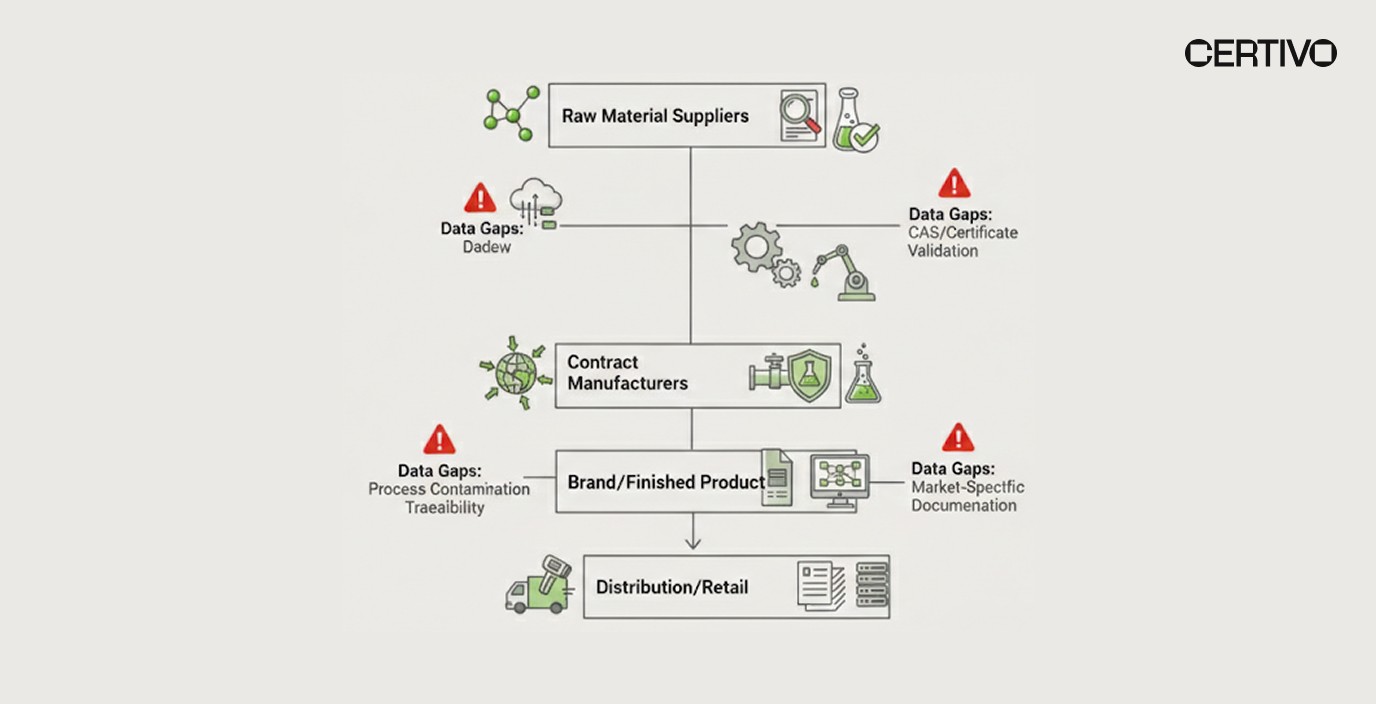
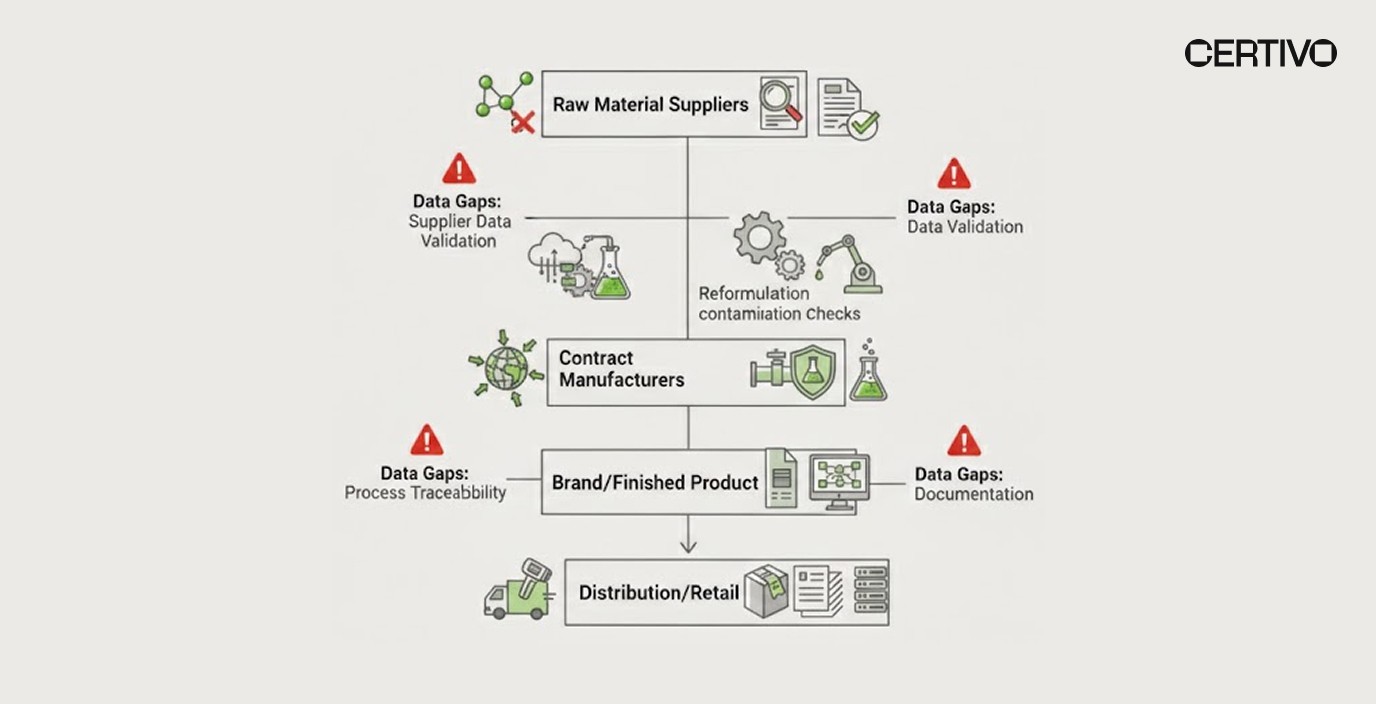
Beyond product reformulation, companies must also evaluate upstream impacts. Suppliers will need to certify microplastic-free ingredient sets. Packaging and labeling may change. Export documents may shift to include microplastic declarations. Every part of the supply chain gets touched when governments adopt a microplastic ban cosmetics strategy. Managing compliance in the cosmetic supply chain during these transitions requires multi-tier supply chain transparency—ensuring that raw material suppliers, contract manufacturers, and ingredient intermediaries all provide verifiable declarations of microplastic-free status, not just at Tier 1 but through every layer where polymer-based additives may be introduced.
The companies that manage this transition smoothly are the ones investing in ingredient transparency platforms, sustainability-driven reformulation R&D, and compliance tracking tools that adjust to evolving environmental rules.
The New Wave of Ingredient Bans and Restrictions
Beyond PFAS and microplastics, global authorities are now banning or restricting dozens of other ingredients—from allergenic fragrances to color additives and UV filters. Staying current with skincare ingredient regulation news today is essential—the velocity of new ingredient restrictions has increased dramatically, with amendments to banned and restricted substance lists occurring multiple times per year across EU, US, and APAC regulatory bodies.
China's updated Safety and Technical Standards for Cosmetics include new test requirements and revised ingredient guidelines. The EU continues to expand its annexes around known or suspected endocrine disruptors. The U.S. is still refining MoCRA-related implementation timelines, but regulators have signaled that more ingredient reviews are underway.
This regulatory tightening ultimately raises cosmetic safety standards worldwide, but it also forces companies to rethink how they design products. Instead of creating formulas first and checking compliance later, modern workflows demand front-loaded regulatory involvement, where compliance teams guide R&D from the start.
Design-for-compliance PLM workflows embed regulatory screening directly into the product development process—enabling R&D teams to evaluate ingredient safety, regional restrictions, and upcoming legislative deadlines before formulations are finalized, eliminating the costly cycle of developing products that fail regulatory review at the market entry stage.
Ingredient-sourcing practices are also under pressure. That’s because cosmetic ingredient regulations are converging with environmental, human rights, and sustainability frameworks. For example:
Certain pigments must now meet heavy-metal limits.
Fragrance allergens require explicit labeling in some regions.
Preservatives face stricter concentration and usage caps.
Sunscreen filters undergo environmental-impact testing tied to coral-reef safety.
These shifts not only affect what goes into products but also how long they can stay on the market before reformulation becomes mandatory.
A More Complex Landscape for Global Distribution
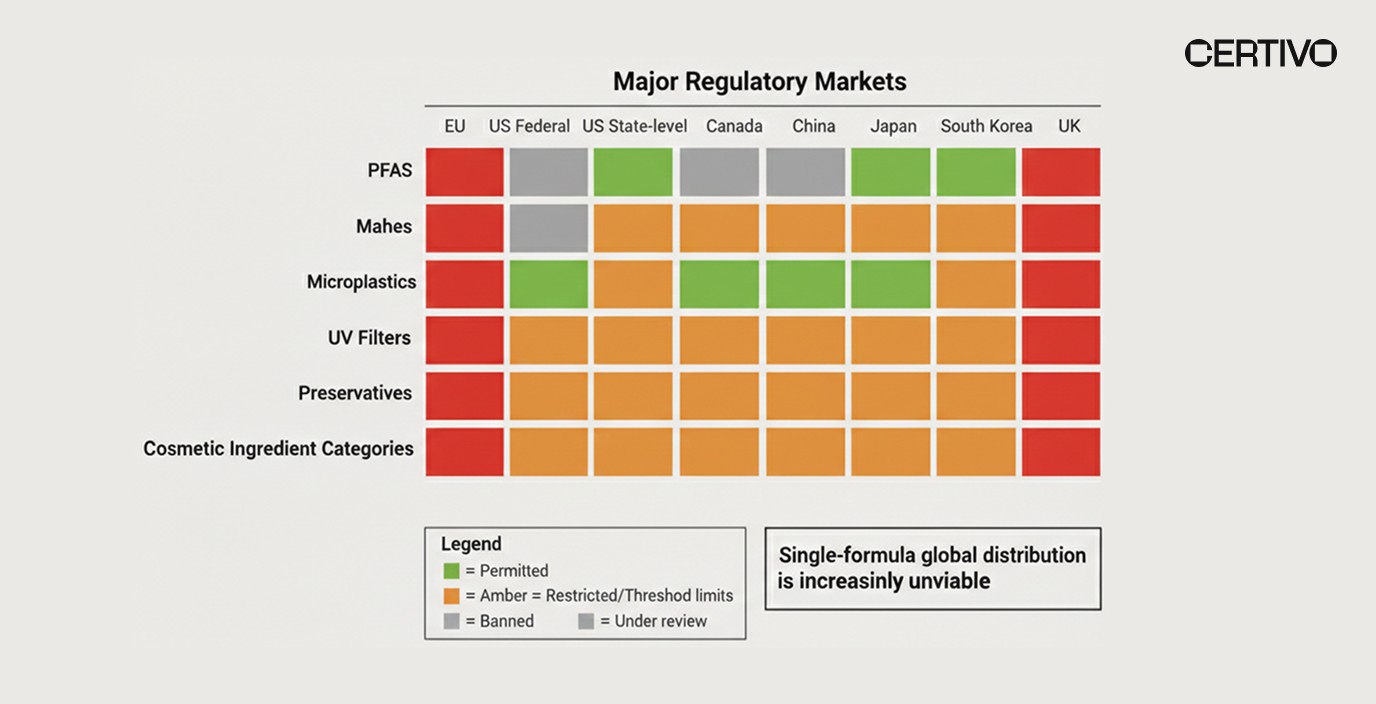
For decades, companies could create a single formulation and distribute it across continents. Today, that playbook is nearly impossible. A product compliant with U.S. regulations may violate EU ingredient listings. A formula that meets Japan’s standards may face revisions to enter Canada. And even within the U.S., state-level actions create fragmentation.
This is why global cosmetic compliance is now a strategic priority, not just a regulatory requirement. Companies that treat compliance as a one-time checklist eventually stumble, whether during audits, through customs checks, or via public recalls.
Multinational brands now rely heavily on digital compliance tools that track evolving regulations, flag ingredient conflicts across markets, and automate documentation workflows for suppliers. Without these systems, staying ahead of regulatory shifts becomes nearly impossible.
More companies are also mapping their chemical inventories, testing supply-chain traceability, and building compliance dashboards that integrate with product lifecycle management systems. This reduces regulatory risk during expansion and simplifies future reformulations. Cosmetics regulatory compliance software that integrates substance-level data with PLM and ERP systems through an integrated compliance thread ensures that formulation decisions, procurement actions, and market-entry documentation remain synchronized—eliminating the disconnects that cause last-minute compliance failures during product launches.
How Brands Are Adapting to the New Rules
The companies succeeding today have restructured their regulatory strategies around three core principles:
1. Reformulating for Long-Term Viability
Instead of making quick ingredient swaps, R&D teams are investing in sustainable alternatives that will remain compliant for years—even as bans expand. Many are reducing reliance on synthetic polymers, fluorinated compounds, and environmentally persistent chemicals.
2. Increasing Supplier Audits and Transparency
Suppliers are now expected to provide detailed chemical composition data, absence declarations, sustainability documentation, and test results. Because stricter cosmetic safety standards require deeper verification, companies can no longer rely on vague spec sheets or partial disclosures.
Standardized supplier questionnaire frameworks ensure that every raw material supplier and contract manufacturer receives consistent, CAS-level data requests—with clear instructions on PFAS absence declarations, microplastic certifications, and heavy-metal threshold documentation—regardless of their size, region, or position in the supply chain. Centralized supplier self-service portals accelerate this process by enabling suppliers to upload declarations, certifications, and test reports directly into a single system, eliminating the email-based document chase that delays compliance verification across complex cosmetics supply chains.
3. Implementing Proactive Compliance Tech
Digital platforms built around global cosmetic compliance help teams track changing legislation, compare requirements across markets, and compile regulatory documents automatically. This shift reduces manual checking and future-proofs operations.
With regulators moving faster than ever, brands that rely only on spreadsheets will fall behind.
For cosmetics companies evaluating technology options, Certivo's guide on AI tools for compliance management provides a comprehensive comparison of platform capabilities for substance tracking, supplier data collection, and multi-market regulatory monitoring.
What the Next Five Years Will Bring
Looking ahead, regulatory momentum isn’t slowing. Expect expansions in:
Microplastic restrictions tied to environmental legislation
Broader definitions of “harmful chemicals.”
Green-washing laws targeting marketing claims
Pre-market safety substantiation requirements in more countries
Tighter cosmetic ingredient regulations surrounding allergens and sensitizers
These changes will influence not only formulations but also how companies communicate with consumers, label products, verify supply chains, and prepare for audits. Maintaining continuous audit-ready documentation across every product line and market ensures that brands can respond to regulatory inquiries, customs audits, and retailer compliance requests without scrambling—a capability that separates market leaders from brands that lose shelf space due to preventable compliance gaps.
The cosmetics industry is entering an era in which transparency is the norm and ingredient accountability is non-negotiable. Companies that prepare now—through reformulation, supplier engagement, and technology adoption—will gain a competitive edge.
Certivo For Cosmetics
In an industry where regulations shift constantly — PFAS bans, microplastic restrictions, evolving ingredient lists — Certivo serves as the system of record for cosmetics compliance, giving brands a practical way to stay ahead. It doesn't just track rules; CORA, Certivo's AI agent, functions as an embedded regulatory intelligence layer that pulls global updates into one place and translates them into clear, actionable steps your team can use immediately. Because the platform functions as both an intelligence engine and a workflow tool, it brings together R&D, procurement, and safety teams with remarkable efficiency.
When your formulators begin testing new concepts, Certivo's substance database, powered by CORA-driven compliance intelligence, enables real-time checking of ingredient safety, regional restrictions, and upcoming legislative deadlines. That means you reduce guesswork and stop wasting time on formulas that won’t pass regulatory review. It also ensures your team isn’t caught off guard by sudden changes, especially as global bans target PFAS, microplastics, or other high-risk substances.
Certivo strengthens supply-chain oversight, too. The system tracks supplier documents, declarations, and compliance evidence across regions. Instead of chasing emails, CORA intelligence automates supplier data collection and highlights missing certificates, outdated documents, or risky materials long before they become a real problem. This improved visibility is crucial for companies preparing for tighter environmental reporting demands worldwide.
The platform’s workflow tools support AI-driven compliance automation, reducing manual steps that normally drain time. Tasks like ingredient validation, document reminders, and global regulatory comparisons happen instantly. And during audits, Certivo gives teams fast access to batch records, safety substantiation, and supplier compliance history — the kind of readiness that protects brands from delays or penalties.
Cosmetics brands navigating the intersection of PFAS restrictions, microplastic bans, and broader ingredient reforms can explore Certivo's dedicated cosmetics industry compliance solutions for a detailed overview of how the platform supports multi-framework cosmetics regulatory compliance at scale.
Ultimately, Certivo brings consistency and clarity to a chaotic regulatory landscape. With its blend of smart data, CORA-powered regulatory intelligence, and intelligent workflows that shift cosmetics compliance from reactive scramble to continuous readiness, cosmetic companies can innovate confidently and launch products without hesitation — even in the face of fast-changing global rules.
FAQs:
1. Why are PFAS being phased out of cosmetics worldwide?
PFAS — often called “forever chemicals” — don’t break down easily in the environment or the human body. Several studies have linked long-term PFAS exposure to health concerns such as hormonal disruption and immune system impacts. Because of this, regulators in the EU, US, Canada, and parts of Asia are moving toward strict limits or outright bans. Many beauty brands are now reformulating products to avoid future compliance issues and to meet rising consumer transparency expectations.
2. What is happening with microplastics regulations in cosmetics?
Microplastics have been under regulatory pressure for nearly a decade, but the newest wave of rules targets not just exfoliating beads — it targets any intentionally added microplastic polymer. The EU’s updated Microplastics Restriction under REACH requires brands to remove microplastics from rinse-off and, later, leave-on products. Other countries, including the UK, South Korea, and Australia, have announced similar timelines. These changes force manufacturers to find biodegradable or naturally derived alternatives.
3. Which cosmetic ingredients are most likely to face bans next?
Beyond PFAS and microplastics, the next regulatory targets include:
Certain preservatives (like formaldehyde releasers)
Endocrine-disrupting UV filters
Fragrance allergens
Specific colorants and hair dye chemicals
Regulators are increasingly relying on new hazard-based assessments, meaning even long-approved ingredients can be pulled from the market quickly.
4. How are U.S. regulations changing compared to the EU?
Historically, the U.S. has taken a slower approach to cosmetic regulation. But with the MoCRA (Modernization of Cosmetics Regulation Act) rollout, manufacturers must now meet stricter requirements around product safety, facility registration, adverse event reporting, and recordkeeping. While MoCRA doesn’t fully mirror EU rules, it signals a major shift toward global regulatory alignment. As PFAS and microplastics become political priorities, more U.S. updates are expected.
5. How do global bans affect cosmetic ingredient sourcing and formulation?
Supply chains are being rewritten. If an ingredient is banned or restricted in one major market — especially the EU — most brands simply remove it globally to avoid producing multiple versions of the same product. This means:
Suppliers must reformulate raw materials
Manufacturers must secure alternative ingredients
Quality and performance testing timelines become longer
Overall, compliance is now influencing product development from the earliest stages of R&D.
Lavanya
Lavanya is an accomplished Product Compliance Engineer with over four years of expertise in global environmental and regulatory frameworks, including REACH, RoHS, Proposition 65, POPs, TSCA, PFAS, CMRT, FMD, and IMDS. A graduate in Chemical Engineering from the KLE Institute, she combines strong technical knowledge with practical compliance management skills across diverse and complex product portfolios.
She has extensive experience in product compliance engineering, ensuring that materials, components, and finished goods consistently meet evolving international regulatory requirements. Her expertise spans BOM analysis, material risk assessments, supplier declaration management, and test report validation to guarantee conformity. Lavanya also plays a key role in design-for-compliance initiatives, guiding engineering teams on regulatory considerations early in the product lifecycle to reduce risks and streamline market access.
Her contributions further extend to compliance documentation, certification readiness, and preparation of customer deliverables, ensuring transparency and accuracy for global stakeholders. She is adept at leveraging compliance tools and databases to efficiently track regulatory changes and implement proactive risk mitigation strategies.
Recognized for her attention to detail, regulatory foresight, and collaborative approach, Lavanya contributes significantly to maintaining product compliance, safeguarding brand integrity, and advancing sustainability goals within dynamic, globally integrated manufacturing environments.