

Table of Contents
Executive Summary
Global PFAS Regulatory Timeline & Status
U.S. EPA PFAS Rules: The Technical Deep Dive
Global Regulatory Comparison
PFAS Drinking Water Standards by Jurisdiction
State-Level PFAS Bans: The Fragmented U.S. Landscape
Industry-Specific Impacts & Compliance Requirements
PFAS Testing Methods: From 537 to 537.1
Compliance Checklist & Action Steps
Future Trends & Pending Proposals
Resources & Interactive Tools
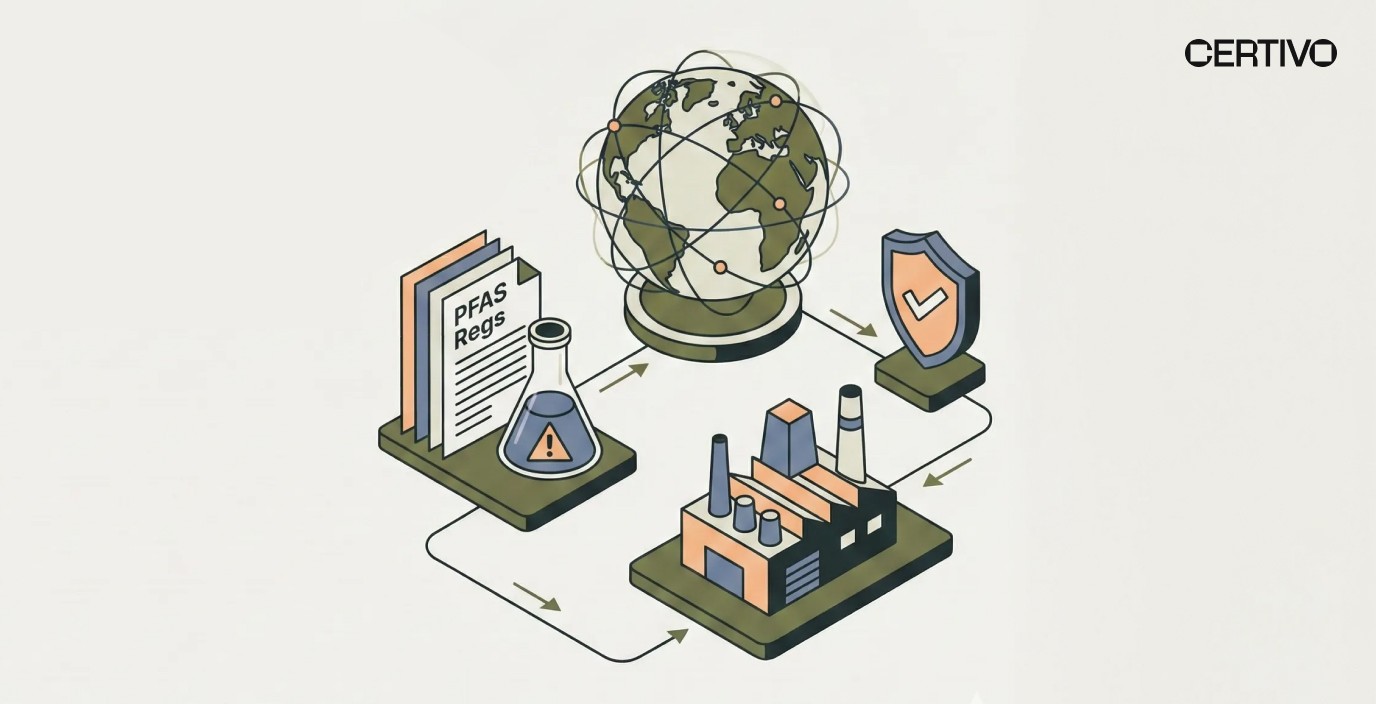
The global PFAS regulatory landscape has fundamentally shifted in 2025, driven by PFAS regulations 2025 and rapid policy acceleration worldwide. The U.S. EPA has finalized drinking water standards, released PFAS EPA 2025 final rules, extended TSCA reporting deadlines to April 2026, and is now proposing major revisions to the scope of reporting requirements in line with PFAS EPA rules. The EU is moving toward a near-total PFAS ban under REACH 2.0, while state-level bans in the U.S. are creating a fragmented patchwork that affects product access to markets like California, Minnesota, and Illinois—an environment that demands constant monitoring of global PFAS regulations update developments. Manufacturers must act immediately to comply with PFAS compliance 2025 obligations and evolving state-level mandates.
The global shift is also being accelerated by the latest PFAS drinking water standards, especially since the U.S. EPA has finalized enforceable limits under the National Primary Drinking Water Regulation. These PFAS drinking water standards have significant impacts on public water systems and industrial users globally. With multiple jurisdictions announcing stricter thresholds, organizations must track every global PFAS regulations update and adjust their supply chains to remain compliant. Many companies are now preparing early for April 2026 reporting and aligning with PFAS EPA rules requirements to avoid penalties under the PFAS EPA 2025 final rules framework.
As part of risk mitigation, manufacturers must also review remediation requirements linked to the latest PFAS drinking water standards and strengthen internal programs to meet PFAS compliance 2025 expectations. The urgency is driven by widespread regulatory tightening, and organizations should ensure readiness for both current and upcoming PFAS regulations 2025 obligations.
Global PFAS Regulatory Landscape Timeline & Status
Key Milestones
Milestone | Date | Status | Impact |
|---|---|---|---|
Canada CEPA Section 71 Reporting Deadline | January 29, 2025 | PASSED | Reporting should have been completed; non-compliance may result in penalties |
Minnesota PFAS Product Bans (11 categories) | January 1, 2025 | ACTIVE | Carpets, cookware, cosmetics, dental floss, fabric treatments, juvenile products, menstruation products, textile furnishings, ski wax, upholstered furniture, cleaning products |
California 100 ppm PFAS Textile Ban | January 1, 2025 | ACTIVE | All textiles and apparel with intentionally added PFAS above 100 ppm are prohibited |
Illinois PFAS Food Packaging Ban | January 1, 2025 | ACTIVE | Foam food containers, takeout packaging with intentionally added PFAS prohibited |
Oregon PFAS Foam Ban | January 1, 2025 | ACTIVE | Foam cups, takeout containers, and similar food packaging |
Washington Progressive PFAS Ban | December 31, 2024 (ongoing through 2025) | ACTIVE | Food-contact packaging must be PFAS-free; annual reporting for priority consumer products |
EPA TSCA PFAS Reporting Portal Opens | July 11, 2025 | COMPLETED | Portal is now operational; data submission window open |
EPA TSCA Reporting Deadline (Most Companies) | January 11, 2026 | APPROACHING | EXTENDED from original May 2025 deadline; compliance is critical |
EPA TSCA Reporting Deadline (Small Businesses) | July 11, 2026 | APPROACHING | Small businesses importing articles have additional 6-month window |
EPA Proposes TSCA Scope Changes | November 13, 2025 (Public Comment Through Dec 29, 2025) | ONGOING | EPA proposing to narrow reporting scope; final rule expected 2026 |
EU ECHA PFAS Restriction Proposal (Updated) | August 20, 2025 | IN REVIEW | Background Document published; sector-by-sector evaluation ongoing through 2026 |
EU Firefighting Foams Ban Effective Date | October 23, 2030 | FUTURE | Sales/use prohibition; transitional periods for specific applications through 2035 |
EPA MCL Compliance Deadline (PFOA/PFOS) | 2031 | FUTURE | Originally 2029; extended due to system readiness challenges |
Maine Full PFAS Ban | January 1, 2032 | FUTURE | Unless unavoidable use exemption granted; currently reviewing exemptions |
Minnesota Full PFAS Ban | January 1, 2032 | FUTURE | Phase 2 of Amara's Law; broader restrictions planned |
U.S. EPA PFAS Rules: The Technical Deep Dive
The TSCA PFAS Reporting Rule:
Effective Date: November 13, 2023
Revised Reporting Period: July 11, 2025 – January 11, 2026 (most companies); July 11, 2025 – July 11, 2026 (small businesses)
Scope: Covers 205 reportable PFAS chemicals
Who Must Report?
Mandatory reporters include:
Manufacturers of PFAS chemicals
Importers of PFAS-containing products (including finished goods, articles, mixtures)
Processors of PFAS-containing materials
Key expansion: The rule applies to "articles" (finished products), not just raw chemicals—this affects packaging suppliers, textiles manufacturers, electronics companies, and food service providers
Exemptions (very limited):
Pure polymers (generally PFAS-based fluoropolymers like PTFE)
Articles imported in quantities of less than 100 lbs per year
De minimis uses below the reporting threshold (though EPA has proposed narrowing this exemption)
What Must You Report?
For each reportable global PFAS regulatory landscape chemical, manufacturers and importers must submit:
Chemical Identity:
CAS Registry Number
Chemical name(s)
Synonyms
Production Volume Data (2011–2022 historical period):
Domestic manufacturing volume (pounds)
Import volume (pounds)
Byproduct volume (pounds)
Total byproduct production
Use Information:
Industrial function(s) or use(s)
Product categories containing the PFAS
Production/manufacturing methods
Environmental release estimates
Exposure Data:
Worker exposure (occupational)
Consumer exposure pathways
Environmental release data
Disposal method(s)
Health and Safety Studies:
Citations to any available epidemiological or health effect studies
Environmental fate and toxicity data
The Reporting Process
Step 1: Gather Historical Data
Compile all manufacturing, import, and processing records from 2011 to 2022
Document global PFAS regulatory landscape content in products, byproducts, and waste streams
Step 2: Categorize Reportable PFAS
Identify which of the 205 reportable PFAS are present in your products/processes
Determine concentration levels (no de minimis exemption for most)
Step 3: Register and Access the EPA Portal
Create an account on the EPA's Central Data Exchange (CDX)
Complete company registration and contact information
Receive credentials for data entry
Step 4: Submit Data
Use the EPA's web form or bulk upload templates
Ensure data accuracy (EPA cross-checks with other regulatory databases)
Submit by the deadline (January 11, 2026, for most; July 11, 2026, for small businesses)
Step 5: Maintain Records
Retain all supporting documentation for 3 years
EPA may request additional documentation for verification
Penalties for Non-Compliance
Violation Type | Penalty |
|---|---|
Failure to Report | Up to $100,000 per day (per TSCA Section 16) |
False/Misleading Information | Criminal penalties: up to $50,000 fine + 1 year imprisonment |
Failure to Maintain Records | $50,000 to $200,000 per violation |
National Primary Drinking Water Regulation (NPDWR) for PFAS
Rule Finalized: April 2024 (EPA finalized first-ever enforceable limits)
Compliance Timeline: Phased through 2031
Maximum Contaminant Levels (MCLs) by Chemical
PFAS Chemical | MCL (parts per trillion / ppt) | MCLG (parts per trillion / ppt) | Status as of Dec 2025 |
|---|---|---|---|
PFOA (Perfluorooctanoic acid) | 4 | Zero | Maintained; compliance extended to 2031 |
PFOS (Perfluorooctanesulfonic acid) | 4 | Zero | Maintained; compliance extended to 2031 |
PFHxS (Perfluorohexanesulfonic acid) | 10 | 10 | Under reconsideration (may be rescinded) |
PFNA (Perfluorononanoic acid) | 10 | 10 | Under reconsideration (may be rescinded) |
HFPO-DA / GenX | 10 | 10 | Under reconsideration (may be rescinded) |
PFBS (Perfluorobutanesulfonic acid) | Hazard Index | Hazard Index | Under reconsideration (may be rescinded) |
Hazard Index (4-chemical mixture: PFHxS + PFNA + HFPO-DA + PFBS) | 1.0 | 1.0 | Under reconsideration (may be rescinded) |
Hazard Index Formula: (PFNA conc./10) + (PFHxS conc./10) + (GenX conc./10) + (PFBS conc./10) = Hazard Index. In case, the index goes beyond 1.0, the system exceeds the standard.
Key Compliance Phases
Phase 1 (2027): Public water systems must begin initial PFAS monitoring and consumer notification
Phase 2 (2029): If MCLs are exceeded, systems must implement treatment/mitigation
Phase 3 (2031): Full compliance deadline (extended from 2029)
Global PFAS Regulatory Landscape Comparison
Table: Global PFAS Regulatory Framework (2025)
Jurisdiction | Regulation | Scope | Reporting Requirement | Key Chemicals Targeted | Enforcement Status | Penalties |
|---|---|---|---|---|---|---|
United States (Federal) | EPA TSCA PFAS Reporting Rule; NPDWR | 205 PFAS chemicals; drinking water standards for 6 PFAS; product bans evolving | Manufacturers/importers report to EPA; 2011–2022 data; deadline Jan 11, 2026 | PFOA, PFOS, PFHxS, PFNA, GenX, PFBS, and 199 others | Active | Up to $100K/day per violation; criminal penalties for false data |
California | Proposition 65 (PFOA/PFOS listed); Textile PFAS Ban SB 1383; Drinking Water MCL | Product bans (100 ppm textile limit); drinking water monitoring | Manufacturers must report PFAS content for textiles; water systems monitor | PFOA, PFOS, and all intentionally added PFAS in textiles | Active (Jan 1, 2025) | Market ban; product recalls; fines up to $2,500/day |
Minnesota | Amara's Law (Minn. Stat. § 116.943) | 11 product categories; phase 2 extends to full ban by 2032 | Phase 1 (Jan 2025): 11 categories banned; phase 2 (Jan 2026): reporting required; phase 3 (Jan 2032): full ban | All intentionally added PFAS (no compound-specific limits; no "currently unavoidable use" exemptions for phase 1) | Active (Jan 1, 2025) | Product ban, fines, compliance orders |
Illinois | PFAS in Food Packaging Ban (HB 5119) | Food-contact packaging requires PFAS-free certification | Manufacturers must declare PFAS-free status; labeling is required | All intentionally added PFAS | Active (Jan 1, 2025) | Market ban; recalls |
Oregon | ORS 431C.990; PFAS Foam Ban | Foam food containers, takeout boxes | Labeling; vendor declarations | All intentionally added PFAS in food contact | Active (Jan 1, 2025) | Product ban; fines |
Washington | RCW 70A.350; Priority Consumer Products Rule | Food packaging, textiles, cosmetics, cleaning products | Annual reporting of PFAS in priority products; effective Jan 31, 2024 | All intentionally added PFAS | Active | Fines; compliance orders |
Maine | Public Law c. 477 | Broad category ban; "currently unavoidable use" exemptions allowed | Manufacturers request exemptions for "currently unavoidable uses" | All intentionally added PFAS (exemptions case-by-case) | Active (Jan 1, 2023 for initial ban) | Product ban; fines; recalls |
European Union | REACH 2.0; ECHA PFAS Restriction Proposal (updated Aug 20, 2025) | Near-total ban on manufacturing, placing on market, or use of PFAS (~10,000+ substances) | Upstream reporting; supply chain notification; transition periods by sector | All PFAS (with exemptions for essential uses only) | In review (finalization expected 2026) | EU market ban; fines up to 5% of global turnover |
EU Firefighting Foams Ban | Commission Regulation (EU) 2025/1988 (Annex XVII amendment) | PFAS in firefighting foams (>1 mg/L) | Manufacturers/distributors must phase out by Oct 2030 (with sector-specific transitions to 2035) | All PFAS in firefighting foams | Active (effective Oct 23, 2025) | EU market ban; product recalls; environmental penalties |
Canada | CEPA Section 71; Drinking Water Quality Guideline | PFAS reporting for manufacturers/importers; federal drinking water limits | Manufacturers report PFAS content to Environment and Climate Change Canada; due Jan 29, 2025 | PFOA, PFOS (strict limits: 0.00009 ppt) | Active (reported deadline: Jan 29, 2025) | Fines; product recalls; market access restrictions |
Australia | State-level regulations; National monitoring | Import restrictions; product phase-out | Notification to state regulators; monitoring programs | PFOA, PFOS, GenX | Active | State-level penalties; product bans |
Japan | Chemical Substance Control Law (Kashin Ho) | Use restrictions for high-risk PFAS; monitoring | Manufacturer notification | Select PFAS compounds | Active | Penalties; use restrictions |
South Korea | Act on the Registration and Evaluation of Chemicals (K-REACH) | Surveillance and risk assessments; restrictions for high-risk compounds | Manufacturer notification | Select PFAS compounds | Active | Penalties; use restrictions |
PFAS Drinking Water Standards by Jurisdiction
Detailed Comparison Table: What Are the MCLs in Your Region?
Region | PFAS Compounds Regulated | MCL or Guideline (ppt) | Enforcement Date | Water System Monitoring Requirements | Remediation Technology Recommended | Cost Impact |
|---|---|---|---|---|---|---|
United States (Federal) | PFOA | 4 ppt | 2031 (extended) | Annual monitoring via EPA Method 537.1; public reporting required | Activated carbon (most common), ion exchange, and advanced oxidation | $20K–$500K+ per system (varies by system size) |
PFOS | 4 ppt | 2031 (extended) | Annual monitoring via EPA Method 537.1 | Activated carbon; ion exchange; advanced oxidation | ||
PFHxS, PFNA, GenX, PFBS (Hazard Index) | 10 ppt individual; 1.0 Hazard Index | Under reconsideration | Monitoring for a 4-chemical mixture | Activated carbon; ion exchange | ||
California | PFOA | 0.054 ppt (noticing level) | 2024 | Quarterly/annual monitoring | Activated carbon; reverse osmosis; advanced oxidation | $50K–$1M+ (CA systems) |
PFOS | 0.054 ppt (noticing level) | 2024 | Quarterly/annual monitoring | Same as PFOA | ||
Canada | PFOA | 0.00009 ppt | 2020 (federal guideline; enforcement varies by province) | Annual monitoring (where available) | Advanced oxidation; granular activated carbon | $30K–$300K per system |
PFOS | 0.00009 ppt | 2020 | Annual monitoring | Advanced oxidation; granular activated carbon | ||
European Union | PFOA | 0.1 ppt (EU drinking water directive) | 2026 | Member State monitoring programs | Advanced oxidation; reverse osmosis; ion exchange | €50K–€500K+ per system |
PFOS | 0.1 ppt | 2026 | Member State monitoring programs | Advanced oxidation; reverse osmosis | ||
GenX (HFPO-DA) | 0.5 ppt (proposed; under evaluation) | 2026+ | Under evaluation | Advanced oxidation | ||
Australia | PFOA | 0.07–0.9 ppt (state-dependent) | 2024 | State-level monitoring | Activated carbon; ion exchange | AU$20K–AU$200K |
PFOS | 0.07–0.9 ppt (state-dependent) | 2024 | State-level monitoring | Same as PFOA | ||
UK | PFOA + PFOS | 0.1 ppt combined | 2023 | Annual monitoring (England; Wales/Scotland vary) | Granular activated carbon; ion exchange | £15K–£150K |
Japan | PFOA + PFOS | 0.05 ppt combined (provisional guideline; under review) | 2022 | Annual monitoring (voluntary in most areas) | Activated carbon; ion exchange | ¥2M–¥20M |
State-Level PFAS Bans: The Fragmented U.S. Landscape
The Critical Challenge for Manufacturers: No single federal product ban exists. Instead, a patchwork of state regulations creates market access barriers and compliance complexity.
State-by-State Ban Summary (as of December 2025)
State | Ban Effective Date | Prohibited Product Categories | Scope | "Currently Unavoidable Use" (CUU) Exemptions? | Medical Device Exemption? | Reporting Requirement |
|---|---|---|---|---|---|---|
Maine | January 1, 2023 | Broad: any product with intentionally added PFAS (exceptions for medicinal uses, FDAapproved medical devices, certain industrial uses) | Most consumer and commercial products | Yes (case-by-case review by state) | Yes (FDA-regulated medical devices exempt) | Yes; notification to Maine DEP required by Jan 2025 for CUU determinations |
Colorado | January 1, 2024 | Textiles, apparel, fabric treatments, leather products, carpet, rug treatments | Phase 1 of broader ban | Yes (state can grant CUU exemptions) | Yes (FDA-regulated items exempt) | SB 24-081 effective Jan 1, 2028 (broader phase 2) |
Vermont | January 1, 2024 | Food service articles (foam takeout containers, cups, plates) | Food-contact packaging | Exemptions available for essential uses | Yes | Reporting optional but recommended |
New Hampshire | January 1, 2024 | Textiles used in consumer products (clothing, upholstery, furnishings) | Apparel and textiles | Yes | Yes | Recommended reporting |
Connecticut | July 1, 2024 | Packaging, food service articles, textiles, cosmetics, cleaning products | Broader than most | Limited (state reviewing exemptions) | Yes | SB 292 effective July 1, 2026 (expanded) |
Minnesota | January 1, 2025 | Phase 1: Carpets/rugs, cleaning products, cookware, cosmetics, dental floss, fabric treatments, juvenile products, menstruation products, textile furnishings, ski wax, upholstered furniture (11 categories) | 11 product categories (phase 1); phase 2 expands (2026); phase 3 full ban (2032) | NO exemptions for phase 1 (Amara's Law mandates prohibition) | Yes (medical devices exempt) | Phase 2 reporting effective January 1, 2026 |
California | January 1, 2025 | Textiles/apparel with >100 ppm intentionally added PFAS | Very broad (affects fashion, home goods, athletic wear) | Possible exemptions under development | Yes | Reporting required for all PFAS-containing products |
Illinois | January 1, 2025 | Foam food containers, takeout boxes, plates (food-contact packaging) | Food packaging specifically | Exemptions under review | Yes | Labeling/"PFAS-free" certification required |
Oregon | January 1, 2025 | Foam cups, foam takeout containers, foam plates | Food-contact packaging; expanding 2026 | Exemptions possible | Yes | Labeling required |
Washington | December 31, 2024 (ongoing through 2025) | Priority consumer products: food contact, textiles, cosmetics, cleaning products | Broad; includes articles and packaging | Exemptions under review (state considering "currently unavoidable" framework) | Yes | Annual reporting required (effective Jan 31, 2024) |
New Mexico | January 1, 2028 | Certain products with intentionally added PFAS (HB 212) | Broader ban; effective 2028 | Yes (medical, pharmaceutical exemptions) | Yes | Notification requirements TBD |
New York | January 1, 2025 (proposed; may be delayed) | Food packaging, textiles, cosmetics, cleaning products | Broad (similar to California) | Under review | Yes | Proposed (pending finalization) |
Key Implications for Manufacturers
Immediate Compliance Risk (Active Since Jan 1, 2025):
California textile bans (100 ppm limit)
Minnesota (11 product categories)
Illinois (food packaging)
Oregon (foam packaging)
Washington (priority consumer products with ongoing annual reporting)
Coming Soon (2026–2028):
Maine full ban (unless CUU exemption granted; currently reviewing requests)
Minnesota phase 2 & 3 expansions
Connecticut expanded ban (July 1, 2026)
New Mexico ban (Jan 1, 2028)
Supply Chain Strategy:
Must maintain separate product lines for compliant (PFAS-free) vs. non-compliant markets
Suppliers of raw materials must be screened for unintentional PFAS contamination
Document all PFAS certifications and testing data
Industry-Specific Impacts & Compliance Requirements
1. Food Packaging & Foodservice Industry
Regulations Affecting This Sector:
California, Minnesota, Illinois, Oregon, Washington bans on foam and PFAS-treated packaging
FDA clearance of certain PFAS for food-contact uses (creates conflict with state bans)
Compliance Actions Required:
Audit all food-contact materials for PFAS content
Obtain Certificates of Compliance (CoCs) from suppliers confirming PFAS-free status
Switch to alternatives: bagasse containers, kraft paper, PLA, compostable CPLA cutlery
Implement testing to EPA Method 8081B (or equivalent) to verify PFAS absence
Cost Impact: $50K–$500K for reformulation and testing
2. Textiles & Apparel Industry
Regulations Affecting This Sector:
California 100 ppm limit for intentionally added PFAS (Jan 1, 2025)
Minnesota fabric treatment ban (Jan 1, 2025)
Washington annual reporting requirement
Colorado phase 2 (Jan 1, 2028): broader textile restrictions
Compliance Actions Required:
Test raw fabrics and finished garments for PFAS content (EPA Method 537.1 or equivalent)
Discontinue use of PFAS-based water/stain repellents
Switch to PFAS-free alternatives (e.g., silicone-based, wax-based treatments)
Maintain CoCs from fabric suppliers
Develop state-specific product lines if necessary
Cost Impact: $100K–$1M+ for reformulation, testing, and supply chain management
3. Medical Devices & Pharmaceuticals
Regulations Affecting This Sector:
FDA has declared fluoropolymers (PFAS) in medical devices "safe and currently irreplaceable" (Aug 2025)
Most state bans include medical device exemptions (though language varies)
EU REACH ban will require exemption applications for medical uses
Compliance Actions Required:
Document FDA approval/authorization for any PFAS-containing medical devices
Maintain medical device exemption status under state laws (coordinate with legal counsel)
For EU market: prepare exemption applications under REACH for essential medical uses
Monitor EU guidance on medical device exemptions (ongoing as of Dec 2025)
Cost Impact: Legal/regulatory consultation: $50K–$200K; potential reformulation if exemptions denied: $500K+
4. Electronics & Semiconductor Manufacturing
Regulations Affecting This Sector:
EPA TSCA reporting for any PFAS-containing components or manufacturing processes
EU REACH ban affects supply chain sourcing
No specific state bans on electronics (yet), but potential future action
Compliance Actions Required:
Audit all electronic components for PFAS (particularly in insulation, coatings, adhesives)
Report to EPA TSCA if PFAS content above 0.1% (deadline Jan 11, 2026)
Source PFAS-free alternatives where possible
Maintain detailed supplier declarations and testing data
Cost Impact: Audit/reporting: $25K–$100K; potential component substitution: $100K–$1M+
5. Manufacturing Processes & Byproducts
Regulations Affecting This Sector:
EPA TSCA reporting for byproduct PFAS and process chemicals
Any facility using PFAS as a manufacturing aid must report
Compliance Actions Required:
Identify all PFAS-containing process chemicals (lubricants, mold releases, surfactants)
Document byproduct generation and disposal methods
Report to EPA TSCA (deadline Jan 11, 2026)
Evaluate process modifications to eliminate PFAS use
Cost Impact: Process assessment: $10K–$50K; reporting: $5K–$25K; process modification: $50K–$500K+
PFAS Testing Methods: From 537 to 537.1
EPA Method 537.1: The Standard for Drinking Water Analysis
What It Is: The gold-standard analytical method for detecting PFAS in drinking water
Analytes Detected: 18 PFAS compounds (expanded from original 537, which detected 14):
PFOA, PFOS, PFHxS, PFNA, PFBA, PFBS
PFDA, PFDoA, PFHxA
PFDA, PFUnA, PFDiA
HFPO-DA (GenX), 9Cl-PF3OUdS, 11Cl-PF3OUdS, 8:2 FTS, 10:2 FTS
Detection Limit: As low as two ppt (parts per trillion) for most analytes
Procedure Overview:
Sample Collection: Use PFAS-free plastic containers (Teflon-lined or pre-cleaned); avoid cross-contamination
Solid-Phase Extraction (SPE): Extract PFAS from water sample using specially conditioned cartridges
LC-MS/MS Analysis: Analyze extracted compounds using liquid chromatography tandem mass spectrometry
Quality Control: Include field blanks, matrix spikes, duplicates (required at 5% minimum frequency)
Typical Lab Cost: $300–$800 per sample
Turnaround Time: 5–10 business days
Accreditation: Must be performed by EPA-certified or state-accredited laboratories
Alternative Methods & Emerging Technologies
Method | Analytes | Detection Limit | Use Case | Cost |
|---|---|---|---|---|
EPA Method 533 | 9 PFAS | 2 ppt | Targeted screening for 9 common PFAS | $200–$600 |
EPA Method 537 (original) | 14 PFAS | 2 ppt | Legacy method; still acceptable but 537.1 preferred | $200–$600 |
EPA Method 1633 (soil/biosolids) | 40+ PFAS | 0.1–2 ppt | Environmental fate; soil/sludge analysis | $400–$1,200 |
HPLC-UV/DAD | Select PFAS | 10–100 ppt | Lower-cost screening (less specific) | $100–$300 |
Mass Spectrometry (MS/MS) | 100+ PFAS | <1 ppt | Research: comprehensive profile (includes unknown PFAS) | $800–$2,000 |
Compliance Checklist & Action Steps
Immediate Actions (December 2025)
Step 1: Audit Your Supply Chain (Weeks 1–4)
Identify all suppliers of PFAS-containing materials, chemicals, or finished goods
Request CoCs (Certificates of Compliance) confirming PFAS-free status
Document any intentional PFAS use in products, processes, or manufacturing aids
Assess for unintentional PFAS contamination (recycled materials, impurities)
Step 2: Determine Your EPA TSCA Reporting Obligation (Weeks 1–2)
Review the 205 reportable PFAS chemicals on the EPA list
Determine if your company fits the definition of "manufacturer," "importer," or "processor"
If yes: You must report by January 11, 2026 (or July 11, 2026 if small business)
Estimate reporting effort: typically 2–8 weeks depending on product complexity
Step 3: Verify State Ban Compliance (Weeks 2–4)
Cross-reference your product categories with state-specific bans (California, Minnesota, Illinois, Oregon, Washington, Maine, Colorado, Connecticut, Vermont, New Hampshire, New Mexico, New York proposed)
For affected products: either reformulate to PFAS-free OR document "currently unavoidable use" (if applicable in your state)
Obtain testing data proving PFAS-free compliance or CUU exemption
Step 4: Prepare EPA TSCA Reporting Package (Weeks 3–12)
Compile historical data (2011–2022):
Production volumes (domestic manufacturing)
Import volumes and source countries
Byproduct generation and disposal
Exposure pathways (worker, consumer, environmental)
Available health/safety studies
Organize data by PFAS chemical
Prepare for EPA portal submission
Step 5: Register for EPA Central Data Exchange (CDX) (Week 4)
Create a company account and register for PFAS reporting
Obtain portal credentials
Confirm data submission capability
Step 6: Test Products for PFAS Content (Ongoing)
For suspected PFAS-containing products: engage accredited laboratory for EPA Method 537.1 (drinking water) or equivalent methods (products, textiles, soil)
Budget $300–$800 per sample for comprehensive analysis
Maintain test results for regulatory records
Medium-Term Actions (January–April 2026)
Step 7: Submit EPA TSCA Report (Deadline: January 11, 2026)
Log in tothe EPA CDX portal
Complete all required data fields per reporting instructions
Submit electronically before 11:59 PM ET on the deadline
Retain confirmation receipt and all supporting documentation
Step 8: Prepare for Regulatory Inspection/Audit
Maintain 3-year record retention policy
Develop internal audit trail for data submitted to EPA
Ensure compliance with state-level reporting requirements (e.g., California product notification, Minnesota phase 2 reporting)
Step 9: Engage Legal Counsel on State Exemptions (if applicable)
If your products are affected by state bans: evaluate "currently unavoidable use" exemptions (Maine, Colorado, Connecticut, Washington)
Submit exemption requests with supporting documentation
Timeline varies by state; some deadlines are approaching
Long-Term Strategic Actions (2026–2031)
Step 10: Reformulate for PFAS-Free Alternatives
Conduct R&D on PFAS-free substitutes:
For water/stain repellents: silicone-based, wax-based, fluorine-free polymers
For non-stick coatings: ceramic coatings, sol-gel technologies
For firefighting foams: fluorine-free aqueous film-forming foams (AFFF)
Budget: typically $100K–$1M+ depending on product complexity
Timeline: 1–3 years for market-ready alternatives
Step 11: Establish Compliance Monitoring System
Implement automated tracking for regulatory changes in all 50 states + federal level
Subscribe to regulatory alerts (EPA, state environmental agencies)
Conduct quarterly compliance audits of product portfolios
Maintain supplier scorecard for PFAS risk
Step 12: Prepare for Drinking Water Compliance (2027–2031)
If you operate a public water system: begin PFAS monitoring by 2027
Budget for activated carbon or ion exchange treatment systems
Typical cost: $50K–$500K+ per system
EPA PFAS OUT Program offers technical assistance (free)
Future Trends & Pending Proposals
2026: EPA TSCA Scope Changes (Pending)
Current Status: EPA published proposed rule on November 13, 2025; public comment period closed December 29, 2025
Proposed Changes:
Narrow the definition of "article" to reduce reporting burden on downstream manufacturers/importers of finished goods
Expand de minimis exemption for PFAS below certain concentration thresholds
Clarify scope for importers to distinguish between manufacturers and distributors
Implication: If adopted, some manufacturers may be relieved of reporting obligations; others may face stricter scrutiny. Final rule expected spring 2026.
2026: EU REACH PFAS Restriction Finalization
Current Status: ECHA Background Document published August 20, 2025; sector-by-sector evaluation ongoing
Expected Milestones:
Q1 2026: Risk Assessment Committee (RAC) and Socio-Economic Analysis Committee (SEAC) finalize opinions
Q2 2026: European Commission proposes final restriction regulation
Q4 2026: Member States vote on final regulation
Likely Outcome:
Restriction Option 2 (RO2) most probable: Phase-in restrictions by sector with transition periods (5–12 years)
Essential uses exempted: medical devices, pharmaceuticals, aerospace, military applications
Firefighting foam already subject to October 2030 ban (with transitional periods through 2035)
Implication: EU-based manufacturers and importers must prepare exemption dossiers NOW for any PFAS-containing products claiming "essential use" status.
2026: State-by-State Exemption Determinations
Current Status: Maine, Colorado, Connecticut, and Washington actively reviewing "currently unavoidable use" (CUU) exemption requests
Expected Actions:
Maine: Likely to grant CUU exemptions for specific medical devices, aerospace components by mid-2026
Minnesota: Phase 2 reporting requirements activate January 1, 2026; phase 3 full ban framework clarified by mid-2026
California: Likely to propose exemptions for medical devices and select industrial uses by Q2 2026
Implication: Manufacturers with products affected by state bans should submit exemption requests IMMEDIATELY if not already submitted.
2027–2031: Drinking Water Treatment Deployment
Key Milestones:
2027: Public water systems must complete initial PFAS monitoring (EPA Method 537.1 or equivalent)
2028–2029: Systems exceeding MCLs for PFOA/PFOS (4 ppt) must implement treatment
2031: Full compliance deadline (extended from 2029)
Treatment Technologies:
Granular activated carbon (GAC): most common; ~$50K–$200K for small systems
Ion exchange: effective for high-PFAS systems; $100K–$500K
Advanced oxidation (ozone, UV/H₂O₂): emerging technology; $200K–$1M for large systems
Implication: Water system operators should budget for treatment capital investments NOW; engineering firms specializing in PFAS remediation are in high demand.
2028–2032: Class-Based Regulation Debate
Scientific Debate Ongoing:
Should regulators ban all PFAS as a chemical class (class-based approach) or regulate individually (compound-specific)?
Arguments for class-based: simpler implementation, prevents manufacturers from swapping one PFAS for another unregulated substitute
Arguments against: unintended consequences for medical devices, aerospace, and other essential uses where alternatives unavailable
Expected Actions:
EPA likely to propose class-based reporting framework by 2028
EU may move toward class-based restrictions if sector-specific approach proves insufficient
Maine, California, other states may adopt class-based language in upcoming legislative sessions
Implication: Manufacturers should prepare for worst-case scenario where ALL PFAS are restricted; invest in truly PFAS-free alternatives NOW.
Certivo Compliance Solution
AI-powered tools transform compliance from a reactive scramble into a proactive system. Instead of people manually processing documents, artificial intelligence handles the repetitive work while humans focus on decisions that require judgment and expertise. When companies incorporate AI into regulatory compliance, the entire documentation process becomes more predictable and less error-prone.
For manufacturers and importers navigating this complex landscape, Certivo's AI-powered compliance platform automates:
PFAS Chemical Tracking: Auto-detect PFAS in your supply chain
Regulatory Monitoring: Real-time alerts for new deadlines and rule changes
Reporting Automation: Generate EPA TSCA reports in hours, not weeks
Supplier Management: Centralized hub for CoCs, test data, and compliance documents
State Compliance Matrix: Automated guidance for product compliance across all 50 states
Schedule a Free Trial to see how Certivo can transform your PFAS compliance from a bottleneck into a competitive advantage.
The Time to Act Is Now
The global PFAS regulatory landscape in 2025 is defined by urgency, fragmentation, and evolution. The U.S. EPA TSCA reporting deadline (January 11, 2026) is just around the corner, state-level bans are already eliminating market access for non-compliant products, and the EU's REACH ban is reshaping entire supply chains.
Manufacturers who act proactively today—by auditing supply chains, reporting to EPA, securing state exemptions, and reformulating for PFAS-free alternatives—will emerge as industry leaders. Those who wait risk market exclusion, regulatory penalties, and irreversible brand damage.
The window to comply is narrowing. Your next step is clear: begin your PFAS compliance audit today, engage regulatory counsel where needed, and deploy a platform (like Certivo) that can automate the complexity.
The future of manufacturing compliance is here. Are you ready?
Lavanya
Lavanya is an accomplished Product Compliance Engineer with over four years of expertise in global environmental and regulatory frameworks, including REACH, RoHS, Proposition 65, POPs, TSCA, PFAS, CMRT, FMD, and IMDS. A graduate in Chemical Engineering from the KLE Institute, she combines strong technical knowledge with practical compliance management skills across diverse and complex product portfolios.
She has extensive experience in product compliance engineering, ensuring that materials, components, and finished goods consistently meet evolving international regulatory requirements. Her expertise spans BOM analysis, material risk assessments, supplier declaration management, and test report validation to guarantee conformity. Lavanya also plays a key role in design-for-compliance initiatives, guiding engineering teams on regulatory considerations early in the product lifecycle to reduce risks and streamline market access.
Her contributions further extend to compliance documentation, certification readiness, and preparation of customer deliverables, ensuring transparency and accuracy for global stakeholders. She is adept at leveraging compliance tools and databases to efficiently track regulatory changes and implement proactive risk mitigation strategies.
Recognized for her attention to detail, regulatory foresight, and collaborative approach, Lavanya contributes significantly to maintaining product compliance, safeguarding brand integrity, and advancing sustainability goals within dynamic, globally integrated manufacturing environments.