


Introduction
In June 2026, the European Chemicals Agency (ECHA) recommended adding a new batch of Substances of Very High Concern (SVHCs) to REACH Annex XIV, the Authorization List. This is a different and more consequential step than a Candidate List addition. Once a substance enters Annex XIV and its sunset date passes, you cannot place it on the EU market or use it unless the European Commission has granted authorization for your specific use.
For any manufacturer, importer, or supplier serving the EU, the practical question is immediate: do your products, materials, or processes contain any of the recommended substances, and can you prove it across your bill of materials and supply chain?
Book a compliance risk assessment to map your potential Annex XIV exposure across products, materials, and suppliers.
Key Takeaways
📌 ECHA's recommendation to add new SVHCs to REACH Annex XIV moves these substances from disclosure-only status toward eventual use restriction.
⚠️ Unlike the Candidate List, Annex XIV inclusion can prohibit continued use after a sunset date unless authorization is granted for an approved use.
🏭 Chemical, electronics, automotive, aerospace, medical device, plastics, and coatings manufacturers face the broadest exposure.
📊 Compliance depends on knowing substance presence at the BOM and Full Material Declaration level, not at the product summary level.
🔗 Most exposure sits in multi-tier supply chains, so supplier engagement and material disclosure are the critical work.
⏳ The European Commission's adoption decision and the resulting sunset dates set the timeline for substitution or authorization applications.
🤖 AI-assisted document parsing and supplier data collection reduce the manual effort of screening large product portfolios against a changing SVHC list.
Executive Regulatory Overview
The June 2026 recommendation is ECHA's formal proposal to the European Commission to prioritize a set of Candidate List SVHCs for authorization. These substances were already identified as SVHCs because of hazardous properties such as carcinogenicity, mutagenicity, reproductive toxicity, persistence, or endocrine disruption.
A recommendation is not yet law. The Commission decides whether to adopt the substances into Annex XIV, and on what schedule. But the recommendation is a strong signal of regulatory direction, and waiting for formal adoption to begin assessment leaves little room to substitute materials or prepare authorization applications.
For organizations already managing REACH compliance, this batch should be treated as an early-warning trigger for portfolio screening, not as a future problem. The authoritative source for the recommendation detail is the European Chemicals Agency (ECHA) itself.
How the REACH Authorization Process Works
REACH authorization follows a defined sequence, and understanding it clarifies where this recommendation sits and what comes next.
The Path From SVHC to Annex XIV
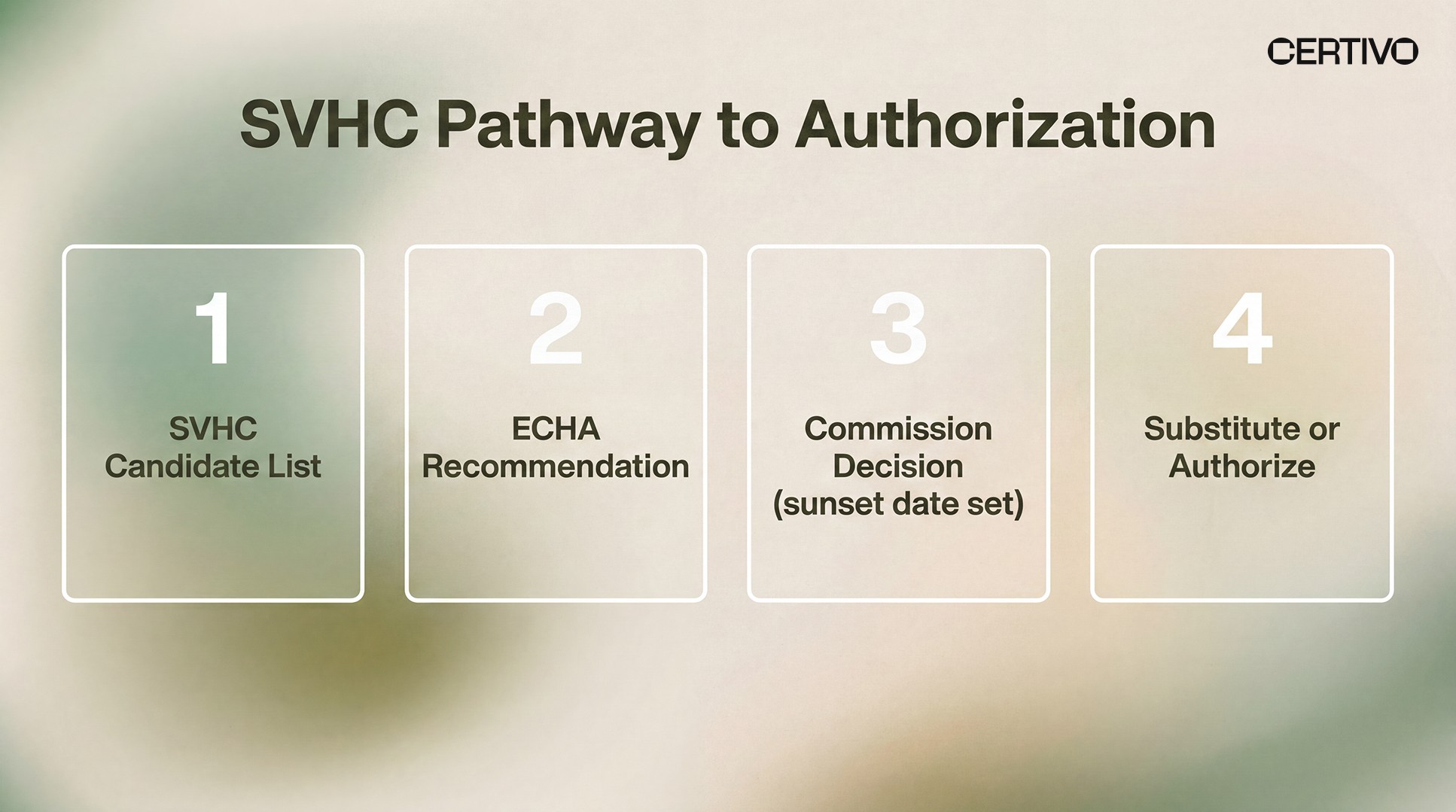
Candidate List identification. A substance is formally identified as an SVHC and added to the Candidate List, triggering disclosure obligations.
Prioritization and recommendation. ECHA recommends selected Candidate List substances for inclusion in Annex XIV. This is the step taken in June 2026.
Commission decision. The European Commission decides whether to add the substances to Annex XIV and sets review periods and sunset dates.
Sunset date. After this date, the substance cannot be placed on the market or used unless authorization has been granted for the specific use.
What Authorization Actually Requires
If a substance critical to your product is added and no suitable alternative exists, continued use requires an authorization application demonstrating adequate control or socio-economic justification. This is a substantial regulatory undertaking, which is why early assessment matters. The detail behind each substance, including EC numbers, CAS numbers, proposed review periods, and any sunset dates, must be read from ECHA's official recommendation package rather than assumed.
For broader context on how authorization fits the wider regime, see Certivo's analysis of REACH SVHC and Annex XVII changes and the related REACH authorization update.
Why Annex XIV Is Different From the Candidate List
This distinction is the single most important concept for executives to understand, because it changes the nature of the obligation.
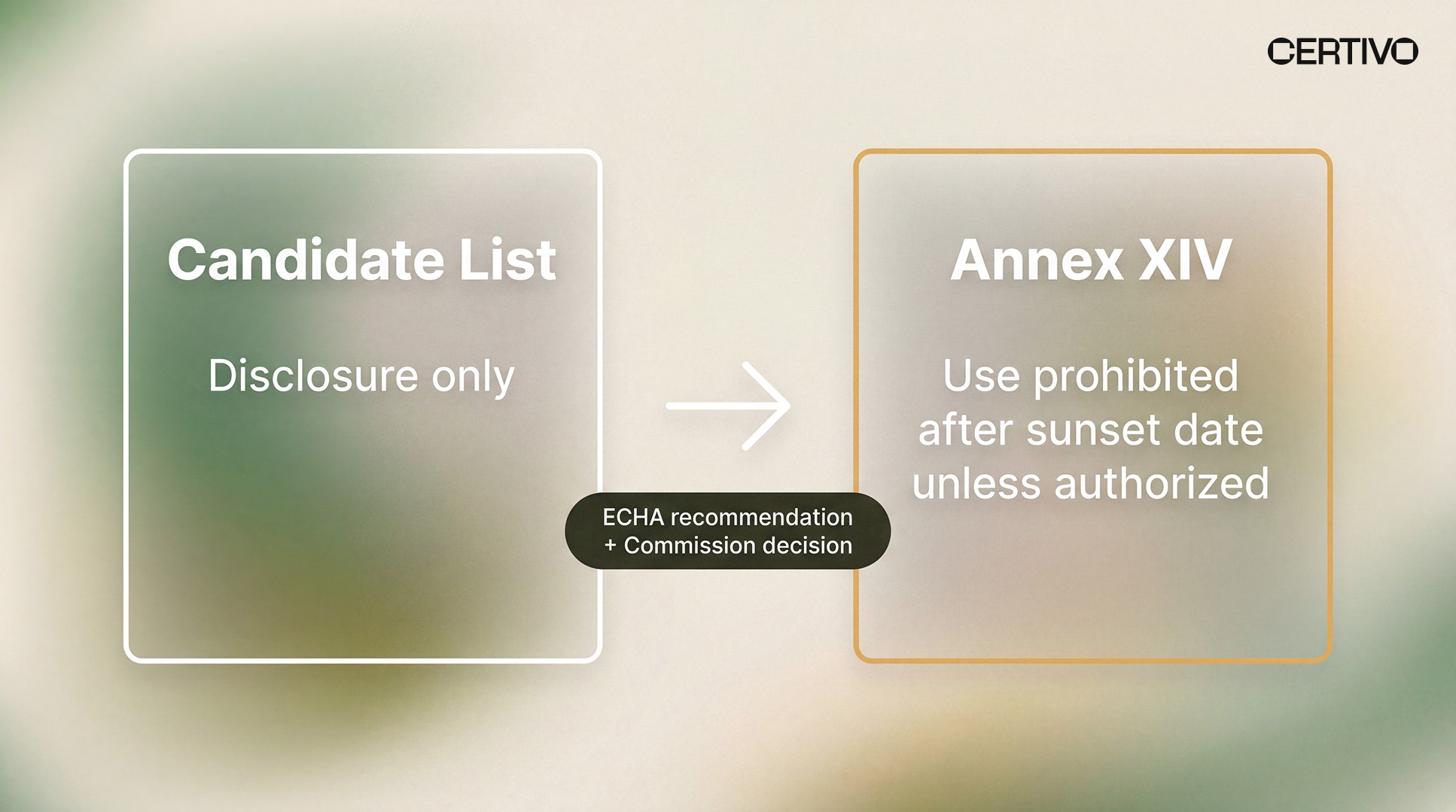
Aspect | Candidate List | Annex XIV (Authorization List) |
|---|---|---|
Legal effect | Disclosure and notification duties | Use prohibited after sunset date unless authorized |
Action required | Communicate presence above threshold | Substitute, or apply for authorization |
Business risk | Reporting burden | Loss of EU market access for the use |
Time pressure | Ongoing | Fixed by sunset date |
A Candidate List entry creates an obligation to tell people the substance is present. An Annex XIV entry can eventually stop you from using the substance at all. Companies that treat the two as equivalent underestimate the operational and commercial consequences of authorization. This is why chemical and hazmat compliance programs should escalate a substance's priority the moment it is recommended for Annex XIV.
REACH Annex XIV authorization list compared to candidate list for manufacturers
Click on image to view full
Industries and Product Categories Affected
SVHCs recommended for authorization tend to appear across a wide range of manufactured goods, so exposure is rarely confined to one sector.
🏭 Chemical manufacturing and chemical producers that formulate or supply affected substances
🏭 Electronics and electrical equipment, where SVHCs appear in components, coatings, and processing aids
🏭 Automotive and transportation, including automotive manufacturers managing long-lived platforms
🏭 Aerospace and defense, where qualified materials are difficult to substitute quickly
🏭 Medical devices, plastics and polymers, coatings and surface treatments, industrial equipment, and consumer products
🏭 Importers and EU-market suppliers, who carry obligations even when they did not manufacture the article
Electronics and industrial manufacturers in particular should review existing materials and environmental compliance data, because the same substances often sit in catalog parts reused across many products.
Key Compliance Requirements
Based on the recommendation, the core compliance actions are clear and should begin before the Commission's decision.
📌 Identify whether any products, materials, or processes contain the recommended substances.
📊 Review supply chain disclosures and Full Material Declarations (FMDs) for substance presence and concentration.
⚠️ Assess the impact if the substances are formally added to Annex XIV, including which product lines lose a compliant material.
📄 Evaluate substitution opportunities and technically feasible alternatives.
⏳ Monitor the European Commission's decision-making process and any proposed sunset dates.
📌 Prepare authorization applications where continued use is critical and no suitable alternative exists.
Doing this at portfolio scale is a data problem first. You cannot assess substitution options for a substance you cannot reliably locate across thousands of parts, which is where BOM-level compliance tracking becomes the practical foundation.
Struggling to locate a single substance across your full BOM? Request a compliance review to see how Certivo maps substance presence across products and suppliers.
Reporting and Documentation Challenges
The recurring difficulty for global manufacturers is not understanding the regulation. It is producing reliable, current substance data across a large product portfolio and a multi-tier supplier base.
Where Data Breaks Down
Supplier declarations arrive in inconsistent formats, with varying completeness and age.
The same component appears in multiple products, so one missing declaration cascades across the portfolio.
SVHC lists change over time, so a declaration that was complete last year may not address newly recommended substances.
Full Material Declarations require concentration data, not just a yes or no, and many suppliers default to summary statements.
A centralized compliance data backbone that normalizes supplier declarations and links them to specific parts is what allows a compliance team to answer "do we use this substance, and where" without a manual file search across systems. Automated supplier data collection reduces the email chasing that otherwise consumes the team.
Compliance Risks and Enforcement Exposure
Enforcement of REACH authorization is carried out through EU member state market surveillance authorities, and the consequences extend beyond regulatory penalties.
⚠️ Market access loss. Using an Annex XIV substance past its sunset date without authorization can remove the product from the EU market for that use.
⚠️ Customer audit findings. OEM customers increasingly require documented SVHC and authorization status. Gaps trigger corrective action requests and can affect supplier approval.
⚠️ Enforcement action. Member state authorities can act on non-compliant placing on the market, with penalties set at national level.
⚠️ Supply chain disruption. If a supplier cannot continue providing a substance and no alternative is qualified, production can stall.
No software makes an organization audit-proof. The realistic objective is to be audit-ready, reducing surprises and shortening the time it takes to assemble an evidence pack when a regulator or customer asks. For this, proactive compliance risk management matters more than reactive document gathering.
REACH Annex XIV authorization process flow for EU market compliance
Click on image to view full
Supply Chain and Operational Impact
Most SVHC exposure originates several tiers down, where visibility is weakest. The operational impact flows in both directions.
Upstream, you need current declarations from Tier 1 suppliers, who in turn need them from their own suppliers. Downstream, your customers expect documented status and, increasingly, product-level answers rather than company-level assurances. The substances recommended for authorization may sit in sub-assemblies and catalog parts shared across many finished goods, so multi-tier supply chain transparency is the difference between a contained issue and a portfolio-wide scramble.
This is also where supplier and contractor management and supplier risk scoring help: knowing which suppliers respond reliably tells you where your data gaps are most likely to sit.
Audit Readiness for SVHC and Authorization Evidence
Compliance engineers are usually the ones who have to produce evidence under time pressure, so it is worth distinguishing the audit types and what each one demands.
Audit Types You Should Prepare For
Internal audits, verifying your own substance data and processes.
Customer audits, typically OEM-driven, asking for SVHC and authorization status at the product level.
Regulatory inspections, including ECHA-coordinated member state market surveillance.
Certification audits under ISO 9001, IATF 16949, or ISO 14001, where compliance data management is in scope.
Evidence Integrity and Historic State
Authorization evidence is fundamentally a data-versioning problem. When a customer or regulator asks what you knew and when, you need point-in-time retrieval, not just the current state. That means time-stamped declarations, immutable audit logs of who submitted which evidence and under what authority, and the ability to reconstruct a product's compliance status as it stood on a specific date. Leading customer trust center models used by companies such as Apple, Microsoft, and major automotive OEMs are built on exactly this principle of retrievable, attributable evidence. Continuous audit-ready documentation is what makes that retrieval fast rather than frantic.
Timeline and Future Outlook
Stage | What Happens |
|---|---|
June 2026 | ECHA recommends the substances for Annex XIV inclusion |
Following period | European Commission reviews the recommendation |
Commission decision | Substances formally added; review periods and sunset dates set |
Sunset date | Use prohibited unless authorization granted for the use |
Based on currently available regulatory guidance, the specific sunset dates and review periods will be defined by the Commission's decision and should be read from the official act once published. The broader trend is consistent: the SVHC and authorization pipeline continues to expand, so a repeatable screening process is more valuable than a one-time response. Regulatory change management supported by horizon scanning keeps each new batch from becoming a fire drill.
Strategic Compliance Preparation Checklist
How AI Supports REACH Authorization Management
Screening a large portfolio against a changing SVHC list by hand does not scale. This is where AI-native compliance automation changes the economics of the work.
CORA-powered regulatory intelligence parses supplier declarations, certificates, and material data to extract substance and concentration information, then links it to specific parts and products. That means when a new batch is recommended for Annex XIV, the question "where do we use this" becomes a query rather than a project.
CORA-enabled analysis also supports validation of supplier certificates and flags incomplete or aging declarations, so the gaps surface before an auditor finds them. Combined with AI-driven compliance management, this shifts the team from reactive document gathering toward continuous readiness, where each regulatory change is absorbed against a maintained data foundation rather than triggering a fresh manual search.
Executive Conclusion
ECHA's recommendation to add new SVHCs to the REACH Annex XIV Authorization List is an early signal, not a finished rule, but the organizations that wait for formal adoption to begin assessment are the ones most likely to face market access disruption. The substantive work, screening the portfolio, refreshing supplier declarations, and evaluating substitution, takes longer than the regulatory timeline often allows.
The defensible position is a maintained, BOM-level view of substance presence, fed by reliable supplier data and retrievable as point-in-time evidence. That capability serves not just this batch, but every future addition to the authorization pipeline.
Speak with a compliance specialist to assess your REACH Annex XIV exposure and build a repeatable screening process across your product portfolio and supply chain.
Lavanya
Lavanya is an accomplished Product Compliance Engineer with over four years of expertise in global environmental and regulatory frameworks, including REACH, RoHS, Proposition 65, POPs, TSCA, PFAS, CMRT, FMD, and IMDS. A graduate in Chemical Engineering from the KLE Institute, she combines strong technical knowledge with practical compliance management skills across diverse and complex product portfolios.
She has extensive experience in product compliance engineering, ensuring that materials, components, and finished goods consistently meet evolving international regulatory requirements. Her expertise spans BOM analysis, material risk assessments, supplier declaration management, and test report validation to guarantee conformity. Lavanya also plays a key role in design-for-compliance initiatives, guiding engineering teams on regulatory considerations early in the product lifecycle to reduce risks and streamline market access.