


The Global PFAS Reckoning is one of the most urgent and complex challenges facing product manufacturers, supply chain leaders, compliance officers, and sustainability professionals around the world.
Whether you’re a compliance veteran, a regulatory strategist, an ESG leader, or someone just getting pulled into the PFAS firestorm because your parts or packaging have been flagged, you’re in the right place.
And because the stakes are rising fast, many teams are beginning to lean on PFAS compliance software and PFAS supply chain compliance frameworks just to keep pace with the volume and velocity of change. Understanding the current ECHA PFAS restriction proposal status and 2025–2026 timeline is now essential for any manufacturer selling into European markets—this single regulatory action could reshape compliance obligations for over 10,000 substances simultaneously.
What we’re going to do over the next few hours is build a complete understanding of:
What PFAS really are — and why they’re such a unique regulatory challenge
How global rules are unfolding — faster than most people realize
Why this is a supply chain problem, not just a materials one
How to operationalize traceability, documentation, and risk modeling
And what it takes to run a defensible, scalable, substitution-ready compliance program
This is not a pitch. This is not a blog post read aloud. This is the real thing. A fully structured, solo deep-dive designed for professionals who need to understand this at the systems level — especially those evaluating whether PFAS regulatory compliance tool platforms or PFAS reporting software could reduce their exposure.
Segment 1: Understanding PFAS
So let’s start with the foundation: What are PFAS — and why are they under fire?
PFAS stands for per- and polyfluoroalkyl substances. That term includes over 10,000 individual chemicals. These aren’t theoretical compounds. They’re real chemicals used widely across industries and supply chains for decades — and they’re in everything.
What they all share is a carbon-fluorine bond. One of the strongest bonds in chemistry. And that bond gives PFAS their signature trait: extreme persistence. PFAS don’t break down. They don’t degrade in soil, in water, or in your bloodstream. That’s why they’re often referred to as "forever chemicals."
Now, the challenge isn’t just their persistence — it’s their mobility and bioaccumulation.
You can find PFAS in:
Groundwater next to factories
Snowpack in the Arctic
Blood samples from almost every population on Earth
They’re used in:
Electronics — in semiconductor etching gases and coatings
Food packaging — for grease resistance
Industrial hoses and valves — because they withstand heat and chemicals
Medical devices — like stent coatings and implantable seals
Consumer goods — carpets, jackets, nonstick cookware
They’re invisible. Ubiquitous. And until recently, it was completely underregulated.
Comprehensive PFAS compliance guidance starts with recognizing that these substances are not isolated material risks—they are systemic supply chain exposures requiring substance-level identification, multi-tier traceability, and continuous regulatory monitoring across every jurisdiction where your products are sold.
Why are they getting attention now?
First: mounting toxicology evidence.
PFAS are linked to a range of health conditions — including liver damage, immune system suppression, developmental issues, and multiple types of cancer. The data is clear enough that major agencies — EPA, ECHA, CDC — have issued warnings and launched rulemaking.
Second: litigation
If you’ve seen headlines about billion-dollar settlements from 3M or DuPont — that’s PFAS. Thousands of municipalities, water utilities, and personal injury lawsuits are driving not just legal risk — but reputational and financial collapse for companies who used or manufactured these substances.
Third: global regulation is catching up.
PFAS are being restricted, reported, or outright banned across Europe, the US, Canada, and many parts of Asia — a trend we will explore in detail later. This is also where PFAS reporting software and PFAS regulatory compliance tool capabilities become essential, especially for teams managing multi-region obligations. CORA-powered regulatory intelligence enables compliance teams to track evolving PFAS compliance & regulations across jurisdictions in real time—surfacing threshold changes, new substance additions, and enforcement date shifts before they create compliance gaps.
Fourth: PFAS is becoming an ESG issue.
Investors are asking about it. Sustainability auditors are flagging it. Brand-conscious customers are increasingly demanding PFAS-free certifications.
Where does that leave you?
If you manage a bill of materials.
If you purchase adhesives, sealants, coatings, electronics, wiring, valves, pumps.
If you work in food contact packaging, consumer goods, textiles, medtech, automotive, or aerospace.
Then you’re almost certainly exposed to PFAS risk — even if no one has told you yet.
The question isn’t if PFAS are in your supply chain.
It’s whether you’ve built the systems to detect, manage, and report them — which is exactly why many organizations are adopting PFAS compliance software solutions paired with PFAS supply chain compliance assessments to detect upstream risks early.
Where are the PFAS in your supply chain?
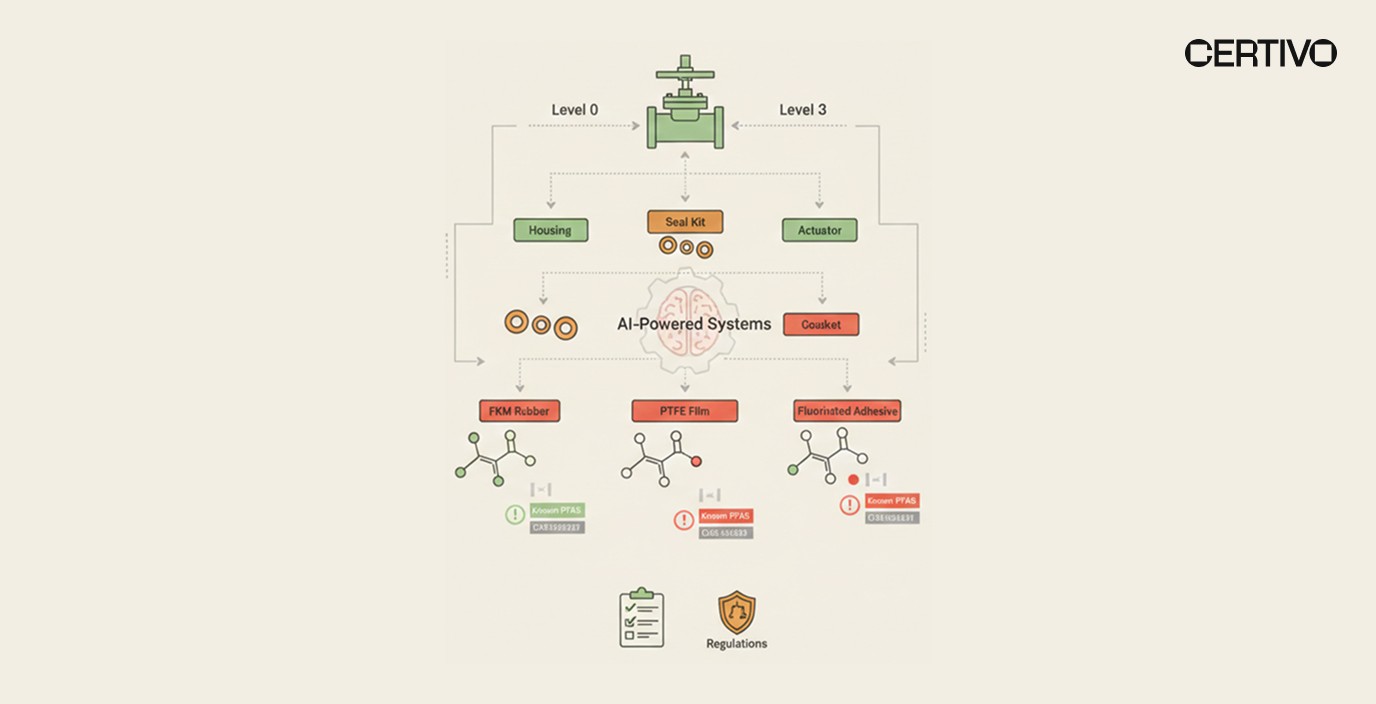
PFAS don’t wave flags. They don’t show up labeled "warning: persistent toxicant" on your BOM. They live in adhesives, coatings, sealants, films, membranes, and process aids — and they’re often several tiers deep in your product structure. This is where BOM-level material mapping becomes critical—exploding your bill of materials to Level 3 or deeper and cross-referencing every component against CAS-level PFAS substance lists to identify exposure points that traditional document review misses entirely.
Let’s start with some practical examples.
Electronics
PFAS might be in:
Thermal interface materials used between chips and heat sinks
Dielectric coatings on wiring
Fluorinated gases used in semiconductor etching (which might leave trace residues)
Medical devices
Commonly found in:
Catheter coatings (for slickness and biocompatibility)
Implantable device seals
PTFE-based membranes in diagnostic equipment
Automotive
O-rings and gaskets made with FKM or PTFE
Brake fluid lines with fluorinated inner linings
Paints and coatings with stain resistance additives
Industrial equipment
Mold release agents
Non-stick internal coatings for pipes and tanks
High-temperature lubricants
Packaging
Fluorinated HDPE containers
Grease-resistant papers and wraps
Anti-static and anti-fog coatings on films
For manufacturers navigating PFAS exposure across multiple product categories, Certivo's complete guide to PFAS regulations for 2025–2026 provides a comprehensive regulatory roadmap organized by jurisdiction, product type, and enforcement timeline.
Why you don’t see PFAS on your documentation
Four systemic data gaps:
SDS limitations — PFAS are often used in trace quantities, invisible on SDSs.
Supplier blind spots — Tier 1 suppliers often don’t know what’s in their upstream materials.
Confidential Business Information (CBI) — full formulations are often withheld.
Recycled content contamination — PFAS may enter unintentionally via recycled streams or equipment.
These data gaps are precisely why multi-tier supply chain transparency is a prerequisite for defensible PFAS compliance preparation—you cannot manage what your direct suppliers themselves cannot see without structured upstream data collection.
How do you find them?
You start by asking better questions.
Instead of: Does this product contain PFAS?
Ask: Have any of the substances listed in the OECD Global PFAS List or EPA’s TSCA PFAS Inventory been intentionally added at any stage of production?
And instead of trusting an SDS, ask for a Full Material Declaration (FMD).
Instead of reviewing your BOM at Level 0 or 1, explode it to Level 3 or deeper.
Let’s talk about risk heuristics
Here are the red flags we use when reviewing a BOM for PFAS risk:
PTFE, FKM, PVDF, or ETFE
Components sourced from seal, adhesive, or coating suppliers
Anything certified for chemical resistance, non-stick behavior, or thermal stability
Anything labeled “fluorinated” or with “fluoro-” prefixes
Another technique is material-function mapping:
If a part requires oil resistance, stain resistance, anti-static behavior, or thermal endurance — PFAS are likely.
If a supplier uses materials from 3M, Chemours, or Daikin — check their technical datasheets.
And always consider geography:
EU-sourced components may have better disclosure under REACH/SCIP.
Regions with weaker regulation require deeper probing.
PFAS live in places you don’t expect — and places your suppliers often don’t know about.
To find them, you need better questions, deeper BOM analysis, and substance-level validation — not just document review.
Global Regulation Deep Dive
Now that we’ve mapped where PFAS live in your supply chain, let’s talk about what the law says — and how it’s evolving fast. This segment is all about regulatory reality — the global web of PFAS-related laws, thresholds, enforcement timelines, and reporting obligations that vary dramatically by region, industry, and product type. As these obligations multiply, PFAS & chemicals risk management must evolve from an ad-hoc compliance function into a continuous, system-level capability
There is no single global PFAS rule. Instead, you’re dealing with a growing patchwork — and navigating it requires specificity. This is where PFAS supply chain compliance becomes a central operational requirement, often supported through PFAS reporting software to streamline data collection.
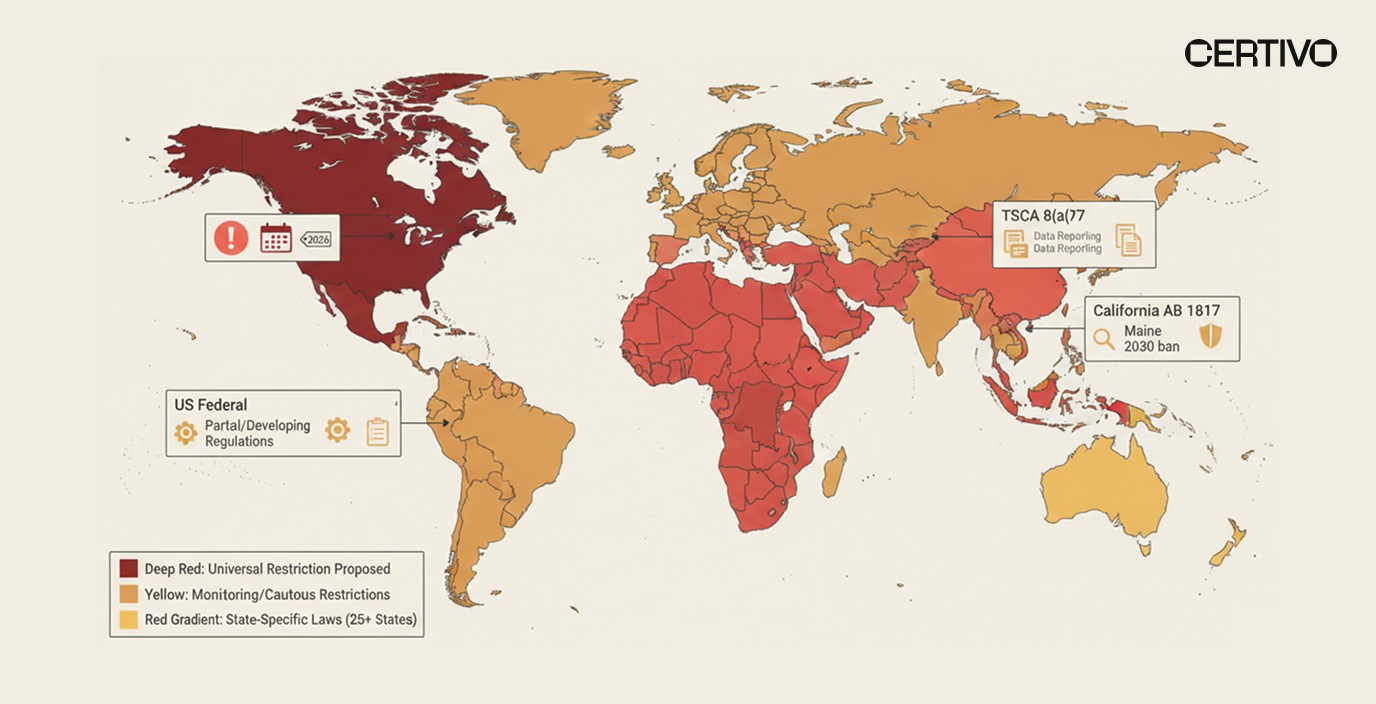
Let’s start with the European Union — the most aggressive regulator on PFAS.
Under the EU’s REACH Regulation, PFAS restrictions are happening on multiple fronts:
SVHC Listings — Some PFAS, like PFOS, PFOA, PFHxA, and PFNA, are already on the REACH Candidate List as Substances of Very High Concern (SVHCs). If present above 0.1% by weight in any article, they must be reported to customers and uploaded to the SCIP database.
Universal Restriction Proposal — In 2023, Germany, the Netherlands, Denmark, Sweden, and Norway submitted a joint proposal to restrict nearly all PFAS under one group restriction. That’s over 10,000 substances in one go.
The scope?
All uses, unless essential
Time-limited derogations for applications like medical, aerospace, and semiconductors
Enforceable by 2026 or sooner
This is the most ambitious chemical ban ever proposed in EU history. If you sell into the EU, and your product contains any fluorinated substance — you need to pay attention. The EU PFAS regulation 2026 timeline is accelerating—manufacturers must understand that the ECHA PFAS restriction proposal status now indicates that committee opinions from RAC and SEAC could finalize in 2025, with binding restrictions following within 12–18 months. For companies relying on PTFE and other fluoropolymers, the EU PFAS regulations PTFE phase-out timeline remains one of the most consequential open questions, as derogation periods and essential use determinations will vary by application sector. The scale of required documentation is exactly why organizations are adopting Certivo as the system of record for PFAS compliance—centralizing CAS-level verification and cross-border requirements with CORA intelligence automating substance matching, threshold checks, and jurisdictional mapping across every product and market.
Now to the United States.
In the U.S., PFAS regulation is split across federal and state levels — and it’s accelerating fast.
At the federal level, the EPA is acting under TSCA — the Toxic Substances Control Act.
Here’s what’s important:
Section 8(a)(7): A mandatory PFAS reporting rule. Any entity that manufactured or imported any PFAS substance — as a chemical or in an article — since 2011 must report detailed data. No de minimis threshold. This applies retroactively and includes byproducts and impurities. Because of the scope, many companies are building automated workflows with CORA-driven compliance intelligence to identify reportable PFAS across historical import and manufacturing records—eliminating data gaps and preparing defensible audit documentation before filing deadlines. For a detailed breakdown of federal PFAS reporting requirements, explore Certivo's guide on PFAS TSCA Section 8(a)(7) reporting deadlines and what manufacturers must do now.
Drinking Water Regulations: In 2023, the EPA proposed enforceable Maximum Contaminant Levels (MCLs) for six PFAS in drinking water — with limits in the parts per trillion range. These levels will drive cleanup efforts and hold manufacturers liable.
Toxics Release Inventory (TRI): PFAS are being added to the TRI list. Companies may be required to report emissions, discharges, or disposal quantities on an annual basis.
But that’s just federal. Let’s go deeper.
U.S. States: The Real Complexity
Over 25 states have introduced or passed their own PFAS regulations, targeting a range of products, including packaging, apparel, and cookware.
A few to highlight:
California AB 1817: Bans PFAS in textiles and clothing, effective 2025.
Maine PFAS in Products Law: Requires manufacturers to report any intentionally added PFAS, with a total ban by 2030.
New York: Bans PFAS in food packaging and requires product labeling in some categories.
Minnesota: Passing similar bans in children’s products and cosmetics.
The problem? These laws don’t always define PFAS the same way. Some use narrow definitions, others take a class-based approach. Some have thresholds, others don’t.
And enforcement varies — but that doesn’t mean you can ignore them. Retailers often act first. If you can’t certify compliance to your customer’s satisfaction, your product won’t hit the shelf — regardless of regulatory grace periods.
Navigating state-by-state PFAS obligations demands regulatory intelligence and horizon scanning capabilities that go beyond manual tracking—CORA's regulatory intelligence layer continuously monitors proposed bills, enacted laws, and enforcement actions across all 50 states, flagging changes that affect your specific product categories and materials before they reach enforcement. For state-specific compliance details, Certivo provides dedicated guides for Minnesota PFAS reporting, Massachusetts PFAS compliance, and California Proposition 65 compliance.
Let’s move to Asia
Japan is moving cautiously — they’ve proposed restrictions on PFOS and PFOA, and are considering broader PFAS actions. Testing methods are being expanded, and manufacturers are being encouraged to seek non-fluorinated alternatives.
China has started flagging PFAS as substances of concern. While there's no REACH-style restriction yet, customs enforcement has begun focusing on imports containing known fluorinated compounds. China is also updating its chemical inventory and toxicological classification system to align more closely with OECD frameworks.
South Korea is moving faster. The Ministry of Environment added PFHxS to its list of toxic substances and is advancing tracking mechanisms.
And India is under pressure from global buyers — especially in textiles — to declare PFAS use, even without a national law in place.
Canada and CEPA
Canada is taking a group-based approach under CEPA — the Canadian Environmental Protection Act.
They’ve proposed to treat PFAS as a chemical class. That means new regulations could apply not just to individual compounds, but to entire families of fluorinated substances.
A risk management scope is already under development, and manufacturers should expect disclosure and possibly restriction requirements in the next 12–24 months.
What does this mean for you?
It means your compliance obligations change by market, by product, and by use case.
Let’s say you manufacture a valve assembly.
In Germany, your fluoropolymer may trigger REACH reporting.
In California, the same part might be banned in consumer goods.
Under TSCA, your import of that part requires PFAS content reporting.
And in Canada, the whole thing may be regulated based on class membership — not function or threshold.
Your product is static. But its compliance profile is not. Maintaining PFAS supply chain compliance is no longer optional — it’s operational survival
Understanding the full scope of PFAS analysis standards for regulatory compliance is equally critical—different jurisdictions reference different testing methodologies (EPA 533, EPA 537.1, ISO 21675, CEN/TS 15968), and your documentation must demonstrate that substance identification aligns with the analytical standards specified by each applicable regulation.
How to keep track?
Maintain a jurisdictional compliance map — with flags for each market your product enters.
Use regulatory timelines — map enforcement dates for each regulation (proposed, pending, adopted, effective).
Monitor multi-tier exposure — not just where PFAS is present, but where it’s functionally necessary.
Invest in a compliance rules engine — something that can match substance + part + geography + regulatory logic dynamically.
This isn’t just about reacting to rules. It’s about navigating the regulatory future.
Documentation & Traceability
In the last segment, we explored the global PFAS regulatory landscape. Now let’s talk about how you prove compliance. That means collecting the right documents, validating data, tracking substances, and ensuring auditability — at scale. Effective PFAS compliance preparation requires building documentation systems that satisfy the most demanding jurisdiction in your portfolio—because if your evidence base meets EU REACH, TSCA, and state-level requirements simultaneously, you're positioned for any future regulation that emerges.
Let’s start with Documentation Types
There are four primary ways PFAS information is documented in supply chains:
Full Material Declarations (FMDs)
These are structured data sets that list every substance in a material or part, usually above 0.1% by weight.
FMDs are the gold standard. If you get one, and it’s valid, you can typically assess compliance for any regulation — REACH, RoHS, TSCA, or PFAS.
Safety Data Sheets (SDSs)
These are common, but limited. SDSs only include substances classified as hazardous — often above 1% by weight. Most PFAS are not listed. So don’t rely on SDSs unless you’re using them only as a trigger for deeper follow-up.
Supplier Declarations
These are legally binding letters or forms — where a supplier affirms that PFAS are or aren’t present. These vary in format and quality. Some are one-line emails. Others are structured forms with CAS references and thresholds. The value depends on how well you define your template.
Testing Reports
Expensive, but useful for high-risk parts. Labs use EPA or ISO methods to detect PFAS at ppm or ppt levels. Great for spot-checking. But don’t build your whole program around testing — it won’t scale.
Certivo functions as the system of record for all PFAS documentation—consolidating FMDs, SDSs, supplier declarations, and lab results into a single, normalized data schema where CORA intelligence automates CAS-level matching, flags data gaps, and maintains continuous audit-ready documentation across every product line and jurisdiction.
Validating declarations
Let’s say a supplier sends you a declaration that says:
“No intentionally added PFAS present.”
Seems simple — but that’s not enough.
What’s missing?
Which PFAS list are they referencing? There’s no universal definition.
What threshold are they using? 0.1%? 100 ppm? Any trace?
Is it based on testing or knowledge?
Is the declaration signed and dated?
Do they reference CAS numbers, or just trade names?
Your job is to close these gaps.
You need a structured declaration form — one that:
Includes a CAS-based list for reference
States the thresholds and jurisdictions being declared against
Defines PFAS based on the OECD or EPA definitions
Includes a checkbox to confirm testing vs knowledge-based assertion
Is signed, timestamped, and archived
Standardized supplier questionnaire frameworks eliminate the ambiguity that undermines most PFAS declarations—ensuring every supplier receives identical CAS reference lists, jurisdiction-specific thresholds, and clear instructions regardless of their size, region, or tier in your supply chain.
CAS-Based Validation
You must validate at the CAS number level — not just by substance name.
Why?
Because many suppliers will say “No PFOS” — but list 1763-23-1 in their FMD. That’s PFOS.
Or they’ll say “No GenX” — but include 13252-13-6.
You need a crosswalk table — matching trade names and aliases to CAS numbers. Use EPA CompTox or the OECD PFAS master list for this.
Then run an exact match — and flag any known PFAS, even if they appear under obscure names. Also check for precursors — substances that degrade into banned PFAS.
CORA-enabled analysis automates this CAS crosswalk at scale—parsing FMDs and supplier declarations against the complete OECD PFAS master list, EPA CompTox database, and REACH SVHC candidate list simultaneously, flagging matches, precursors, and alias conflicts that manual review consistently misses. This is where specialized substance reporting solutions deliver the most value—providing CAS-level precision across thousands of parts without proportionally increasing headcount.
Multi-level BOM Traceability
Traceability doesn’t stop at the top of the BOM.
Many PFAS live at Level 2, 3, or 4 — in adhesives, films, tapes, and insulators.
You need to explode your BOM and map:
Material compositions by part
Supplier for each component
Declaration coverage level (Full, Partial, Unknown)
Parts without documentation should be flagged as data gaps, not assumed clean.
For each component, ask:
Do I have an FMD or equivalent?
Does it list all substances over 0.1% w/w?
Are any known PFAS present?
Has the supplier signed and dated the declaration?
When was the last update?
You’re building a living system — not a spreadsheet snapshot.
BOM-level compliance intelligence transforms this from a periodic audit exercise into a continuous monitoring capability—Certivo maps substance data against every component in your BOM, maintains declaration coverage metrics in real time, and escalates data gaps automatically before they become audit findings. Organizations looking to track compliance by BOM can eliminate the manual reconciliation that delays PFAS compliance preparation across complex product portfolios.
Mapping Documentation Coverage
We recommend maintaining a PFAS compliance matrix — listing every part or material in your BOM against:
Documentation type received (FMD, SDS, Declaration, None)
PFAS status (Confirmed, Declared-Free, Suspect, Unknown)
Supplier responsiveness
Next action (Escalate, Substitution, Test, Accept)
This matrix becomes your operating dashboard — and your defensible evidence base.
If a regulator asks, “Why did you consider this part PFAS-free?”, you point to the supplier declaration, the CAS match, and the signed timestamp.
If you don’t have that trail — you’re exposed.
Due Diligence vs Perfection
Let me pause here and emphasize a point that many legal and compliance teams misunderstand:
You are not expected to be perfect.
But you are expected to demonstrate due diligence.
That means:
You asked the right questions
You documented supplier outreach
You validated what you received
You followed up on known risks
And you maintained an auditable system
Regulators understand that PFAS is messy. They don’t expect you to have 100% coverage. But they do expect you to show that you’re trying — systematically, consistently, and in good faith.
Automation & Platform Considerations
As you scale, you’ll need to automate:
Declaration requests to suppliers — with reminders and translations
Data normalization — parsing SDSs, FMDs, and declarations into a single schema
CAS matching and risk flagging
Status dashboards for each BOM or product line
Audit trails for all data and decisions
This isn’t about using a database. It’s about building a compliance engine.
And that engine only works if the data is clean, complete, and current.
Certivo's platform, with CORA as the embedded intelligence layer, delivers this compliance engine out of the box—automating supplier data collection, normalizing multi-format documents into a single schema, running continuous CAS-level substance matching, and maintaining the audit trails that transform PFAS compliance from reactive firefighting into continuous readiness.
Supplier Engagement & Risk Scoring
Now that you’ve got a handle on documentation and traceability, we need to talk about something that breaks a lot of PFAS programs: supplier engagement.
It’s one thing to know what to collect. It’s another thing entirely to actually get it — from dozens, hundreds, or even thousands of suppliers across the globe.
The Challenge of Supplier Engagement
You’re asking suppliers to:
Provide chemical data they may not have
Translate that data into unfamiliar formats
Sign off on legal declarations
And do it under tight timelines
That’s a big ask — especially for small or international suppliers who have never dealt with PFAS before.
So what happens?
Many don’t respond
Others send partial or outdated information
Some push back or claim ignorance
And a few flat-out refuse
If you don’t plan for this, you’re setting yourself up for failure.
Campaign-Based Outreach: Not Ad Hoc Emails
Here’s how to do it right:
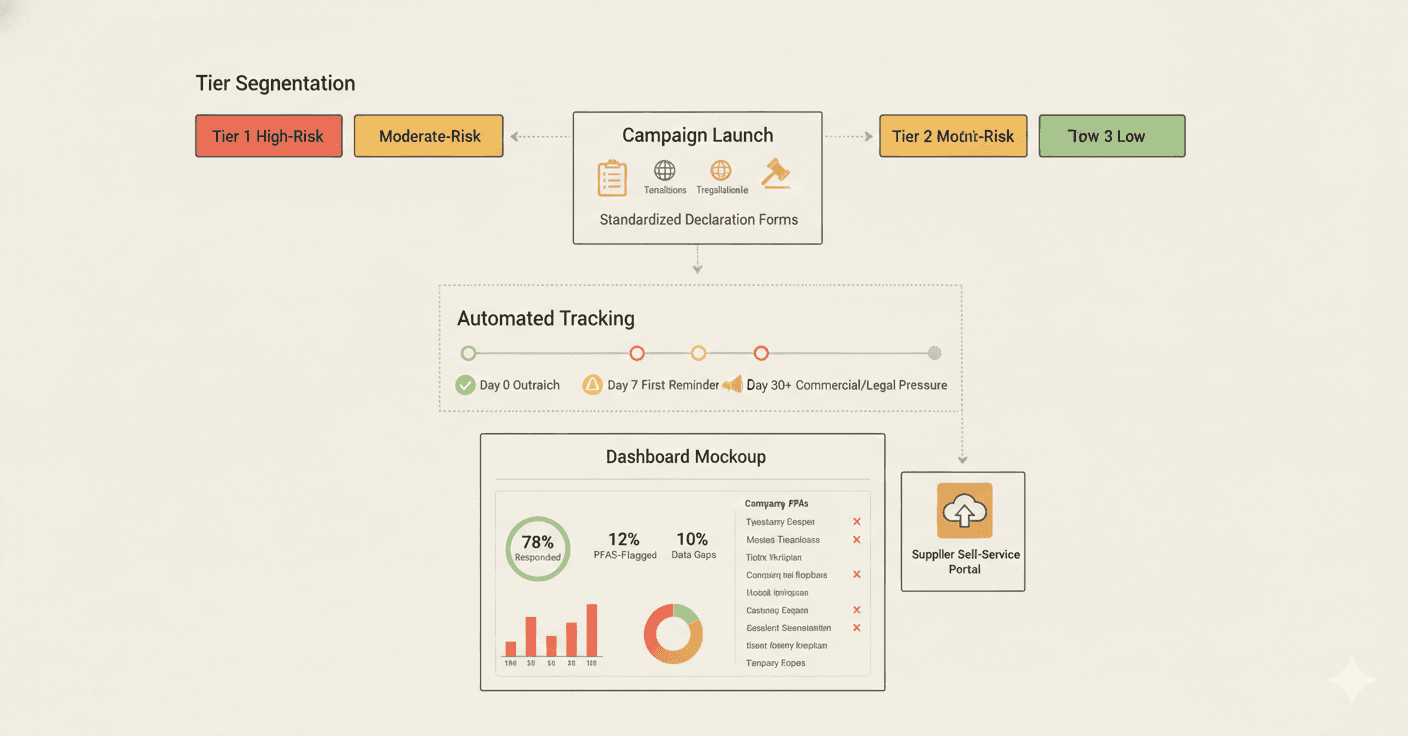
Segment your suppliers into tiers:
Tier 1: High-risk materials or strategic suppliers
Tier 2: Moderate risk or mid-volume parts
Tier 3: Low-risk or indirect spend
Launch campaigns, not emails:
Use standardized forms and translations
Include a list of target CAS numbers or substance families
State your regulatory rationale and thresholds clearly
Give a response window — 2–4 weeks is typical
Track everything:
Who received it
Who opened it
Who responded
What they submitted
Automate follow-ups:
First reminder at 7 days
Escalation at 14 days
Commercial or legal pressure at 30+
This is a workflow — not a favor.
Centralized supplier self-service portals transform this workflow from email-based chaos into a structured, trackable system—giving every supplier a single destination to access declaration templates, upload completed forms, check CAS reference lists, and monitor their own compliance status without requiring manual follow-up from your team.
What to Provide Suppliers
Don’t just send a blank email.
Send:
A declaration template — with fields for CAS #, concentration, threshold, and jurisdiction
A sample list of PFAS to cross-check (OECD, EPA, REACH SVHC)
A FAQ: what counts as PFAS, what to do if they don’t know, who to contact
Language translation if needed — particularly for Asia or LATAM-based suppliers
Make it easy. Remove ambiguity. Clarify that this is part of your quality and risk program.
What If They Don’t Respond?
This is where most companies stall.
Here’s what to do:
Log the non-response. That’s your audit defense.
Escalate through sourcing — tie it to payment terms, future RFQs, or compliance ratings.
Mark the part as “Unknown” — and assign it a risk score.
If it’s critical or high-risk, launch testing or prepare for substitution.
If it’s non-critical — begin sourcing alternatives.
Don’t let one supplier paralyze your compliance position.
Risk Scoring Framework
Let’s shift to triage. Because you can’t tackle 10,000 parts the same way.
You need a PFAS Risk Score — a composite rating you assign to each part or supplier. Use it to prioritize effort.
Here’s a simple model (scale of 1 to 5):
Material type: If it’s fluoropolymer, coating, or adhesive — score 5.
Declaration status: If it’s missing or outdated — score 4–5.
Supplier profile: If they’re non-responsive or low-maturity — score higher.
Regulatory exposure: If the part is sold in the EU or California — score higher.
Add it up. Parts with scores 12–15 are your top priority. That’s where you focus testing, substitution, and audit prep.
Supplier risk scoring and ESG ratings formalize this triage process—enabling compliance teams to assign data-driven risk profiles to every supplier based on PFAS declaration status, response history, geographic exposure, and material risk category, then allocate resources proportionally to actual risk rather than treating all suppliers equally.
Visualizing Supplier Risk
Create a dashboard — show:
% of suppliers with valid declarations
% of PFAS-flagged parts by status (Confirmed, Suspect, Unknown)
Average supplier response time
Top 10 non-responders
Upcoming regulatory enforcement deadlines by geography
This dashboard becomes your compliance cockpit. It shows progress. Drives accountability. And keeps leadership engaged.
Feedback Loops and Continuous Improvement
PFAS compliance isn’t one-and-done. It’s ongoing.
Update supplier declarations annually
Add new PFAS to your declaration forms as lists expand
Refresh risk scores every quarter
Retest high-risk parts on a rotating basis
This is how you move from reactive firefighting to proactive risk governance.
For compliance teams ready to operationalize this shift, Certivo's guide on building a future-ready compliance infrastructure from spreadsheets to AI-powered systems outlines the practical steps for transitioning from manual PFAS tracking to continuous, CORA-powered compliance readiness.
Substitution & Redesign
Once you’ve identified parts that are PFAS-containing or high risk, the next logical question is: Can we replace them?
But not all substitutions are created equal — and some can actually increase your risk. Let’s walk through the frameworks that help you avoid that trap.”
Why Substitution Isn’t Just Chemistry
Substitution isn’t just about swapping a bad substance for a better one.
It involves:
Performance: Will the replacement meet technical specs?
Safety: Is the alternative actually safer — or just less regulated?
Availability: Can you source it globally at scale?
Cost: What are the financial implications across products and markets?
Compliance: Does it meet both regulatory and customer-driven requirements?
These dimensions need to be evaluated holistically — using a structured process.
Design-for-compliance PLM workflows embed these substitution assessments directly into the product development cycle—ensuring that engineering teams evaluate PFAS alternatives against performance, safety, availability, and multi-jurisdiction regulatory requirements before materials are specified, not after products reach the market.
Frameworks for Alternatives Assessment
There are a few widely accepted frameworks:
GreenScreen® for Safer Chemicals
A full hazard assessment that scores chemicals from Benchmark 1 (avoid) to Benchmark 4 (preferred).
OECD Substitution Principles
Focuses on functional equivalence, life cycle risk, and stakeholder engagement.
EPA’s Safer Choice Program
Uses chemical classes and data screening to recommend substitutions for consumer and industrial products.
Build your internal evaluation grid around these models — even if you simplify them.
The “Essential Use” Principle
This concept comes from the EU — and it’s gaining traction globally.
It asks:
Is this use of PFAS truly essential to health, safety, or the functioning of society — and is there no safer alternative?
If the answer is no, the use should be phased out — regardless of how inconvenient that is.
This principle is already embedded in proposed EU PFAS bans. And major manufacturers — especially in medtech and aerospace — are using it internally to prioritize which parts to redesign and which to justify.
Building a Substitution Watchlist
Here’s how to operationalize substitution:
Start by identifying all parts flagged for PFAS — confirmed or suspected.
Filter down to parts:
With no valid declaration
Sold into high-regulation markets
With known performance alternatives in your system or industry
Prioritize based on:
PFAS function (coating, sealing, anti-static, etc.)
Risk score
Supplier responsiveness
Tag parts for:
Immediate substitution
Long-term redesign
Essential use justification
Assign substitution leads — usually in Engineering or Product.
This transforms PFAS substitution into a managed initiative, rather than a scattered effort.
Avoiding Regrettable Substitutions
Be careful not to swap one problem for another.
Classic mistake:
Replacing PFOA with GenX. GenX was marketed as safer, but is now under regulatory scrutiny and may soon be restricted.
Ask:
Does the alternative degrade in the environment?
Is it bioaccumulative?
What’s the toxicology profile?
What’s its regulatory status in your key markets?
Are NGOs or consumer groups targeting it?
You can’t just switch chemicals. You have to assess them.
Partnering With Engineering
Get your design teams involved early.
Provide substitution scorecards and comparison tools
Pre-approve alternative materials and suppliers
Build constraints into CAD tools or material libraries
Run pilot tests to validate performance
Design engineers are often eager to help — but only if the data is clear and the impact is measurable.
Make PFAS risk visible at the design stage, not the sourcing stage.
Timeline Planning
Substitution takes time. Build timelines around:
Lab validation and prototyping (1–3 months)
Regulatory pre-checks (0.5–1 month)
Internal design sign-off (1–2 months)
Supplier change notification and onboarding (1–2 months)
Re-certification if needed (industry dependent)
You’re looking at 6–12 months for complex changes. That’s why the time to start is now — not when enforcement hits.
Documenting Decisions
Every substitution — or decision not to substitute — should be documented:
The original PFAS use
Exposure rationale (regulatory or customer-driven)
Alternatives considered
Why you select or rejected them
Performance and safety tradeoffs
Who approved it, and when
This creates defensibility — and helps you scale learnings across product lines.
Forecasting & Policy Horizon
So far we’ve covered documentation, supplier risk, and substitution — all critical for compliance today. But if you’re building for scale, you also need to prepare for tomorrow.
This segment is about regulatory forecasting — how to anticipate what’s coming next in PFAS policy, and how to stay ahead of it.”
Why Forecasting Matters
Let’s be honest — most organizations operate on a reactive compliance model. A regulation goes into effect, and everyone scrambles.
But PFAS policy isn’t creeping forward. It’s accelerating.
Draft laws are becoming enforceable in under 24 months.
NGOs are pushing for bans before toxicology reviews are complete.
Customers are imposing PFAS restrictions in contracts, regardless of legal requirements.
If you wait for enforcement, you’re already behind.
Signals to Track
Regulatory forecasting isn’t magic — it’s pattern recognition.
Here’s what to monitor:
Scientific committee outputs
EU’s RAC and SEAC issue opinions that often precede bans.
U.S. EPA’s IRIS and TSCA risk evaluations flag chemicals for regulation.
NGO Watchlists
ChemSec’s SIN List, Green Science Policy Institute, and ClientEarth publish early warning lists.
Substances on these lists often face market pressure before legal restriction.
Public consultations
REACH restriction proposals
TSCA dockets
State-level bills and hearings
Track what’s in discussion — not just what’s passed.
Industry phase-outs
If 3M or DuPont announces a voluntary PFAS withdrawal, take notice. That’s a strong signal that regulation — or litigation — is imminent.
CORA-powered regulatory intelligence automates this signal tracking—continuously monitoring RAC/SEAC opinions, NGO watchlists, TSCA dockets, state-level legislative activity, and industry phase-out announcements, then mapping those signals to the specific substances and product categories in your compliance portfolio. This is how organizations shift from reactive compliance to continuous regulatory readiness.
Building a Regulatory Radar
Forecasting only works if you structure it.
Create a Regulatory Radar that includes:
Substance: the PFAS compound or group
Jurisdiction: EU, US, state, etc.
Stage: Proposed → Consulted → Finalized → Enforced
Effective date (expected or confirmed)
Risk rating (Low / Medium / High)
Action required (Monitor / Substitution / Disclosure / Market Exit)
Update monthly. Share internally. Use it to drive roadmap decisions.
Managing Jurisdictional Complexity
PFAS policy is not harmonized.
For example:
The EU is banning all PFAS except essential uses.
California bans PFAS in textiles above detection limits — no thresholds.
TSCA requires reporting of any imported PFAS, even in trace amounts.
Maine bans PFAS in products entirely by 2030, with mandatory reporting now.
You must map these differences to your products.
That’s where jurisdictional overlays in your data system become critical.
Each part or product needs to know:
Where it’s sold
Which PFAS rules apply
What exemptions are valid — and when they expire
Modeling Regulatory Scenarios
Here’s where it gets interesting.
Once you have a radar and overlays, you can start modeling scenarios. Ask:
“What happens if the EU ban goes into effect in 2026?”
“What if California expands its PFAS ban to all electronics?”
“What’s the substitution lead time if our main gasket compound is restricted?”
Then build buffers:
Redesign timelines
Supplier readiness windows
Inventory runout plans
Scenario planning turns uncertainty into strategy.
Timeline Compression
Traditionally, regulation moved slowly — 5 to 10 years from hazard identification to enforcement.
Not anymore.
PFAS timelines are collapsing:
PFOA was evaluated in 2015, restricted by 2020.
The EU’s universal PFAS restriction was proposed in 2023 and may be enforced by 2026.
U.S. TSCA reporting was finalized in 2023 and takes effect in 2025 — covering 12 years of history.
That’s why you need design buffers.
Start planning 12–18 months ahead of any proposed rule — not just final ones.
Feedback Loops
Forecasting isn’t just forward-looking. It improves your substitution and supplier outreach as well.
For example:
If you know that PFHxS is likely to be restricted in Canada next year, you can update your declaration forms now — and start outreach in Q3 instead of Q4.
If an emerging PFAS analog shows up on NGO lists, you can flag that compound in your FMD parser — before customers or regulators do.
The goal is early motion — not perfect prediction.
Architecture & Governance
We’ve now walked through everything from detection and documentation to substitution and forecasting.
But none of that sticks if a compliance architecture does not back it — and by that I mean:
The systems
The roles
The rules
And the governance model to manage PFAS like a long-term capability, not a project.”
Start with System Design Principles
Think of PFAS compliance as an engine — one that constantly takes in new inputs (rules, supplier data, risks) and outputs clean, traceable compliance logic.
That engine needs to be:
Modular — so you can update rules and lists without rewriting your workflows
Scalable — so it works for 100 parts or 100,000
Integrated — with ERP, PLM, QMS, LIMS, and sourcing tools
Auditable — with version control, timestamps, and evidence trails
If your PFAS data lives in inboxes or spreadsheets — it’s not scalable.
You need a proper system-of-record.
Certivo delivers this system of record—providing the centralized compliance architecture where CORA intelligence continuously processes substance data, validates supplier declarations, maps jurisdictional requirements, and maintains the audit trails that make PFAS compliance defensible at enterprise scale. For organizations ready to replace spreadsheets with a scalable system, the transition from reactive spreadsheet tracking to continuous CORA-powered compliance readiness is the defining operational upgrade.
Data Architecture Essentials
Here’s what your data model must include:
CAS-level tagging — for every chemical, with aliases and groupings
Jurisdictional overlays — so parts know which markets and laws they’re exposed to
Traceability metadata — document source, version, timestamp, supplier
Relationship mapping — multi-level BOMs, subparts, coatings, and materials
Risk scoring — by part, supplier, and product line
Regulatory timelines — for proactive substitution and reporting
Normalize everything: SDSs, FMDs, declarations, lab results. Bring it into one schema — or you can’t run analytics.
An integrated PLM/ERP compliance thread ensures that PFAS substance data flows seamlessly between your product lifecycle management, enterprise resource planning, and compliance systems—so that engineering decisions, procurement actions, and regulatory obligations stay synchronized without manual data transfer or reconciliation.
Human-in-the-Loop Workflows
Compliance isn’t fully automatable — especially for PFAS.
You need human-in-the-loop checkpoints:
When declarations are flagged as inconsistent
When substitution tradeoffs require judgment
When regulatory interpretations vary
So build workflows where people can review, override, comment, and sign off — then store those actions in your audit log.
Balance automation with accountability.
Assigning Roles and Ownership
This is where many organizations fail.
You must assign ownership across functions:
Compliance owns regulatory logic and validation standards.
Engineering owns substitution feasibility and BOM updates.
Procurement owns supplier outreach and enforcement.
Legal owns attestation language and liability thresholds.
Sustainability/ESG owns public disclosure and reporting.
Create a RACI matrix — who’s Responsible, Accountable, Consulted, and Informed — for each step of the PFAS process.
No more ambiguity.
Policy & SOPs
Document everything:
How you define PFAS (which lists)
What thresholds you use
What documentation is acceptable
How often data must be refreshed
Escalation paths for non-compliance
When to substitute versus justify
Turn tribal knowledge into SOPs — so the process survives turnover, audits, and scaling.
ESG & CSRD Integration
PFAS compliance now intersects with ESG reporting — especially in Europe under CSRD.
CSRD requires:
Disclosure of environmental risk and financial exposure (double materiality)
Supply chain traceability
Quantified metrics and mitigation timelines
PFAS maps directly to:
Chemical footprinting
Hazardous substance phaseouts
Product redesign efforts
Scope 3 emissions (indirect chemical exposure)
Your system must export PFAS data into your ESG stack — or you’ll miss critical disclosures.
Customer trust centers and self-service reporting capabilities extend this transparency to your downstream customers—enabling buyers, auditors, and procurement teams to access your PFAS compliance documentation, substance declarations, and substitution status on demand without generating manual RFQ workloads for your compliance team.
Continuous Monitoring
The PFAS landscape changes constantly.
So your architecture must support continuous updates:
New substances
New thresholds
New jurisdictions
Supplier changes
Product redesigns
Compliance is not a snapshot — it’s a subscription.
Schedule reviews. Automate updates. Track policy changes. Keep the system alive.
Tools & Platform Considerations
Look for systems that:
Accept FMD, SDS, and test data uploads
Parse CAS numbers from PDFs or Excel
Map part-supplier relationships
Tag parts with jurisdictional rules
Manage supplier campaigns and track responsiveness
Export audit packs and declaration libraries
Don’t just track documents — track decisions.
For a comprehensive evaluation of available compliance technology, Certivo's guide on AI tools for compliance management provides a detailed comparison of platform capabilities, integration requirements, and selection criteria for teams scaling their PFAS programs.
The Big Takeaways
Let’s pull together what we’ve covered:
PFAS are not theoretical.
They’re in your supply chain — likely in your adhesives, coatings, and specialty materials — whether or not you’ve seen them listed.
Regulation is accelerating.
The EU’s universal PFAS restriction could take effect as early as 2026. U.S. TSCA rules require retroactive reporting. States like California, Maine, and New York are already enforcing bans. And NGOs are driving phaseouts ahead of legislation.
Documentation matters — but it’s not enough.
You need CAS-level validation, structured supplier outreach, and multi-tier BOM traceability.
Substitution is hard — but essential.
Not all uses are justified. Use Essential Use logic. Avoid regrettable swaps. Partner with engineering early.
You must operationalize this.
That means systems, ownership, workflows, and continuous monitoring. You’re not managing a project — you’re building a compliance capability.
PFAS is not just about risk.
It’s about ESG alignment, brand trust, and long-term resilience. The companies that win on PFAS will be better prepared for all chemical regulation.
A 3-Phase Strategy to Get Started
Here’s how to break this down into action.
Phase 1: Baseline & Visibility (0–3 months)
Run a PFAS exposure mapping exercise — identify suspect parts, materials, and suppliers
Launch an initial declaration campaign using a structured template
Create a PFAS compliance dashboard
Build a regulatory radar covering key markets
Phase 2: Substitution & Systemization (3–12 months)
Tag parts for redesign vs justification
Align with engineering and begin substitution pilots
Stand up a compliance system with traceability and reporting
Document governance, RACI, and SOPs
Phase 3: Integration & Reporting (12+ months)
Integrate PFAS into ESG, CSRD, and supplier scorecards
Expand program to other chemical risks (SVHCs, Prop 65, TSCA, etc.)
Build internal knowledge base and training modules
Continue risk scoring, auditing, and supplier outreach
You don’t have to do everything at once. But you do need to start — and move intentionally.
CORA, Certivo's AI agent, as the embedded intelligence layer—supports every phase of this strategy: from initial PFAS exposure mapping and automated supplier declaration campaigns, through continuous CAS-level substance monitoring and multi-framework regulatory reporting, to full ESG integration and customer-facing compliance transparency. Explore Certivo's features to see how the platform operationalizes PFAS compliance preparation at enterprise scale.
FInal Thoughts
I’ll leave you with this.
PFAS isn’t just a compliance challenge — it’s a systems test.
It tests how deeply you know your supply chain.
It tests whether your data is auditable.
It tests whether you can move from policy to action — fast, at scale, and with confidence.
Most of all — it’s a blueprint.
Because the same skills, systems, and workflows that solve PFAS will prepare you for what’s next:
Microplastics
Endocrine disruptors
Titanium dioxide bans
AI-based product labeling requirements
This is your dry run for the future of regulatory agility.
So invest now. Build systems. Build relationships. Build resilience.
And lead — from compliance.
Book a demo with Certivo to see how CORA-powered regulatory intelligence and Certivo's system-of-record platform can operationalize your PFAS compliance program—from substance-level BOM mapping to multi-jurisdiction reporting and continuous audit readiness.
Kunal Chopra
Kunal Chopra is the CEO of Certivo, an AI-driven compliance management platform revolutionizing how manufacturers navigate regulatory challenges. With a career spanning over two decades, Kunal is a seasoned technology leader, 3x tech CEO, product innovator, and board member with a passion for driving transformative growth and innovation.
Before leading Certivo, Kunal spearheaded successful transformations at renowned companies like Beckett Collectibles, Kaspien, Amazon, and Microsoft. His strategic vision and operational excellence have led to achievements such as a 25x EBITDA valuation increase at Beckett Collectibles and a 450% shareholder return at Kaspien. He has a track record of turning challenges into opportunities, delivering operational efficiencies, and driving market expansions.
Kunal’s deep expertise lies in blending technology and business strategy to create scalable solutions. At Certivo, he applies this expertise to empower manufacturers, using AI to turn product compliance from an operational burden into a strategic advantage.
Kunal holds an MBA from The University of Chicago Booth School of Business, an MS in Computer Science from Clemson University, and a BE in Computer Engineering from The University of Mumbai. When he’s not transforming businesses, Kunal is an advocate for innovation, growth, and building cultures that inspire excellence.
Stay tuned for insights from Kunal on how technology can redefine compliance, drive efficiency, and create opportunities for growth in the manufacturing sector.