


EPA's enforcement posture toward chemical importers has shifted from periodic audits to sustained, high-penalty investigations. On June 1, 2026, EPA filed an administrative complaint against a major chemical supplier alleging a years-long pattern of TSCA violations, including failure to submit Chemical Data Reporting (CDR) for hundreds of substances, missing Pre-Manufacture Notifications (PMNs), and false compliance certifications. The potential penalty exposure exceeds $34 million across 684 alleged counts.
For manufacturers, distributors, and importers handling chemical substances, this case is not an isolated event. It reflects a deliberate expansion of EPA's import enforcement capacity that began in late 2025 and is now producing formal actions. TSCA compliance for chemical importers is no longer a background administrative obligation. It is a front-line business risk.
📌 Book a free compliance risk assessment to evaluate your TSCA import reporting exposure before the next CDR cycle.
Key Takeaways
📌 EPA filed a $34M+ administrative complaint against a chemical supplier for systemic TSCA violations spanning multiple reporting cycles.
📌 Violations include missed CDR submissions, omitted use data, false certifications, and unreported imports of new chemical substances.
📌 EPA has expanded import enforcement capacity and is actively targeting chemical importers and distributors.
📌 CDR, PMN, SNUN, and TSCA certification obligations apply to all importers of chemical substances.
📌 Companies importing chemicals from China and other markets face heightened scrutiny at ports of entry.
📌 Audit-ready documentation and proactive compliance verification are the most effective risk mitigation strategies.
Why EPA Is Escalating TSCA Import Enforcement in 2026
In December 2025, EPA announced a dramatic expansion of its imports investigative capacity and enforcement scope. The agency framed this as part of broader efforts to secure U.S. borders against illegal and improperly documented chemical imports.
This is not rhetoric without action. EPA's Fiscal Year 2025 enforcement results highlighted increased collaboration with U.S. Customs and Border Protection, federal law enforcement agencies, and port-of-entry inspection teams. The agency trained enforcement personnel specifically on detection of non-compliant chemical imports.
The June 2026 complaint against a chemical supplier represents the operational output of that expanded capacity. The allegations span violations dating back to at least 2016, with the formal investigation beginning in May 2021. This timeline signals that EPA is willing to pursue historic non-compliance, not just current-cycle failures.
For companies managing TSCA compliance across import operations, the practical takeaway is straightforward: EPA is auditing backward, not just forward. Documentation gaps from prior CDR cycles remain enforceable.
TSCA compliance for chemical importers EPA enforcement 2026
Click on image to view full
What Types of TSCA Violations Carry the Highest Penalties
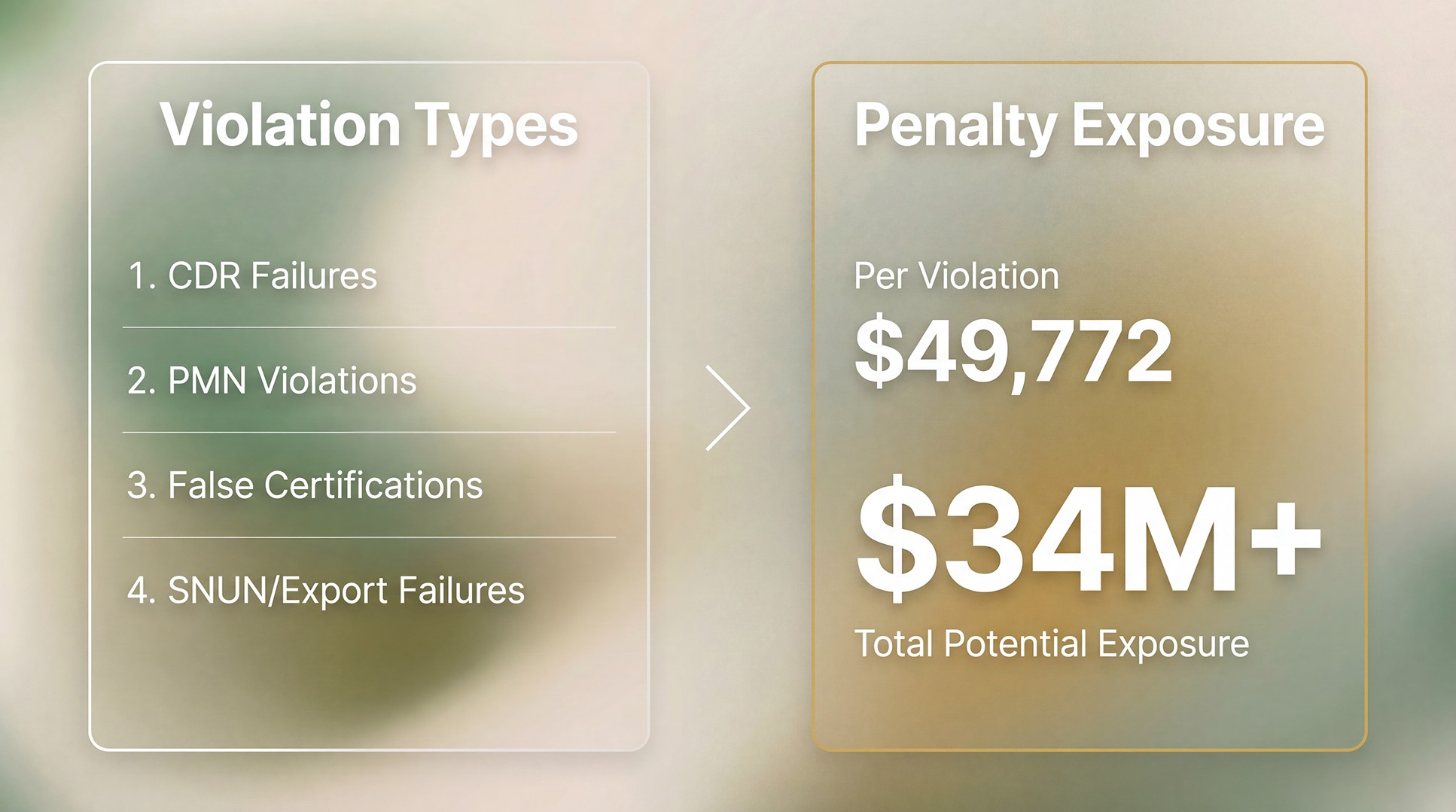
The June 2026 complaint alleges eight distinct categories of TSCA violations. Understanding the penalty structure matters because each individual chemical substance or individual violation event is counted separately.
Penalty-Multiplying Violation Categories
✓ CDR Reporting Failures account for the largest share of counts. The complaint alleges that the company failed to submit timely CDR data for over 200 chemicals across two reporting cycles, and separately failed to include required use information for 247 chemicals. Each chemical constitutes a separate violation, with penalties of up to $49,772 per chemical.
✓ PMN Violations arise when a new chemical substance is imported without prior EPA notification. The complaint alleges seven PMN violations, each carrying the same per-violation penalty ceiling.
✓ False Certifications create a separate enforcement track. Filing a TSCA certification stating compliance when the underlying requirements have not been met is treated as an independent violation. The complaint alleges both false import certifications and a false Notice of Commencement.
✓ SNUN and Export Notification Failures relate to significant new use notices and export reporting for chemicals subject to Significant New Use Rules (SNURs).
The compounding effect is severe. When CDR failures apply per-chemical and per-cycle, a single company can accumulate hundreds of counts from what might appear to be a single administrative failure: not submitting a report on time.
Companies managing chemical and hazmat compliance programs should treat CDR submissions with the same rigor applied to financial reporting. The penalty math demands it.
CDR Reporting Failures and the Cost of Delayed Submissions
CDR is EPA's primary mechanism for collecting data on chemical substances manufactured or imported in the United States. Reporting is required every four years for substances exceeding specified volume thresholds (25,000 pounds for most chemicals, 2,500 pounds for certain categories).
The complaint highlights a critical operational failure: the company initially missed its 2020 CDR submission entirely. When it eventually filed, the submission omitted required information about how each chemical would be used. EPA relies on this use data to evaluate public health risks. Omitting it does not satisfy the reporting obligation.
Why CDR Gaps Persist
Many importers treat CDR as a periodic administrative task rather than a continuous data management responsibility. The root causes of CDR failures are predictable:
⚠ Import volume data is scattered across ERP systems, customs brokers, and supplier invoices with no centralized aggregation
⚠ Chemical identity mapping between commercial product names and TSCA Inventory nomenclature is inconsistent
⚠ Use information requires coordination with downstream customers, which is rarely systematic
⚠ Internal ownership of CDR submissions is unclear, particularly in companies where regulatory affairs, procurement, and logistics operate independently
Organizations that maintain a centralized compliance data backbone for substance-level tracking are better positioned to generate accurate CDR submissions without last-minute scrambles.
📌 Struggling with chemical import data scattered across systems? See how Certivo centralizes substance-level compliance data. Book a demo
How False Certifications Create Compounding Legal Exposure
TSCA requires importers to certify at the time of import that their shipments comply with applicable TSCA requirements. This certification is not a formality. Filing a false certification, whether the company knew it was false or simply failed to verify, constitutes an independent violation.
The June 2026 complaint alleges that the company:
Filed import certifications for a chemical that had not received PMN clearance
Filed a Notice of Commencement claiming it had begun importing a chemical when it had not
Filed a certification stating it had not imported a chemical under a TSCA risk evaluation during the previous five years, when it had
Each false certification is a separate count. For importers handling dozens or hundreds of chemical substances, the certification obligation must be backed by verifiable, time-stamped evidence of compliance status for every substance at the point of import.
This is fundamentally a data integrity problem. AI document parsing and certificate validation capabilities can cross-reference TSCA Inventory status, PMN clearances, SNUR applicability, and risk evaluation coverage before certifications are filed, reducing the risk of inadvertent false statements.
TSCA compliance violation categories and penalty exposure for chemical importers
Click on image to view full
How Manufacturers and Importers Should Respond Now
The enforcement trajectory is clear. Companies importing chemical substances into the United States should take the following steps:
✅ Audit CDR Submission History — Verify that all prior CDR submissions were timely, complete, and included required use information. EPA is pursuing historic violations, not just current-cycle gaps.
✅ Verify TSCA Inventory Status for All Imports — Confirm that every imported chemical substance is listed on the TSCA Inventory or has received appropriate PMN clearance. A single unlisted substance creates PMN and certification violations simultaneously.
✅ Review TSCA Import Certification Procedures — Ensure that certifications filed with U.S. Customs are backed by verified compliance data, not assumptions. Implement pre-import verification workflows.
✅ Map SNUR Applicability — Determine whether any imported substances are subject to Significant New Use Rules and ensure that SNUNs and export notifications have been filed where required.
✅ Centralize Import Compliance Data — Consolidate chemical identity, volume, use, and certification records in a single system that supports continuous audit-ready documentation and time-stamped evidence trails.
✅ Assign Clear Internal Ownership — Designate responsibility for TSCA import compliance across regulatory affairs, procurement, and logistics functions. Cross-functional accountability gaps are the most common root cause of systemic reporting failures.
For a broader view of TSCA requirements, see Certivo's TSCA framework page and the related guide on how Certivo automates TSCA PFAS reporting for article importers.
How AI Reduces TSCA Compliance Risk at Scale
Manual TSCA compliance processes, built on spreadsheets, email chains, and periodic consultant reviews, cannot keep pace with the volume and complexity of import operations at enterprise scale.
CORA-powered regulatory intelligence enables automated cross-referencing of imported chemical substances against the TSCA Inventory, active SNURs, risk evaluation subjects, and CDR reporting thresholds. This reduces the likelihood of the exact failure modes alleged in the June 2026 complaint: missed submissions, omitted use data, and false certifications.
Certivo's platform supports automated supplier data collection for chemical identity and use information, BOM-level compliance intelligence linking substances to specific products, and regulatory intelligence and horizon scanning that alerts teams to SNUR changes and CDR cycle deadlines before they become enforcement risks.
For a deeper perspective on AI-driven chemical compliance, see the AI Tools for Compliance Management guide on Certivo.
Executive Conclusion
EPA's $34 million complaint against a chemical supplier for TSCA violations is not an outlier. It is the direct result of a deliberate enforcement expansion targeting chemical importers announced in late 2025. The violations alleged, including CDR failures, missing PMNs, false certifications, and unreported exports, are common operational gaps in companies that treat TSCA compliance for chemical importers as a periodic administrative task rather than a continuous data management discipline.
The penalty math is unforgiving. Per-chemical, per-cycle counting means that even a single missed CDR submission can generate hundreds of separate violation counts. Companies importing chemical substances into the United States should audit their TSCA compliance posture now, centralize substance-level data, and implement verification workflows that prevent false certifications before they are filed.
📌 Book a demo to see how Certivo automates TSCA import compliance across your chemical portfolio and supply chain, or get a free compliance risk assessment to evaluate your current CDR and certification readiness.
FAQs
1. What penalties can chemical importers face for CDR reporting failures under TSCA?
EPA can impose penalties of up to $49,772 per chemical substance per reporting cycle for CDR failures. Because penalties are counted per-chemical, a company importing hundreds of substances can face exposure in the tens of millions of dollars. Certivo's CORA intelligence automates CDR threshold monitoring and submission tracking to prevent these gaps.
2. How far back can EPA pursue TSCA enforcement for missed reports?
EPA's June 2026 complaint covers violations dating to at least 2016, with the formal investigation starting in 2021. This confirms that EPA pursues historic non-compliance, not just current-cycle failures. Maintaining time-stamped, audit-ready documentation is essential for demonstrating past compliance.
3. What is the difference between a CDR violation and a PMN violation under TSCA?
CDR violations relate to failure to report data on manufactured or imported chemicals. PMN violations occur when a new chemical substance not on the TSCA Inventory is imported without prior EPA notification. Both carry per-violation penalties, and importing without a PMN also triggers a separate false certification count.
4. How can importers verify TSCA Inventory status before filing import certifications?
Importers must confirm that each chemical substance is listed on the TSCA Inventory or has received PMN clearance before certifying compliance at import. CORA-driven compliance intelligence can cross-reference substance identities against Inventory status, active SNURs, and risk evaluation coverage automatically.
5. What operational changes reduce the risk of TSCA enforcement action for importers?
Centralizing chemical identity, volume, and use data in a single compliance platform, assigning clear internal ownership of TSCA obligations, and implementing pre-import verification workflows are the most effective structural changes. Certivo's automated supplier data collection and substance-level tracking support all three.
Vasanth
Vasanth is a skilled Compliance Engineer with over five years of experience specializing in global environmental regulations, including REACH, RoHS, Proposition 65, POPs, TSCA, PFAS, CMRT, EMRT, FMD, and IMDS. With a strong academic foundation in Chemical Engineering from Anna University, he brings a deep technical understanding to compliance processes across complex product lines.
Vasanth excels in analyzing Bills of Materials (BOMs), evaluating supplier declarations, and ensuring regulatory conformity through meticulous review and risk assessment. He is highly proficient in supplier engagement, adept at interpreting material disclosures, and experienced in preparing customer-ready compliance documentation tailored to diverse global standards.