


Article importers face unprecedented regulatory complexity as the EPA's TSCA Section 8(a)(7) PFAS reporting deadline approaches in October 2026. The requirement to track and report over 12,000 PFAS compounds across imported articles creates operational challenges that manual compliance processes cannot address at scale.
TSCA PFAS reporting for article importers demands substance-level intelligence across multi-tier supply chains, automated data collection from overseas suppliers, and systematic documentation linking specific PFAS compounds to individual articles. Certivo addresses these challenges through AI-native compliance automation that transforms TSCA PFAS reporting from operational burden into systematic, scalable process. This guide examines the regulatory requirements, operational obstacles, and automated compliance strategies that enable article importers to meet the October 2026 deadline while maintaining continuous audit-ready documentation.
Table of Contents
Why TSCA PFAS Reporting Creates Unique Challenges for Article Importers
TSCA Section 8(a)(7) Legal Framework and Article Importer Obligations
What Qualifies as an "Article" Under TSCA PFAS Reporting
The 12,000+ PFAS Compound Identification Challenge
Supplier Data Collection Across International Supply Chains
Documentation and Record-Keeping Requirements
Compliance Risks and Enforcement Penalties for Non-Reporting
October 2026 Deadline: Reporting Timeline and Preparation Requirements
How Certivo's AI-Native Compliance Automation Solves TSCA PFAS Complexity
Strategic Compliance Preparation Checklist for Article Importers
Frequently Asked Questions
Conclusion
Why TSCA PFAS Reporting Creates Unique Challenges for Article Importers
Article importers occupy a distinct regulatory position under TSCA Section 8(a)(7). Unlike domestic manufacturers who control production processes and material specifications, importers depend entirely on foreign suppliers for PFAS composition data. This dependency creates compliance vulnerabilities that traditional manual processes cannot systematically address.
The operational challenge extends beyond identifying PFAS presence. Article importers must verify supplier declarations against the EPA's comprehensive PFAS list, track specific compound identities including CAS numbers and molecular formulas, document intended use categories for each article, and maintain records demonstrating due diligence in supplier data collection.
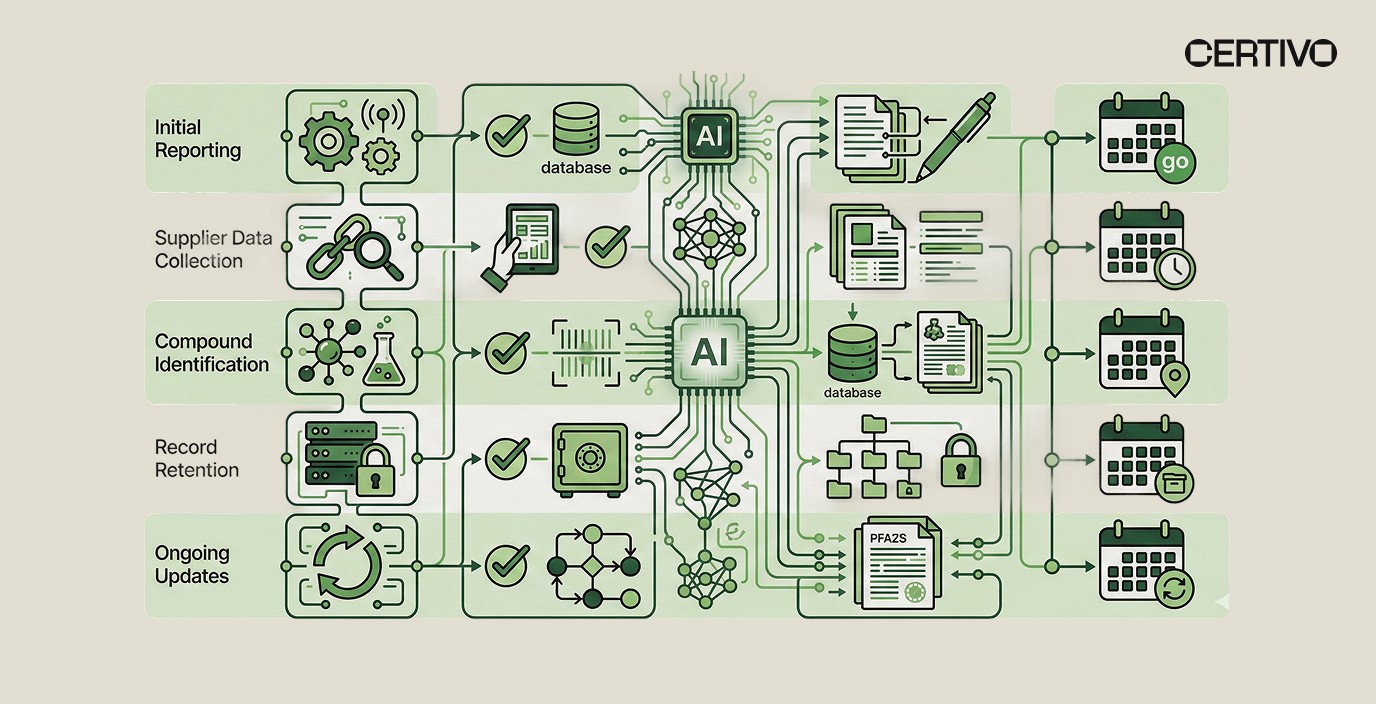
PFAS compliance in 2026 reflects the reality that "out of scope" no longer exists for global manufacturers and importers. Supply chain transparency requirements now reach component-level PFAS identification across thousands of article categories. Manual spreadsheet-based tracking fails when importers manage hundreds of suppliers across multiple countries, each providing data in different formats and languages. Certivo's centralized compliance platform addresses these complexities through systematic supplier data collection and automated compound verification.
TSCA Section 8(a)(7) Legal Framework and Article Importer Obligations
The EPA finalized TSCA Section 8(a)(7) reporting requirements in October 2023, establishing mandatory PFAS reporting for manufacturers and importers. The regulation defines specific obligations for entities importing articles containing PFAS into U.S. commerce.
Regulatory Scope and Applicability
TSCA PFAS reporting requirements apply to any entity that manufactures or imports articles for commercial purposes if those articles contain PFAS that was manufactured or imported after January 1, 2011. The lookback period requires article importers to assess PFAS presence in articles imported over the past 15+ years.
Article importers must report if they have manufactured, imported, or processed PFAS-containing articles during the reporting period. The regulation defines "importer" broadly to include any entity bringing articles into U.S. customs territory, regardless of ownership structure or commercial relationship.
Reporting Triggers and Exemptions
Small manufacturers and importers with annual sales under $10 million qualify for limited exemptions, though they must still maintain records and respond to EPA information requests. Articles containing PFAS below de minimis thresholds may qualify for partial exemptions, but importers must document the basis for claiming exemptions.
The EPA provides no blanket exemptions for specific article categories or industries. Managing 12,000+ PFAS compounds requires systematic compound-level tracking rather than product category assumptions.
What Qualifies as an "Article" Under TSCA PFAS Reporting
The TSCA definition of "article" determines reporting scope for importers. Understanding which imported products constitute articles versus substances or mixtures affects compliance obligations and reporting strategies.
TSCA Article Definition
Under TSCA, an "article" is a manufactured item formed to a specific shape or design during manufacture, whose end use function depends in whole or in part upon its shape or design during end use, and that does not release or otherwise result in exposure to a chemical substance under normal conditions of processing or use.
This definition excludes fluids and particles but includes finished goods, components, and parts that maintain structural integrity during use. Article importers bringing in textiles, electronics, automotive parts, construction materials, consumer products, and industrial equipment typically fall under TSCA PFAS reporting requirements.
Common Article Categories Containing PFAS
Textiles and Apparel: Treated fabrics, outdoor clothing, uniforms, protective gear, carpeting, and upholstery frequently contain PFAS for water and stain resistance. Global cosmetics and textile PFAS restrictions demonstrate increasing regulatory attention to these product categories.
Electronics and Electrical Components: Semiconductor components, printed circuit boards, wire insulation, and electronic housings may contain PFAS in manufacturing residues or intentional applications.
Automotive Parts: Gaskets, seals, hoses, fuel system components, and interior treatments use PFAS for chemical resistance and durability. Automotive compliance now includes substance-level PFAS tracking alongside traditional material restrictions.
Construction Materials: Coatings, sealants, adhesives, roofing membranes, and treated building materials incorporate PFAS for weather resistance and longevity. Construction material compliance requires verification across diverse product types.
Consumer Products: Cookware, food packaging, personal care items, and household goods may contain PFAS despite increasing state-level restrictions. Importers must verify PFAS presence even in products claiming PFAS-free status.
The 12,000+ PFAS Compound Identification Challenge
The EPA's PFAS definition encompasses over 12,000 distinct chemical compounds, each with unique CAS numbers, molecular formulas, and structural identifiers. Article importers must identify specific PFAS compounds rather than providing generic PFAS-present declarations.
PFAS Chemical Identification Requirements
TSCA reporting requires specific chemical identifiers including CAS Registry Number when available, chemical name following IUPAC nomenclature, molecular formula, and structural representation for novel PFAS without established CAS numbers. Generic terms like "PFAS-containing" or "fluoropolymer" do not satisfy reporting requirements.
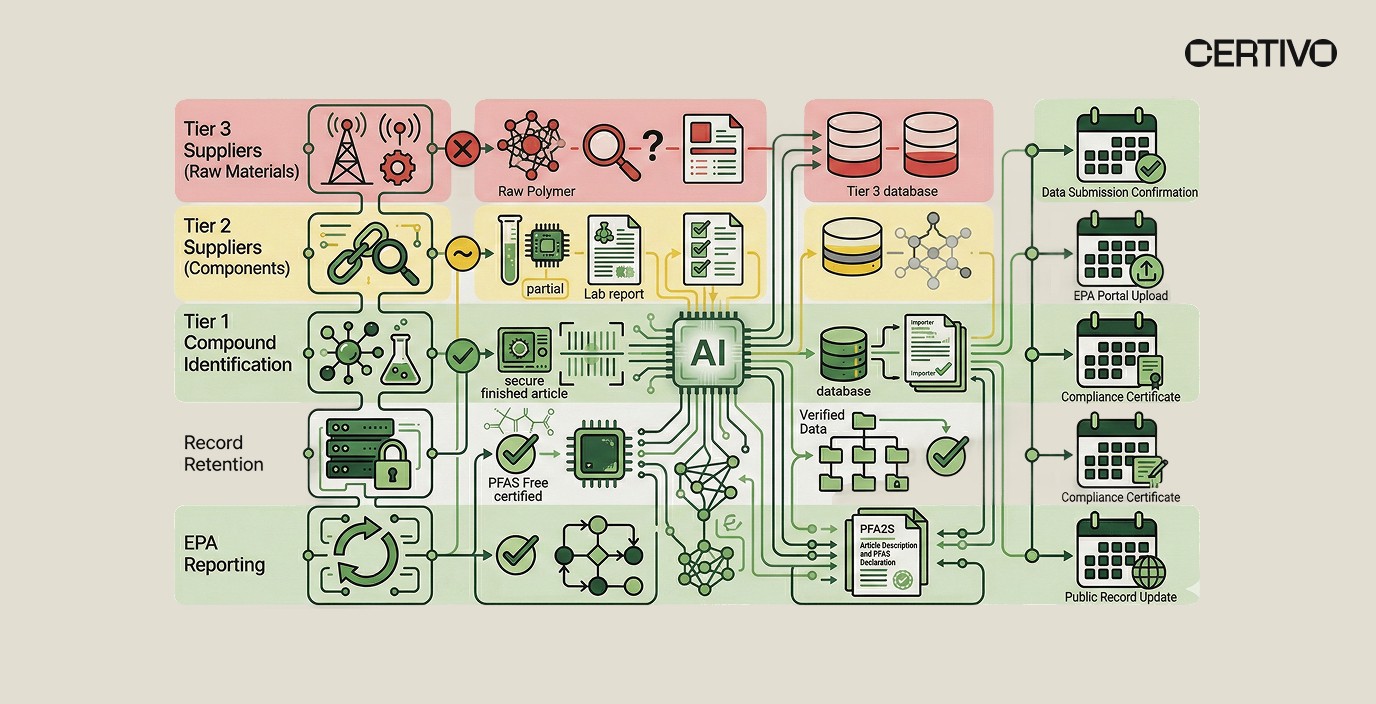
The challenge intensifies because many suppliers lack compound-specific PFAS data. Overseas manufacturers may use proprietary formulations, source materials from sub-tier suppliers, or lack laboratory testing infrastructure to identify specific PFAS compounds. Multi-tier supply chain transparency becomes essential for importers to obtain compound-level data.
Common PFAS Compounds in Imported Articles
High-priority PFAS compounds in imported articles include PTFE (polytetrafluoroethylene), PFOA (perfluorooctanoic acid) and its salts, PFOS (perfluorooctanesulfonic acid) and its derivatives, GenX chemicals and newer alternatives, and fluoropolymer manufacturing aids and processing residues.
Importers cannot assume PFAS absence based on product category or supplier claims. PFAS compliance and chemical ID intelligence requires systematic verification protocols and AI-enabled compound matching.
Supplier Data Collection Across International Supply Chains
Article importers depend on foreign suppliers for PFAS composition data. Systematic supplier data collection represents the most significant operational challenge in achieving TSCA PFAS reporting compliance.
Supplier Communication and Questionnaire Design
Effective PFAS data collection requires clear communication of U.S. regulatory requirements to suppliers unfamiliar with TSCA. Standardized supplier questionnaire frameworks must request compound-specific PFAS identifiers, concentration levels or ranges, intended function of PFAS in the article, and manufacturing process descriptions.
Generic supplier questionnaires asking "Does your product contain PFAS?" generate insufficient data for TSCA reporting. Suppliers need specific compound lists, CAS number references, and clear instructions on required documentation. Centralized supplier self-service portals improve response rates and data quality through structured data collection workflows.
Addressing Language and Technical Barriers
International suppliers may not understand PFAS terminology, lack analytical testing capabilities, or face internal restrictions on disclosing proprietary formulations. Importers must provide multilingual questionnaires, offer technical assistance interpreting PFAS definitions, and establish confidentiality agreements protecting supplier proprietary information.
Supplier self-service compliance portals enable suppliers to submit data in their native language with automated translation and validation. AI-native compliance automation reduces manual follow-up cycles and accelerates data collection timelines.
Managing Non-Responsive Suppliers
Suppliers failing to provide PFAS data create compliance gaps. Article importers must document outreach attempts, escalate requests through commercial relationships, consider alternative suppliers when data remains unavailable, and in some cases, commission independent laboratory testing.
The EPA expects importers to demonstrate reasonable inquiry and due diligence in obtaining supplier data. Documentation of supplier outreach and response tracking becomes essential compliance evidence. Certificate lifecycle automation maintains organized records of supplier communications and data submissions.
Documentation and Record-Keeping Requirements
TSCA Section 8(a)(7) imposes specific documentation and record retention requirements on article importers. Systematic record-keeping determines audit readiness and EPA inspection outcomes.
Required Documentation Categories
Article importers must maintain supplier questionnaires and responses, analytical test reports and certificates of analysis, PFAS compound identification records with CAS numbers, article descriptions and intended use categories, import volume and value data, and EPA reporting submissions with confirmation receipts.
Documentation must demonstrate the importer's reasonable inquiry process and due diligence in obtaining PFAS information. The EPA may request supporting records during inspections or enforcement proceedings. Continuous audit-ready documentation systems maintain organized, version-controlled compliance records.
Record Retention Requirements
TSCA requires article importers to retain records for five years from the date of reporting or the date the article was last imported, whichever is later. This extended retention period necessitates systematic document management beyond typical commercial record-keeping practices.
Paper-based or email-based record systems fail to support five-year retention with version control and audit traceability. Automated regulatory dossier generation creates organized compliance packages linking supplier data, test reports, and EPA submissions.
Article-Level Tracking and BOM Integration
Importers managing diverse product portfolios must link PFAS data to specific article numbers, SKUs, or product identifiers. When articles contain multiple components from different suppliers, BOM-level substance intelligence enables accurate PFAS tracking at the component level.
BOM-level compliance intelligence decomposes complex articles into components and links PFAS declarations to specific parts. This granular tracking supports accurate EPA reporting and facilitates supplier change impact analysis.
Compliance Risks and Enforcement Penalties for Non-Reporting
TSCA Section 8(a)(7) violations carry significant financial penalties and operational consequences. Understanding enforcement exposure informs compliance investment decisions and organizational prioritization.
Civil Penalties for TSCA Violations
The EPA can assess civil penalties up to $45,268 per violation per day for TSCA Section 8(a)(7) non-compliance. Each article imported without required PFAS reporting could constitute a separate violation. For importers bringing in thousands of articles annually, potential penalty exposure reaches tens of millions of dollars.
Civil penalties apply regardless of intent. Article importers lacking PFAS data due to unresponsive suppliers still face enforcement exposure. The EPA considers mitigation factors including good faith compliance efforts and documented due diligence, but penalties remain possible even with demonstrated reasonable inquiry.
Import Restrictions and Market Access Risk
The EPA and U.S. Customs and Border Protection coordinate on TSCA enforcement. Articles imported without TSCA compliance documentation may be refused entry, detained at ports pending compliance verification, or subject to immediate export requirements. Import disruptions create supply chain delays, customer contract breaches, and revenue loss.
Managing compliance risk proactively prevents import disruptions that cascade through commercial operations. Systematic PFAS verification before import attempts reduces customs detention risk.
Commercial and Reputational Consequences
Beyond regulatory penalties, TSCA non-compliance creates commercial risk. Customer contracts increasingly require PFAS disclosure and TSCA compliance warranties. Downstream manufacturers using imported articles in their products face their own TSCA obligations and may terminate supplier relationships following compliance failures.
Reputational damage from EPA enforcement actions affects brand value, investor confidence, and customer trust. Public disclosure of TSCA violations through EPA enforcement databases creates lasting commercial consequences. Why ESG failure is a supply chain risk explains how regulatory non-compliance extends beyond direct penalties.
October 2026 Deadline: Reporting Timeline and Preparation Requirements
The EPA established staggered reporting deadlines based on entity size and manufacturing volume. Article importers face the October 2026 deadline for PFAS reporting covering activities from January 1, 2011 through the reporting date.
Reporting Period and Lookback Requirements
Article importers must report PFAS-containing articles imported between January 1, 2011 and the reporting deadline. This 15-year lookback period requires historical record reconstruction for many importers. Organizations lacking systematic PFAS tracking since 2011 face substantial data collection challenges.
The EPA provides no safe harbor for incomplete historical records. Importers must demonstrate reasonable efforts to obtain historical PFAS data through supplier outreach, internal document review, and analytical testing when supplier data remains unavailable. PFAS compliance in 2026 explains why retrospective compliance creates operational complexity.
Submission Process and Technical Requirements
Article importers submit PFAS reports through the EPA's Central Data Exchange (CDX) portal using standardized electronic reporting formats. The submission process requires detailed information including specific PFAS compound identifiers, article descriptions and categories, import volumes and dates, and supplier information.
Technical submission requirements demand structured data rather than narrative descriptions or PDF uploads. Importers extracting PFAS data from unstructured supplier communications must transform that information into EPA-specified reporting formats. Automated regulatory dossier generation converts supplier data into EPA reporting formats systematically.
Critical Preparation Milestones
Achieving October 2026 compliance requires systematic preparation beginning months in advance. Critical milestones include completing supplier inventory and initial outreach, implementing systematic PFAS data collection processes, verifying compound identification and CAS number accuracy, documenting reasonable inquiry and due diligence efforts, preparing EPA submission data packages, and establishing ongoing PFAS monitoring protocols.
Importers beginning TSCA PFAS preparation in 2026 face compressed timelines and elevated supplier follow-up burden. PFAS reporting requirements preparation emphasizes early systematic data collection over last-minute reporting scrambles.
How Certivo's AI-Native Compliance Automation Solves TSCA PFAS Complexity
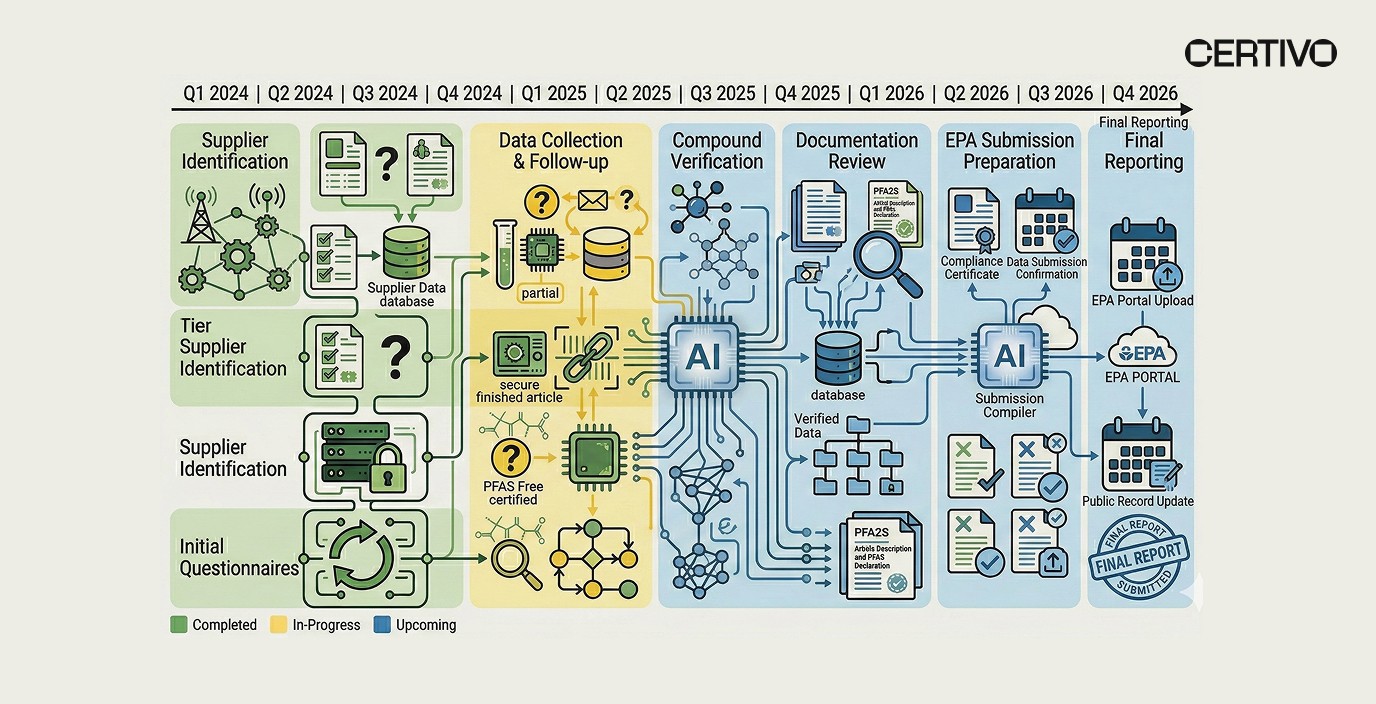
Manual TSCA PFAS reporting processes fail at the scale and complexity article importers face. Certivo's AI-native compliance automation transforms operational burden into systematic, scalable compliance capability through CORA-powered regulatory intelligence.
Automated PFAS Compound Identification
Certivo's CORA-powered regulatory intelligence automatically matches supplier-provided chemical names, trade names, and partial identifiers against the EPA's comprehensive PFAS compound database. When suppliers provide incomplete data like "fluoropolymer" or "PFAS-containing coating," Certivo's AI systems cross-reference chemical categories, typical uses, and industry practices to identify probable specific compounds requiring reporting.
Managing 12,000+ PFAS compounds becomes operationally feasible through automated compound matching and CAS number verification. Certivo eliminates manual CAS number lookup and molecular formula validation for thousands of supplier declarations.
Intelligent Supplier Data Collection
Certivo deploys intelligent questionnaires adapting to supplier responses through AI-native compliance automation. When suppliers indicate PFAS presence, follow-up questions automatically request compound-specific identifiers, concentration data, and functional use information. When suppliers claim PFAS absence, validation protocols request certification statements and basis for determination.
Centralized supplier self-service portals powered by Certivo's AI reduce importer workload while improving data completeness. Automated follow-up sequencing based on response patterns accelerates data collection without manual tracking.
Multi-Language Document Intelligence
Article importers receive supplier documentation in multiple languages and formats. Certivo's CORA intelligence extracts PFAS data from Chinese, Japanese, Korean, German, and other language documents automatically. AI-powered translation and data extraction convert foreign-language test reports and safety data sheets into structured English-language PFAS data.
Document intelligence capabilities process PDFs, scanned images, and unstructured text to extract CAS numbers, chemical names, concentration values, and test methodologies without manual data entry. Automated regulatory dossier generation compiles extracted data into organized compliance packages.
BOM-Level PFAS Tracking
Complex articles containing multiple components require component-level PFAS tracking. Certivo's BOM-level substance intelligence links PFAS declarations to specific parts within assembled products. When components change or suppliers substitute materials, Certivo's AI systems identify affected articles requiring updated PFAS verification.
BOM-level compliance intelligence enables article importers to track PFAS at the granular level EPA reporting requires while managing data at scale across thousands of article SKUs.
Automated EPA Reporting Package Generation
Certivo's CORA-driven compliance intelligence transforms collected supplier data, verified compound identifications, and article descriptions into EPA CDX submission formats automatically. AI systems validate data completeness, flag missing required fields, and ensure CAS number and molecular formula accuracy before submission.
Automated regulatory dossier generation eliminates manual data transcription errors that trigger EPA rejection or require resubmission. Specialized substance reporting solutions streamline multi-framework compliance including TSCA PFAS alongside REACH, RoHS, and state-level PFAS mandates.
Continuous Monitoring and Update Protocols
TSCA PFAS compliance extends beyond initial October 2026 reporting. Article importers must update reports when PFAS composition changes, new articles enter import portfolios, or EPA expands PFAS compound coverage. Certivo's CORA regulatory intelligence layer monitors regulatory updates and identifies when imported articles require supplemental reporting.
Certivo maintains continuous audit-ready documentation supporting ongoing compliance rather than periodic reporting sprints. Regulatory intelligence and horizon scanning anticipates regulatory changes before enforcement begins.
Strategic Compliance Preparation Checklist for Article Importers
Systematic preparation determines TSCA PFAS reporting success. Article importers should implement these strategic compliance measures immediately.
✓ Immediate Actions (Q1-Q2 2024)
1. Conduct Comprehensive Article Inventory: Catalog all imported article categories with product descriptions, supplier identifications, import volumes, and known PFAS applications. Prioritize high-volume articles and products with likely PFAS presence based on functional properties.
2. Assess Current PFAS Data Availability: Review existing supplier documentation for PFAS information. Identify data gaps requiring supplier outreach and articles needing analytical testing. Document baseline data completeness to measure progress.
3. Establish Supplier Communication Protocols: Develop standardized PFAS questionnaires with compound-specific data requirements. Prepare multilingual versions for international suppliers. Create supplier outreach sequencing and escalation procedures.
4. Implement Centralized Data Management: Deploy centralized supplier self-service portals replacing email-based data collection. Establish document management systems supporting five-year record retention. Create version control protocols for supplier data updates.
✓ Near-Term Priorities (Q3 2024-Q2 2025)
5. Execute Systematic Supplier Outreach: Distribute PFAS questionnaires to prioritized suppliers. Track response rates and data completeness. Implement automated follow-up sequencing for non-responsive suppliers. Streamlining supplier documentation accelerates data collection cycles.
6. Verify PFAS Compound Identifications: Cross-reference supplier-provided PFAS names against EPA compound databases. Validate CAS numbers and molecular formulas. Flag generic or incomplete compound descriptions requiring clarification.
7. Commission Laboratory Testing: For articles with unresponsive suppliers or incomplete data, commission independent analytical testing. Select accredited laboratories with PFAS testing capabilities. Maintain test reports and chain of custody documentation.
8. Develop BOM-Level PFAS Tracking: Link PFAS declarations to specific article components and assemblies. Implement BOM-level substance intelligence for complex multi-component articles. Track compliance by BOM to enable granular PFAS reporting.
✓ Pre-Submission Activities (Q3 2025-Q3 2026)
9. Complete Documentation Review: Verify all required data elements for EPA reporting. Document reasonable inquiry efforts and due diligence measures. Organize supporting records by article category and supplier.
10. Prepare EPA Submission Packages: Transform collected data into EPA CDX reporting formats. Validate data completeness and accuracy. Conduct internal quality review of submission packages before filing.
11. Establish Ongoing Monitoring Protocols: Implement continuous PFAS monitoring for new article imports. Create supplier change notification requirements. Deploy regulatory intelligence monitoring for TSCA updates affecting reported articles.
12. Train Cross-Functional Teams: Educate procurement, quality, and operations teams on TSCA PFAS requirements. Establish compliance responsibilities and escalation procedures. Integrate PFAS verification into import approval workflows.
Frequently Asked Questions
What happens if my foreign suppliers refuse to provide PFAS data?
Article importers must document reasonable inquiry efforts including multiple outreach attempts, escalation through commercial relationships, and consideration of alternative suppliers. If suppliers remain unresponsive, importers should commission independent laboratory testing and document the inability to obtain supplier data. The EPA expects demonstrated due diligence rather than guaranteed data completeness, but importers retain reporting responsibility regardless of supplier cooperation. Certivo's automated supplier follow-up protocols document all outreach attempts and maintain compliance evidence.
Do I need to report PFAS in articles imported before 2011?
No. TSCA Section 8(a)(7) reporting covers articles manufactured or imported between January 1, 2011 and the reporting deadline. Articles imported before 2011 fall outside reporting scope even if still in inventory or commercial use. However, importers must maintain records documenting import dates to demonstrate articles qualify for pre-2011 exclusion.
How do I handle articles containing multiple components from different suppliers?
Articles with multi-supplier components require BOM-level PFAS tracking linking compound declarations to specific parts. Importers must collect PFAS data from each component supplier and aggregate compound-level information for the finished article. BOM-level compliance intelligence enables systematic tracking across complex assemblies. Report all PFAS compounds present in any article component rather than attempting whole-article characterization. Certivo's platform automatically aggregates component-level PFAS data into article-level reporting packages.
Can I claim PFAS absence without laboratory testing?
Article importers may rely on supplier declarations of PFAS absence if suppliers provide certified statements and technical basis for determination. However, importers should verify supplier claims through questionnaire responses addressing manufacturing processes, material specifications, and quality control procedures. Generic PFAS-free claims without supporting documentation provide insufficient verification. When supplier claims appear questionable based on article function or industry practices, independent testing provides compliance assurance. Certivo's validation protocols flag inconsistent supplier declarations requiring verification.
What ongoing obligations exist after October 2026 reporting?
TSCA Section 8(a)(7) requires updated reporting when article PFAS composition changes, new PFAS-containing articles enter import portfolios, or the EPA adds compounds to PFAS reporting requirements. Importers must maintain continuous monitoring protocols identifying when supplemental reporting becomes necessary. Record retention requirements extend five years from reporting date or last import date, requiring systematic document management. Continuous audit-ready documentation maintained through Certivo's CORA-powered regulatory intelligence supports ongoing compliance.
How does Certivo handle PFAS data for articles imported from multiple countries?
Certivo's AI-native compliance automation processes supplier documentation in multiple languages through intelligent document extraction and translation. Centralized supplier self-service portals enable international suppliers to submit data in their native language with automated validation and compound matching. Certivo's CORA intelligence cross-references supplier-provided chemical names against global substance databases to identify specific PFAS compounds regardless of regional nomenclature differences. BOM-level substance intelligence aggregates multi-country component data into unified article-level reporting packages meeting EPA submission requirements.
Conclusion
TSCA PFAS reporting for article importers represents a regulatory compliance challenge that manual processes cannot address at scale. The October 2026 deadline requires systematic preparation beginning immediately, with supplier data collection, compound identification, and documentation protocols established months in advance.
Article importers managing diverse international supply chains face operational complexity that Certivo's AI-native compliance automation systematically resolves. CORA-powered regulatory intelligence transforms the burden of tracking 12,000+ PFAS compounds across thousands of imported articles into scalable, automated compliance capability.
The shift from reactive compliance to continuous audit-ready documentation enables article importers to meet TSCA obligations while maintaining operational efficiency. Organizations implementing Certivo's centralized supplier self-service portals, BOM-level substance intelligence, and automated regulatory dossier generation position TSCA PFAS reporting as manageable regulatory requirement rather than existential compliance crisis. Explore how Certivo automates TSCA PFAS reporting for article importers before the October 2026 deadline.
Hari prasanth
Hariprasanth is a Chemical Compliance Specialist with nearly four years of experience, underpinned by a degree in Chemical Engineering. He brings in-depth expertise in global product compliance, working across key regulations such as REACH, RoHS, TSCA, Proposition 65, POPs, FMD, and PFCMRT.
Hariprasanth specializes in reviewing technical documentation, validating supplier inputs, and ensuring that products consistently meet regulatory standards. He works closely with cross-functional teams and suppliers to collect accurate material data and deliver clear, audit-ready compliance reports that stand up to scrutiny.
Through his strong analytical skills and regulatory insight, Hariprasanth enables organizations to navigate evolving compliance challenges while aligning with sustainability initiatives in an increasingly dynamic regulatory environment.