

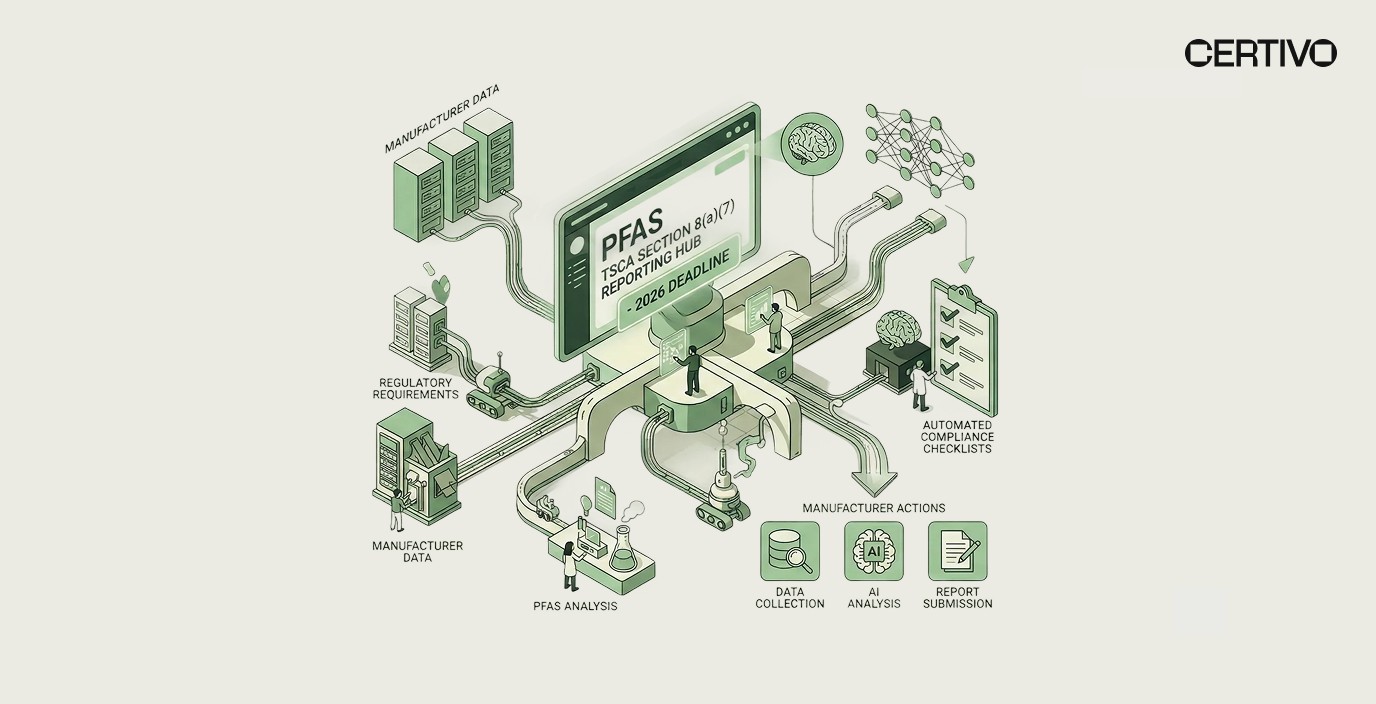
The TSCA Section 8(a)(7) PFAS reporting rule is still in force, but the date manufacturers were preparing for no longer exists. On April 13, 2026, EPA published a final rule moving the start of the data submission period to January 31, 2027, or 60 days after the effective date of a forthcoming rule revising the reporting requirements themselves, whichever comes first. EPA did not set a new closing deadline. Manufacturers now face an unusual position: a firm obligation, an unfixed deadline, and a pending rule that may narrow who has to report at all.
This post covers what the rule currently requires, what EPA has proposed to change, and how to prepare without committing budget to scope that may be exempted.
1. What TSCA Section 8(a)(7) requires
TSCA Section 8(a)(7) was added by Section 7351 of the National Defense Authorization Act for Fiscal Year 2020 (Pub. L. 116-92) in December 2019. It is a congressional mandate, not a discretionary EPA initiative. The provision directs EPA to promulgate a rule requiring each person who has manufactured a PFAS in any year since January 1, 2011 to report the information described in TSCA Sections 8(a)(2)(A) through (G).
EPA finalized that rule on October 11, 2023, codified at 40 CFR Part 705. It is a one-time retrospective reporting exercise, not a recurring obligation. Reporting is submitted electronically through EPA's Central Data Exchange (CDX). For a broader view of federal PFAS obligations, see the Certivo TSCA framework overview and the PFAS framework page.
How the rule defines PFAS
The rule does not use a list. It uses a structural definition. A chemical substance is PFAS for purposes of Part 705 if it contains at least one of three structures:
R-(CF2)-CF(R')R", where both the CF2 and CF moieties are saturated carbons
R-CF2OCF2-R', where R and R' can be F, O, or saturated carbons
CF3C(CF3)R'R", where R' and R" can be F or saturated carbons
EPA has identified at least 1,462 PFAS covered by TSCA that may fall within the rule as of February 2023, of which 770 appear on the active TSCA Inventory. Because the definition is structural, a substance can be reportable even if it does not appear on any published PFAS list a company has been screening against.
2. Current deadline status after the April 2026 final rule
The April 13, 2026 final rule (91 FR 18786) amended 40 CFR 705.20. The submission period now begins on January 31, 2027, or 60 days following the date EPA identifies in a subsequent final rule, whichever is earlier. The rule became effective on publication.
EPA left the duration of the submission period untouched. As currently codified:
Reporter category | Submission window |
|---|---|
All reporters under 40 CFR 705.15 and 705.18(b) (R&D) | Six months from the start date |
Reporters filing exclusively under 40 CFR 705.18(a) as article importers who also meet the small manufacturer definition at 40 CFR 704.3 | Twelve months from the start date |
Two points matter for planning. First, EPA has stated it expects to issue the substantive final rule well before January 31, 2027, and expects to remove the January 2027 backstop at that point. The realistic start date is therefore tied to the pending rule, not to the calendar. Second, EPA built the two commencement dates to be severable: if one is vacated on judicial review, the other survives.
Why EPA moved the date
EPA received 27 unique comments plus 639 from a mail-in campaign on the May 2025 interim final rule, and nearly 600 unique comments plus more than 8,500 from two mail-in campaigns on the November 2025 proposal. The agency stated it needed additional time to address those comments, publish a final rule, release updated guidance, and update its reporting tool. Commenters had also pointed out that the codified submission period would have opened before any revision took effect, forcing companies to report under requirements that were about to change.
3. How the reporting period has shifted since 2023
The submission period has moved four times. Companies tracking this rule should assume the current date is provisional until the substantive final rule publishes.
Action | Date | Submission period start |
|---|---|---|
Final rule (88 FR 70516) | Oct 11, 2023 | November 12, 2024 |
Direct final rule (89 FR 72336) | Sep 5, 2024 | July 11, 2025 |
Interim final rule (90 FR 20236) | May 13, 2025 | April 13, 2026 |
Final rule (91 FR 18786) | Apr 13, 2026 | Jan 31, 2027, or 60 days after a forthcoming final rule |
The first two extensions were attributed to delays developing and testing the CDX reporting application. The most recent reflects the pending scope revisions. For a longer-view analysis of what this cadence of delays means for manufacturer readiness, see the Certivo analysis of the EPA's revised TSCA PFAS timeline.
4. Who must report under the rule as written today
The obligation falls on manufacturers and importers. TSCA defines manufacture to include import, so importers are manufacturers for purposes of this rule. Applicability criteria sit at 40 CFR 705.10 and 705.12.
[IMAGE 2: Who Must Report Under TSCA 8(a)(7) — Scope Decision Tree, see §F.2]
Covered under the current rule:
Domestic manufacturers of PFAS substances
Importers of PFAS substances and PFAS-containing mixtures
Importers of articles containing PFAS
Manufacturers whose PFAS is produced as a byproduct or is present as an impurity
Not covered:
Companies that purchase PFAS from a domestic source for subsequent processing or use. If you did not manufacture or import the PFAS, you are not the reporter for that substance. The rule does not create a processor obligation.
Substances excluded from TSCA's definition of chemical substance under TSCA Section 3(2)(B), including food, food additives, drugs, cosmetics, and devices when manufactured, processed, or distributed for use as such. Chemical suppliers into those sectors may still have obligations for substances that are within TSCA.
Decision tree showing which manufacturers must report PFAS under TSCA Section 8(a)(7) rule (13 words)
Click on image to view full

Sector-specific implications differ meaningfully across electronics manufacturing, automotive, medical devices, consumer goods, and building materials. Article-importer exposure in particular is concentrated in these sectors and is the scope EPA has proposed to narrow.
There is no de minimis threshold
Under the rule as currently written, there is no minimum volume and no minimum concentration. Any quantity of a PFAS manufactured or imported for a commercial purpose within the lookback period is reportable. This is the single largest source of scoping surprise for downstream importers, and it is also the provision EPA has proposed to change. See Section 7.
5. The lookback period: January 1, 2011 through December 31, 2022
The reporting period is twelve calendar years: January 1, 2011 through December 31, 2022. Activity after December 31, 2022 is outside the scope of this rule.
This differs from Chemical Data Reporting in an important way. Under CDR, only principal reporting years require full data. Under Part 705, every year in the lookback period is treated the same, and the same data set must be reported for each year in which reportable activity occurred. EPA's reporting tool allows companies to select only the years in which they manufactured or imported.
The practical consequence is that data assembly reaches back to records that may predate current ERP systems, supplier relationships, and in many cases the corporate entity itself. Divested business units, closed sites, and discontinued product lines remain in scope if the activity occurred during the period.
6. What data must be reported
TSCA Section 8(a)(7) incorporates the data elements at Section 8(a)(2)(A) through (G):
(A) Common or trade name, chemical identity, and molecular structure of each substance or mixture
(B) Categories or proposed categories of use
(C) Total amount manufactured or processed, amounts for each category of use, and reasonable estimates of proposed amounts
(D) Descriptions of byproducts resulting from manufacture, processing, use, or disposal
(E) All existing information concerning environmental and health effects
(F) Number of individuals exposed in their places of work, reasonable estimates of future exposure, and duration of exposure
(G) Manner or method of disposal, and any change in that method
The known or reasonably ascertainable standard
Reporting covers information known to or reasonably ascertainable by the submitter. This is an established TSCA standard and it requires more than reporting what is already in hand. It obligates a company to conduct a reasonable inquiry within its own organization and, where appropriate, of its suppliers. EPA maintains a due diligence guide with worked examples of how the standard applies. Absence of prior PFAS tracking is not a basis for reporting nothing.
7. What EPA proposed to change in November 2025
On November 13, 2025, EPA proposed revisions to Part 705 (90 FR 50923). The comment period closed December 29, 2025. EPA proposed exemptions for:
PFAS manufactured or imported in mixtures or products at concentrations of 0.1% or lower
Imported articles
Certain byproducts
Impurities
Research and development chemicals
Non-isolated intermediates
EPA also requested comment on whether a de minimis exemption should be set at 1.0% rather than 0.1%, and on ways to consolidate the proposed exemptions.
Comparison of TSCA 8(a)(7) proposed exemptions versus unchanged rule requirements from November 2025 proposal (14 words)
Click on image to view full

What EPA did not propose to change is as important as what it did. The proposal leaves intact the lookback period, the structural definition of PFAS, the data elements required, and the known or reasonably ascertainable standard.
If finalized as proposed, the imported-article exemption would remove a substantial share of downstream importers from the rule entirely. Any company whose only anticipated obligation runs through imported articles should weight its near-term spending accordingly. For a deeper read of what the proposed exemptions mean for scope, see Certivo's breakdown of EPA's proposed TSCA 8(a)(7) exemptions.
8. What to do now
The delay does not justify stopping work, but it does change what work is worth doing. The distinction is between activities that hold their value regardless of how the final rule lands and activities that could be wasted.
Work that holds its value
Determine whether you are a reporter at all. Confirm whether your activity is manufacture or import, or whether you are a domestic purchaser and therefore outside the rule. This answer does not change with the pending revisions.
Establish your 2011 through 2022 activity map. Identify which legal entities, sites, and business units conducted manufacture or import during the lookback period, including divested and closed operations. The lookback period is not under revision.
Screen against the structural definition, not a list. Move substance screening from named-PFAS lists to the three structural criteria at 40 CFR 705. This is durable work.
Locate and preserve historical records. Retention schedules will continue to erode 2011 through 2016 records while the rule is pending. Identify and hold what exists now.
Document your due diligence method. The known or reasonably ascertainable standard is not being revised. A defensible, written inquiry methodology is required whichever version of the rule takes effect.
Work worth staging until the final rule publishes
Full supplier outreach on imported articles. If the article exemption is finalized, this campaign may be unnecessary. Scope it, but do not launch at full breadth.
Analytical testing to resolve low-concentration presence. A 0.1% or 1.0% de minimis threshold would change which results matter.
Byproduct, impurity, and non-isolated intermediate characterization. All three are subject to proposed exemptions.
CDX submission preparation. EPA has stated it will update the reporting tool after the final rule. Building submission workflows against the current tool risks rework.
Where a compliance system helps
The work that holds its value has a common shape: it depends on being able to identify PFAS across a large substance set, tie that identification to legal entities and sites across a twelve-year historical window, and reproduce the reasoning under audit. Manufacturers running this on spreadsheets typically discover the effort is not the reporting itself — it is reconstructing which historical BOMs, supplier declarations, and site records survive, and mapping them to a structural definition of PFAS rather than a named list.
Certivo's platform functions as a system of record for compliance — centralizing supplier evidence, BOM-level substance data, and regulatory scope in one place. CORA's regulatory intelligence layer screens substances against the structural PFAS definition (not a static list), maps identified PFAS to affected BOMs, and preserves the point-in-time evidence needed for the known or reasonably ascertainable standard. For manufacturers with concentrated article-import exposure, our detail on how Certivo automates PFAS supplier data collection at scale covers the sequence.
Monitor these two triggers
The date that matters is the effective date of EPA's substantive final rule. When it publishes, the submission period opens 60 days later, and the closing deadline will be defined in that same action. Companies should also watch for whether EPA removes the January 31, 2027 backstop, which the agency has said it expects to do.
Prepare your TSCA 8(a)(7) position before the final rule opens the window
Once EPA publishes the substantive final rule, the submission period opens 60 days later. That is not enough time to reconstruct a twelve-year lookback across divested sites, closed lines, and supplier files that have already aged out of retention. The work that holds its value — activity mapping, structural PFAS screening, evidence preservation, and documented due diligence — can be started now with no exposure to being wasted by exemption changes.
Book a compliance risk assessment to map your entity-level exposure across the 2011–2022 lookback and identify the historical records worth preserving before the final rule publishes.
Hari prasanth
Hariprasanth is a Chemical Compliance Specialist with nearly four years of experience, underpinned by a degree in Chemical Engineering. He brings in-depth expertise in global product compliance, working across key regulations such as REACH, RoHS, TSCA, Proposition 65, POPs, FMD, and PFCMRT.
Hariprasanth specializes in reviewing technical documentation, validating supplier inputs, and ensuring that products consistently meet regulatory standards. He works closely with cross-functional teams and suppliers to collect accurate material data and deliver clear, audit-ready compliance reports that stand up to scrutiny.
Through his strong analytical skills and regulatory insight, Hariprasanth enables organizations to navigate evolving compliance challenges while aligning with sustainability initiatives in an increasingly dynamic regulatory environment.