


UK packaging EPR (pEPR) is now a live financial and reporting obligation, not a future policy. Producers are paying confirmed base fees, submitting packaging data twice a year, and facing recyclability-based fee modulation from the 2026 to 2027 scheme year. This guide explains who is obligated, what must be reported and by when, how base fees and modulation work, and where enforcement exposure sits, so UK compliance managers and producers selling into the UK can map their obligations accurately.
The UK scheme is separate from the EU Packaging and Packaging Waste Regulation (PPWR). A business selling into both markets carries two distinct regimes with different data models, fee mechanics, and administrators. If you are comparing them, start with our overview of PPWR requirements for packaging producers and our Extended Producer Responsibility framework page.
Key Takeaways
📌 pEPR is live: producers pay confirmed base fees and report packaging data through the GOV.UK RPD service under the 2024 Packaging Regulations.
⏳ Large producers report every 6 months (1 April and 1 October); small producers report annually by 1 April.
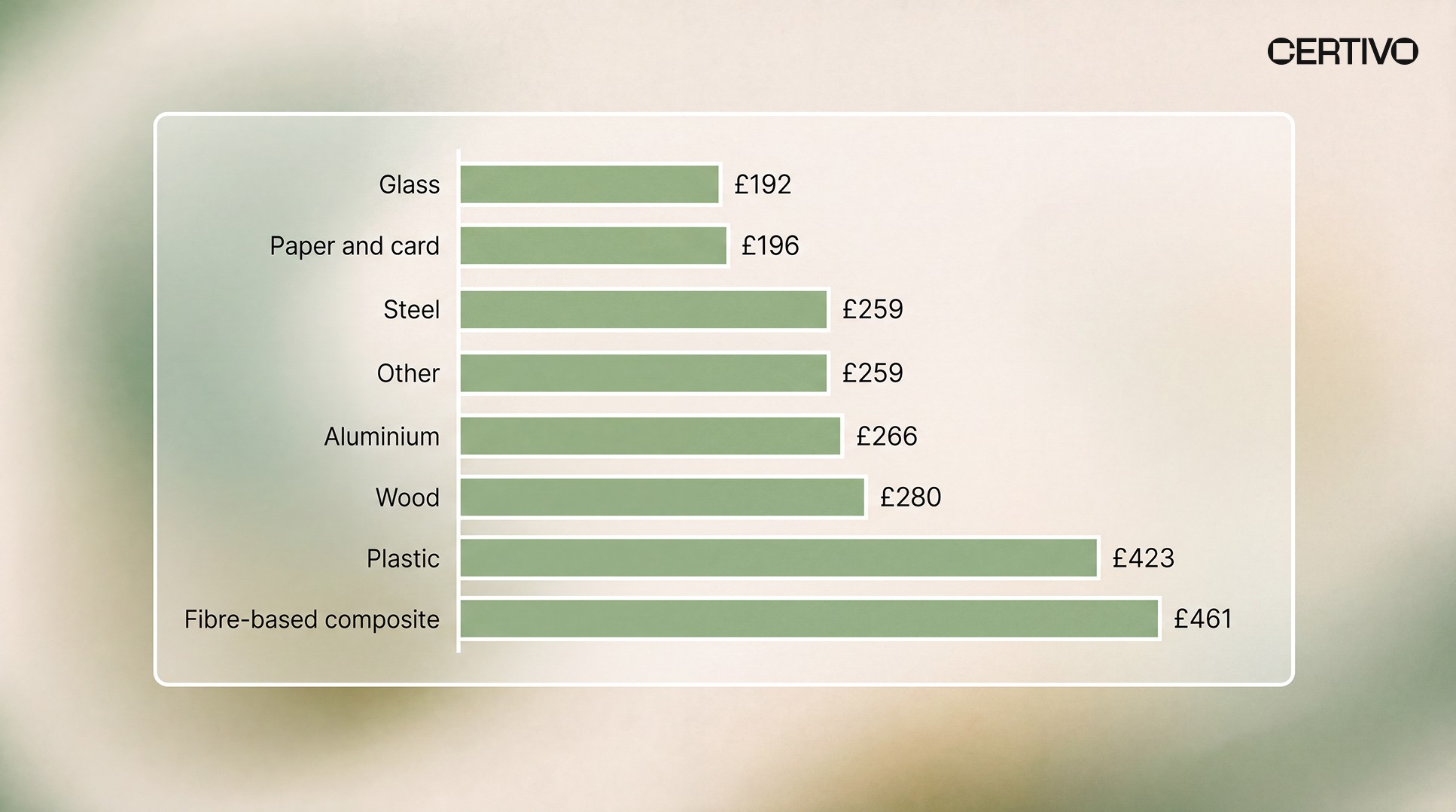
📊 2025 to 2026 base fees range from £192/tonne (glass) to £461/tonne (fibre-based composite).
📌 From 2026 to 2027, RAM modulation adjusts fees by recyclability; Red-rated packaging escalates from 1.2x to 2.0x by 2028 to 2029.
⚠️ Enforcement includes £1,000 fixed penalties, variable penalties up to 5% of turnover for unpaid fees, and possible director liability.
🔗 UK pEPR is separate from EU PPWR; multi-market producers carry two distinct regimes.
📄 Retain packaging data and evidence for at least 7 years; audited producers have been required to resubmit inaccurate data.
Book a Compliance Risk Assessment to map your UK pEPR reporting and fee obligations across products, materials, and nations of sale. → Speak with a compliance specialist
What UK Packaging EPR (pEPR) Is
Packaging extended producer responsibility (pEPR) is a UK-wide scheme that requires packaging producers to cover the full net cost of managing household packaging waste, including collection, sorting, recycling, and disposal once packaging is discarded by consumers. It operates under powers in the Environment Act 2021, with the core framework set out in the Producer Responsibility Obligations (Packaging and Packaging Waste) Regulations 2024, which largely came into force on 1 January 2025.
The scheme is administered by PackUK, the government-appointed scheme administrator acting on behalf of all four UK nations. Fees collected from producers are passed to local authorities to fund household recycling services. The government has estimated the shift in cost from local authorities to producers at around £1.2 billion annually, according to the House of Commons Library briefing on pEPR.
The distinction that matters operationally: this is the "polluter pays" model in practice. What you place on the UK market, by material and weight, now maps directly to a fee. For a broader view of how this fits global obligations, see our materials and environmental compliance solution.
Who Is an Obligated Producer
You are likely obligated if your business supplies packaging under your own brand, imports packaged goods, packs or fills packaging, supplies empty packaging, hires or loans reusable packaging, or operates an online marketplace enabling sales into the UK. The scheme covers all packaging types, including primary, secondary, tertiary, and shipment packaging, and it captures reusable packaging.
A key concept is "first UK supply." Under the revised rules, the brand owner making the first UK supply of filled packaging is generally the obligated producer for that item. This single-producer logic determines who carries the reporting and fee liability, which matters when several businesses touch the same packaged product.
Determining obligation across a complex portfolio is a data exercise. Producers with thousands of SKUs need to map packaging components to materials and weights before they can report accurately. Our track compliance by BOM use case explains how material-level mapping supports this, and our consumer goods industry page covers sector-specific packaging exposure.
Large vs Small Producer Thresholds
Producer category is set by two tests applied together: annual turnover and packaging tonnage handled in the relevant period. The category determines reporting frequency, dataset detail, and fee liability.
Producer Category | Turnover | Packaging Handled | Core Obligations |
|---|---|---|---|
Large producer | £2 million or more | More than 50 tonnes per year | Register annually; report data every 6 months; pay base fees; obtain PRNs/PERNs; report RAM and nation of sale data |
Small producer | £1 million to £2 million (or above £1m supplying 25–50 tonnes) | More than 25 tonnes, up to 50 tonnes | Register; report data annually; not currently required to pay disposal fees or obtain PRNs |
A business falls below scope only if it fails either the turnover test or the tonnage test. Small producers are not currently required to pay EPR waste management fees or obtain PRNs, though the government has indicated this may change as the scheme matures. Verify your current category against GOV.UK's "who is affected" guidance at each reporting cycle, since thresholds and obligations are being reviewed.
Struggling to confirm producer category and tonnage across multiple legal entities? A compliance review can help you map obligation before the next deadline.
UK packaging EPR large vs small producer thresholds and reporting obligations
Click on image to view full

What Must Be Reported and When
Reporting is built around calendar-period data submitted through the GOV.UK "Report packaging data" (RPD) service. Deadlines relate to the period in which packaging was supplied, and registration deadlines relate to the producer category and registration year.
Large producers collect and submit core packaging data every six months. Small producers submit once a year. Both must register with the appropriate environmental regulator (the Environment Agency in England, SEPA in Scotland, NRW in Wales, and NIEA in Northern Ireland).
Deadline | Who | What Is Due |
|---|---|---|
1 April 2026 | Large producers | Data for 1 July to 31 December 2025 |
1 April 2026 | Small producers | Full-year 2025 data; 2026 registration |
1 October 2026 | Large producers | Data for 1 January to 30 June 2026; 2027 registration |
1 April 2027 | Large producers | Data for 1 July to 31 December 2026 |
1 April 2027 | Small producers | Full-year 2026 data |
Source: GOV.UK packaging data reporting periods and submission deadlines.
From 2026, large producers must also collect nation of sale data, showing where packaging is supplied or discarded across the UK, reported by 1 April of the following year. Producers running closed-loop recycling can register intent to submit self-managed packaging waste data, with a legal registration deadline of 1 October each year, per GOV.UK closed loop packaging guidance. All producers must retain packaging data and supporting evidence for at least seven years.
The reporting burden is a data-quality problem more than a form-filling one. Audited producers have been required to resubmit data due to errors and inconsistencies, and PackUK set correction deadlines for resubmitting prior-year data. Continuous, audit-ready documentation and centralized material data reduce the risk of a rejected or challenged submission.
Confirmed 2025 to 2026 Base Fees
For scheme year one (2025 to 2026), producers pay flat base fees per tonne of material. These reflect average handling and recycling costs and are not adjusted for recyclability. PackUK published confirmed 2025 base fees on 27 June 2025, following several rounds of illustrative fees.
Material | Base Fee (£ per tonne) |
|---|---|
Glass | £192 |
Paper and card | £196 |
Steel | £259 |
Other | £259 |
Aluminium | £266 |
Wood | £280 |
Plastic | £423 |
Fibre-based composite | £461 |
Source: GOV.UK / PackUK 2025 base fees announcement (27 June 2025). Fees are rounded to the nearest £1. Base fees are calculated by dividing household packaging waste management costs by the total household packaging placed on the market, per material category.
Two practical points. First, plastic (£423) and fibre-based composite (£461) carry the highest per-tonne cost, so material choice has a direct, calculable effect on fee liability. Second, certain drinks containers in scope of the Deposit Return Scheme (aluminium, steel, and PET plastic drinks containers) are excluded from pEPR disposal cost fees, per the DEFRA illustrative base fees guidance. Confirm current DRS interactions before modelling costs.
UK packaging EPR 2025 to 2026 base fees per tonne by packaging material
Click on image to view full
Fee Modulation and the Recyclability Assessment Methodology (RAM)
From the 2026 to 2027 scheme year, fees move from flat base rates to modulated fees adjusted for recyclability. This is the most significant change in the scheme's mechanics. Modulation applies to the household packaging waste disposal fee, which is a major component of the base fee.
Under the Recyclability Assessment Methodology (RAM), in-scope packaging is rated Red, Amber, or Green, with Red being least recyclable and Green most recyclable. From 2026, the base fee for each material reflects an Amber rating; Red-rated packaging pays more, Green-rated pays less. Environmental regulators verify these self-reported ratings.
The modulation multiplier escalates over three scheme years, according to the PackUK modulation policy statement:
Scheme Year | Red-Rated Multiplier |
|---|---|
2026 to 2027 | 1.2x base fee |
2027 to 2028 | 1.6x base fee |
2028 to 2029 | 2.0x base fee |
Large producers report RAM data; small producers do not. Because recyclability now drives cost, packaging design and compliance data need to sit together. Design-for-recyclability decisions made now affect fee liability for years, which is why RAM ratings belong in the same system of record as your packaging material data rather than in a separate spreadsheet.
Recycling Obligations: PRNs and PERNs
Beyond fees, large producers must meet annual recycling targets for each packaging category they supply. Compliance is evidenced through Packaging Waste Recovery Notes (PRNs) or Packaging Export Recovery Notes (PERNs) obtained from accredited reprocessors or exporters. These are separate from base fees and administration charges.
Producers therefore carry three parallel financial obligations: disposal base fees paid to PackUK, PRN/PERN acquisition to meet recycling targets, and scheme administrator plus regulator charges. Modelling total cost means accounting for all three, not base fees alone. Our sustainability and carbon compliance solution covers how recycling and environmental obligations connect to broader reporting.
Enforcement, Penalties, and Director Liability
The pEPR regime is backed by a strengthened enforcement framework. Environmental regulators have wide information-gathering and investigatory powers and can impose civil sanctions alongside or instead of prosecution.
Reported civil sanctions include:
Fixed monetary penalties of £1,000 for less significant breaches, such as failing to retain adequate recycling evidence or missing a certificate of compliance deadline.
Variable monetary penalties (VMPs) for more serious failures. Where a producer has not paid disposal and administration fees, the VMP has been reported as the higher of 20% of the outstanding amount or 5% of the producer's annual turnover, per legal analysis of the pEPR enforcement framework.
Compliance notices and enforcement undertakings requiring remediation or financial redress.
Criminal prosecution in the most serious cases, with unlimited fines and potential personal liability for directors or senior managers where an offence is committed with their knowledge or through their neglect.
The regulator need only be satisfied on the balance of probabilities that a breach has occurred, a lower threshold than most other environmental enforcement regimes. For CFOs and boards, the turnover-linked VMP means non-payment risk scales with company size. For a wider view of penalty exposure across frameworks, see why people-only compliance can't scale.
UK pEPR vs EU PPWR
Producers selling into both the UK and EU face two separate regimes. They share the "producer pays" principle but differ in structure, administrator, and data model.
Dimension | UK pEPR | EU PPWR |
|---|---|---|
Legal basis | Environment Act 2021; 2024 Packaging Regulations | Regulation (EU) 2025/40 (PPWR) |
Administrator | PackUK (four UK nations) | National systems across EU member states |
Fee driver | Base fees + RAM modulation (Red/Amber/Green) | Eco-modulation and recyclability provisions per member-state schemes |
Reporting | RPD service; 6-monthly (large) / annual (small) | Member-state EPR reporting |
Because the UK sits outside PPWR, UK obligations do not satisfy EU obligations and vice versa. Multi-market producers need a single view that separates jurisdictional requirements while reusing the same underlying packaging data. Our expand into new markets faster use case addresses managing parallel regimes without duplicating data collection.
Supply Chain and Data Challenges
The recurring failure point in pEPR is data. Accurate reporting requires packaging weights by material for every SKU, mapped to household versus non-household classification and, for large producers, nation of sale and RAM ratings. Much of this data sits with suppliers and contract packers rather than the obligated producer.
Common operational gaps include incomplete supplier packaging specifications, inconsistent material classifications, and packaging weight data held in disconnected systems. Under audit, the Environment Agency can require evidence for classifications and exemptions, retained for seven years. Manual spreadsheet processes make point-in-time evidence retrieval slow and error-prone.
This is where automated supplier data collection and a centralized compliance data backbone change the workload. Instead of chasing packaging specs by email each cycle, producers collect and validate supplier data once and reuse it across reporting periods, nations, and regimes.
How Certivo Supports pEPR Reporting
Certivo functions as a system of record for product and packaging compliance data, with CORA-powered regulatory intelligence embedded to help teams interpret changing obligations. For pEPR specifically, the platform supports the workflows that make accurate, on-time reporting sustainable.
📊 Material and weight mapping: structure packaging data by material and SKU to support base fee and tonnage calculations.
📄 Supplier data collection: gather and validate packaging specifications and evidence through supplier portals, reducing manual follow-up.
⏳ Deadline and reporting readiness: maintain audit-ready documentation aligned to six-monthly and annual submission cycles.
🔗 Multi-jurisdiction visibility: keep UK pEPR data separate from EU PPWR obligations while reusing the same underlying dataset.
🤖 Regulatory change tracking: CORA-enabled regulatory analysis helps teams monitor RAM modulation, threshold reviews, and scheme updates.
Certivo does not remove producer liability or make an organisation "audit-proof." What it does is reduce compliance surprises, improve evidence retrieval, and shorten response time when regulators or customers request documentation. Explore the Certivo platform features or our supplier and contractor management solution for detail.
Map your UK pEPR reporting and fee obligations. Get a Compliance Risk Assessment to understand your producer category, material fee exposure, and data gaps before the next deadline.
Shivani
Shivani is an accomplished Climate-Tech professional specializing in bridging technical Life Cycle Assessment (LCA) with global ESG compliance requirements. With expertise in climate intelligence, LCA data, and sustainability frameworks, she helps manufacturing and agribusiness firms navigate the growing complexity of environmental reporting, ESG assurance, and global market requirements.
She currently serves as an LCA Expert Advisor at CarbonBright AI, where she develops and refines Life Cycle Inventory (LCI) datasets and emission factor libraries. Her work focuses on ensuring that SaaS-based carbon management platforms align with globally recognized frameworks and standards, including the GHG Protocol, ISO 14044, EN 15804, and ISO 21930.
Shivani also brings specialized experience in the agri-food sector, having played a key role in Mondra’s transition from research-led services to a scalable, productized climate intelligence platform. Her work has focused particularly on high-impact categories such as meat and dairy, contributing to the development and application of climate intelligence within these complex sectors.