


The Form SD filing deadline of May 31 is not a future planning exercise—it is a recurring, calendar-locked obligation that demands verified smelter-level data across every product line containing Tin, Tungsten, Tantalum, or Gold. Simultaneously, the EU Conflict Minerals Regulation (2017/821) is in active enforcement for importers, and the German Supply Chain Due Diligence Act (LkSG) now applies to companies with 1,000 or more employees following the 2024 threshold reduction. Add cobalt due diligence under EMRT reporting for EV and battery supply chains, and the operational burden becomes unsustainable without automation.
Manual CMRT and EMRT collection across 500 to 5,000 suppliers no longer scales. Organizations that automate conflict minerals reporting gain audit readiness, reduce filing risk, and consolidate supplier data across SEC, EU, and German jurisdictions from a single platform.
📌 Book a free compliance assessment to evaluate your conflict minerals reporting readiness before your next Form SD filing.
Why Manual Conflict Minerals Reporting Breaks at Scale
A typical manufacturer with $5B+ in revenue manages 2,000 or more supplier surveys annually for 3TG minerals alone. Each survey requires distribution of the correct CMRT version, follow-up for incomplete responses, smelter identification validation, and reconciliation against RMI's RMAP conformant smelter list. When cobalt and mica are added through the EMRT, the survey volume increases further.
The Operational Reality
⚠ CMRT v6.4 and EMRT v1.x introduce expanded data validation requirements that reject incomplete or inconsistent submissions at the template level—but only if someone checks.
⚠ Smelter of Origin (SOR) validation requires cross-referencing supplier-declared smelters against the RMAP conformant smelter list, which updates periodically. Manual tracking means stale data and audit exposure.
⚠ Supplier response rates on conflict minerals questionnaires typically range from 40–70% without portal-based collection and automated reminders. Each non-response is a gap in your Form SD filing.
For organizations managing conflict minerals compliance alongside REACH, RoHS, and PFAS, the challenge compounds. The same suppliers are asked for different data through disconnected systems, creating friction that lowers response rates across all compliance domains.
Conflict minerals and ethical sourcing automation eliminates the manual bottleneck by centralizing survey distribution, template validation, and smelter reconciliation into a single workflow—building continuous audit-ready documentation rather than annual scramble-mode filing.
Automate conflict minerals reporting across SEC EU CMR and LkSG jurisdictions
Click on image to view full
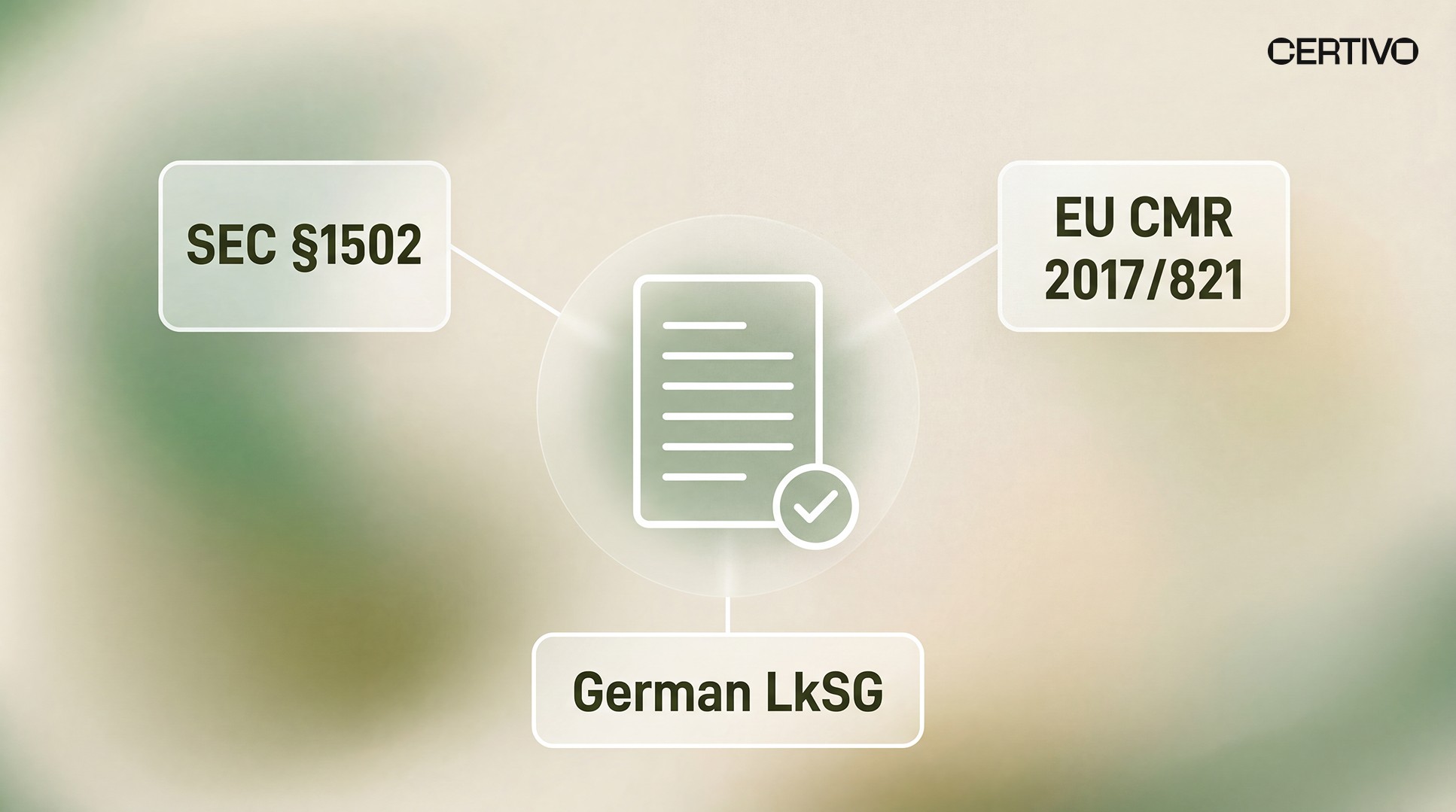
Multi-Jurisdiction Coverage: SEC §1502, EU CMR, LkSG, and OECD Guidance
Conflict minerals reporting is no longer a single-jurisdiction obligation. Manufacturers selling into or sourcing from multiple regions must satisfy overlapping but distinct requirements.
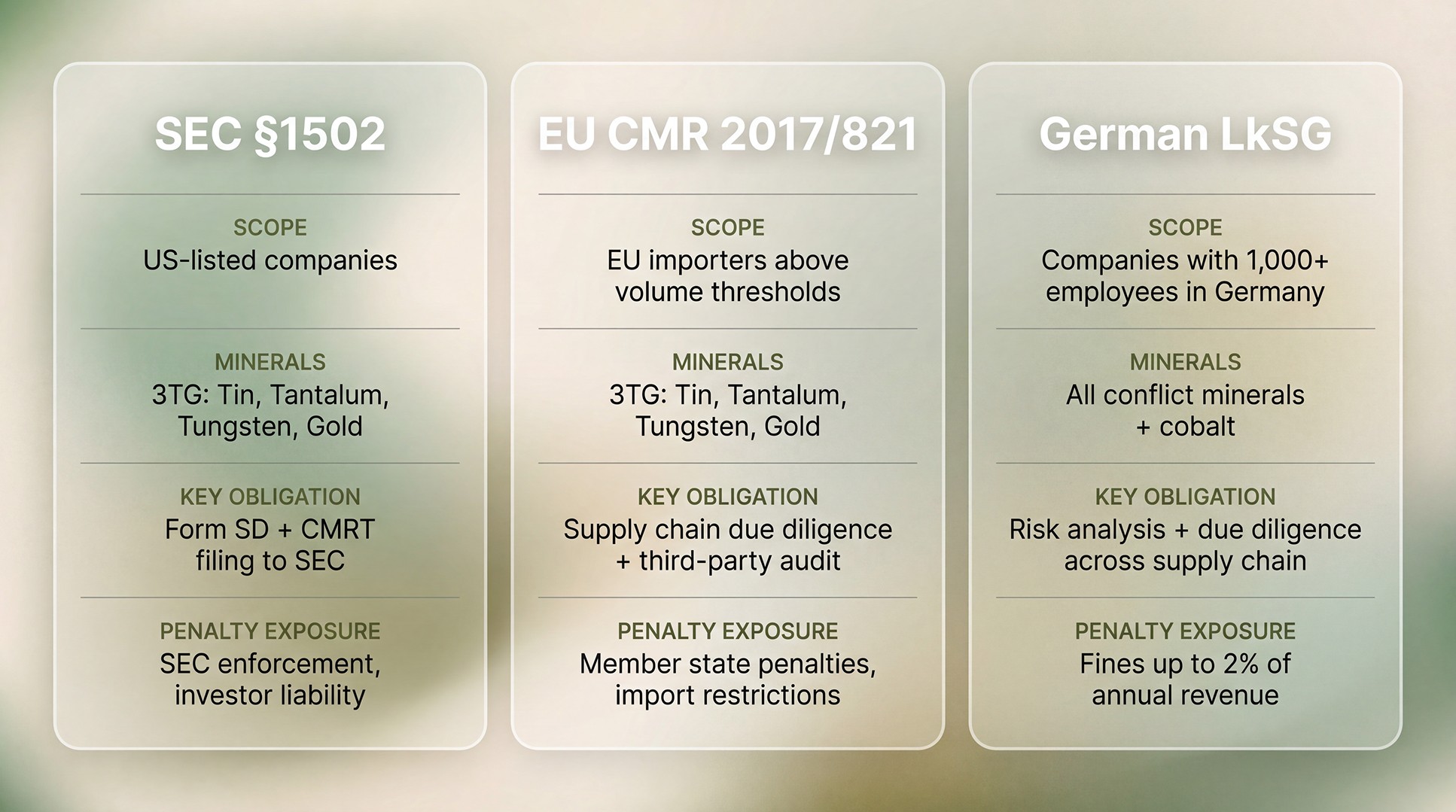
SEC Dodd-Frank §1502: Form SD and Conflict Minerals Report
SEC-registered companies must file Form SD annually by May 31 if their products contain 3TG minerals necessary to product function. The filing requires a Conflict Minerals Report describing the due diligence measures taken, including the OECD-aligned framework used.
📌 IPSA Status: In 2017, the SEC staff issued a no-action position regarding the independent private sector audit (IPSA) requirement. Based on currently available regulatory guidance, companies are not required to obtain an IPSA, though the underlying filing obligation and due diligence narrative remain mandatory.
EU Conflict Minerals Regulation (2017/821)
In force since January 1, 2021, this regulation requires EU importers of tin, tantalum, tungsten, gold, and their ores to conduct supply chain due diligence aligned with OECD guidance. Enforcement is importer-focused, with member state competent authorities conducting checks. Unlike Dodd-Frank, it applies to raw mineral and metal importers—not finished product manufacturers—but downstream pressure from OEMs extends the practical scope.
German Supply Chain Due Diligence Act (LkSG)
The LkSG applies to companies with 1,000 or more employees (threshold lowered in 2024 from 3,000). It mandates human rights and environmental due diligence across direct suppliers, with fines up to 2% of global annual revenue. Conflict minerals fall squarely within its scope.
⚠ LkSG is not CSDDD. The EU Corporate Sustainability Due Diligence Directive (CSDDD) has a separate phased rollout beginning 2027–2029 and will apply to a broader set of companies. Conflating the two creates compliance gaps.
OECD Due Diligence Guidance: The 5-Step Framework
Auditors and regulators across all three jurisdictions reference the OECD Due Diligence Guidance for Responsible Supply Chains of Minerals from Conflict-Affected and High-Risk Areas. The five steps are:
Establish strong company management systems
Identify and assess risks in the supply chain
Design and implement a strategy to respond to identified risks
Carry out independent third-party audit of supply chain due diligence
Report on supply chain due diligence
Any automation platform that cannot generate OECD 5-step narrative documentation is incomplete for regulatory filing purposes.
For organizations managing multi-jurisdiction EHS and ESG obligations, conflict minerals reporting intersects with broader supply chain due diligence requirements under LkSG and CSDDD.
Automate conflict minerals reporting comparison SEC EU CMR LkSG requirements
Click on image to view full
Cobalt and Battery-Specific Due Diligence: Why EMRT Matters as Much as CMRT
Cobalt is a board-level compliance topic for any manufacturer in the EV, electronics, or battery sector. The Extended Minerals Reporting Template (EMRT) covers cobalt and mica—and with recent RMI updates, now extends to copper, natural graphite, lithium, and nickel under EMRT 2.11.
Why Cobalt Triggers Elevated Due Diligence
⚠ The Democratic Republic of Congo (DRC) and adjoining countries remain red-flag jurisdictions for cobalt sourcing. Artisanal and small-scale mining (ASM) in these regions carries documented human rights risks that trigger obligations under LkSG, CSDDD, and OECD guidance.
⚠ The EU Battery Regulation requires due diligence on battery raw materials—including cobalt, lithium, nickel, and natural graphite—creating a direct overlap with EMRT reporting.
⚠ Battery passport requirements under the EU Battery Regulation will require mineral-origin traceability data that feeds directly from EMRT-level disclosures and digital passport and traceability systems.
Organizations that treat CMRT and EMRT as separate, disconnected programs create data silos that undermine both filings. Conflict minerals automation workflows must handle both templates through a unified supplier engagement process.
📌 Managing cobalt and battery mineral compliance across tiers? Book a demo to see how Certivo consolidates CMRT and EMRT data collection into one workflow.
What Conflict Minerals Automation Should Actually Do
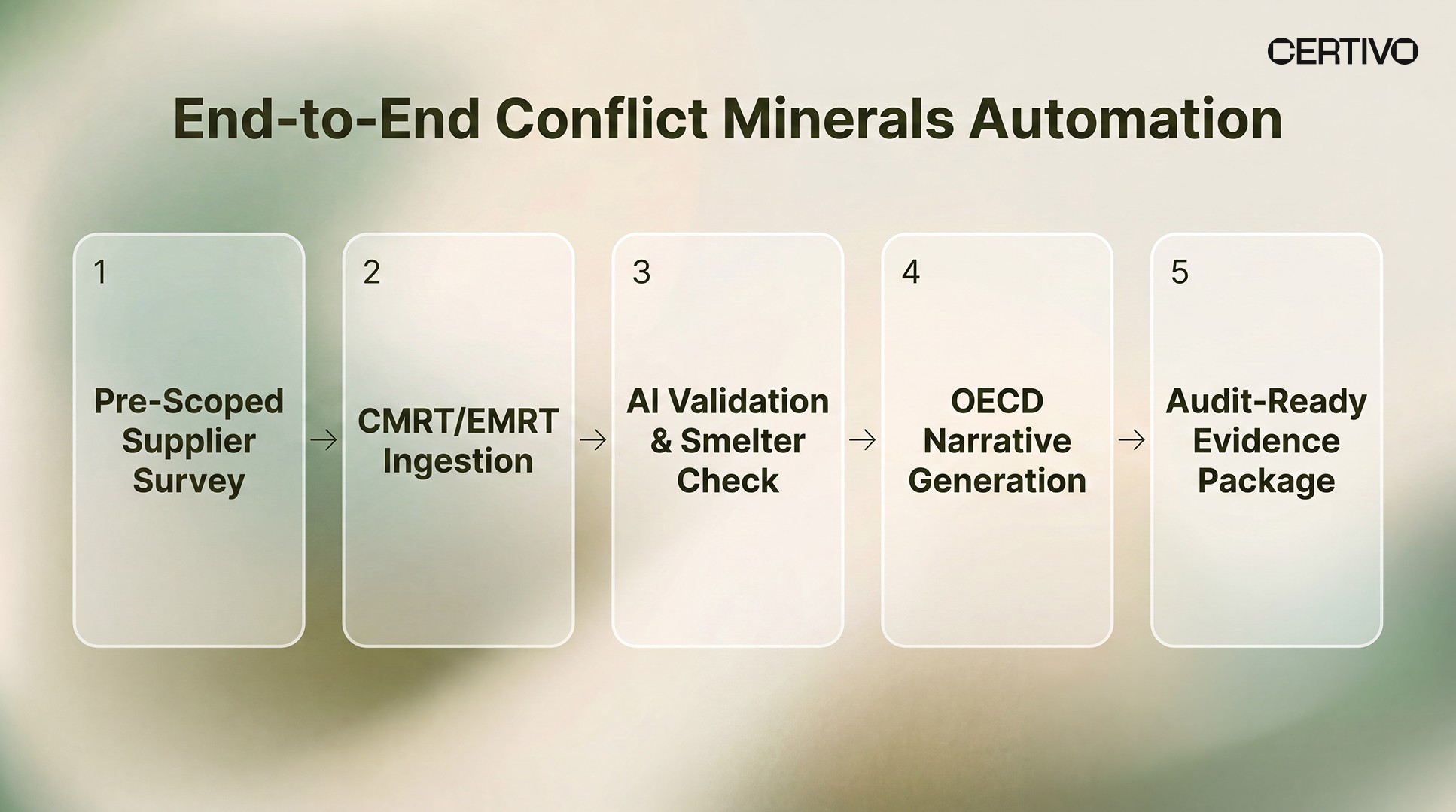
Not every platform labeled "conflict minerals software" delivers the operational capabilities that enterprise compliance teams require. Effective automation must address five core functions:
✓ Supplier Portal with Pre-Populated Scope
Suppliers receive survey requests pre-scoped to relevant SKUs, BOMs, and mineral categories. This eliminates blank-template confusion and improves response rates. Centralized supplier self-service portals reduce email chaos and give suppliers a single destination for all compliance data requests.
✓ Automated CMRT and EMRT Ingestion and Validation
The platform must ingest CMRT v6.4 and EMRT v1.x files, parse all fields, and validate data against template-specific rules. AI document parsing and certificate validation capabilities catch errors at intake—incomplete smelter IDs, invalid country codes, scope mismatches—before they propagate to your filing.
CORA-powered regulatory intelligence parses inbound CMRT and EMRT files, validates Smelter of Origin IDs against the RMAP conformant list in real time, flags red-flag jurisdictions per Dodd-Frank §1502, and auto-drafts OECD 5-step due diligence narratives.
✓ Smelter List Reconciliation Against RMAP
Every declared smelter must be cross-referenced against the current RMAP conformant smelter list. Non-conformant or unrecognized smelters must be flagged for supplier follow-up or risk escalation. Supplier risk scoring and due diligence capabilities enable prioritized engagement with high-risk suppliers rather than blanket follow-ups.
✓ OECD 5-Step Narrative Generation
Form SD filings require a due diligence narrative aligned with the OECD framework. Automation should generate draft narratives from validated data—documenting management systems, risk identification, risk response strategies, audit findings, and reporting actions.
✓ Audit-Ready Evidence Chain
Every data point must carry an evidence chain: who provided it, when it was provided, and with what authority. Immutable audit logs, time-stamped declarations, and point-in-time query capability ensure that continuous audit-ready documentation is maintained—not reconstructed annually.
This is the standard that Certivo's automated supplier data collection and portals deliver. Standardized supplier questionnaire frameworks ensure that every supplier interaction follows a consistent, validated process across all minerals and jurisdictions.
Automate conflict minerals reporting workflow from survey to audit-ready filing
Click on image to view full
Why Conflict Minerals Reporting Cannot Live in a Silo
The suppliers providing CMRT and EMRT data are the same suppliers you query for REACH SVHC declarations, RoHS compliance, PFAS substance tracking, and ESG performance data. When conflict minerals tools operate in isolation, organizations create duplicative supplier touchpoints, inconsistent supplier identities, and fragmented risk views.
A centralized compliance data backbone ensures:
A single supplier identity across all compliance domains—no re-onboarding
Cross-domain risk visibility: a supplier flagged for smelter non-conformance also surfaces in REACH and PFAS workflows
BOM-level compliance intelligence that links mineral declarations to specific products alongside substance and threshold data
Multi-tier supply chain transparency that traces mineral origins through sub-tier suppliers, not just Tier 1
Platforms that consolidate environmental, health, safety, and product compliance data—rather than siloing conflict minerals—deliver the cross-functional visibility that compliance, engineering, and procurement teams need.
For a comprehensive view of how AI-native platforms manage this convergence, see AI Tools for Compliance Management: The Complete Guide.
Strategic Compliance Preparation Checklist
✅ Confirm all active supplier campaigns use CMRT v6.4 and EMRT v1.x (or the latest published versions)
✅ Validate all declared smelters against the current RMAP conformant smelter list
✅ Ensure Form SD narrative aligns with all five steps of the OECD Due Diligence Guidance
✅ Verify LkSG applicability: does your organization meet the 1,000-employee threshold?
✅ Assess EU CMR exposure: are you importing 3TG minerals or metals into EU member states?
✅ Expand EMRT scope to include cobalt, mica, and—where applicable—copper, natural graphite, lithium, and nickel per recent RMI template updates
✅ Establish immutable audit logs with time-stamped, point-in-time query capability for all mineral declarations
✅ Integrate conflict minerals data with broader compliance datasets (REACH, RoHS, PFAS, ESG) through a single compliance platform
Executive Conclusion
The convergence of SEC §1502, EU Conflict Minerals Regulation (2017/821), German LkSG, and emerging CSDDD requirements means that conflict minerals reporting is now a multi-jurisdiction, multi-mineral, year-round obligation—not an annual checkbox. Cobalt and extended minerals under the EMRT carry the same level of regulatory and reputational risk as traditional 3TG minerals under the CMRT.
Organizations that continue to manage this through spreadsheets, email, and disconnected tools face escalating audit risk, supplier friction, and filing exposure. To automate conflict minerals reporting effectively requires a platform that combines supplier self-service portals, AI-powered template ingestion and validation, smelter reconciliation, OECD narrative generation, and cross-domain compliance visibility.
No software eliminates audit findings entirely. The objective is to reduce surprises, compress response time, and maintain continuous audit-ready documentation across every mineral category and jurisdiction.
📌 Book a demo to see how Certivo automates conflict minerals and cobalt reporting across your product portfolio and multi-tier supply chain—or get a free compliance risk assessment to evaluate your current Form SD, EU CMR, and LkSG readiness.
FAQs
1. How do platforms handle smelter rollups across sub-assemblies shared by multiple SKUs?
Effective conflict minerals platforms map smelter declarations at the BOM level, linking each smelter to the specific sub-assemblies and finished products it feeds. When a sub-assembly appears across multiple SKUs, the platform rolls up smelter data without duplication, maintaining a single smelter identity that surfaces in every product-level report. Certivo's BOM-level compliance intelligence supports this rollup natively.
2. What is the difference between CMRT and EMRT in conflict minerals reporting?
The CMRT (Conflict Minerals Reporting Template) covers the four 3TG minerals: Tin, Tungsten, Tantalum, and Gold. The EMRT (Extended Minerals Reporting Template) covers Cobalt and Mica, with recent RMI updates expanding to Copper, Natural Graphite, Lithium, and Nickel. Both templates are published by RMI and follow similar structures, but address different mineral categories with distinct regulatory drivers.
3. Does the SEC still require an independent private sector audit for Form SD filings?
Based on currently available regulatory guidance, the SEC staff issued a no-action position in 2017 indicating it would not recommend enforcement if companies did not obtain an independent private sector audit (IPSA). The underlying Form SD filing obligation, Conflict Minerals Report, and OECD-aligned due diligence narrative requirements remain fully in effect.
4. How frequently does the RMAP conformant smelter list update, and why does it matter?
RMI updates the RMAP conformant smelter list periodically as smelters complete or lose conformance assessments. Manufacturers must validate supplier-declared smelters against the current list—not a cached version. CORA-driven compliance intelligence automates this cross-reference in real time, flagging non-conformant or unrecognized smelters at the point of data intake.
5. What determines whether LkSG or CSDDD applies to a manufacturer's conflict minerals obligations?
LkSG applies to companies with 1,000 or more employees operating in or from Germany, with fines up to 2% of global annual revenue. The EU CSDDD has a separate phased rollout (2027–2029) covering a broader set of companies based on revenue and employee thresholds at the EU level. They are distinct regulations with different timelines, scope, and enforcement mechanisms. Both require supply chain due diligence that encompasses conflict minerals.
Lavanya
Lavanya is an accomplished Product Compliance Engineer with over four years of expertise in global environmental and regulatory frameworks, including REACH, RoHS, Proposition 65, POPs, TSCA, PFAS, CMRT, FMD, and IMDS. A graduate in Chemical Engineering from the KLE Institute, she combines strong technical knowledge with practical compliance management skills across diverse and complex product portfolios.
She has extensive experience in product compliance engineering, ensuring that materials, components, and finished goods consistently meet evolving international regulatory requirements. Her expertise spans BOM analysis, material risk assessments, supplier declaration management, and test report validation to guarantee conformity. Lavanya also plays a key role in design-for-compliance initiatives, guiding engineering teams on regulatory considerations early in the product lifecycle to reduce risks and streamline market access.
Her contributions further extend to compliance documentation, certification readiness, and preparation of customer deliverables, ensuring transparency and accuracy for global stakeholders. She is adept at leveraging compliance tools and databases to efficiently track regulatory changes and implement proactive risk mitigation strategies.
Recognized for her attention to detail, regulatory foresight, and collaborative approach, Lavanya contributes significantly to maintaining product compliance, safeguarding brand integrity, and advancing sustainability goals within dynamic, globally integrated manufacturing environments.