

California Proposition 65 compliance has become more complex in 2026 following the December 2025 addition of two significant chemicals to the state's official list of substances known to cause cancer or reproductive harm. The Office of Environmental Health Hazard Assessment (OEHHA) announced on December 5, 2025 that Bisphenol S (BPS) and N-Methyl-N-Formylhydrazine are now subject to California's strict warning requirements, creating immediate compliance obligations for manufacturers, importers, and retailers whose products contain these substances and are sold or distributed in California.
For compliance leaders, product safety teams, and executive decision-makers, understanding California Proposition 65 compliance requirements is essential to avoiding costly enforcement actions, protecting brand reputation, and maintaining California market access. With businesses facing a 12-month compliance window from the December 8, 2025 effective date, organizations must act now to assess product portfolios, evaluate exposure risks, and implement warning protocols by December 2026. Companies lacking AI-powered compliance infrastructure and systematic regulatory monitoring face significant challenges meeting this timeline while managing broader environmental compliance obligations.
This comprehensive guide explains what changed in California Proposition 65, which industries are most affected by the new chemical listings, compliance timelines and enforcement risks, and how organizations can prepare for 2026 requirements while building scalable capabilities for ongoing Proposition 65 obligations.
Table of Contents
What Changed in California Proposition 65 (December 2025 Update)
Understanding the Newly Listed Chemicals and Their 2026 Impact
Who Must Comply: Industry-by-Industry Breakdown
California Proposition 65 Compliance Timelines and the 12-Month Warning Window
Enforcement Risks, Penalties, and Executive-Level Exposure
2026 California Proposition 65 Compliance Action Checklist
How Certivo Simplifies California Proposition 65 Compliance
1. What Changed in California Proposition 65 (December 2025 Update)
California Proposition 65, formally known as the Safe Drinking Water and Toxic Enforcement Act of 1986, requires businesses to provide clear and reasonable warnings before knowingly and intentionally exposing individuals to chemicals that California has identified as causing cancer, birth defects, or other reproductive harm. The December 2025 update added two chemicals to the official Proposition 65 list, expanding the scope of substances subject to warning requirements.
The December 8, 2025 Effective Date
OEHHA's announcement on December 5, 2025 established December 8, 2025 as the official listing date for both chemicals. This date triggers the 12-month compliance clock, giving businesses until December 8, 2026 to implement required warning protocols for products containing these substances at exposure levels exceeding safe harbor thresholds.
Organizations treating this as a distant 2027 concern misunderstand the immediate compliance imperative. The 12-month window requires:
Product portfolio assessment (Q1 2026) - Identifying products potentially containing newly listed chemicals
Exposure evaluation (Q1-Q2 2026) - Determining whether exposure levels exceed safe harbor limits
Warning implementation (Q2-Q3 2026) - Developing and deploying compliant warning labels and protocols
Supply chain verification (ongoing) - Confirming supplier chemical disclosures and reformulation timelines
Companies deferring California Proposition 65 compliance activities until late 2026 face severe time pressure and potential enforcement exposure beginning December 9, 2026.
Why These Chemical Additions Matter
The addition of Bisphenol S and N-Methyl-N-Formylhydrazine represents more than routine list updates. These chemicals appear in products across multiple industries, creating widespread compliance obligations that extend far beyond traditional chemical manufacturing sectors.
Read More: Official regulatory source (OEHHA)
2. Understanding the Newly Listed Chemicals and Their 2026 Impact
Bisphenol S (BPS) - CAS No. 80-09-1
Listed for: Reproductive toxicity (developmental toxicity)
Bisphenol S has emerged as a common substitute for Bisphenol A (BPA) following widespread BPA restrictions and consumer demand for "BPA-free" products. The irony of this Proposition 65 listing is that many manufacturers reformulated products to eliminate BPA only to introduce BPS—now itself listed for reproductive toxicity.
Common BPS Applications:
Thermal paper - Cash register receipts, airline boarding passes, event tickets
Plastics and polymers - Polycarbonate and epoxy resin alternatives marketed as BPA-free
Coatings - Can linings, food packaging coatings, protective coatings
Personal care products - Some cosmetics and toiletries
Consumer goods - Products marketed as BPA-free alternatives
The BPS listing creates particular challenges for organizations that invested in BPA-to-BPS reformulation as a "safer alternative" strategy. These companies must now either:
Implement Proposition 65 warnings for BPS-containing products
Reformulate again to eliminate both BPA and BPS
Conduct exposure assessments demonstrating levels below safe harbor thresholds
Organizations in consumer goods and packaging materials sectors face particularly urgent BPS compliance requirements given widespread use in products sold through California retail channels.
N-Methyl-N-Formylhydrazine - CAS No. 758-17-8
Listed as: Carcinogen
N-Methyl-N-Formylhydrazine is primarily encountered as a chemical intermediate in pharmaceutical manufacturing and specialty chemical production. While less widely distributed in consumer products than BPS, this substance's carcinogen classification creates strict warning requirements where exposure occurs.
Potential N-Methyl-N-Formylhydrazine Applications:
Pharmaceutical intermediates - Chemical synthesis processes in drug manufacturing
Specialty chemicals - Industrial chemical production
Research chemicals - Laboratory and R&D applications
The carcinogen designation means organizations cannot avoid warnings through exposure assessments showing levels below reproductive toxicity thresholds—any exposure exceeding carcinogen safe harbor levels triggers warning requirements.
Why "BPA-Free" Is No Longer Sufficient Marketing
The BPS listing demonstrates a critical compliance principle: substituting one restricted chemical with a structurally similar alternative does not guarantee regulatory or safety advantages. Organizations marketing products as "BPA-free" must now verify that BPS (and other bisphenol alternatives like BPF, BPAF) are either absent or present only below Proposition 65 safe harbor levels.
This pattern extends beyond Bisphenols to other chemical classes where "regrettable substitution" creates ongoing compliance challenges. Companies need proactive chemical tracking systems that assess alternatives against current and emerging regulatory restrictions rather than reactively responding to each new listing.
3. Who Must Comply: Industry-by-Industry Breakdown
California Proposition 65 compliance applies broadly to any business with 10 or more employees that causes exposure to listed chemicals in California through:
Products manufactured or sold in California
Products imported into California
Workplace exposures at California facilities
Environmental releases affecting California residents
Plastics and Polymer Manufacturers
Businesses producing or processing BPS-containing plastics face immediate California Proposition 65 compliance obligations. This includes:
Polycarbonate plastic manufacturers marketing BPA-free alternatives
Epoxy resin producers using BPS
Plastic compounding operations incorporating BPS
Injection molding facilities processing BPS-containing resins
Manufacturers must verify whether finished products contain BPS at levels exceeding 0.3 micrograms per day exposure (the current safe harbor level for developmental toxicity), requiring either product reformulation or warning implementation.
Consumer Goods and Household Products
Consumer product companies selling BPS-containing goods into California markets must implement warnings or reformulate. Affected categories include:
Kitchenware and food storage containers
Water bottles and beverage containers
Food service items and utensils
Household storage and organization products
Baby products and children's items
Consumer goods manufacturers face particular enforcement pressure as consumer advocacy organizations actively pursue Proposition 65 settlements for products lacking required warnings.
Electronics and Electrical Equipment
Electronic products may contain BPS in:
Component coatings and enclosures
Circuit board materials
Display technologies
Protective casings marketed as BPA-free
Electronics manufacturers must assess BPS presence in components and determine whether consumer or workplace exposure triggers warning requirements.
Packaging Materials Manufacturers
The packaging industry faces widespread BPS compliance challenges given use in:
Food contact coatings replacing BPA epoxy
Thermal paper for receipts and labels
Protective packaging films
Can linings and beverage container coatings
Organizations producing packaging materials for California food and beverage markets must verify BPS compliance across product lines and implement supplier verification programs ensuring upstream chemical compliance.
Chemical Manufacturers and Distributors
Chemical companies manufacturing, importing, or distributing BPS or N-Methyl-N-Formylhydrazine face direct Proposition 65 obligations including:
Warning requirements for chemical products sold in California
Downstream customer notification regarding Proposition 65 status
Safety Data Sheet (SDS) updates reflecting California listings
Workplace exposure warnings for California facilities
Retailers and Importers
California retailers and importers share Proposition 65 compliance responsibility for products they sell, creating due diligence obligations to:
Verify supplier Proposition 65 compliance before accepting products
Implement point-of-sale warnings for non-compliant products
Maintain documentation demonstrating compliance efforts
Remove non-compliant products lacking warnings after the 12-month grace period
Major California retailers increasingly require suppliers to provide Proposition 65 compliance certifications as condition of doing business, making California Proposition 65 compliance a market access requirement rather than optional regulatory obligation.
4. California Proposition 65 Compliance Timelines and the 12-Month Warning Window
California Proposition 65 provides a 12-month grace period from the official listing date before enforcement of warning requirements begins. For the December 8, 2025 BPS and N-Methyl-N-Formylhydrazine listings, the compliance timeline follows:
Compliance Phase | Timeline | Key Activities |
|---|---|---|
Listing Effective Date | December 8, 2025 | Chemicals officially added to Proposition 65 list |
Assessment & Planning | Q1 2026 (Jan-Mar) | Product portfolio review; exposure assessment; compliance strategy development |
Warning Development | Q2 2026 (Apr-Jun) | Warning label design; regulatory review; printing/production |
Implementation | Q3 2026 (Jul-Sep) | Warning deployment; supply chain coordination; documentation |
Compliance Deadline | December 8, 2026 | All products must carry required warnings or be reformulated |
Enforcement Period | December 9, 2026 onward | Notices of Violation; civil litigation; settlements |
Understanding the 12-Month Window
The 12-month compliance period is not an extension or optional timeline—it represents the maximum time businesses have to achieve compliance before enforcement begins. Organizations should not interpret this as 12 months to start working on compliance, but rather 12 months to complete:
Product Portfolio Assessment (Months 1-2)
Inventory all products sold in California
Identify products potentially containing BPS or N-Methyl-N-Formylhydrazine
Prioritize high-volume or high-risk products for immediate attention
Exposure Evaluation (Months 2-4)
Determine chemical concentrations in products
Calculate reasonably anticipated exposure levels
Compare exposure to safe harbor levels
Engage laboratories for testing where supplier data is unavailable
Strategic Decision-Making (Months 3-5)
Decide whether to warn, reformulate, or discontinue products
Assess economic implications of each strategy
Coordinate with suppliers on reformulation timelines
Develop implementation plans
Warning Implementation (Months 5-10)
Design warning labels compliant with Proposition 65 requirements
Obtain regulatory review if necessary
Produce new packaging or labels
Coordinate warning deployment across distribution channels
Verification and Documentation (Months 10-12)
Confirm warnings are properly displayed
Maintain compliance documentation
Train customer service and sales teams
Prepare for potential enforcement inquiries
Organizations lacking automated compliance tracking discover timeline pressures too late, rushing through critical assessment and implementation phases that require methodical execution.
Safe Harbor Levels and Exposure Assessment
California Proposition 65 compliance does not require warnings for all products containing listed chemicals—only those causing exposure exceeding "safe harbor" levels. OEHHA establishes safe harbor levels representing daily exposure amounts below which warnings are not required.
For developmental toxicity (BPS classification):
Current safe harbor: 0.3 micrograms per day maximum allowable dose level (MADL)
For carcinogens (N-Methyl-N-Formylhydrazine classification):
Safe harbor determined by "no significant risk level" (NSRL) calculated to represent negligible cancer risk
Organizations must calculate reasonably anticipated consumer exposure considering:
Chemical concentration in products
Frequency and duration of product use
Routes of exposure (dermal, ingestion, inhalation)
Vulnerable populations (children, pregnant women)
Exposure assessments require technical expertise and conservative assumptions to withstand regulatory scrutiny and potential litigation challenges.
5. Enforcement Risks, Penalties, and Executive-Level Exposure
California Proposition 65 enforcement operates through a unique "private attorney general" mechanism allowing private parties and advocacy organizations to file lawsuits against businesses violating warning requirements. This creates enforcement risks extending beyond traditional government regulatory actions.
Notices of Violation and the 60-Day Notice Requirement
Proposition 65 enforcement typically begins with a Notice of Violation (NOV) alleging non-compliance. The NOV must provide 60-day advance notice to:
The alleged violator
California Attorney General
District attorneys and city attorneys for jurisdictions where violations occurred
The 60-day notice period allows parties to negotiate settlements before formal litigation commences. Most Proposition 65 cases settle during this pre-litigation period, creating substantial costs even without trial.
Civil Penalties and Settlement Amounts
Proposition 65 violations carry civil penalties up to $2,500 per violation per day. With "per day" calculated from the date warning obligations began (December 9, 2026 for newly listed chemicals), penalties accumulate rapidly.
A single product sold continuously in California for one year without required warnings theoretically creates:
365 days × $2,500 = $912,500 in potential penalties (per product)
In practice, settlement amounts vary widely but commonly include:
Civil penalties - negotiated amounts typically lower than maximum statutory penalties
Reformulation commitments - agreements to remove listed chemicals within specified timelines
Attorney fees and costs - plaintiff attorney compensation often exceeding civil penalties
Compliance verification - ongoing monitoring and reporting requirements
Public notification - settlement terms published creating reputational impacts
The Private Enforcement Landscape
Proposition 65's private enforcement mechanism has created an active ecosystem of:
Consumer advocacy organizations pursuing public interest litigation
Bounty hunter law firms filing hundreds of cases annually
Testing laboratories analyzing products for Proposition 65 violations
Settlement mills generating revenue through high-volume NOV campaigns
Organizations selling consumer products into California face near-certain Proposition 65 enforcement pressure if products contain listed chemicals without proper warnings. The question is not if but when enforcement occurs.
Executive and Corporate Liability
While Proposition 65 violations typically result in corporate liability, executive officers and board members face indirect exposure through:
Shareholder derivative actions alleging failure to implement adequate compliance systems
Securities litigation if material Proposition 65 exposures are not disclosed
Reputational damage from public settlement disclosures
Customer relationship impacts when major retailers disqualify suppliers
For publicly traded companies, significant Proposition 65 settlements may constitute material events requiring disclosure, creating investor relations and SEC reporting implications.
Enforcement Timeline After December 2026
Beginning December 9, 2026, businesses selling BPS or N-Methyl-N-Formylhydrazine-containing products in California without compliant warnings face immediate enforcement risk. Advocacy organizations and plaintiff attorneys actively monitor newly listed chemicals, filing NOVs shortly after grace periods expire.
Organizations should anticipate:
Q1 2027: Initial NOVs filed against high-visibility consumer product companies
Q2-Q3 2027: Settlement negotiations and precedent-setting agreements
Q4 2027 onward: Expanded enforcement as plaintiff firms replicate successful strategies
Companies achieving California Proposition 65 compliance by December 2026 avoid this enforcement wave while competitors face settlement costs, reformulation mandates, and market disruption.
6. 2026 California Proposition 65 Compliance Action Checklist
Organizations subject to California Proposition 65 requirements should implement these compliance actions immediately:
☑ Conduct Comprehensive Product Portfolio Assessment
Inventory California Market Products:
Identify all products manufactured, imported, sold, or distributed in California
Include products sold online reaching California consumers
Prioritize high-volume products and product lines generating significant California revenue
Assess BPS and N-Methyl-N-Formylhydrazine Presence:
Review product formulations and material specifications
Flag products marketed as "BPA-free" as high-risk for BPS presence
Identify plastic, coating, and thermal paper products requiring evaluation
List chemical manufacturing or pharmaceutical products potentially containing N-Methyl-N-Formylhydrazine
☑ Engage Suppliers for Chemical Disclosure
Launch Systematic Supplier Verification:
Develop standardized chemical disclosure requests covering newly listed substances
Distribute requests to material, component, and chemical suppliers
Establish response deadlines allowing time for validation before December 2026
Implement automated supplier engagement workflows
Validate Supplier Responses:
Verify chemical identity and concentration data
Request supporting documentation for BPS or N-Methyl-N-Formylhydrazine claims
Flag incomplete or inconsistent responses requiring follow-up
Escalate non-responsive suppliers through procurement channels
☑ Conduct Exposure Assessments
Determine Exposure Levels:
Calculate reasonably anticipated consumer exposure based on product use
Consider concentration, frequency, duration, and exposure routes
Compare calculated exposure to safe harbor levels (0.3 μg/day MADL for BPS developmental toxicity)
Engage qualified toxicologists for complex exposure scenarios
Document Assessment Methodology:
Preserve exposure calculations and supporting assumptions
Maintain chemical concentration data and product use scenarios
Create defensible documentation for regulatory or litigation challenges
☑ Develop Compliance Strategy
Evaluate Compliance Options:
Option 1: Implement Warnings
Design Proposition 65-compliant warning labels
Coordinate warning implementation across packaging, signage, and online channels
Train customer service and sales teams on warning requirements
Maintain warning compliance documentation
Option 2: Reformulate Products
Identify alternative materials eliminating BPS or N-Methyl-N-Formylhydrazine
Conduct testing validating alternatives meet performance requirements
Update product specifications and manufacturing processes
Verify reformulated products comply with all applicable regulations
Option 3: Discontinue Products
Assess economic viability of warning or reformulation strategies
Phase out products where compliance costs exceed revenue potential
Manage inventory drawdown and customer transition
☑ Implement Warning Protocols (If Applicable)
Design Compliant Warnings:
Use OEHHA-approved warning language and symbols
Ensure warnings are clear, reasonable, and prominently displayed
Adapt warnings to product type (consumer products, workplace, environmental)
Review warning designs against regulatory requirements
Deploy Warnings Across Channels:
Update product packaging and labels
Implement point-of-sale warnings for retail locations
Add website warnings for online sales
Coordinate with distributors and retailers on warning compliance
☑ Establish Ongoing Monitoring
Track Proposition 65 List Updates:
Monitor OEHHA announcements for new chemical listings
Assess impacts of new listings on product portfolios
Implement continuous regulatory intelligence capabilities
Participate in industry association information sharing
Maintain Compliance Documentation:
Organize supplier chemical disclosures by product and supplier
Retain exposure assessments and toxicology evaluations
Preserve warning implementation records
Document reformulation activities and testing results
Organizations implementing centralized compliance data management transform Proposition 65 from reactive crisis response to systematic, scalable capabilities.
☑ Prepare for Enforcement Scenarios
Develop Response Protocols:
Establish procedures for responding to Notices of Violation
Identify qualified Proposition 65 legal counsel
Create settlement negotiation guidelines
Prepare communications strategies for public disclosure
Train Cross-Functional Teams:
Brief product development teams on Proposition 65 implications for new products
Train procurement staff on supplier chemical verification
Inform sales teams on compliance status and customer inquiries
Update executive leadership on enforcement risks and financial exposure
7. How Certivo Simplifies California Proposition 65 Compliance
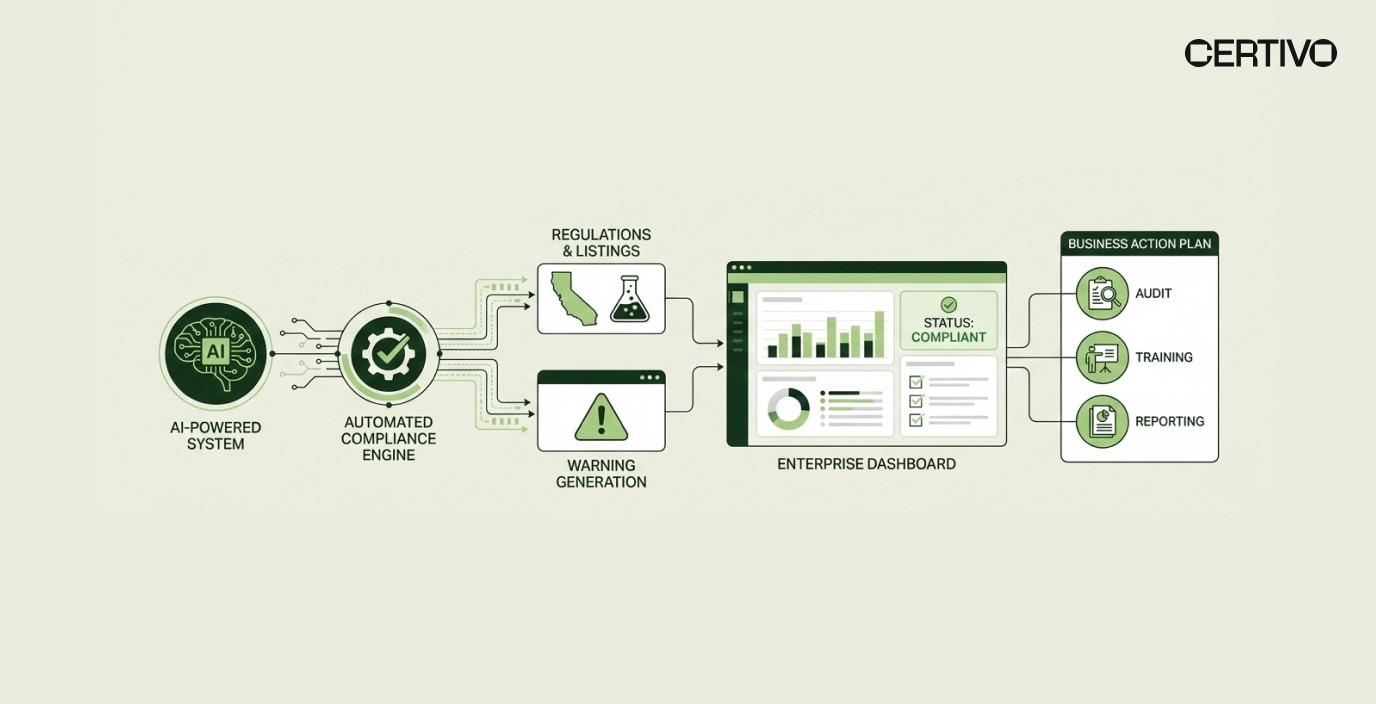
Certivo provides manufacturers, importers, and retailers with an AI-powered compliance management platform specifically designed for California Proposition 65 requirements and broader chemical regulatory obligations:
AI-Driven Chemical Tracking and List Monitoring
Certivo creates comprehensive visibility into Proposition 65-listed chemicals across product portfolios:
Chemical-level substance tracking linking listed chemicals to specific products and formulations
Automated list monitoring alerting teams immediately when new chemicals are added to Proposition 65
Impact assessment identifying affected products when new listings occur
Historical tracking maintaining compliance status as regulations evolve
Organizations achieve the chemical intelligence required for rapid Proposition 65 response without manual regulatory monitoring creating awareness gaps.
Automated Proposition 65 Compliance Assessment
Certivo streamlines Proposition 65 compliance evaluation:
Product portfolio screening identifying products potentially containing newly listed chemicals
Exposure assessment support organizing data required for safe harbor calculations
Compliance status tracking showing which products require warnings, reformulation, or no action
Deadline management ensuring timely compliance before 12-month grace periods expire
The platform eliminates manual compliance assessments that consume weeks and introduce evaluation errors.
Intelligent Supplier Declaration Management
Certivo automates supplier chemical disclosure verification:
Standardized disclosure templates aligned with Proposition 65 requirements
Automated supplier engagement distributing requests and tracking responses
Validation rules ensuring supplier data includes required chemical information
Supplier performance analytics identifying high-risk suppliers requiring escalation
Organizations scale supplier verification across hundreds of suppliers without manual tracking creating bottlenecks.
Multi-Regulation Visibility and Cross-Compliance
Certivo provides unified visibility across California Proposition 65 and other chemical regulations:
Jurisdiction-specific tracking showing compliance status for Prop 65, REACH, RoHS, TSCA
Cross-regulatory data reuse leveraging chemical data across multiple frameworks
Comparative analysis identifying products subject to multiple restrictions
Global compliance readiness supporting operations across regulatory jurisdictions
Organizations investing in Proposition 65 compliance build scalable infrastructure supporting broader environmental regulatory requirements.
Warning Implementation and Documentation
Certivo supports warning compliance execution:
Warning requirement tracking identifying products needing warnings
Implementation workflows coordinating warning deployment across teams
Documentation management organizing compliance evidence for enforcement defense
Audit readiness maintaining records demonstrating due diligence
Organizations respond to Notices of Violation with complete, organized documentation rather than scrambling to assemble evidence during settlement negotiations.
Proactive Compliance Intelligence
Certivo's AI continuously monitors California Proposition 65 regulatory developments:
OEHHA announcement tracking monitoring new chemical listings and regulatory updates
Enforcement precedent analysis identifying compliance trends and settlement patterns
Industry impact assessment tracking how competitors address Proposition 65 challenges
Strategic planning support informing reformulation and product development decisions
The platform eliminates manual regulatory monitoring that creates gaps between policy changes and organizational awareness.
Cross-Functional Collaboration
Certivo connects teams across compliance, product development, procurement, and legal functions:
Role-based access providing relevant Proposition 65 data to each stakeholder
Workflow automation routing compliance tasks to appropriate teams
Notification systems alerting teams to deadline-driven actions
Executive dashboards giving leadership visibility into compliance status and enforcement exposure
The platform transforms California Proposition 65 compliance from isolated compliance activities to coordinated, enterprise-wide capabilities.
Conclusion
California Proposition 65 compliance in 2026 requires immediate action from businesses manufacturing, importing, or selling products containing Bisphenol S or N-Methyl-N-Formylhydrazine in California markets. The December 8, 2025 listing of these chemicals triggered a 12-month compliance window ending December 8, 2026, creating urgent obligations to assess product portfolios, evaluate exposure risks, and implement warning protocols or reformulate products.
Organizations deferring California Proposition 65 compliance activities until late 2026 face severe time pressure to complete complex exposure assessments, supplier verification, and warning implementation before enforcement begins December 9, 2026. The unique private enforcement mechanism means compliance failures attract immediate litigation from advocacy organizations and plaintiff attorneys who actively monitor newly listed chemicals.
Beyond these specific chemical listings, effective Proposition 65 compliance requires ongoing monitoring of OEHHA announcements, systematic supplier verification programs, and scalable chemical tracking infrastructure that adapts as the Proposition 65 list expands. Companies investing in AI-powered compliance platforms build capabilities supporting continuous regulatory readiness rather than reactive crisis response to each new listing.
The question is not whether your organization will achieve California Proposition 65 compliance by December 2026. The question is whether you will build the compliance infrastructure required for sustained California market access as chemical regulations continue evolving.
Ready to transform your California Proposition 65 compliance approach? Contact Certivo to see how AI-powered compliance automation helps organizations meet 2026 deadlines while building scalable chemical regulatory infrastructure.
Lavanya
Lavanya is an accomplished Product Compliance Engineer with over four years of expertise in global environmental and regulatory frameworks, including REACH, RoHS, Proposition 65, POPs, TSCA, PFAS, CMRT, FMD, and IMDS. A graduate in Chemical Engineering from the KLE Institute, she combines strong technical knowledge with practical compliance management skills across diverse and complex product portfolios.
She has extensive experience in product compliance engineering, ensuring that materials, components, and finished goods consistently meet evolving international regulatory requirements. Her expertise spans BOM analysis, material risk assessments, supplier declaration management, and test report validation to guarantee conformity. Lavanya also plays a key role in design-for-compliance initiatives, guiding engineering teams on regulatory considerations early in the product lifecycle to reduce risks and streamline market access.
Her contributions further extend to compliance documentation, certification readiness, and preparation of customer deliverables, ensuring transparency and accuracy for global stakeholders. She is adept at leveraging compliance tools and databases to efficiently track regulatory changes and implement proactive risk mitigation strategies.
Recognized for her attention to detail, regulatory foresight, and collaborative approach, Lavanya contributes significantly to maintaining product compliance, safeguarding brand integrity, and advancing sustainability goals within dynamic, globally integrated manufacturing environments.