


Introduction
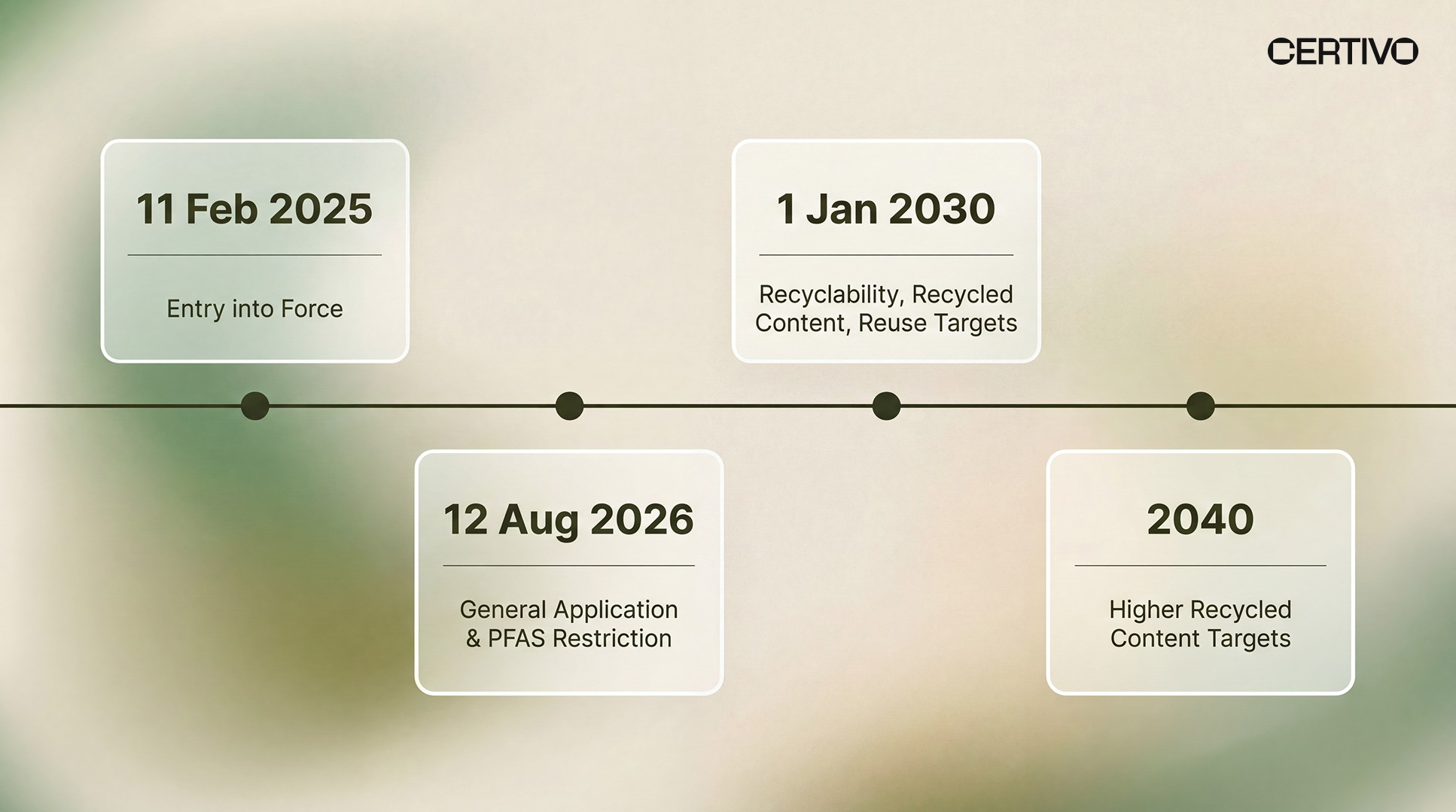
EU PPWR compliance is now a board-level priority for any brand placing packaged goods on the European market. The Packaging and Packaging Waste Regulation (Regulation (EU) 2025/40) replaces the old Packaging and Packaging Waste Directive and moves Europe from fragmented national rules to a single, directly applicable law. The first obligations apply from 12 August 2026, with phased requirements running through 2030 and 2040.
For consumer goods brands, importers, and operations leaders, the questions are practical and urgent: What does PPWR require? Does it apply to me? What do I do first? This guide answers each question and shows how a dedicated EU PPWR compliance software platform turns a multi-year obligation into a managed, audit-ready program. To map your exposure first, review Certivo's EU PPWR framework overview.
📌 Book a compliance risk assessment to see your PPWR exposure across products, packaging, and suppliers before the deadline.
Key Takeaways
📌 PPWR is a Regulation, not a Directive. It applies directly in every EU member state, removing the country-by-country variation brands relied on before.
⏳ First obligations apply from 12 August 2026, including the PFAS food-contact restriction, with recyclability, recycled content, and reuse targets phasing in through 2030 and 2040.
⚠️ PFAS in food-contact packaging is restricted above defined thresholds, creating direct overlap with REACH and existing PFAS rules.
🏭 Almost all packaged verticals are affected, from cosmetics and food to electronics and household goods.
🔗 Manufacturer and producer are distinct legal roles. Importers and brand owners usually hold producer (EPR) obligations even when they outsource manufacturing.
📄 Conformity documentation is mandatory. Packaging needs technical documentation and an EU declaration of conformity, retrievable on demand.
🤖 A PPWR compliance platform is the practical answer. Substance-level packaging data, supplier evidence, and conformity records must be managed continuously, not in spreadsheets.
What Is the EU PPWR and Why It Matters
The Packaging and Packaging Waste Regulation is the EU's comprehensive law governing how packaging is designed, placed on the market, and managed at end of life. It entered into force on 11 February 2025 and becomes generally applicable on 12 August 2026.
The most important change is legal form. The previous regime was a Directive, transposed into 27 national variations. PPWR is a Regulation, applying uniformly and directly across the EU. For brands selling into multiple markets, this reduces fragmentation but raises the baseline, since there is no softer national interpretation to fall back on. You can review the consolidated text through the EUR-Lex official record.
For consumer brands, this is the point where a materials and environmental compliance solution stops being optional and becomes structural.
EU PPWR compliance timeline showing key 2026 and 2030 packaging regulation deadlines
Click on image to view full
What Changes on 12 August 2026
The 12 August 2026 date marks general application of the Regulation. Several obligations take effect on or near this milestone, while others are phased to allow packaging redesign.
From this date, the following become directly relevant:
✓ The PFAS restriction on food-contact packaging applies.
✓ General sustainability obligations and conformity expectations begin to bind economic operators.
✓ Producer responsibility and registration obligations move into active scope.
Labeling harmonization, recyclability grading, recycled content minimums, and reuse targets follow later, primarily from 2030. Treating 12 August 2026 as the finish line is a mistake. It is the start of a multi-year compliance program, which is exactly why brands deploy a compliance automation platform with regulatory intelligence and horizon scanning rather than chasing each deadline manually.
📌 Struggling to track phased PPWR deadlines across your portfolio? Request a compliance review and see how Certivo maps each milestone to your affected SKUs.
Does PPWR Apply to Me? Manufacturer vs Producer Roles
PPWR assigns obligations by role, and many brands misjudge which role they hold. The two most consequential definitions are manufacturer and producer.
Manufacturer
The manufacturer is the economic operator that makes packaging or a packaged product, or has it designed or made, and markets it under its own name or trademark. Manufacturers carry the core design, documentation, and conformity obligations.
Producer
The producer is the operator responsible under Extended Producer Responsibility. In practice this is the entity that first makes packaging available on the market within a given member state, including importers and brand owners selling packaged goods into that market.
Why the Distinction Matters
An importer or brand owner can be a producer for EPR purposes while relying on suppliers for manufacturing data. If you place packaged consumer goods on the EU market, you are very likely a producer with registration and fee obligations, even if you never physically make the packaging. A supplier compliance management system is what lets you hold this accountability without owning every data point, and it connects directly to your existing extended producer responsibility obligations.
⚠️ Brands that assume their packaging supplier holds all obligations frequently learn, during an audit, that the legal accountability sits with them.
PFAS and Substances of Concern Under PPWR
PPWR places clear limits on hazardous substances in packaging, with a specific and immediate restriction on PFAS in food-contact packaging.
PFAS Restriction in Food-Contact Packaging
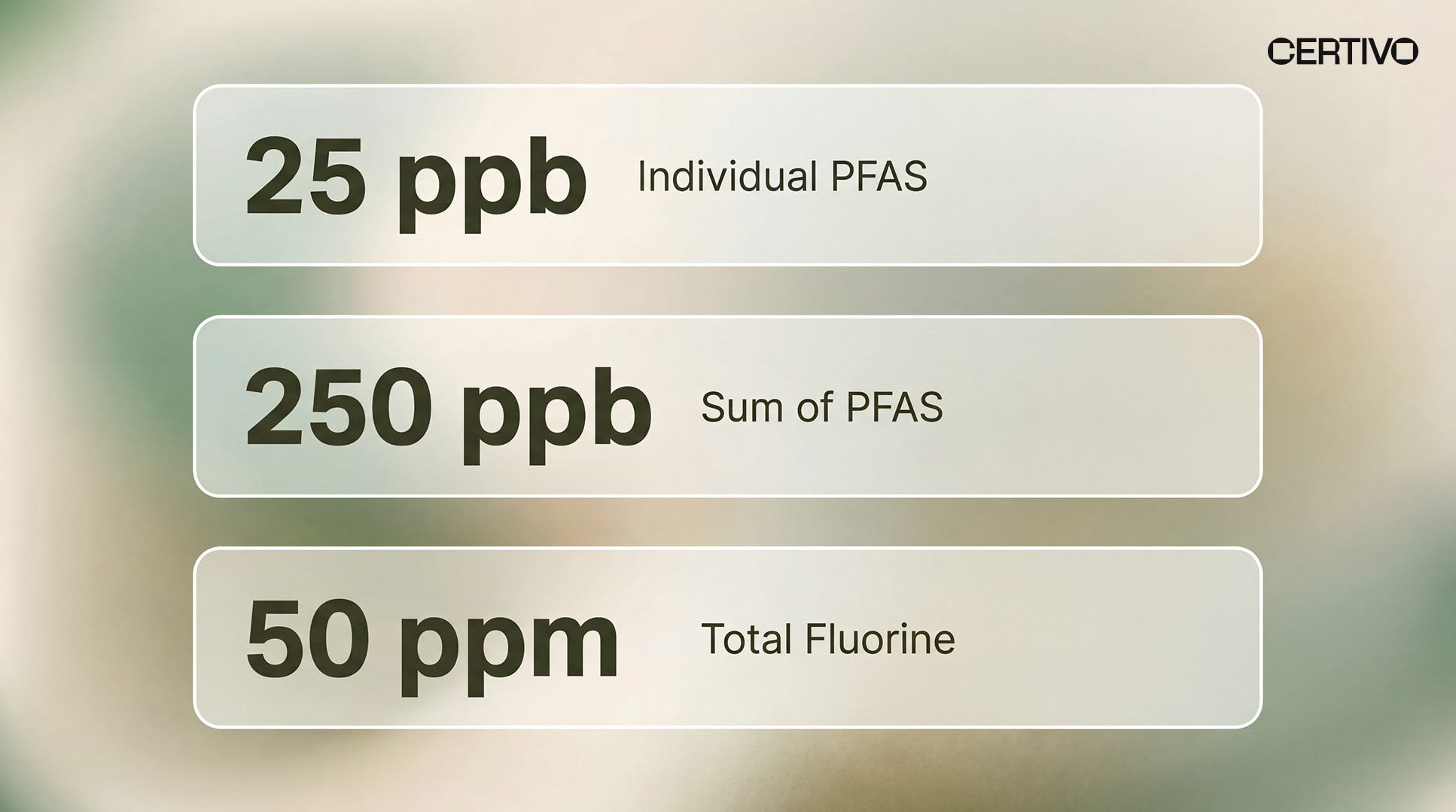
From 12 August 2026, food-contact packaging may not be placed on the EU market where PFAS concentrations meet or exceed the following thresholds:
Measurement basis | Threshold |
|---|---|
Any individual PFAS (targeted analysis) | 25 ppb |
Sum of PFAS (targeted analysis) | 250 ppb |
Total fluorine (as a PFAS indicator) | 50 ppm |
Above 50 ppm total fluorine, the operator must demonstrate whether that fluorine is present as PFAS or non-PFAS, a direct documentation burden on the supply chain. This is where PFAS compliance software earns its place, validating supplier evidence against thresholds at the component level. See Certivo's analysis of the EU packaging PFAS ban for food-contact manufacturers.
Substances of Concern and the REACH Overlap
PPWR also requires substances of concern in packaging to be minimized. These obligations sit alongside existing chemical restrictions, not in place of them. Brands must reconcile PPWR with REACH compliance requirements, since a substance restricted under REACH stays restricted regardless of PPWR. A BOM-level compliance tool tracks these limits per component rather than guessing at the finished-product level.
PPWR PFAS thresholds for food-contact packaging compliance under EU packaging regulation
Click on image to view full
Conformity Assessment and Labeling Requirements
PPWR introduces conformity expectations that resemble product safety frameworks rather than traditional waste rules.
Technical Documentation and Declaration of Conformity
Packaging must be supported by technical documentation demonstrating it meets the applicable sustainability requirements, and operators must draw up an EU declaration of conformity. Without complete, retrievable documentation, a brand cannot demonstrate conformity during a market surveillance check. A product compliance management platform keeps this documentation audit-ready and on demand.
Harmonized Labeling
PPWR introduces harmonized labeling to support consumer sorting and separate collection, phased in after general application. Packaging will need standardized markings for material composition, and reusable packaging will carry specific identifiers. This connects to the broader EU move toward the Digital Product Passport and traceability systems that link packaging data to product records.
Phased PPWR Obligations Through 2030 and Beyond
PPWR is sequenced so that the most demanding design obligations arrive in 2030. The following is a high-level view based on currently available regulatory guidance.
From 2030
📌 Recyclability: All packaging must be designed for recycling and graded against performance criteria. Packaging that fails minimum recyclability grades faces market restrictions.
📊 Recycled content: Minimum recycled content thresholds apply to plastic packaging, with separate levels for contact-sensitive packaging, single-use plastic beverage bottles, and other plastic packaging.
🔗 Reuse and refill: Reuse targets apply to defined categories, alongside packaging minimization rules limiting excess empty space in grouped, transport, and e-commerce packaging.
⚠️ Format bans: Certain single-use plastic packaging formats are prohibited.
From 2040
Recycled content thresholds increase substantially, raising the bar across plastic packaging.
Because these obligations compound, packaging redesign decisions made in 2026 and 2027 directly determine 2030 readiness. Brands expanding across the EU should align this with their strategy to enter new markets faster without building compliance debt.
Affected Industries and Product Categories
PPWR is broad by design. It covers nearly all packaging placed on the EU market, which means the regulation reaches across packaged verticals rather than targeting a single sector.
🏭 Food and beverage brands face the most immediate impact through the PFAS food-contact restriction and recycled content rules for beverage bottles.
🏭 Cosmetics and personal care brands must address substances of concern, recyclability, and the single-use format restrictions common to the category.
🏭 Consumer electronics and household goods producers face packaging minimization, recyclability, and labeling obligations across high-volume SKUs. These align with Certivo's work supporting consumer goods manufacturers.
🏭 Importers and private-label brands carry producer obligations even when manufacturing is outsourced, making supplier and contractor management central to readiness.
Compliance Risks and Enforcement Exposure
PPWR is enforced through member-state market surveillance authorities, similar to other EU product regulations. The practical risks for non-compliant brands include several distinct exposure types.
Market access risk. Packaging that fails conformity, recyclability, or substance requirements can be restricted from the EU market, directly affecting revenue.
Documentation risk. During a regulatory inspection or customer audit, the inability to produce technical documentation and a declaration of conformity is itself a finding, even if the packaging is physically compliant.
Supply chain risk. Because much of the required data sits with suppliers, gaps in automated supplier data collection translate directly into compliance gaps.
It is worth being precise here. No software makes a brand audit-proof. The realistic objective is to be audit-ready, reducing surprises and shortening the time it takes to assemble a complete evidence pack when an authority or OEM customer requests one. Distinguishing internal audits, customer audits, regulatory inspections such as ECHA-linked market surveillance, and certification audits like ISO 14001 helps teams prepare the right evidence for each.
Best PPWR Compliance Software: What to Look For
Most brands begin PPWR with spreadsheets and supplier email chains, then hit a wall as obligations phase in and packaging changes. When evaluating PPWR compliance software or a broader packaging compliance management platform, look for the following capabilities.
Capability | Why it matters for PPWR |
|---|---|
✓ BOM-level substance tracking | Validates PFAS and substances of concern per component, not just per product |
✓ Automated supplier data collection | Gathers and chases packaging evidence without manual follow-up |
✓ AI certificate and test report parsing | Extracts and validates data from supplier documents at scale |
✓ Conformity documentation management | Keeps technical files and declarations of conformity retrievable on demand |
✓ Multi-framework coverage | Manages PPWR alongside PFAS, REACH, EPR, and Prop 65 in one system |
✓ Regulatory change tracking | Maps phased 2026 to 2040 obligations to your affected SKUs |
A purpose-built compliance automation platform consolidates these into a single compliance data backbone, so PPWR is managed continuously rather than rebuilt before every audit. This is the core difference between a documentation exercise and a managed compliance program.
📌 Comparing PPWR compliance software options? Speak with a compliance specialist to see how Certivo handles packaging compliance end to end.
How to Prepare for PPWR Now
The following checklist gives operations and compliance owners a practical starting sequence.
✅ Confirm your legal roles. Determine where you are a manufacturer, an importer, and a producer for EPR, by member state.
✅ Inventory your packaging. Build a complete list of packaging formats and materials at the SKU and component level.
✅ Map substances. Identify PFAS and substances of concern in food-contact and other packaging, with supporting supplier evidence.
✅ Assess recyclability and recycled content. Establish where current packaging will stand against 2030 design criteria.
✅ Build the documentation backbone. Centralize technical documentation and declarations so they are retrievable on demand.
✅ Register for EPR where you hold producer obligations.
✅ Establish supplier data workflows to keep packaging data current as formats change.
This sequence depends on a centralized product compliance management platform rather than spreadsheets, because packaging data changes constantly and must stay linked to live product records.
📋 Book a compliance risk assessment and use the PPWR Readiness Checklist to identify gaps across products, substances, and supplier evidence.
The Role of AI in Managing PPWR Compliance
PPWR compliance is fundamentally a data problem. The requirements are clear, but the underlying packaging and substance data is fragmented across suppliers, formats, and regions. Manual collection cannot keep pace with phased obligations and constant packaging changes.
AI-native compliance automation addresses this directly. Certivo functions as the system of record for product and packaging compliance, while CORA serves as the embedded intelligence layer. CORA-powered regulatory intelligence monitors changes across PPWR, REACH, and PFAS obligations and maps them to affected packaging components. CORA-enabled analysis parses supplier certificates and test reports, validates them against thresholds, and flags gaps before they become audit findings.
The result is a shift from reactive, deadline-driven scrambling to continuous readiness, with packaging substance data, recyclability status, and conformity documentation maintained at the BOM level across a multi-tier supply chain.
Why Brands Choose Certivo for PPWR Compliance
Certivo connects regulatory requirements to component-level data, automates supplier evidence collection, and keeps documentation audit-ready as obligations evolve. For brands managing PPWR alongside PFAS, REACH, and EPR, this consolidation cuts manual effort and shortens audit response time, without claiming to eliminate findings. That combination of multi-framework coverage, substance-level reporting at scale, and automated supplier engagement is what separates Certivo from spreadsheets and from single-regulation point tools.
Continuous EU PPWR compliance workflow for consumer goods brands using automated supplier data
Click on image to view full

Executive Conclusion
EU PPWR compliance is a multi-year program, not a single deadline. The 12 August 2026 application date triggers the PFAS food-contact restriction and the move into active producer responsibility, while the most demanding design obligations arrive in 2030. The brands that manage this well will treat packaging compliance as structured, component-level data rather than a documentation exercise completed at the last minute.
The practical priorities are clear: confirm your legal roles, map substances and packaging formats, build retrievable conformity documentation, and establish supplier data workflows that stay current. Certivo and CORA give consumer goods brands the compliance data backbone and regulatory intelligence to do this at scale.
📌 Speak with a compliance specialist to build your PPWR readiness plan across products, substances, and suppliers.
Kunal Chopra
Kunal Chopra is the CEO of Certivo, an AI-driven compliance management platform revolutionizing how manufacturers navigate regulatory challenges. With a career spanning over two decades, Kunal is a seasoned technology leader, 3x tech CEO, product innovator, and board member with a passion for driving transformative growth and innovation.
Before leading Certivo, Kunal spearheaded successful transformations at renowned companies like Beckett Collectibles, Kaspien, Amazon, and Microsoft. His strategic vision and operational excellence have led to achievements such as a 25x EBITDA valuation increase at Beckett Collectibles and a 450% shareholder return at Kaspien. He has a track record of turning challenges into opportunities, delivering operational efficiencies, and driving market expansions.