


On July 28, 2026, the U.S. EPA published a final rule extending several PCE and CTC TSCA compliance dates for non-federal facilities, aligning them with deadlines that already applied to federal agencies and their contractors. The rule took effect on publication. It does not weaken worker protections, change the underlying unreasonable-risk findings, or alter any prohibitions or phase-outs. It changes timelines only. If your facility uses perchloroethylene or carbon tetrachloride, the extended dates now in force are June 21, 2027 and September 20, 2027, with one PCE requirement moving to December 20, 2027.
For teams tracking chemical obligations across many sites and products, mapping these revised deadlines against your chemical and hazmat compliance program is the first practical step. Book a compliance risk assessment to confirm where PCE and CTC appear in your product and supplier data.
Key Takeaways
📌 EPA finalized PCE and CTC TSCA compliance date extensions on July 28, 2026 (91 Fed. Reg. 47145); the rule is in effect and timelines only were changed.
⏳ Initial inhalation exposure monitoring for non-federal entities is extended to June 21, 2027; ECEL, regulated areas, and respiratory PPE program deadlines move to September 20, 2027.
📄 The PCE exposure control plan deadline for non-federal entities is extended to December 20, 2027; workplace information and training plan extensions apply to PCE (all entities) and CTC (non-federal entities).
⚠️ Dermal protection requirements, recordkeeping, phase-outs, and the PCE dry-cleaning schedule are unchanged and still enforceable on original timelines.
🏭 Affected sectors include chemicals, metal degreasing, adhesives and coatings, electronics, aerospace and defense, refrigerant production, laboratories, and dry cleaning.
🔗 Compliance status differs by entity type, so facilities must confirm whether each site is a non-federal entity, federal agency, or federal contractor.
🤖 AI-native compliance automation helps identify PCE and CTC across BOMs and SDS data, track revised deadlines, and keep evidence audit-ready.
What Changed in the PCE and CTC Compliance Date Extensions
The final rule extends specific Workplace Chemical Protection Program (WCPP) compliance dates for non-federal owners and operators so they match the dates already applicable to federal agencies and federal contractors. Compared with the March 2026 proposal, EPA added one extension covering workplace information and training plans. For PCE this extension applies to all entities. For CTC it applies to non-federal entities only.
EPA was explicit that this action does not revisit its unreasonable-risk determinations and does not modify existing prohibitions, phase-outs, or use restrictions. You can confirm the scope directly through the EPA final rule announcement. For a broader view of how these obligations sit within the statute, see Certivo's TSCA framework overview.
Background: The December 2024 TSCA Section 6 Risk Management Rules
EPA finalized separate risk management rules for PCE and CTC under TSCA Section 6(a) in December 2024. Both rules were published in the Federal Register on December 18, 2024 and became effective January 17, 2025. The agency determined that each substance presents an unreasonable risk to human health, which triggered the WCPP obligations and, for certain uses, prohibitions and phase-outs.
That unreasonable-risk finding is unchanged. The 2026 action addresses only the practicality of certain non-federal compliance timelines. Manufacturers moving from spreadsheets toward a centralized compliance data backbone are better positioned to absorb this kind of timeline revision without disrupting existing programs.
New PCE and CTC Compliance Deadlines for 2027
The table below reflects the finalized extended dates now in effect. The June 21, 2027 and September 20, 2027 deadlines already applied to federal agencies and contractors; this rule aligns non-federal entities to them.
Requirement | Chemical | Original Date | Extended Date | Applies To |
|---|---|---|---|---|
Initial exposure monitoring | PCE | Dec 15, 2025 | Jun 21, 2027 | Non-federal entities |
Initial exposure monitoring | CTC | Jun 11, 2026 | Jun 21, 2027 | Non-federal entities |
Meet ECEL, regulated areas, respiratory PPE program | PCE | Mar 13, 2026 | Sep 20, 2027 | Non-federal entities |
Meet ECEL, regulated areas, respiratory PPE program | CTC | Sep 9, 2026 | Sep 20, 2027 | Non-federal entities |
Workplace information and training plan | PCE | Mar 13, 2026 | Sep 20, 2027 | All entities |
Workplace information and training plan | CTC | Sep 9, 2026 | Sep 20, 2027 | Non-federal entities |
Exposure control plan | PCE | Jun 7, 2027 | Dec 20, 2027 | Non-federal entities |
Dermal protection requirements | PCE and CTC | No change | No extension | All applicable entities |
Requirements That Did Not Change
Several obligations remain on their original timelines and are still enforceable. Treating the extension as blanket relief is a common and costly error, so these should stay on your active compliance calendar.
✓ Dermal protection requirements (no extension)
✓ Manufacturing, processing, and distribution restrictions
✓ Product prohibitions and phase-outs
✓ Recordkeeping and downstream notification obligations
✓ PCE dry-cleaning phase-out schedule
Verify each date against the SBA Office of Advocacy summary, then map affected uses to your bill of materials with BOM-level compliance tracking.
PCE and CTC TSCA compliance deadlines extended to 2027 for non-federal facilities
Click on image to view full

Which Entities Are Affected: Federal vs Non-Federal
The single most important operational nuance is entity classification. Extended deadlines apply to non-federal owners and operators, because federal agencies and contractors were already on the June 21, 2027 and September 20, 2027 timeline. The workplace information and training plan extension is the exception that reaches all entities for PCE.
Multi-site manufacturers frequently operate a mix of commercial facilities and federal-contract facilities under one corporate umbrella. Confirming the status of each site prevents applying the wrong deadline. A supplier and contractor management system that records site-level attributes makes this classification repeatable rather than manual.
Industries Affected by the PCE and CTC Rules
PCE and CTC appear across a wide range of industrial uses, so the affected footprint is broad. PCE is used as a solvent for metal degreasing and certain manufacturing processes, while CTC is used mainly as a feedstock for producing other chemicals such as refrigerants.
Sector | Typical PCE / CTC Exposure |
|---|---|
🏭 Chemicals and petrochemicals | Feedstock, processing, distribution |
🏭 Metal and vapor degreasing | Solvent cleaning operations |
🏭 Adhesives, sealants, coatings | Solvent-based formulations |
🏭 Electronics and electrical equipment | Precision cleaning, degreasing |
🏭 Aerospace and defense | Maintenance, cleaning, specialty processes |
🏭 Refrigerant and HFC-alternative production | CTC as raw material |
🏭 Laboratories and tank cleaning | Solvent handling |
🏭 Dry cleaning | PCE phase-out schedule unchanged |
Chemical producers can align these obligations with related restriction tracking through Certivo's chemical manufacturing solutions and connect them to adjacent programs such as REACH and PFAS where the same suppliers and materials overlap.
Documentation and Supplier Data Challenges
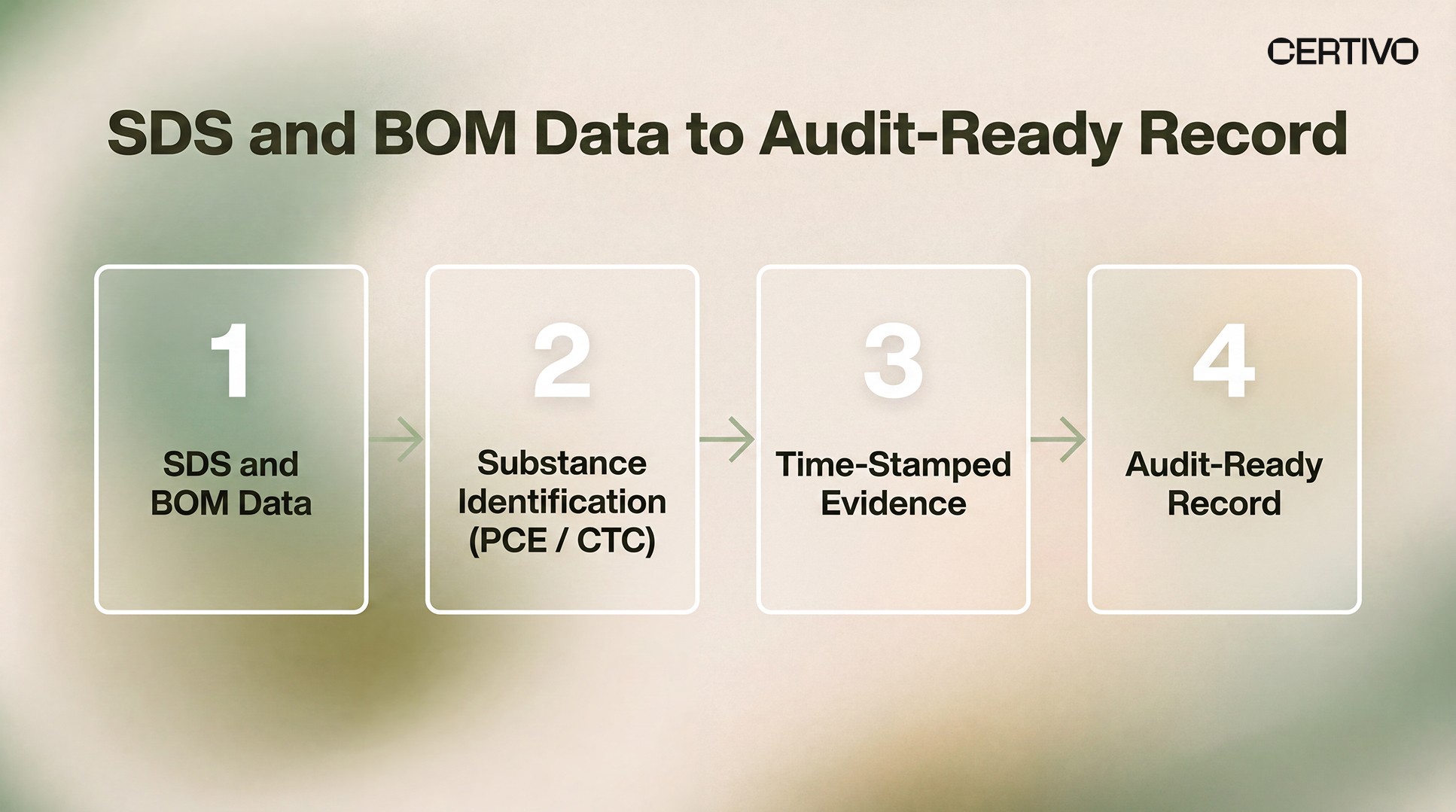
The practical burden of these rules is not the deadline itself, it is proving which products, processes, and sites are in scope. That requires reconciling safety data sheets, supplier declarations, and BOM data to locate every use of PCE and CTC, then separating permitted uses from prohibited or phased-out ones.
For manufacturers relying on email and spreadsheets, this reconciliation is slow and error-prone. Automated supplier data collection and AI document parsing shorten it considerably by extracting substance data from SDS files and certificates at scale. Certivo's approach to streamlined supplier documentation and AI-driven certificate validation reduces manual data entry and flags gaps before they become findings.
Struggling to locate PCE and CTC across thousands of SDS files and BOM lines? Request a compliance review to see how Certivo maps substances to products automatically.
Compliance Risks and Enforcement Exposure
Extended deadlines do not reduce enforcement risk, they shift it. Two exposures dominate. First, unchanged requirements, especially dermal protection, remain enforceable now, so misreading the extension as broad relief creates near-term liability. Second, entity misclassification can cause a non-federal site to apply a federal timeline incorrectly, or the reverse.
TSCA Section 6 obligations carry federal enforcement authority, and both underlying rules are also being challenged in court, which adds uncertainty to any future substantive changes. Maintaining continuous audit-ready documentation across sites is the most reliable way to reduce surprises during an EPA inspection.
Audit Readiness for Compliance Engineers
For compliance engineers, PCE and CTC readiness is fundamentally a data-versioning and evidence-integrity problem, not a one-time filing. Different audiences will test your records in different ways.
📄 Internal audits: confirm exposure monitoring, ECEL compliance, and training records are current per site.
📄 Customer audits: OEM buyers may request proof that supplied components and processes meet TSCA obligations.
📄 Regulatory inspections: EPA market surveillance may request point-in-time evidence for a specific facility and date.
📄 Certification audits: ISO 14001 and IATF 16949 assessors expect consistent, retrievable documentation.
Sound programs preserve immutable audit logs, time-stamped declarations, and point-in-time queries so you can show who submitted each record, when, and under what authority. Customer trust center models used by large technology and automotive OEMs illustrate the direction of travel toward self-service evidence. No software makes any facility audit-proof, but a well-structured system makes you audit-ready by cutting response time and eliminating surprises. Certivo functions as a centralized system of record built for exactly this retrieval problem.
TSCA compliance evidence workflow for PCE and CTC audit readiness
Click on image to view full
Timeline, Litigation, and Future Outlook
EPA has signaled that separate proposals to amend the substantive provisions of both the PCE and CTC rules are expected later in 2026. Because both December 2024 rules are also under court challenge, the compliance landscape may continue to shift.
Date | Event |
|---|---|
Dec 18, 2024 | PCE and CTC risk management rules published |
Jan 17, 2025 | Underlying rules effective |
Mar 27, 2026 | Proposed compliance date extensions published |
Jul 28, 2026 | Final extension rule published and effective |
Later 2026 | Proposed substantive amendments expected |
Jun–Dec 2027 | Extended non-federal compliance deadlines |
Because the picture is evolving, regulatory intelligence and horizon scanning that alerts teams when a rule changes is more valuable than a static compliance calendar.
PCE and CTC Compliance Preparation Checklist
✅ Review SDS, supplier declarations, and BOM data to locate every product and process using PCE or CTC.
✅ Separate permitted uses from prohibited or phased-out uses.
✅ Classify each facility as non-federal, federal agency, or federal contractor.
✅ Continue dermal protection measures, which were not extended.
✅ Update compliance calendars to June 21, 2027, September 20, 2027, and December 20, 2027.
✅ Maintain recordkeeping and downstream notification on original timelines.
✅ Monitor EPA's expected substantive amendments and the ongoing litigation.
Teams still running this on spreadsheets should evaluate replacing spreadsheets with a scalable system before the 2027 dates approach.
How AI Simplifies TSCA Chemical Compliance
Manual chemical compliance does not scale across thousands of parts, suppliers, and sites. AI-native compliance automation changes the economics of TSCA readiness in four ways.
Substance identification at scale: CORA-powered regulatory intelligence parses SDS files and supplier certificates to locate PCE and CTC across BOMs, connecting substances to specific products.
Deadline mapping: CORA compliance intelligence links each affected use to the correct 2027 deadline based on entity type, reducing misclassification risk.
Automated supplier outreach: Certivo requests and validates missing declarations through supplier self-service portals, cutting manual follow-up.
Continuous monitoring: CORA regulatory insights flag when EPA amends the rules or when litigation changes obligations, shifting teams from reactive to continuous readiness.
This is the same AI-powered compliance management approach manufacturers use to manage overlapping frameworks such as TSCA, REACH, RoHS, and PFAS from a single compliance data backbone.
Get complete visibility into your PCE and CTC exposure across products and sites. Speak with a compliance specialist to see how Certivo automates TSCA readiness.
Lavanya
Lavanya is an accomplished Product Compliance Engineer with over four years of expertise in global environmental and regulatory frameworks, including REACH, RoHS, Proposition 65, POPs, TSCA, PFAS, CMRT, FMD, and IMDS. A graduate in Chemical Engineering from the KLE Institute, she combines strong technical knowledge with practical compliance management skills across diverse and complex product portfolios.
She has extensive experience in product compliance engineering, ensuring that materials, components, and finished goods consistently meet evolving international regulatory requirements. Her expertise spans BOM analysis, material risk assessments, supplier declaration management, and test report validation to guarantee conformity. Lavanya also plays a key role in design-for-compliance initiatives, guiding engineering teams on regulatory considerations early in the product lifecycle to reduce risks and streamline market access.