


The PPWR compliance deadline is August 12, 2026. From that date, every packaging item placed on the EU market must be backed by a signed EU Declaration of Conformity and a complete technical file, or it cannot be legally marketed. There is no transition window and no sell-through period for the core obligations. Packaging placed on the market on or after that date must already comply.
This is the hardest packaging deadline of 2026 for one reason. The PPWR replaced a directive with a directly applicable regulation, so the same rules apply in all 27 member states at once, with no national grace period to absorb the shock. For Directors of Packaging Compliance, Regulatory Affairs Heads, and Supply Chain Compliance Managers in FMCG, food, pharma, and cosmetics, the practical question is no longer "what does the PPWR require," but "can we produce the evidence on demand."
Run a free PPWR readiness check on your packaging portfolio through Certivo's compliance risk assessment to see where your Declaration of Conformity evidence is missing before enforcement begins.
Key Takeaways
📌 The PPWR (Regulation (EU) 2025/40) applies from PPWR August 12 2026 across all 27 member states as a directly applicable regulation, with no national transposition.
⏳ There is no grace period for the core obligations. Packaging placed on the market on or after August 12 must already carry a valid PPWR Declaration of Conformity.
📄 Every distinct packaging type needs its own signed DoC (Annex VIII) supported by a technical file (Annex VII), assessed internally under Module A with no notified body required.
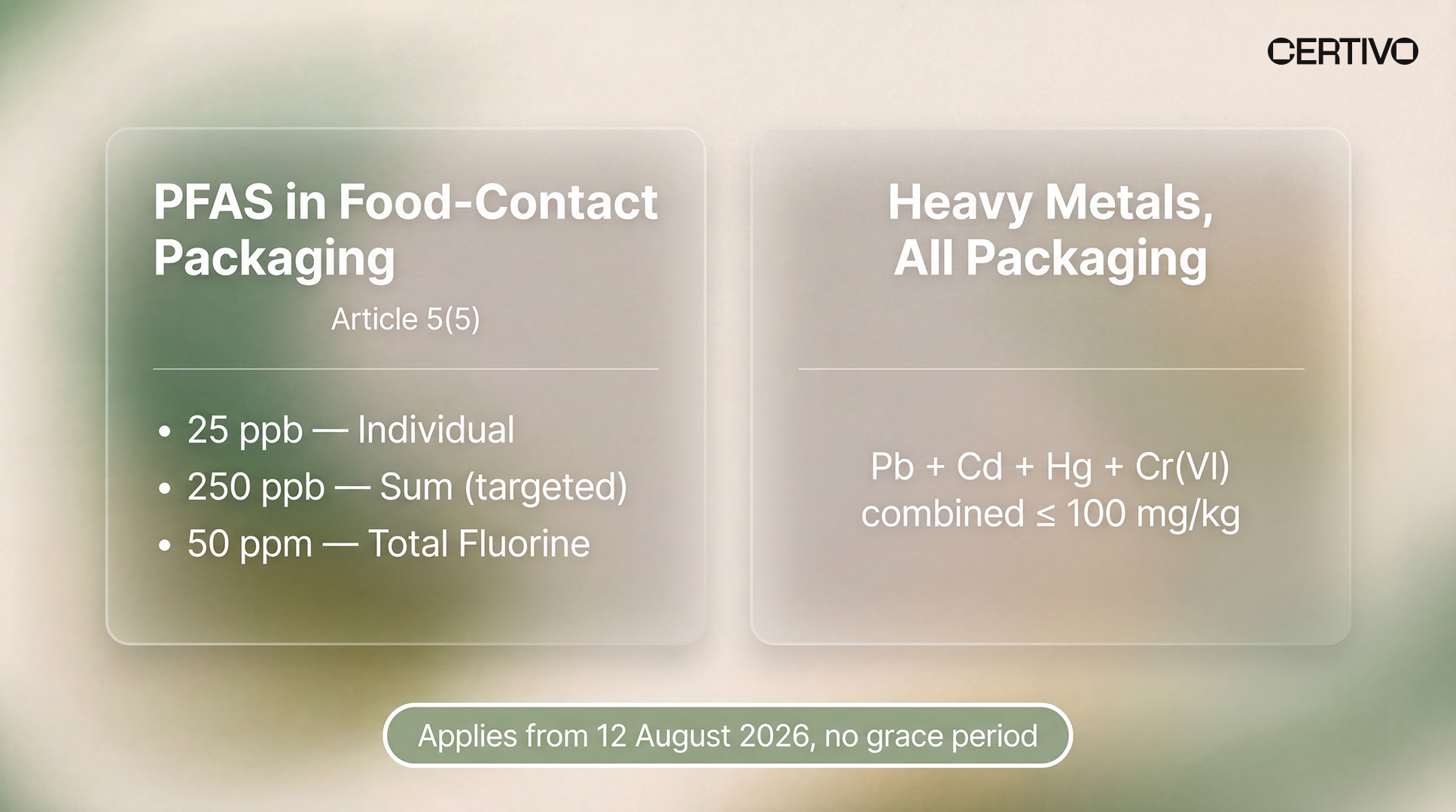
⚠️ PPWR substance restrictions bite immediately: three PFAS thresholds in food-contact packaging and a combined 100 mg/kg cap on lead, cadmium, mercury, and hexavalent chromium across all packaging.
🔗 The DoC is only as strong as the supplier evidence behind it, so the real bottleneck is collecting Certificates of Analysis and material data across a multi-tier supply chain.
📊 Documentation must be retained for 5 years (single-use) or 10 years (reusable) and produced to market surveillance authorities on request, typically within 10 days.
🤖 Manual, spreadsheet-based DoC preparation does not scale to a full portfolio, which is why manufacturers are shifting to continuous, evidence-linked compliance systems.
What Happens on August 12, 2026
On the PPWR compliance deadline, three things become directly enforceable at once. First, the previous Packaging and Packaging Waste Directive (94/62/EC) is repealed. Second, every packaging type on the EU market must have a Declaration of Conformity and technical documentation ready. Third, the substance restrictions on PFAS and heavy metals apply to packaging placed on the market from that date.
The important word is "regulation." A directive gives member states time to transpose rules into national law. A regulation does not. The obligations apply directly and uniformly, which is why compliance teams cannot rely on a national implementation lag. For a fuller framework view, Certivo maintains a dedicated PPWR framework page and a broader materials and environmental compliance overview.
PPWR at a Glance: Regulation (EU) 2025/40
The PPWR was published in the Official Journal on January 22, 2025, and entered into force on February 11, 2025. It covers all packaging placed on the EU market regardless of material, and it reaches every economic operator in the chain, including manufacturers, importers, and distributors, regardless of where the company is established. That extraterritorial reach is what pulls non-EU brands into scope.
The regulation is structured in waves. August 12, 2026 is the general date of application, but recycled content minimums, recyclability performance grades, reuse targets, and digital labelling arrive later. Treating the deadline as the finish line is a mistake. It is the point at which packaging compliance EU obligations become continuous rather than periodic. Certivo positions this as a shift toward proactive compliance risk management rather than one-time certification.
The Declaration of Conformity: What the Deadline Actually Requires
The PPWR Declaration of Conformity is a signed, one-page statement under Annex VIII declaring that a specific packaging type meets the relevant requirements of Articles 5 to 12. It sits on top of a technical file. The declaration is the conclusion, and the technical file is the proof. Signing the DoC is the easy part. Assembling defensible evidence for every packaging type is the work that most teams underestimate.
Who Signs the DoC
Accountability follows the role definitions in the regulation. The manufacturer, defined as the party marketing packaging under its own name or brand, carries out the conformity assessment, prepares the technical documentation, and signs the DoC under Article 39. A brand owner that outsources production to a converter is still the manufacturer for PPWR purposes. Importers do not create the DoC. They must hold a copy per packaging type, verify the conformity assessment was completed, and make documentation available to authorities. Non-EU manufacturers may appoint an authorized representative in the EU. Managing these roles cleanly is a supplier and contractor management discipline.
What Goes in the Technical File
The technical file under Annex VII is the evidence base. It typically includes a general description of the packaging type, component-level construction and materials, substance and PFAS test results, recyclability and minimisation assessments, applied harmonised standards, and supporting supplier documentation. Every distinct packaging type needs its own file mapped to the SKUs and markets that use it. This is fundamentally a BOM-level compliance tracking problem, because each material and component contributes evidence that must roll up to a single declaration.
Conformity Assessment Under Module A
The PPWR uses Module A, internal production control. In practice this means no third-party notified body is involved for the large majority of packaging. The manufacturer assesses internally, signs internally, and remains auditable externally. That autonomy is not leniency. Article 39(5) allows competent authorities to check the accuracy of declarations each year on a risk basis and to withdraw non-compliant products. Self-declaration raises the evidentiary bar rather than lowering it, which is why audit-ready documentation matters.
PPWR Declaration of Conformity and technical file structure for packaging compliance
Click on image to view full

PPWR Substance Restrictions: PFAS and Heavy Metals
The PPWR substance restrictions are the fastest-moving risk on the deadline, because they apply to packaging placed on the market from August 12, 2026, even if it was manufactured earlier. This closes the usual "old stock" escape route for chemical limits.
PFAS Limits in Food-Contact Packaging (Article 5(5))
Food-contact packaging must not contain PFAS at or above three thresholds: 25 ppb for any individual PFAS by targeted analysis, 250 ppb for the sum of PFAS by targeted analysis (both excluding polymeric PFAS), and 50 ppm for total fluorine or total PFAS including polymeric PFAS. The European Commission's March 2026 guidance sets out a stepwise testing route starting with total fluorine screening. Supplier word alone is not evidence. You need Certificates of Analysis from ISO/IEC 17025 accredited laboratories. Certivo's approach to PFAS compliance across multi-tier supply chains is built for exactly this evidence chain, and the wider PFAS framework page tracks parallel restrictions.
Heavy Metals Limit Across All Packaging
Separately, the combined concentration of lead, cadmium, mercury, and hexavalent chromium must not exceed 100 mg/kg. Unlike the PFAS limits, this cap applies to all packaging, not only food-contact. Managing both restrictions against thousands of components is a classic substance and threshold management task, closely related to the discipline your teams already apply for REACH and RoHS through chemical and hazmat compliance workflows.
PPWR substance restrictions showing PFAS and heavy metal packaging compliance thresholds
Click on image to view full
Struggling to collect PFAS test reports and material declarations from hundreds of packaging suppliers before the deadline? See how Certivo automates supplier evidence collection through a compliance review.
Why "No Grace Period" Compresses Your Timeline
The PPWR no grace period reality is what separates this deadline from most regulatory transitions. There is no phase-in for the DoC or the substance limits. If a packaging type cannot demonstrate conformity on August 12, it cannot be placed on the market. That converts a documentation project into a market-access dependency.
The lead time problem is severe. Accredited PFAS testing has queues, borderline results may need confirmatory analysis, and supplier response cycles are measured in weeks. A team starting late faces the worst combination: constrained lab capacity, incomplete supplier data, and a hard date. This is why PPWR enforcement should be planned backward from August 12, not forward from today, with buffer for retesting.
Affected Industries and Product Categories
The PPWR reaches any organization that places packaged goods on the EU market. The pressure is highest where packaging volume and chemical risk intersect.
Food and beverage: Direct exposure to the PFAS food-contact limits and the highest SKU counts.
Cosmetics and personal care: Complex multi-layer and decorative packaging with many suppliers.
Pharma and medical: Strict traceability plus overlapping product-specific rules.
FMCG and consumer goods: High packaging turnover and retailer-driven documentation demands, addressed on Certivo's consumer goods industry page.
E-commerce and D2C: Transport and grouped packaging face minimisation rules, including limits on empty space in parcels.
Documentation and Supplier Data Challenges
The DoC is a supplier data collection problem before it is a chemistry problem. Each declaration depends on material breakdowns, substance test results, and recyclability assessments that live with converters and upstream suppliers. Chasing this by email does not scale to a full portfolio, and version drift between the DoC, the technical file, and your ERP identifiers is where audits find gaps.
A durable approach centralizes evidence into a single compliance data backbone, links each document to a packaging type and its SKUs, and standardizes supplier requests so responses arrive in a usable structure. This turns supplier documentation from a recurring fire drill into a maintained dataset, and it supports faster customer RFQ and audit responses when downstream buyers ask for proof.
PPWR Declaration of Conformity supplier data collection workflow for packaging compliance
Click on image to view full

Compliance Risks and Enforcement Exposure
PPWR compliance will be tested through several distinct channels, and each expects a different evidence posture.
Regulatory inspections: Member state market surveillance authorities can request the technical file and control the accuracy of declarations on a risk basis, with power to withdraw non-compliant packaging.
Customer audits: OEMs and large retailers increasingly require proof of conformity as a condition of supply, often modeled on trust-center expectations set by companies like Apple and automotive OEMs.
Internal and certification audits: Quality systems under ISO 9001 and ISO 14001 will fold PPWR evidence into existing audit cycles.
No software makes a portfolio "audit-proof." The realistic goal is audit-ready: reducing surprises and cutting the hours between an authority's request and a complete evidence pack. That depends on immutable, time-stamped records showing who submitted each piece of evidence, when, and with what authority, and on the ability to retrieve the state of a declaration at a point in time. Retention is fixed at 5 years for single-use and 10 years for reusable packaging, so historic state tracking is a data versioning requirement, not a filing convenience.
The Staggered PPWR Timeline Beyond August 2026
August 12, 2026 is the start, not the whole regulation. Recyclability performance grades and recycled-content minimums for plastic packaging phase in around 2030, reuse targets and further labelling obligations arrive on their own dates, and digital solutions such as the Digital Product Passport will shape traceability later. Extended Producer Responsibility obligations connect to national registers, which link the PPWR to schemes tracked under extended producer responsibility. Planning only for the first deadline guarantees a second scramble.
PPWR Readiness Checklist
✅ Inventory every distinct packaging type placed on the EU market and map each to its SKUs and markets.
✅ Confirm your role per packaging type: manufacturer, importer, or distributor, and appoint an authorized representative where required.
✅ Collect Certificates of Analysis from accredited labs for PFAS in food-contact packaging and heavy metals across all packaging.
✅ Build the Annex VII technical file for each packaging type and link it to a signed Annex VIII DoC.
✅ Establish retention: 5 years single-use, 10 years reusable, from the last unit placed on the market.
✅ Set up a repeatable supplier request process so evidence stays current as materials and suppliers change.
✅ Prepare a retrieval process to produce a complete evidence pack to authorities on request.
How AI-Native Compliance Automation Closes the Gap
The PPWR turns packaging compliance into a continuous, evidence-heavy obligation across a full portfolio. That is difficult to sustain manually. Certivo operates as the compliance data backbone that holds every packaging type, its technical file, and its DoC in one place, with time-stamped records that support audit readiness rather than one-off certification.
CORA-powered regulatory intelligence parses returned supplier documents, extracts substance and test data, and flags missing or borderline evidence before it becomes an enforcement problem. Structured supplier portals replace email chasing, and BOM-level material mapping rolls component evidence up to a single declaration. The result is a defensible technical file that is retrievable on demand, and a shift from reactive scrambling toward continuous readiness across PPWR, PFAS, REACH, and adjacent frameworks.
If your team is preparing for the PPWR compliance deadline and cannot yet produce a full DoC evidence pack on demand, the fastest way to find the gaps is to test the portfolio directly. Book a compliance review with a Certivo specialist to run a PPWR readiness check across your packaging portfolio and supply chain.
Vasanth
Vasanth is a skilled Compliance Engineer with over five years of experience specializing in global environmental regulations, including REACH, RoHS, Proposition 65, POPs, TSCA, PFAS, CMRT, EMRT, FMD, and IMDS. With a strong academic foundation in Chemical Engineering from Anna University, he brings a deep technical understanding to compliance processes across complex product lines.
Vasanth excels in analyzing Bills of Materials (BOMs), evaluating supplier declarations, and ensuring regulatory conformity through meticulous review and risk assessment. He is highly proficient in supplier engagement, adept at interpreting material disclosures, and experienced in preparing customer-ready compliance documentation tailored to diverse global standards.