


The Australia IChEMS PFAS ban now extends to three more perfluoroalkane sulfonic acids. On 18 June 2026, the Department of Climate Change, Energy, the Environment and Water (DCCEEW) registered an amendment adding PFHpS, PFNS, and PFDS to Schedule 7 of the IChEMS Register, the highest-severity tier reserved for chemicals with no identified essential uses. From 1 January 2027, manufacture, import, use, and export of these substances, their salts, and related compounds are prohibited above narrow trace limits. Any manufacturer, importer, or exporter with an Australian touchpoint should begin PFAS supplier screening now.
Book a Compliance Risk Assessment to understand your PFAS exposure across products and supply chains before the deadline.
Key Takeaways
📌 The Australia IChEMS PFAS ban adds PFHpS (CAS 375-92-8), PFNS (CAS 68259-12-1), and PFDS (CAS 335-77-3) to Schedule 7, effective 1 January 2027.
⚠️ Schedule 7 carries no essential-use exemption pathway. Reformulation or substitution is the primary compliance route.
📊 Trace limits apply: ≤0.025 mg/kg for each parent acid or salt, and (verify at build) ≤1 mg/kg for related compounds.
🏭 Priority sectors: metal finishing and electroplating, printing and packaging, surface coatings, cleaning products, and firefighting foam.
🔗 Substances are scheduled as classes, so supplier declarations must address precursors and degradants, not only the three named CAS numbers.
📄 This is a domestic Australian action, independent of Stockholm Convention POPs status (only PFOS, PFOA, and PFHxS are POPs-listed).
🤖 A centralized compliance data backbone with automated supplier data collection turns this from a manual fire drill into a controlled screening exercise.
Executive Regulatory Overview
IChEMS is Australia's national framework for managing the environmental risk of industrial chemicals, established under the Industrial Chemicals Environmental Management (Register) Act 2021. It is administered by DCCEEW and is a separate scheme from AICIS, which handles import and manufacture notification. Chemicals are sorted into seven schedules by environmental risk, with Schedule 7 the most severe.
The 1 January 2027 prohibition gives global manufacturers a short runway. For teams already tracking obligations through materials and environmental compliance programs, the change is another entry in a widening global PFAS map. For teams still relying on spreadsheets, it is a reason to move toward continuous compliance monitoring.
What the 2026 Amendment Changed
The Industrial Chemicals Environmental Management (Register) Amendment (2026 Measures No. 1) Instrument 2026 was registered on 18 June 2026 and commenced 19 June 2026. Its provisions were absorbed into the principal 2022 Register, so the live legal text now sits in the current compilation rather than the amending instrument itself.
The instrument is broader than PFAS. It also amended Schedule 6 essential uses for UV-328, updated risk management for HBCD, and assigned other substances across Schedules 2 to 5. This article focuses on the three highest-severity Schedule 7 PFAS additions, which carry the strictest prohibition and the shortest practical runway. The primary source is the Federal Register of Legislation.
The Three Substances and Their CAS Numbers
The amendment lists each substance as a chemical class, covering the parent acid, its salts, and any related compound that can degrade to the parent sulfonic acid. This mirrors the drafting already used for PFOS, PFOA, and PFHxS.
Substance | Abbreviation | CAS Number | Scheduled class |
|---|---|---|---|
Perfluoroheptanesulfonic acid | PFHpS | 375-92-8 | Acid, salts, and precursors that degrade to PFHpS |
Perfluorononanesulfonic acid | PFNS / PFNSA | 68259-12-1 | Acid, salts, and precursors that degrade to PFNS |
Perfluorodecanesulfonic acid | PFDS | 335-77-3 | Acid, salts, and precursors that degrade to PFDS |
Because these are classes, a supplier declaration stating only "does not contain PFHpS" may be incomplete. It must also address precursor and degradant chemistry. This is where BOM substance and threshold management becomes essential rather than optional.
Understanding Schedule 7 as the Highest-Severity Tier
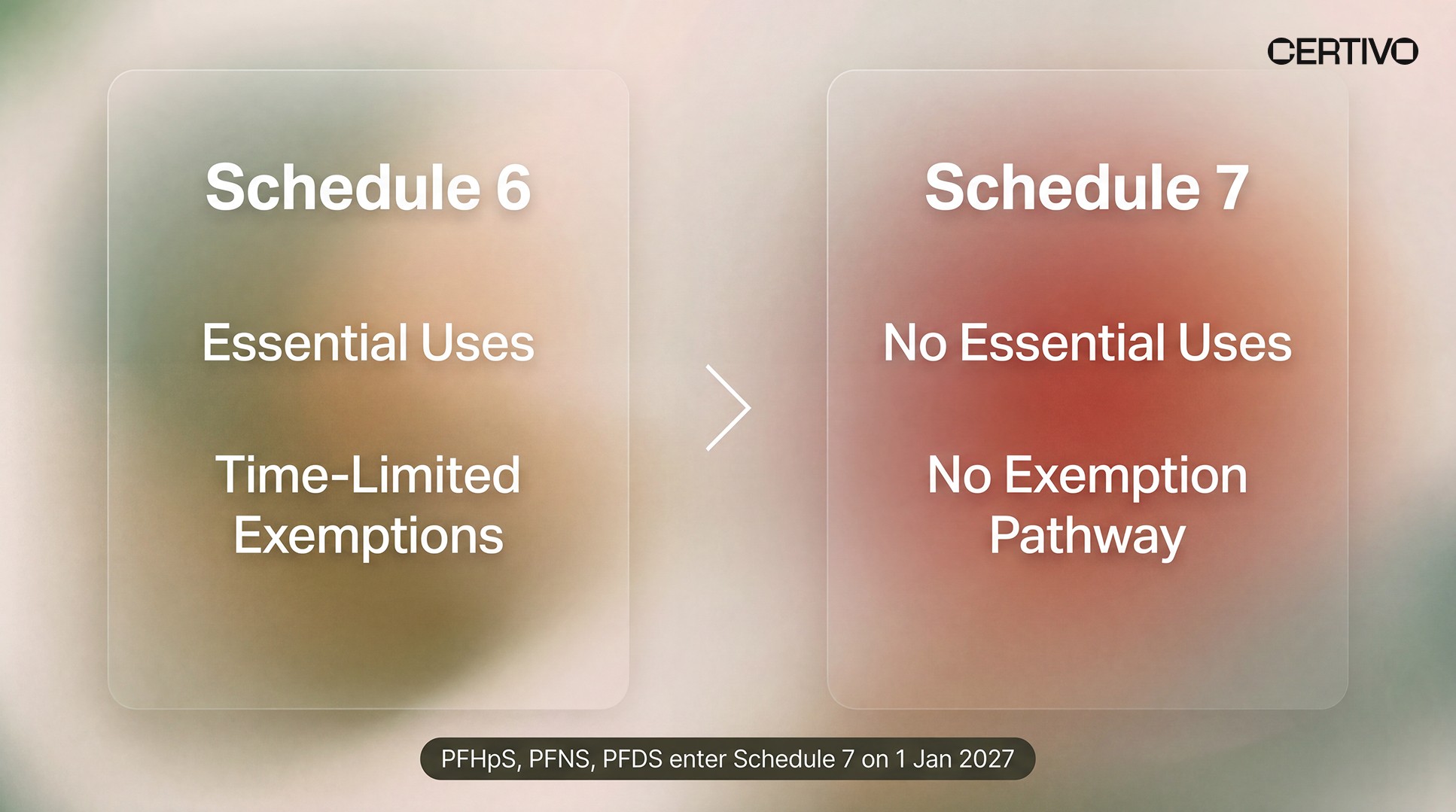
Schedule 7 is defined as chemicals likely to cause serious or irreversible environmental harm with no identified essential uses. It sits one level above Schedule 6, which covers the same harm profile but permits time-limited essential-use exemptions. That distinction matters for planning.
Schedule | Meaning |
|---|---|
1–5 | Increasing potential for environmental harm, managed through tiered standards |
6 | Serious or irreversible harm, essential uses identified (time-limited exemptions apply) |
7 | Serious or irreversible harm, no essential uses (this action) |
For Schedule 7, there is no case-by-case exemption pathway analogous to Schedule 6. The only routes to compliance are staying below the trace limits, qualifying for the narrow research or pre-existing-article carve-outs, or reformulating. That reality shapes every downstream decision, which is why audit-ready documentation should be built now, not after 2027.
IChEMS Schedule 7 PFAS ban with no essential use exemption for manufacturers
Click on image to view full
Prohibition Scope, Trace Limits, and Exceptions
From 1 January 2027, the manufacture, use, import, and export of PFHpS, PFNS, PFDS, their salts, and related compounds are prohibited in chemicals, mixtures, and articles, subject only to narrow exceptions.
✓ Unintentional trace contamination (UTC): permitted up to ≤0.025 mg/kg for each parent acid or salt individually, and up to ≤1 mg/kg for any individual related compound or combination (confirm the related-compound figure against the compiled Schedule 7 text).
✓ Research and laboratory use: remains permitted, consistent with the existing PFOS, PFOA, and PFHxS entries.
✓ Pre-existing articles: articles already in use in Australia before 1 January 2027 are not retroactively captured. New manufacture, import, or export after that date is in scope.
✓ Narrow carve-outs: hazardous-waste-permitted handling and environmentally sound disposal.
For confirmed presence, evaluate levels against the trace limits before assuming reformulation is required. This kind of threshold logic is exactly what BOM-level compliance intelligence is designed to automate across thousands of parts.
Industries and Product Categories Affected
The named uses in the underlying risk assessment point to clear screening priorities. Any organization with Australian manufacture, import, export, or domestic use should treat these process chemistries as high priority.
Metal finishing and electroplating — PFHpS as a mist suppressant in plating baths.
Printing and packaging — PFHpS as a wetting agent in printing inks.
Surface coatings and industrial finishes — all three substances named for coatings.
Cleaning and furnishing-care products — PFHpS, PFNS, and PFDS all named.
Firefighting foam — PFHpS specifically named, consistent with the global focus on PFAS foams.
Electronics and manufacturing supply chains — any BOM covering surface treatments, coatings, or cleaning agents with an Australian touchpoint. See how Certivo supports electronics manufacturers and chemical manufacturers.
Struggling to trace these chemistries across suppliers? Request a Compliance Review to see where your exposure sits.
BOM and Supplier Data Challenges
The operational difficulty is not understanding the rule. It is proving compliance across a multi-tier supply chain. Three challenges recur.
Class-based screening. Suppliers must confirm the absence of the parent acid, salts, and degradant-capable precursors. Simple keyword checks against three CAS numbers will miss precursor chemistry, so standardized supplier questionnaires need class-level logic.
Threshold interpretation. Trace-limit decisions require normalized, comparable data. Inconsistent units and formats across supplier declarations make this error-prone by hand, which is where AI document parsing and certificate validation removes manual guesswork.
Data quality at scale. For manufacturers with Australian touchpoints across many product lines, re-issuing and validating declarations manually does not scale. A centralized supplier data collection portal with version control is the practical answer.
PFAS supplier declaration screening workflow for IChEMS Schedule 7 compliance
Click on image to view full

Compliance Risks and Enforcement Exposure
IChEMS obligations are enforced federally and, in some cases, at state level. New South Wales has incorporated the IChEMS regime into its Protection of the Environment Operations Act 1997, where failure to comply with an IChEMS risk management measure is treated as having caused a pollution incident, and certain activities may require an environment protection licence.
For a compliance engineer, the practical exposure spans four audit types: internal audits, customer or OEM audits, regulatory inspections, and certification audits under ISO 14001 or IATF 16949. No software makes a program audit-proof. The realistic objective is audit-ready: reducing surprises and shortening response time when an auditor asks who submitted a declaration, when, and with what authority. Immutable, time-stamped records and point-in-time evidence retrieval, delivered through continuous audit-ready documentation, are what make that possible.
Supply Chain and Operational Impact
The change flows both upstream and downstream. Upstream, Tier 1 suppliers must collect class-level declarations from sub-tier suppliers, and smaller suppliers may need guided forms rather than complex spreadsheets. Downstream, customer RFQs and trust-center requests increasingly demand product-level PFAS evidence at short notice.
The important nuance for supply-chain communications is that this is a purely domestic Australian action. It is independent of Stockholm Convention POPs listings, where only PFOS, PFOA, and PFHxS are listed. PFHpS, PFNS, and PFDS documentation should not be conflated with POPs-specific paperwork. Managing that distinction cleanly across jurisdictions is a core function of multi-tier supply chain transparency.
Timeline and Compliance Checklist
Date | Event |
|---|---|
23 Mar–24 Apr 2026 | DCCEEW consultation on the broader chemical set |
18 Jun 2026 | Amendment registered on the Federal Register of Legislation |
19 Jun 2026 | Amendment commenced |
1 Jan 2027 | Prohibition of PFHpS, PFNS, PFDS takes effect |
Preparation checklist
✅ Screen BOMs and supplier declarations for the three substances, their salts, and related compounds in any Australia-bound or Australia-sourced items.
✅ Prioritize the named use categories: coatings, plating mist suppressants, printing-ink wetting agents, cleaning products, and firefighting foam.
✅ Check confirmed presence against the trace limits before deciding on reformulation.
✅ Plan substitution timelines now, since Schedule 7 offers no essential-use exemption.
✅ Separate this domestic action from POPs documentation used for PFOS, PFOA, and PFHxS.
To benchmark readiness, ask about the Customer Audit Readiness Scorecard when you speak with a compliance specialist.
How AI Reduces the Screening Burden
Manual PFAS screening cannot keep pace with class-based definitions across thousands of parts. CORA-powered regulatory intelligence changes the economics of that work.
CORA-enabled analysis parses supplier certificates and declarations, extracts substance data, and flags where precursor or degradant chemistry may bring a part into scope, not just where a named CAS appears. CORA's regulatory intelligence layer maps the IChEMS entries to affected BOM lines, so compliance teams answer product-level questions rather than company-level ones. Combined with a centralized compliance data backbone, this shifts a program from reactive scrambles toward continuous readiness. For the wider picture, see the global PFAS compliance master guide.
Executive Conclusion
The Australia IChEMS PFAS ban on PFHpS, PFNS, and PFDS is narrow in substance count but strict in effect. Schedule 7 offers no essential-use exemption, the class-based drafting demands precursor-aware screening, and the 1 January 2027 deadline leaves limited time for substitution. Manufacturers that treat this as a data problem, solved through automated supplier collection, class-level screening, and audit-ready records, will absorb it without disruption. Those relying on spreadsheets will feel every one of the challenges above.
Certivo functions as the system of record that connects supplier data, BOM-level intelligence, and regulatory change management in one place. Book a Compliance Risk Assessment to map your PFHpS, PFNS, and PFDS exposure before the deadline.
Lavanya
Lavanya is an accomplished Product Compliance Engineer with over four years of expertise in global environmental and regulatory frameworks, including REACH, RoHS, Proposition 65, POPs, TSCA, PFAS, CMRT, FMD, and IMDS. A graduate in Chemical Engineering from the KLE Institute, she combines strong technical knowledge with practical compliance management skills across diverse and complex product portfolios.
She has extensive experience in product compliance engineering, ensuring that materials, components, and finished goods consistently meet evolving international regulatory requirements. Her expertise spans BOM analysis, material risk assessments, supplier declaration management, and test report validation to guarantee conformity. Lavanya also plays a key role in design-for-compliance initiatives, guiding engineering teams on regulatory considerations early in the product lifecycle to reduce risks and streamline market access.