

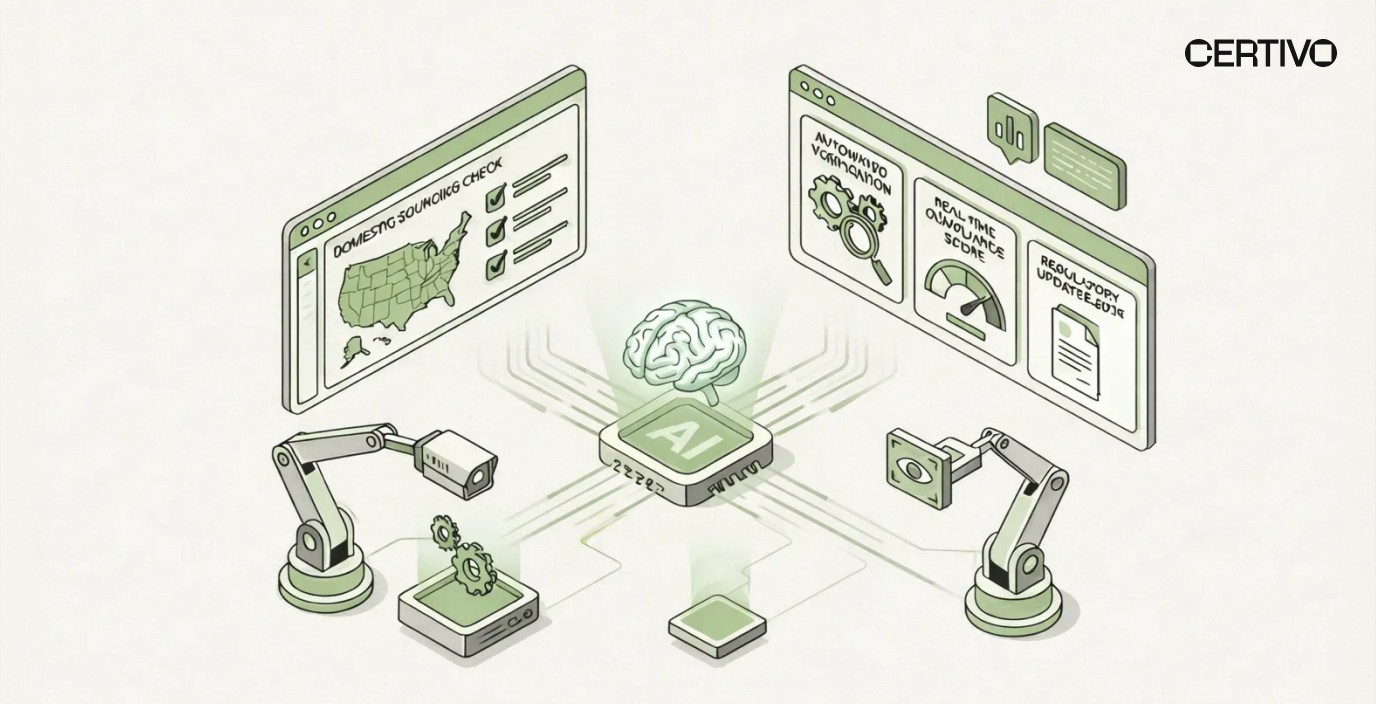
Federal infrastructure spending under the Bipartisan Infrastructure Law (BIL) has triggered the most aggressive enforcement of Buy America Act compliance requirements in decades. For manufacturers bidding on federally funded projects—highways, bridges, water systems, transit infrastructure—2026 marks a critical compliance inflection point where documentation gaps, supplier declaration failures, and manual tracking systems become disqualifying risks.
The financial stakes are substantial. A single compliance violation can result in contract termination, debarment from future federal projects, penalties exceeding millions of dollars, and reputational damage that eliminates access to the largest procurement market in the world. Yet most manufacturers approach Buy America Act compliance with spreadsheets, email chains, and periodic supplier surveys—methods that cannot scale to meet the material traceability, domestic content calculations, and audit requirements federal agencies now demand.
This is not a regulatory formality. Buy America Act compliance in 2026 is a market access requirement that determines which manufacturers win federal contracts and which are excluded. Organizations that treat compliance as a documentation exercise rather than a strategic capability will face enforcement consequences, customer disqualification, and lost revenue opportunities measured in tens of millions of dollars.
Table of Contents
What Is the Buy America Act and Why Does BABA Matter in 2026?
Key Changes in Buy America Act Compliance Requirements for 2026
Who Must Comply: Manufacturers, Suppliers, and Federal Contractors
Core Buy America Act Compliance Requirements and Documentation
The Supplier Declaration and Material Traceability Challenge
Common Buy America Act Compliance Failures and Enforcement Penalties
Why Manual Compliance Processes Fail at Federal Project Scale
The Role of AI in Buy America Act Compliance Automation
How Certivo Simplifies Buy America Act Compliance for Manufacturers
2026 Readiness Checklist: How Manufacturers Should Prepare
1. What Is the Buy America Act and Why Does BABA Matter in 2026?
The Buy America Act (BAA), originally enacted in 1933 and strengthened through subsequent legislation including the Build America, Buy America Act (BABA) provisions of the Infrastructure Investment and Jobs Act, requires that iron, steel, manufactured products, and construction materials used in federally funded infrastructure projects be produced in the United States.
The BABA Expansion Under the Bipartisan Infrastructure Law
BABA expanded Buy America Act requirements to cover all federally funded infrastructure programs, not just transportation projects. This expansion encompasses:
Highway and bridge construction
Public transportation systems
Water infrastructure and treatment facilities
Broadband deployment
Electric grid modernization
Airport improvements
The scope increase means manufacturers across sectors—steel fabrication, electrical components, piping systems, construction materials, telecommunications equipment—now face Buy America Act compliance requirements for the first time.
Why 2026 Is a Critical Compliance Year
Federal agencies are transitioning from waivers and transitional compliance periods to full enforcement. The Office of Management and Budget (OMB) and agency-specific guidance issued in 2024 and 2025 established stricter domestic content thresholds, tighter waiver standards, and enhanced verification requirements that take full effect in 2026. For detailed federal guidance, see the Build America, Buy America Act implementation resources.
Manufacturers relying on broad material waivers or lenient interpretation of domestic content calculations will face compliance challenges as agencies prioritize enforcement, conduct supplier audits, and impose penalties for false certifications.
2. Key Changes in Buy America Act Compliance Requirements for 2026
Several regulatory developments fundamentally alter how manufacturers must approach Buy America compliance in 2026:
Increased Domestic Content Thresholds
Federal agencies are implementing phased increases in domestic content requirements. For manufactured products, the domestic content threshold increases from 55% to 60% or higher depending on the federal program and agency. Manufacturers must recalculate cost-based domestic content for every product line and component assembly to ensure compliance.
Stricter Waiver Standards
Federal agencies previously granted broad waivers for products deemed unavailable domestically or where compliance would impose unreasonable costs. Waiver approval rates are declining significantly as agencies adopt stricter review standards and require manufacturers to demonstrate exhaustive efforts to source domestically before granting exceptions.
Enhanced Material Traceability Requirements
Buy America Act compliance now requires manufacturers to trace materials and components through multi-tier supply chains, documenting country of origin, production location, and domestic content percentages at the subcomponent level. Supplier declarations must include verifiable evidence, not just attestations.
Mandatory Supplier Certifications
Federal contractors must obtain detailed supplier certifications that identify manufacturing locations, raw material sources, and domestic content calculations. Generic compliance statements are no longer acceptable. Suppliers must provide bill of materials tracking at the component level that supports domestic content claims.
Real-Time Compliance Verification
Federal agencies are implementing continuous compliance verification rather than periodic audits. Manufacturers must maintain audit-ready documentation systems that can be produced on demand, demonstrating compliance across product portfolios, supplier networks, and material sourcing decisions in real time.
These changes eliminate the compliance strategies manufacturers used historically. Buy America Act compliance requirements 2026 demand systematic data infrastructure, not spreadsheet tracking.
3. Who Must Comply: Manufacturers, Suppliers, and Federal Contractors
Buy America Act compliance obligations extend across the entire supply chain, creating accountability for multiple parties:
Prime Contractors and Project Developers
Engineering, procurement, and construction (EPC) firms and prime contractors on federally funded projects bear ultimate responsibility for Buy America Act compliance. They must verify that every material, component, and manufactured product meets domestic content requirements and maintain documentation proving compliance.
Direct Equipment and Material Manufacturers
Manufacturers supplying steel, iron, construction materials, electrical equipment, piping, valves, and other products directly to federal projects must certify that their products meet Buy America domestic content thresholds. False certifications create legal liability and debarment risk.
Component and Subassembly Suppliers
Upstream suppliers providing components, raw materials, and subassemblies must furnish accurate declarations to manufacturers regarding country of origin, production location, and domestic content. Supplier data gaps create compliance failures for downstream manufacturers.
Importers and Distributors
Organizations importing products or distributing materials to federal projects must verify Buy America compliance even when they do not manufacture products themselves. Importers cannot claim ignorance of material origins as a defense against compliance violations.
The distributed compliance obligation means manufacturers cannot rely solely on their own operations—they must implement supplier compliance management programs that ensure upstream partners provide accurate, verifiable data.
4. Core Buy America Act Compliance Requirements and Documentation
Meeting Buy America Act compliance in 2026 requires manufacturers to produce specific documentation and maintain detailed records:
Domestic Content Calculations
Manufacturers must calculate the percentage of domestic content in each product using cost-based formulas prescribed by federal regulations. Calculations must account for:
Direct material costs (iron, steel, raw materials)
Manufacturing costs (labor, overhead, facility costs)
Component costs (domestic vs. foreign sourced)
Domestic content calculations must be updated when suppliers change, material sourcing shifts, or cost structures evolve. Static calculations performed once annually do not satisfy federal requirements.
Supplier Declarations and Certifications
Every supplier in the manufacturing supply chain must provide signed declarations certifying:
Country of origin for materials and components
Manufacturing location for processing and assembly
Domestic content percentage with supporting calculations
Material composition at the BOM level
Supplier declarations must be renewed periodically and updated when sourcing changes. Manufacturers relying on outdated or incomplete declarations face audit failures.
Bill of Materials (BOM) Documentation
Federal agencies require manufacturers to maintain detailed BOMs that map every component, material, and subassembly to supplier declarations and domestic content calculations. BOMs must be traceable, version-controlled, and linked to compliance evidence.
Audit-Ready Compliance Files
Manufacturers must organize compliance documentation by product, by project, and by supplier, enabling rapid response to federal agency inquiries. Audit-ready files include:
Supplier certifications
Domestic content calculations
Material test reports
Country of origin documentation
Correspondence demonstrating due diligence
Organizations that cannot produce complete compliance files within days face enforcement actions and contract termination.
Continuous Monitoring and Updates
Buy America compliance is not a one-time certification. Manufacturers must continuously monitor supplier changes, material sourcing shifts, and regulatory updates that impact compliance status. Static compliance programs create false confidence and enforcement risk.
These requirements exceed the capacity of manual tracking systems. Manufacturers need compliance management software for manufacturers that automates data collection, validation, and reporting.
5. The Supplier Declaration and Material Traceability Challenge
Supplier data gaps represent the single largest Buy America Act compliance risk for manufacturers. Federal enforcement actions increasingly target supplier declaration failures rather than manufacturer calculation errors.
Why Suppliers Cannot Provide Accurate Declarations
Most suppliers lack internal systems to track country of origin and domestic content across their own supply chains. They source materials from distributors who lack compositional data. They rely on generic statements from upstream suppliers rather than verified evidence. The result is supplier declarations filled with qualifiers like "to the best of our knowledge" that provide no legal protection.
Multi-Tier Supply Chain Visibility Gaps
Buy America compliance requires tracing materials through multiple supply chain tiers. A manufacturer sources a component from Supplier A, who sources subcomponents from Supplier B, who sources raw materials from Supplier C. Each tier introduces data gaps, declaration delays, and verification challenges that manual processes cannot resolve.
Supplier Non-Response and Incomplete Data
Manufacturers send compliance questionnaires to suppliers and receive no response, partial responses, or responses that lack required detail. Follow-up attempts consume weeks while project deadlines approach. Manufacturers face a choice: delay projects waiting for complete supplier data or proceed with incomplete compliance documentation that creates enforcement risk.
Validation and Verification Burden
Even when suppliers provide declarations, manufacturers must validate accuracy. Suppliers may misunderstand domestic content definitions, miscalculate percentages, or provide false information. Manufacturers bear responsibility for supplier errors but lack resources to audit every declaration.
Regulatory Changes Outpace Supplier Updates
When federal agencies update Buy America requirements or change domestic content thresholds, manufacturers must collect updated declarations from suppliers. Manual processes cannot scale to re-certify hundreds of suppliers across thousands of components within compressed timelines.
Supplier documentation for Buy America compliance requires automated systems that standardize declaration templates, track response rates, validate completeness, and flag inconsistencies in real time.
6. Common Buy America Act Compliance Failures and Enforcement Penalties
Federal agencies are actively enforcing Buy America Act requirements with significant consequences for non-compliance:
False Certification
Manufacturers who certify products meet Buy America requirements based on incomplete supplier data or inaccurate domestic content calculations commit false certification violations. Federal law treats false certifications as fraud, triggering criminal penalties, civil fines, and mandatory debarment.
Material Substitution Without Re-Certification
Projects approved based on specific materials and suppliers often face substitution requests during execution. Manufacturers who substitute components without re-verifying Buy America compliance and updating certifications violate federal requirements even when substitutions involve domestic suppliers.
Inadequate Supplier Due Diligence
Federal agencies hold manufacturers responsible for supplier declaration accuracy. Manufacturers who accept supplier statements without conducting due diligence—requesting supporting documentation, validating claims, confirming manufacturing locations—face liability for supplier misrepresentations.
Documentation Gaps During Audits
Federal audits require manufacturers to produce complete compliance files demonstrating Buy America compliance for every material and component. Missing supplier declarations, incomplete domestic content calculations, or gaps in country of origin documentation result in compliance failures regardless of actual product origin.
Enforcement Penalties and Consequences
Buy America Act compliance violations carry severe penalties according to federal procurement regulations:
Contract termination and payment withholding
Debarment from federal contracting (typically 3 years minimum)
Civil penalties ($10,000+ per violation)
Criminal prosecution for knowing false certifications
Reputational damage affecting future federal and commercial opportunities
The risk of non-compliance Buy America Act far exceeds the cost of implementing proper compliance infrastructure. Additional federal procurement guidance can be found at the OMB Made in America Office. Organizations that defer compliance investments face existential business risk.
7. Why Manual Compliance Processes Fail at Federal Project Scale
Most manufacturers approach Buy America compliance using methods designed for simpler regulatory requirements: spreadsheets, email requests, and periodic supplier surveys. Federal project scale and complexity overwhelm these manual processes.
Data Volume Exceeds Spreadsheet Capacity
A single federal infrastructure project can involve thousands of components sourced from hundreds of suppliers. Tracking domestic content calculations, supplier declarations, and material origins for this volume in spreadsheets creates data management chaos, version control failures, and error propagation.
Supplier Engagement Cannot Scale Manually
Sending compliance questionnaires to 200 suppliers, tracking responses, following up on non-responses, validating incomplete declarations, and updating records when information changes requires dedicated full-time resources that most manufacturers cannot allocate. Manual supplier engagement creates bottlenecks that delay project execution.
Regulatory Updates Require Mass Re-Certification
When federal agencies update Buy America requirements, manufacturers must re-assess compliance across entire product portfolios and collect updated supplier declarations. Manual processes require months to complete what must happen in weeks, creating project delays and lost contract opportunities.
Audit Response Time Is Inadequate
Federal audits demand rapid production of compliance documentation. Manufacturers relying on spreadsheets and email archives cannot assemble audit-ready compliance files within required timeframes, resulting in adverse audit findings even when products actually comply.
No Single Source of Truth
Manual compliance creates data silos across procurement, engineering, quality, and compliance teams. Different departments maintain separate spreadsheets with conflicting information. No single source of truth exists for compliance status, creating risk exposure and internal confusion.
Human Error Compounds Over Time
Manual data entry, calculation errors, missed supplier follow-ups, and documentation gaps accumulate across projects and product lines. Organizations discover compliance failures during audits or enforcement actions—when remediation costs are highest and reputation damage is irreversible.
Manufacturers need AI-powered compliance automation that eliminates manual data entry, standardizes supplier engagement, and maintains continuous audit readiness.
8. The Role of AI in Buy America Act Compliance Automation
AI-powered compliance platforms transform Buy America Act compliance from reactive documentation exercises to proactive, continuously optimized capabilities:
Automated Supplier Data Collection and Validation
AI systems automate supplier engagement by sending standardized declaration requests, tracking response rates, sending automated reminders, and validating completeness against federal requirements. Natural language processing extracts data from unstructured documents—PDFs, emails, certificates—and maps it to structured compliance databases.
Intelligent Domestic Content Calculations
AI models analyze BOMs, supplier declarations, and cost data to calculate domestic content percentages automatically, applying federal formulas and identifying products at risk of falling below required thresholds. Automated calculations update continuously as supplier data or material costs change.
Real-Time Compliance Risk Scoring
AI compliance software for Buy America Act assigns risk scores at the product, supplier, and project level by analyzing declaration completeness, supplier reliability, material traceability gaps, and regulatory requirement alignment. Risk scoring enables compliance teams to prioritize high-risk products and allocate resources where exposure is greatest.
Continuous Regulatory Monitoring
AI platforms monitor federal agency guidance, OMB memoranda, and program-specific Buy America requirements in real time, automatically assessing impacts on product compliance status. When domestic content thresholds increase or waiver standards tighten, the system identifies affected products and generates action plans.
Automated Audit Documentation
AI-powered systems organize compliance evidence by product, by project, and by federal program, generating audit-ready compliance files on demand. Automated documentation eliminates manual file assembly and ensures complete, accurate responses to federal inquiries.
Supply Chain Visibility and Traceability
AI platforms integrate with ERP, PLM, and procurement systems to create unified visibility across supply chains, mapping materials from raw material suppliers through component manufacturers to finished product assembly. End-to-end traceability enables manufacturers to demonstrate Buy America compliance with verifiable evidence.
Automating Buy America Act certifications through AI reduces compliance costs, accelerates project execution, and eliminates the manual processes that create enforcement risk.
9. How Certivo Simplifies Buy America Act Compliance for Manufacturers
Certivo provides manufacturers with an AI-powered compliance management platform specifically designed to handle the complexity, scale, and continuous verification requirements of Buy America Act compliance:
Unified Compliance Data Backbone
Certivo creates a single source of truth for Buy America compliance data, integrating supplier declarations, domestic content calculations, BOM documentation, and regulatory requirements in one centralized platform. Teams across procurement, engineering, quality, and compliance access consistent, real-time compliance status without data silos or version control issues.
Intelligent Supplier Declaration Management
Certivo automates supplier engagement with standardized declaration templates aligned to federal requirements, automated follow-up workflows, and validation rules that flag incomplete or inconsistent responses. Suppliers receive clear data requests through automated portals, reducing response time and improving declaration quality.
AI-Powered Domestic Content Calculations
Certivo's AI engine analyzes BOMs and supplier data to calculate domestic content percentages automatically, applying federal formulas and updating calculations continuously as supplier information or material costs change. Manufacturers identify products at risk of non-compliance before submitting certifications to federal agencies.
CORA: AI Agent for Compliance Intelligence
Certivo's AI agent, CORA, monitors regulatory changes, assesses compliance impacts, and provides actionable recommendations. When federal agencies update Buy America requirements, CORA identifies affected products, calculates compliance gaps, and generates remediation plans—eliminating manual regulatory research and impact analysis.
Audit-Ready Documentation at Scale
Certivo organizes compliance evidence by product, by project, and by federal program, enabling manufacturers to generate complete audit files in minutes rather than weeks. Automated documentation ensures manufacturers can respond to federal agency inquiries with confidence and speed.
Continuous Compliance Monitoring
Certivo tracks supplier changes, material sourcing shifts, and product modifications that impact Buy America compliance status in real time. The platform alerts manufacturers to compliance risks before they become project delays or enforcement actions, enabling proactive remediation.
Seamless Integration with Existing Systems
Certivo integrates with ERP, PLM, and procurement systems to leverage existing product data, supplier relationships, and material specifications. Manufacturers implement Buy America compliance infrastructure without replacing core business systems or disrupting operational workflows.
Certivo transforms Buy America Act compliance from a documentation burden to a competitive advantage, enabling manufacturers to respond faster to federal contract opportunities and execute projects without compliance delays.
10. 2026 Readiness Checklist: How Manufacturers Should Prepare
Manufacturers bidding on federal infrastructure projects in 2026 should implement the following compliance preparation steps:
☑ Conduct Product Portfolio Compliance Assessment
Evaluate every product line against current and projected Buy America domestic content thresholds. Identify products at risk of non-compliance and prioritize remediation efforts on highest-value or highest-volume products.
☑ Implement Supplier Declaration Programs
Establish standardized supplier declaration templates aligned to federal requirements. Launch supplier engagement campaigns to collect complete, accurate declarations from every supplier in your network. Set supplier compliance performance standards and track response rates.
☑ Centralize Compliance Documentation
Consolidate compliance data from spreadsheets, shared drives, and email into a centralized platform that provides single-source-of-truth visibility. Eliminate data silos and version control failures that create audit risk.
☑ Automate Domestic Content Calculations
Implement systems that calculate domestic content percentages automatically based on BOMs, supplier declarations, and cost data. Ensure calculations update continuously as supplier information changes.
☑ Build Audit-Ready Compliance Files
Organize compliance documentation by product, by project, and by federal program. Ensure every product has complete supplier declarations, domestic content calculations, and country of origin evidence readily accessible for federal audits.
☑ Monitor Regulatory Changes Continuously
Establish processes to track federal agency guidance on Buy America requirements, OMB memoranda, and program-specific updates. Assess regulatory impacts on product compliance status in real time rather than discovering changes during audits.
☑ Invest in Compliance Infrastructure
Transition from manual, project-based compliance efforts to systematic compliance infrastructure powered by AI and automation. Infrastructure investments provide long-term scalability, reduce per-project compliance costs, and enable rapid adaptation to regulatory changes.
☑ Train Cross-Functional Teams
Ensure procurement, engineering, quality, and compliance teams understand Buy America requirements, documentation standards, and internal compliance workflows. Cross-functional alignment prevents compliance gaps caused by organizational silos.
☑ Conduct Compliance Dry Runs
Simulate federal audits by attempting to assemble complete compliance files for representative products. Identify documentation gaps, supplier data weaknesses, and process failures before facing actual enforcement scrutiny.
☑ Establish Supplier Performance Metrics
Track supplier declaration quality, response timeliness, and data accuracy. Implement supplier scorecards that reward high-performing suppliers and remediate or replace suppliers who cannot meet compliance data requirements.
Organizations that complete these preparation steps position themselves to win federal contracts, avoid enforcement penalties, and execute projects without compliance-driven delays.
Conclusion
Buy America Act compliance in 2026 is not a regulatory formality—it is a market access requirement that determines which manufacturers participate in the largest infrastructure investment cycle in US history. Federal agencies are enforcing Buy America Act compliance requirements with unprecedented rigor, conducting supplier audits, imposing significant penalties for false certifications, and debarring manufacturers who fail to demonstrate adequate compliance due diligence.
Manual compliance processes—spreadsheets, email chains, periodic supplier surveys—cannot scale to meet the material traceability, domestic content calculations, and continuous verification requirements federal projects demand. Manufacturers need centralized compliance infrastructure that eliminates operational silos and automates supplier engagement, calculates domestic content in real time, maintains audit-ready documentation, and monitors regulatory changes continuously.
BABA compliance for federal contracts is permanent infrastructure, not a project. Organizations that invest in AI-powered compliance automation will win contracts, execute projects without delays, and avoid the enforcement consequences that eliminate competitors. Those that defer compliance investments face contract termination, debarment, and lost access to billions of dollars in federal procurement opportunities.
The question is not whether your organization will achieve Buy America Act compliance in 2026. The question is whether you will build the compliance infrastructure required to compete successfully in the federal market for the next decade.
Ready to transform your Buy America compliance approach? See how Certivo's AI-powered platform works to automate supplier declarations, domestic content calculations, and audit-ready documentation for manufacturers winning federal infrastructure contracts.
Kunal Chopra
Kunal Chopra is the CEO of Certivo, an AI-driven compliance management platform revolutionizing how manufacturers navigate regulatory challenges. With a career spanning over two decades, Kunal is a seasoned technology leader, 3x tech CEO, product innovator, and board member with a passion for driving transformative growth and innovation.
Before leading Certivo, Kunal spearheaded successful transformations at renowned companies like Beckett Collectibles, Kaspien, Amazon, and Microsoft. His strategic vision and operational excellence have led to achievements such as a 25x EBITDA valuation increase at Beckett Collectibles and a 450% shareholder return at Kaspien. He has a track record of turning challenges into opportunities, delivering operational efficiencies, and driving market expansions.
Kunal’s deep expertise lies in blending technology and business strategy to create scalable solutions. At Certivo, he applies this expertise to empower manufacturers, using AI to turn product compliance from an operational burden into a strategic advantage.
Kunal holds an MBA from The University of Chicago Booth School of Business, an MS in Computer Science from Clemson University, and a BE in Computer Engineering from The University of Mumbai. When he’s not transforming businesses, Kunal is an advocate for innovation, growth, and building cultures that inspire excellence.
Stay tuned for insights from Kunal on how technology can redefine compliance, drive efficiency, and create opportunities for growth in the manufacturing sector.