


The EU REACH PFAS restriction is moving from proposal toward decision, and manufacturers selling into the European Union cannot afford to wait for the final outcome. Through its Committee for Socio-Economic Analysis (SEAC), the European Chemicals Agency (ECHA) is reviewing one of the most far-reaching chemical restrictions ever proposed under REACH Annex XVII. Depending on the final scope, the restriction could affect thousands of per- and polyfluoroalkyl substances across electronics, automotive, aerospace, medical devices, textiles, and industrial equipment.
For compliance leaders, the practical question is no longer whether PFAS will be restricted, but how much PFAS exposure exists across products and suppliers, and how fast that exposure can be documented. Book a compliance risk assessment to understand your current PFAS exposure across products, materials, and jurisdictions.
Key Takeaways
📌 The EU REACH PFAS restriction under Annex XVII is one of the broadest chemical restrictions ever proposed, potentially covering more than 10,000 substances.
📊 As of 2026, SEAC is reviewing over 3,500 stakeholder comments, with a final opinion expected in late 2026.
🏭 Ten sectors are directly affected, including electronics, automotive, aerospace, medical devices, and construction materials.
🔗 Compliance depends on multi-tier supplier data, full material disclosures, and traceable PFAS content at the component level.
⚠️ Market access risk is the core exposure. Products containing restricted PFAS may lose the right to be placed on the EU market.
📄 Audit readiness requires time-stamped declarations and point-in-time evidence retrieval, not static spreadsheets.
🤖 AI-native compliance automation reduces the manual burden of PFAS inventory, supplier engagement, and regulatory monitoring.
Executive Regulatory Overview
The proposed universal PFAS restriction is being evaluated under REACH Annex XVII, the section of the regulation that governs restrictions on hazardous substances. PFAS, often described as forever chemicals, are valued for heat resistance, water repellency, and chemical stability. Those same properties make them persistent in the environment and difficult to substitute.
According to the official consultation update published by GvW Graf von Westphalen, the SEAC draft opinion was published with a consultation period open until 25 May 2026. The scale of engagement, more than 3,500 comments, signals how broadly this restriction is expected to reshape product design and sourcing. Manufacturers tracking the wider regulatory picture can review Certivo's REACH compliance framework for context on how Annex XVII restrictions are structured.
What Is the EU REACH Annex XVII PFAS Restriction
The proposal seeks to restrict PFAS as a broad chemical class rather than substance by substance. This is a deliberate shift. Regulating individual PFAS one at a time has allowed manufacturers to substitute one fluorinated compound for another with similar risk. A class-based EU REACH PFAS restriction closes that gap.
Key features of the proposal include:
Class-wide scope. Potentially thousands of PFAS substances across multiple applications, with estimates that more than 10,000 substances may ultimately be impacted depending on final scope.
Use-based assessment. SEAC and the Risk Assessment Committee (RAC) are weighing socio-economic impact and the availability of alternatives for each use category.
Parallel action on firefighting foams. The EU has advanced separate restrictions on PFAS in firefighting foams, reflecting the broader move to eliminate non-essential PFAS uses.
For a deeper view of how the ECHA opinion process affects global supply chains, see Certivo's analysis on what the ECHA review means for manufacturers.
EU REACH PFAS restriction Annex XVII overview for global manufacturers
Click on image to view full

Which Industries Are Affected
The breadth of the restriction is what makes it significant. PFAS are embedded in components and processes across nearly every advanced manufacturing sector.
Sector | Typical PFAS Exposure |
|---|---|
Electronics & semiconductor | Coatings, etching, fluoropolymer insulation |
Automotive & transportation | Seals, gaskets, fuel system components |
Aerospace & defense | Wiring, lubricants, surface treatments |
Medical devices & healthcare | Tubing, coatings, implantable materials |
Chemical manufacturing | Process aids, intermediates |
Textiles & apparel | Water and stain repellents |
Consumer goods & packaging | Food-contact coatings, barriers |
Industrial equipment | Hydraulic seals, non-stick surfaces |
Construction materials | Membranes, sealants |
Firefighting equipment | Fluorinated foams and suppression systems |
Electronics and automotive teams face particularly high complexity because PFAS appear deep in multi-tier supply chains. Certivo supports sector-specific programs across electronics manufacturing and automotive manufacturing, where component-level disclosure is the core challenge.
Proposed Compliance Requirements
Based on the published proposal, manufacturers should prepare for the following obligations. These requirements are proposed and subject to the final SEAC opinion.
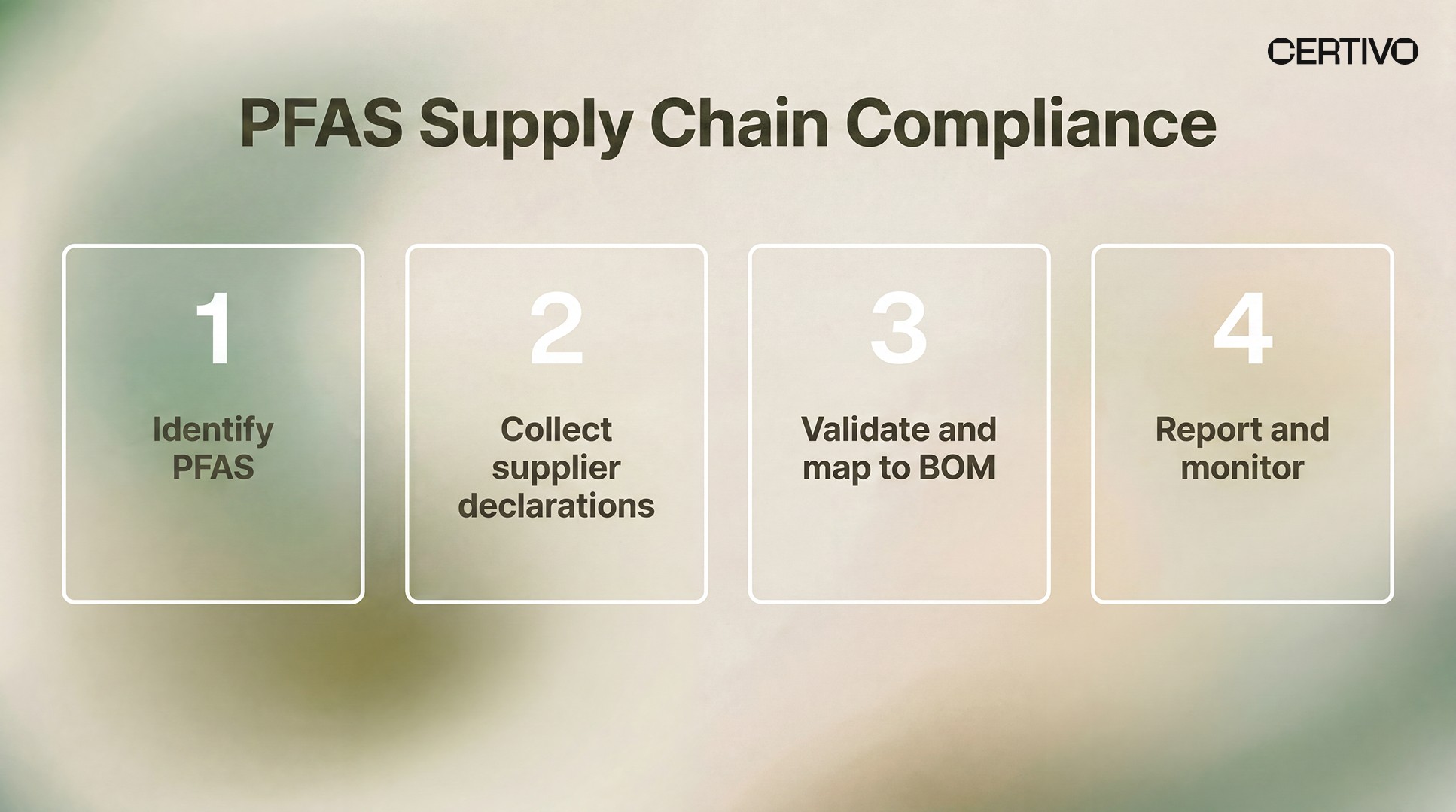
Identify PFAS present in products, materials, and manufacturing processes.
Conduct supply chain assessments to determine PFAS content at the material and component level.
Obtain supplier declarations and Full Material Disclosures (FMDs).
Evaluate alternatives for PFAS-containing materials and components.
Monitor transition periods and regulatory developments through the ECHA process.
Prepare for product redesign and material substitution where alternatives are viable.
Meeting these obligations at scale requires structured BOM-level material mapping rather than ad hoc requests. Certivo's track compliance by BOM approach connects substance data directly to part numbers, which is essential when a single restricted substance can sit inside hundreds of finished products.
Struggling to collect PFAS data from suppliers at scale? See how Certivo handles automated supplier documentation before you commit to a manual program.
Reporting and Documentation Challenges
The hardest part of the EU REACH PFAS restriction is not understanding the rule. It is producing defensible evidence across a fragmented supply base.
Common pain points include:
⚠️ Incomplete or low-quality supplier responses, often returned in inconsistent formats.
📊 No single source of truth linking declarations to specific BOMs and SKUs.
📄 Difficulty validating supplier certificates for authenticity and accuracy at scale.
⏳ Slow follow-up cycles when suppliers fail to respond on time.
Manufacturers managing thousands of parts cannot resolve these challenges with email and spreadsheets. A centralized chemical and hazmat compliance system allows compliance, engineering, and procurement teams to share one validated dataset. AI document parsing and certificate validation further reduce manual data entry by reading test reports and declarations automatically.
PFAS compliance data collection workflow for REACH restriction readiness
Click on image to view full
Compliance Risks and Enforcement Exposure
The central risk of the EU REACH PFAS restriction is loss of market access. Once a restriction takes effect, placing a product containing a restricted PFAS on the EU market becomes unlawful. Enforcement falls to national market surveillance authorities, supported by ECHA coordination.
Exposure types include:
Regulatory inspections. ECHA-coordinated market surveillance can request technical documentation proving PFAS status.
Customer audits. OEMs increasingly require PFAS declarations as a condition of supply.
Reputational and ESG risk. PFAS disclosure now influences investor and procurement decisions.
No software makes a company audit-proof. The realistic objective is audit readiness: reducing surprises and shortening the time from audit request to evidence pack. Certivo's stay audit-ready across frameworks model supports continuous documentation rather than reactive scrambling.
Supply Chain and Operational Impact
PFAS data lives upstream, often several tiers removed from the manufacturer placing the product on the market. This makes multi-tier supply chain visibility the defining operational challenge.
Expect impact in three areas:
Upstream. Tier 1 suppliers must cascade requests to Tier 2 and Tier 3 sources, many of which lack mature compliance programs.
Internal. Engineering and sourcing teams need shared, real-time visibility into component PFAS status to support design-for-compliance decisions.
Downstream. Customers expect rapid, accurate responses to PFAS inquiries through self-service reporting.
Certivo's supplier and contractor management capabilities, combined with supplier risk scoring, help prioritize which suppliers carry the highest PFAS exposure and engagement risk.
Timeline and Future Outlook
Milestone | Status |
|---|---|
SEAC draft opinion published | Consultation open until 25 May 2026 |
Stakeholder comments under review | More than 3,500 comments |
Final SEAC opinion | Expected late 2026 |
Firefighting foam restrictions | Already advancing |
Based on currently available regulatory guidance, the final opinion will shape transition periods and use-specific derogations. The direction of travel is clear. Manufacturers that build a PFAS inventory now will absorb the final rule with far less disruption than those waiting for legal certainty. Certivo's global PFAS compliance master guide tracks how EU and US timelines are converging.
PFAS Compliance Preparation Checklist
Building Audit Readiness for PFAS
Compliance engineers know that an audit pack is only as strong as its evidence chain. For PFAS, that means being able to answer three questions for every declaration: who provided the evidence, when it was provided, and with what authority.
This is fundamentally a data versioning problem. Effective PFAS programs rely on:
Immutable audit logs that record every submission and change.
Time-stamped declarations tied to specific suppliers and parts.
Point-in-time evidence retrieval so teams can reproduce the compliance state as it existed on any past date.
These capabilities matter across all four audit types: internal audits, customer audits driven by OEMs, regulatory inspections by bodies such as ECHA market surveillance, and certification audits under ISO 9001, IATF 16949, or ISO 14001. Leading manufacturers increasingly expose this evidence through customer trust center models similar to those used by Apple, Microsoft, and major automotive OEMs.
📋 Customer Audit Readiness Scorecard
Most teams discover documentation gaps during the audit, not before it. This 20-question self-assessment shows where you stand across RoHS, REACH, Prop 65, PFAS, and conflict minerals, then scores your historic-state retrievability, evidence quality, and hours-to-audit-pack.
See your audit-readiness score and the gaps worth fixing first. Request the Audit Readiness Scorecard.
How AI Supports REACH PFAS Compliance
Manual PFAS programs do not scale to thousands of substances and multi-tier suppliers. AI-native compliance automation changes the economics of the EU REACH PFAS restriction in four ways.
AI document parsing. CORA-powered regulatory intelligence reads supplier declarations, test reports, and material disclosures, extracting PFAS data without manual entry.
Automated supplier data collection. Self-service portals let suppliers submit and validate disclosures directly, with automated follow-ups on missing data.
BOM-level compliance intelligence. Substance data maps to part numbers, so teams can instantly identify which finished products contain a restricted PFAS.
Regulatory horizon scanning. CORA compliance intelligence monitors ECHA developments and flags changes against affected SKUs.
This is the shift from reactive compliance to continuous readiness. Explore the underlying platform capabilities or review how Certivo delivers PFAS compliance across multi-tier supply chains.
Executive Conclusion
The EU REACH PFAS restriction represents a structural change in how manufacturers must manage chemical content, supplier data, and product stewardship. With a final SEAC opinion expected in late 2026 and a potential scope exceeding 10,000 substances, the cost of delay is rising. Organizations that establish PFAS inventories, secure supplier disclosures, and centralize evidence now will protect EU market access while competitors are still building spreadsheets.
Certivo serves as the compliance data backbone for this work, combining BOM-level material mapping, automated supplier engagement, and CORA-enabled analysis into one system of record.
Speak with a compliance specialist or book a compliance risk assessment to map your PFAS exposure across products and supply chains before the final restriction lands.
Lavanya
Lavanya is an accomplished Product Compliance Engineer with over four years of expertise in global environmental and regulatory frameworks, including REACH, RoHS, Proposition 65, POPs, TSCA, PFAS, CMRT, FMD, and IMDS. A graduate in Chemical Engineering from the KLE Institute, she combines strong technical knowledge with practical compliance management skills across diverse and complex product portfolios.
She has extensive experience in product compliance engineering, ensuring that materials, components, and finished goods consistently meet evolving international regulatory requirements. Her expertise spans BOM analysis, material risk assessments, supplier declaration management, and test report validation to guarantee conformity. Lavanya also plays a key role in design-for-compliance initiatives, guiding engineering teams on regulatory considerations early in the product lifecycle to reduce risks and streamline market access.