

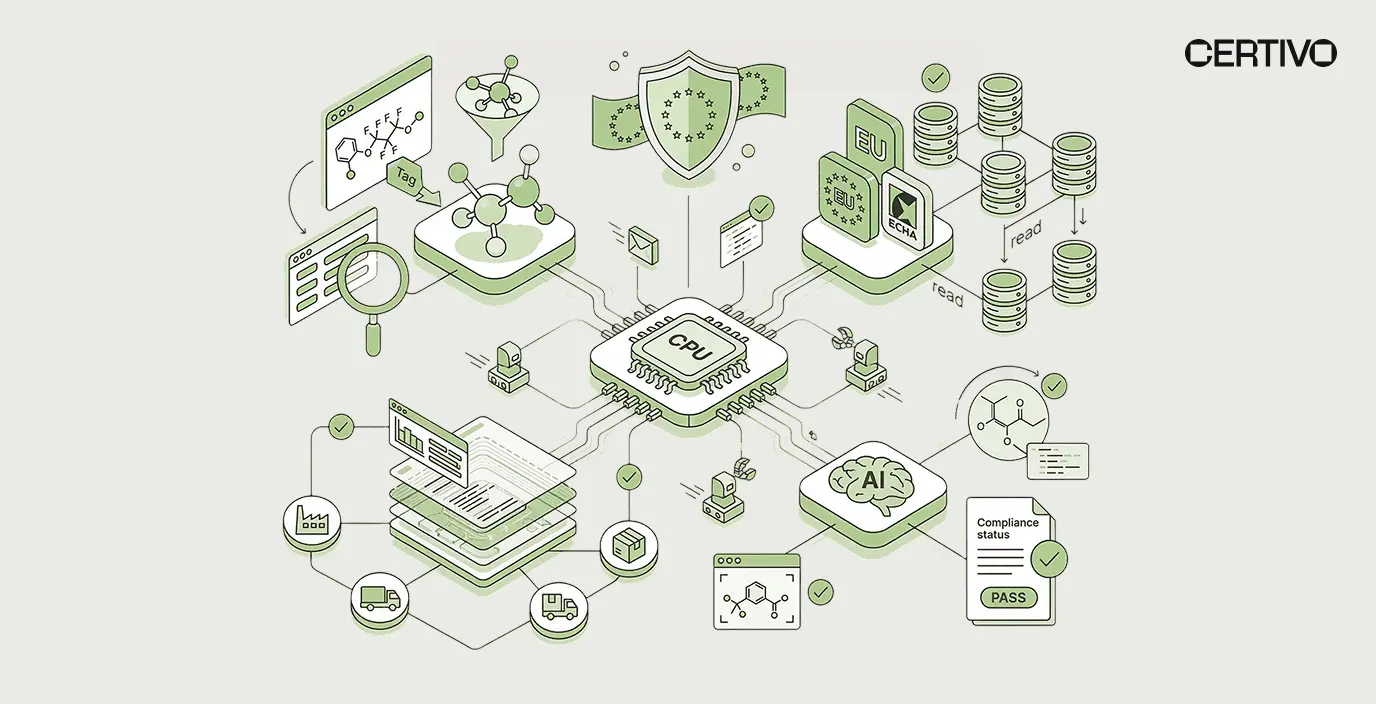
The proposed EU REACH PFAS restriction is entering the most consequential stage of its regulatory journey — and the window for manufacturers to influence the outcome is narrowing. Originally submitted in January 2023 by the national authorities of Denmark, Germany, the Netherlands, Norway, and Sweden, this restriction proposal targeting per- and polyfluoroalkyl substances (PFAS) under REACH Annex XVII is now under scientific evaluation within the European Chemicals Agency (ECHA).
For compliance directors, supply chain leaders, and executive teams across electronics, automotive, aerospace, chemicals, and consumer goods, the EU REACH PFAS restriction represents a generational shift in how substances are regulated across European markets. With ECHA's Committee for Socio-Economic Analysis (SEAC) expected to adopt its final opinion by the end of 2026 — and a critical 60-day public consultation window approaching — manufacturers that use PFAS-containing products in the EU must begin preparing now. The REACH framework already imposes significant substance obligations; this restriction would expand them dramatically.
📌 Table of Contents
What Is the EU REACH PFAS Restriction Proposal
Where the Proposal Stands: RAC, SEAC, and the Regulatory Timeline
Why This Phase Is Critical for Manufacturers
Industries and Products Affected
Key Obligations and What Companies Should Do Now
Supply Chain and Product Design Impact
Compliance Risks of Inaction
Compliance Readiness Checklist
The Role of AI in PFAS Compliance Monitoring
FAQs
Executive Conclusion
1. What Is the EU REACH PFAS Restriction Proposal
The EU REACH PFAS restriction proposal is the most comprehensive chemical restriction ever submitted under the REACH Regulation (EC) No 1907/2006. It targets the entire class of per- and polyfluoroalkyl substances — commonly known as PFAS or "forever chemicals" — for potential restriction under REACH Annex XVII. For manufacturers already managing REACH obligations, this guide on mastering the REACH recast and securing EU market access provides essential context.
The proposal was jointly submitted in January 2023 by five national authorities: Denmark, Germany, the Netherlands, Norway, and Sweden. Unlike previous REACH restrictions that targeted individual substances, this proposal covers the full PFAS class — an estimated 10,000+ substances used across virtually every manufacturing sector.
📊 Scope of the proposal:
Substance class: All per- and polyfluoroalkyl substances (PFAS)
Regulatory pathway: Restriction under REACH Annex XVII
Submitting authorities: Denmark, Germany, Netherlands, Norway, Sweden
Evaluating body: European Chemicals Agency (ECHA)
Current status: Scientific evaluation by RAC and SEAC committees
The breadth of this proposal means it will affect not only chemical producers but any organization whose products contain PFAS. For a comprehensive overview of how PFAS rules are evolving globally, see the global PFAS regulations master guide for manufacturers.
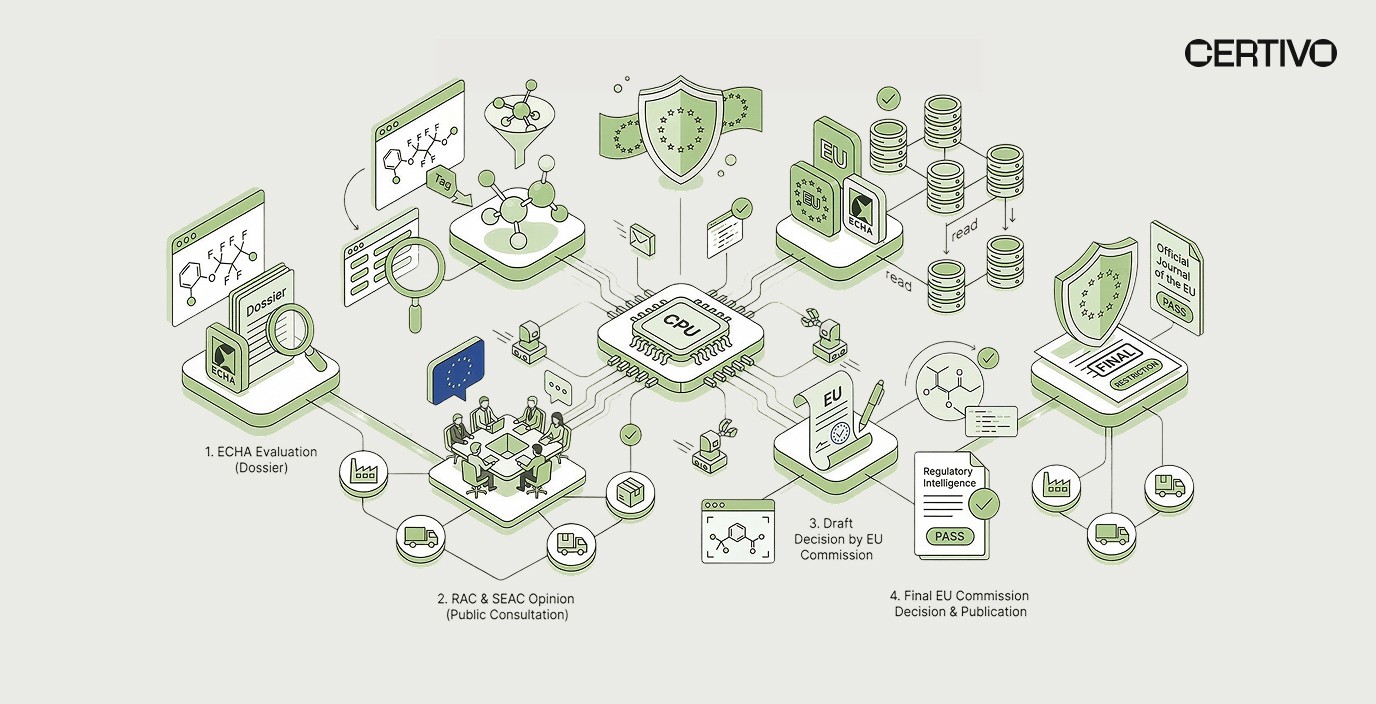
2. Where the Proposal Stands: RAC, SEAC, and the Regulatory Timeline
The restriction proposal is currently being evaluated by two key ECHA scientific committees. Understanding where the process stands is critical for compliance planning. Organizations tracking REACH substance changes should also review recent REACH SVHC and Annex XVII changes.
ECHA Risk Assessment Committee (RAC): RAC is responsible for evaluating the environmental and human health risks associated with PFAS. This includes assessing exposure pathways, persistence, bioaccumulation, and toxicity data across the full substance class.
ECHA Committee for Socio-Economic Analysis (SEAC): SEAC evaluates the socio-economic impacts of the proposed restriction — including effects on industry, supply chains, employment, and the availability of technically and economically feasible alternatives.
📌 Key regulatory milestones:
Milestone | Expected Timing |
|---|---|
PFAS restriction proposal submitted | January 2023 |
RAC & SEAC scientific evaluations | Ongoing |
SEAC draft opinion + public consultation | Upcoming (60-day window) |
SEAC final opinion expected | End of 2026 |
EU Commission decision on restriction | After SEAC final opinion |
⚠ The 60-day public consultation following SEAC's draft opinion is the last structured opportunity for stakeholders to submit technical evidence, including data on alternatives, sector-specific uses, and realistic transition timelines. The official proposal and all related scientific opinions are published on the ECHA PFAS restriction proposal page.
Once SEAC adopts its final opinion, the European Commission — together with EU Member States — will decide whether and how to implement the PFAS restriction under REACH Annex XVII. Organizations that have not engaged before this point will have significantly less ability to influence the outcome. Quality directors and VPs should be directly involved in shaping consultation submissions.
3. Why This Phase Is Critical for Manufacturers
The REACH restriction process is designed to allow stakeholder input to shape the final regulation. This is not a formality — the consultation phase can materially influence several critical elements of the restriction. For context on why acting now matters more than reacting later, see market readiness vs. risk exposure in compliance.
Elements that stakeholder input can still influence:
✓ Derogations for specific uses where PFAS substitution is not yet feasible
✓ Transition periods that allow industries adequate time to reformulate or redesign
✓ Sector-specific exemptions for critical applications (e.g., medical devices, semiconductor manufacturing, aerospace)
✓ Threshold definitions that determine which concentrations trigger the restriction
For manufacturers operating across multiple product categories, the difference between a 5-year and a 12-year transition period — or the inclusion or exclusion of a specific derogation — can represent millions of euros in reformulation, supply chain restructuring, and market access costs. CEOs and founders must understand the strategic significance of this regulatory window.
⚠ Critical point: Once the consultation window closes and SEAC adopts its final opinion, the opportunity to influence regulatory outcomes narrows dramatically. Companies that engage now — with evidence-based submissions on alternatives, transition needs, and sector impacts — will be positioned to adapt. Those that engage late may face outcomes they cannot change.
Organizations assessing how PFAS obligations have evolved should also review why PFAS "out of scope" no longer exists for global manufacturers.
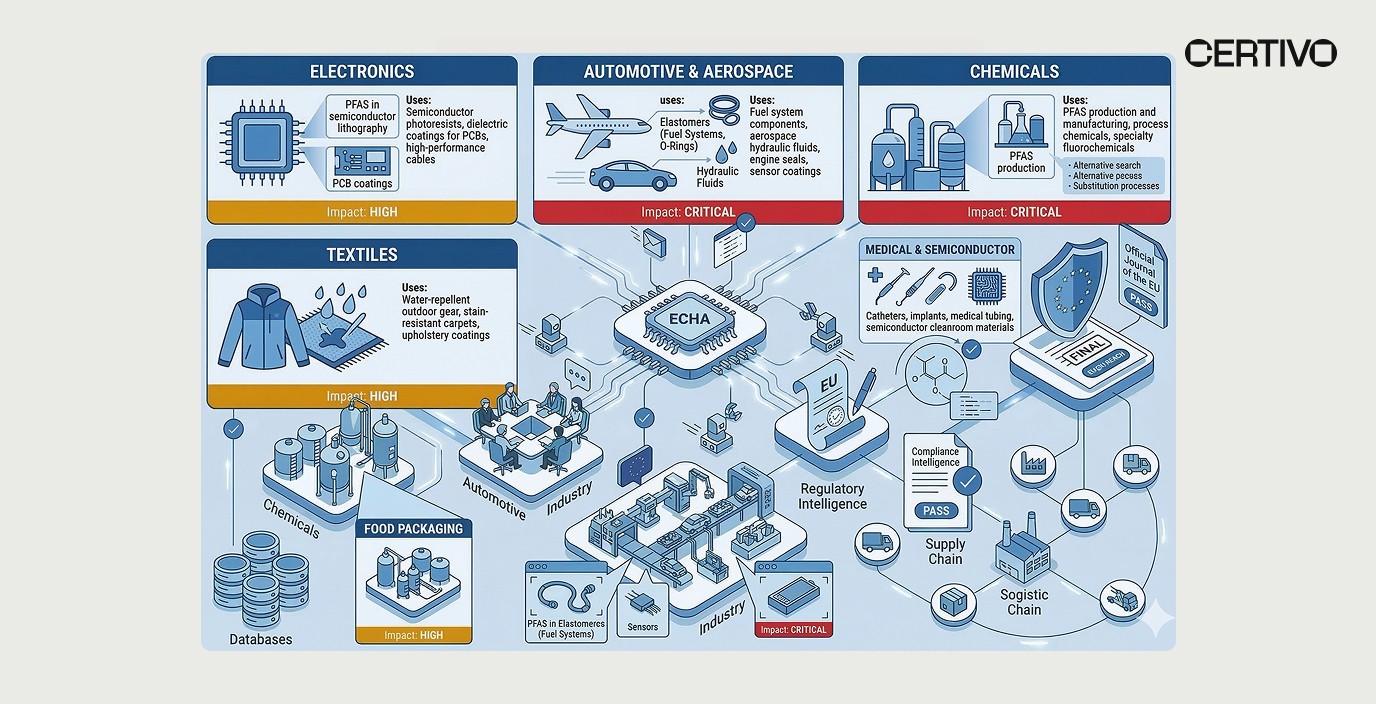
4. Industries and Products Affected
The EU REACH PFAS restriction proposal affects an extraordinarily wide range of industries due to the ubiquity of PFAS in modern manufacturing. Organizations should evaluate their exposure against the PFAS compliance framework to understand substance-level obligations.
Industry | PFAS Use Cases | Impact Level |
|---|---|---|
Electronics & Electrical Equipment | Circuit boards, insulation, semiconductor processing fluids | ⚠ High |
Automotive & Aerospace | Fuel systems, seals, coatings, lubricants, wire insulation | ⚠ High |
Chemical & Polymer Manufacturing | Fluoropolymers, surfactants, processing aids | ⚠ Critical |
Textiles & Consumer Products | Water-repellent coatings, stain-resistant treatments | ⚠ High |
Food Packaging & Industrial Coatings | Grease-resistant coatings, non-stick surfaces | ⚠ High |
Medical Devices & Semiconductor Manufacturing | Biocompatible coatings, etching fluids, cleanroom materials | ⚠ Critical |
For electronics manufacturers, PFAS substances are embedded in critical components including wire insulation, circuit board laminates, and thermal management materials. Substitution in these applications is technically complex and may require extended transition periods. For deeper analysis on tracking PFAS in electronic supply chains, see PFAS in electronics manufacturing: how to track materials across the supply chain.
Aerospace and defense manufacturers face particular challenges because PFAS are used in safety-critical applications where alternatives must meet stringent performance and certification requirements. For aerospace-specific compliance demands, see aerospace regulatory compliance and supply chain management.
Chemical manufacturers — particularly fluoropolymer producers — sit at the center of the restriction. These organizations face the most direct and immediate reporting and transition obligations.
The automotive manufacturing sector uses PFAS in fuel systems, gaskets, coatings, and electrical components. For a broader view of automotive-specific compliance, see the automotive regulatory landscape guide.
5. Key Obligations and What Companies Should Do Now
The EU REACH PFAS restriction is still in the proposal phase — it has not been finalized. However, the current regulatory stage requires active preparation, not passive monitoring. Companies that wait for the final decision will face significantly greater disruption. For practical approaches to reducing compliance workload, see how to save time on compliance management with AI solutions.
📌 Immediate actions for manufacturers:
Step 1: Identify PFAS in your products and supply chain
Map all PFAS substances present in your product BOMs, raw materials, and manufacturing processes. The ability to track compliance at BOM level is essential for understanding substance-level exposure across product portfolios.
Step 2: Review the RAC and SEAC scientific assessments
Monitor ECHA publications for RAC opinions on risk characterization and SEAC's draft socio-economic analysis. Subscribe to regulatory updates through Certivo's compliance newsletter to track developments in real time.
Step 3: Prepare evidence-based consultation submissions
Document available alternatives for specific PFAS uses in your sector. Quantify transition timelines and economic impacts of substitution. Provide technical evidence on applications where alternatives are not yet feasible. Compliance and regulation managers should lead this effort with support from R&D and procurement.
Step 4: Assess supply chain and product design impacts
Evaluate which suppliers provide PFAS-containing materials or components. Identify products that may require reformulation or redesign. Begin qualification of alternative materials where commercially available. Procurement and supply chain leaders must be involved in alternative sourcing evaluations.
6. Supply Chain and Product Design Impact
The EU REACH PFAS restriction will not only affect finished product compliance — it will reshape supply chain relationships, material sourcing strategies, and product development workflows across Europe. For a broader perspective on supply chain compliance trends, see the future of supply chain due diligence and key EU regulations.
Supply chain implications:
⚠ Supplier transparency requirements will increase as manufacturers need verified PFAS content data from upstream suppliers across multiple tiers
⚠ Material substitution timelines will vary dramatically by sector — fluoropolymers used in semiconductor manufacturing may require 10+ years to replace, while textile coatings may transition within 3–5 years
⚠ Multi-tier visibility is essential because PFAS may be present in sub-components that are several tiers removed from the final assembler
Organizations relying on manual supplier data collection will struggle to meet the granularity requirements. Streamlining supplier documentation through structured, automated collection portals is critical for building the evidence base needed during the consultation phase and beyond.
Product design implications:
Products currently dependent on PFAS for performance characteristics (water repellency, chemical resistance, thermal stability, low friction) will require redesign
Design-for-compliance workflows must incorporate substance restrictions at the earliest stages of product development
Coordination between compliance teams and engineering is essential — see what tools support end-to-end product compliance for practical approaches
Companies that proactively invest in supplier collaboration workflows and material alternatives research now will have a significant competitive advantage when the restriction is finalized.
7. Compliance Risks of Inaction
While the EU REACH PFAS restriction is not yet finalized, the risks of inaction during this critical phase are substantial. Organizations should understand what's at stake. For context on why reactive approaches fail, see why people-only compliance can't scale.
Risks of not preparing now:
⚠ Loss of consultation influence — Companies that do not submit evidence during the 60-day window forfeit their ability to shape derogations, transition periods, and exemptions
⚠ Supply chain disruption — Without early supplier engagement, organizations will face material shortages and production delays when restrictions take effect
⚠ Market access loss — Products containing restricted PFAS substances will be barred from the EU market after transition periods expire
⚠ Reformulation costs — Late-stage product redesign is exponentially more expensive than planned transitions
⚠ Competitive disadvantage — Competitors that engage early will secure alternative supply chains and gain market positioning
The proposed restriction covers the entire PFAS class. This is not a single-substance action. It requires systemic supply chain assessment and long-term material strategy. Managing compliance risk proactively is the only viable approach at this scale.
8. Compliance Readiness Checklist
📌 Use this checklist to assess your organization's preparedness for the EU REACH PFAS restriction proposal:
Action Item | Owner |
|---|---|
Inventory all PFAS substances in product BOMs, materials, and processes | Compliance + Engineering |
Map PFAS presence across supply chain tiers | Procurement + Compliance |
Monitor ECHA for RAC opinion and SEAC draft opinion publication | Regulatory Affairs |
Prepare technical evidence for 60-day consultation submission | R&D + Compliance |
Document available alternatives by application and sector | Engineering + R&D |
Quantify transition timeline requirements for PFAS-dependent products | Operations + Engineering |
Issue structured supplier data requests for PFAS substance content | Procurement |
Evaluate product redesign requirements for PFAS-critical applications | Product Development |
Assess overlap with other PFAS regulations (TSCA, state-level U.S., national EU rules) | Compliance |
Assign executive ownership for PFAS restriction response strategy | C-Suite |
For organizations managing PFAS compliance alongside U.S. TSCA obligations, the TSCA framework page provides a parallel reference point. Companies managing overlapping state-level PFAS rules should review the state PFAS regulations tracker for 2026.
Organizations assessing whether their current infrastructure can handle this level of regulatory change should see building a future-ready compliance infrastructure. IT and systems leaders should lead platform evaluation and integration planning.
9. The Role of AI in PFAS Compliance Monitoring
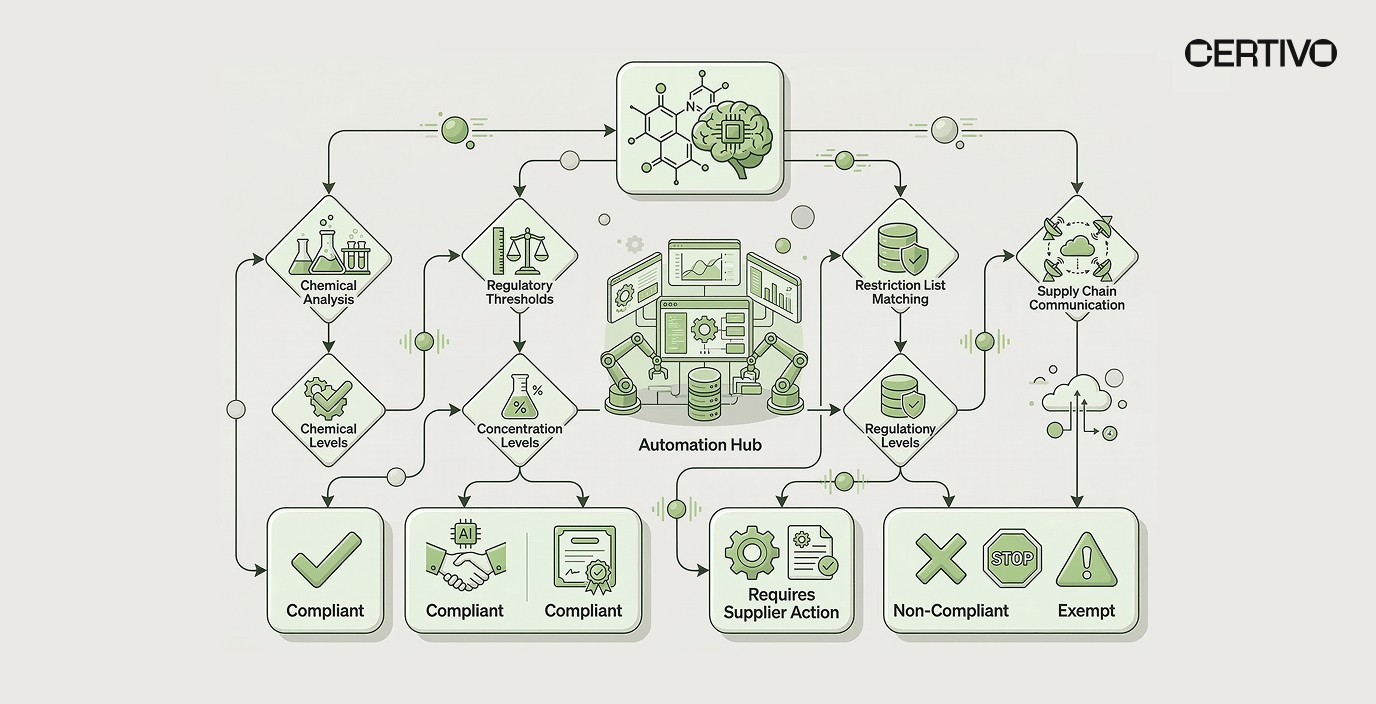
The scale of the EU REACH PFAS restriction — covering 10,000+ substances across every manufacturing sector — exceeds what manual compliance processes can manage effectively. For a practical view of how AI transforms daily compliance operations, see a compliance engineer's week with and without AI.
Core challenges that demand AI-driven solutions:
Substance identification across 10,000+ PFAS compounds in product BOMs, raw materials, and supplier inputs
Multi-tier supply chain mapping to identify PFAS presence beyond direct suppliers
Regulatory monitoring of evolving ECHA opinions, consultation windows, and Member State implementations
Alternative substance evaluation to identify technically feasible replacements by application
AI-native compliance platforms address these challenges through:
✓ Automated BOM scanning to identify PFAS presence at the component and substance level
✓ Supplier data aggregation through structured questionnaire portals — reducing manual follow-up cycles
✓ Regulatory horizon scanning that alerts compliance teams when ECHA publishes draft opinions or opens consultation periods
✓ Document parsing that extracts substance data from supplier certificates, safety data sheets, and material declarations
✓ Risk scoring that prioritizes high-PFAS-exposure products and suppliers for immediate action
For a comprehensive overview, see AI tools for compliance management: the complete guide. Organizations specifically managing PFAS at substance scale should also review how AI automates compliance across 12,000+ PFAS compounds.
Companies managing EU REACH PFAS alongside TSCA and emerging national restrictions can explore how AI in supply chain compliance management consolidates multi-jurisdictional obligations. The ability to stay audit-ready across frameworks becomes essential when the same substance class is regulated differently across regions.
10. Frequently Asked Questions (FAQs)
Q1: Is the EU REACH PFAS restriction already in effect?
No. The restriction proposal is currently undergoing scientific evaluation by ECHA's RAC and SEAC committees. SEAC's final opinion is expected by the end of 2026, after which the European Commission will decide on implementation. The restriction has not yet been added to REACH Annex XVII. Organizations should monitor the ECHA PFAS restriction proposal page for official updates.
Q2: What is the 60-day public consultation, and why does it matter?
Once SEAC publishes its draft opinion, a 60-day public consultation period opens. This is the last structured opportunity for manufacturers to submit technical evidence on alternatives, sector-specific uses, and transition timelines. Input during this phase can influence derogations and exemptions in the final restriction. The solutions for materials and environmental compliance can help teams prepare data-driven submissions.
Q3: Which industries are most affected by the EU REACH PFAS restriction?
The proposal affects virtually every manufacturing sector because PFAS are used in an extremely wide range of applications. The most heavily impacted include electronics, automotive, aerospace, chemical manufacturing, textiles, food packaging, medical devices, and semiconductor and high-tech manufacturing. Each sector faces different substitution timelines and technical challenges.
Q4: How does the EU REACH PFAS restriction relate to U.S. TSCA PFAS reporting?
The EU REACH proposal and the U.S. TSCA Section 8(a)(7) PFAS reporting rule are separate regulatory actions with different scopes and requirements. However, both target the same substance class. Companies operating in both jurisdictions should coordinate compliance. For U.S.-specific obligations, see the TSCA PFAS reporting rule exemptions analysis.
Q5: Can companies still influence the outcome of the EU REACH PFAS restriction?
Yes — this is precisely why the current phase is critical. The 60-day consultation following SEAC's draft opinion allows stakeholders to submit evidence that can shape derogations, transition periods, and sector-specific exemptions. Companies should begin preparing evidence now. For broader context, see the global PFAS reckoning and how to prepare for bans and substitution requirements.
11. Executive Conclusion
The EU REACH PFAS restriction proposal is entering the phase that will determine its final shape — including which sectors receive derogations, how long transition periods last, and which uses are exempt. For manufacturers across electronics, automotive, aerospace, chemicals, medical devices, and consumer goods, the decisions made in the coming months will define compliance obligations for a generation.
The EU REACH PFAS restriction is not a future problem. It is a present-tense strategic priority. Organizations that identify their PFAS exposure, engage in the ECHA consultation process, and build the supply chain transparency needed to respond to the final regulation will be positioned for compliance. Those that wait will face disruption. For organizations navigating how PFAS compliance intersects with broader EU chemical regulation changes, see REACH Annex XVII CMR substances update for 2026.
📌 The official ECHA PFAS restriction proposal is available at ECHA's PFAS hot topics page.
For organizations managing complex, multi-jurisdictional PFAS obligations across the EU and beyond, compliance infrastructure that scales with regulatory complexity is essential. To explore how AI-driven compliance platforms like Certivo support continuous regulatory readiness, connect with the Certivo team.
Lavanya
Lavanya is an accomplished Product Compliance Engineer with over four years of expertise in global environmental and regulatory frameworks, including REACH, RoHS, Proposition 65, POPs, TSCA, PFAS, CMRT, FMD, and IMDS. A graduate in Chemical Engineering from the KLE Institute, she combines strong technical knowledge with practical compliance management skills across diverse and complex product portfolios.
She has extensive experience in product compliance engineering, ensuring that materials, components, and finished goods consistently meet evolving international regulatory requirements. Her expertise spans BOM analysis, material risk assessments, supplier declaration management, and test report validation to guarantee conformity. Lavanya also plays a key role in design-for-compliance initiatives, guiding engineering teams on regulatory considerations early in the product lifecycle to reduce risks and streamline market access.
Her contributions further extend to compliance documentation, certification readiness, and preparation of customer deliverables, ensuring transparency and accuracy for global stakeholders. She is adept at leveraging compliance tools and databases to efficiently track regulatory changes and implement proactive risk mitigation strategies.
Recognized for her attention to detail, regulatory foresight, and collaborative approach, Lavanya contributes significantly to maintaining product compliance, safeguarding brand integrity, and advancing sustainability goals within dynamic, globally integrated manufacturing environments.