


The European Chemicals Agency's Committee for Socio-Economic Analysis (SEAC) has published its draft opinion supporting the proposed broad restriction of per- and polyfluoroalkyl substances (PFAS) under EU REACH. A 60-day public consultation period is open until May 25, 2026, making this the most consequential regulatory milestone for PFAS-dependent manufacturers since the original restriction proposal was submitted by five EU member states.
For compliance leaders, supply chain directors, and executive teams at global manufacturers, this draft opinion signals that the EU PFAS restriction is advancing through the legislative process with regulatory support. Organizations that have not yet initiated PFAS compliance readiness programs face narrowing windows to assess exposure, collect supplier data, and prepare for obligations under REACH Annex XVII.
📌 Book a free compliance risk assessment to map your PFAS exposure across products, materials, and supply chains before the consultation window closes.
What Is the EU REACH PFAS Restriction Proposal
The EU REACH PFAS restriction proposal targets the entire class of per- and polyfluoroalkyl substances—a group of more than 10,000 persistent fluorinated chemicals used across virtually every manufacturing sector. Unlike previous substance-specific restrictions under REACH Annex XVII, this proposal takes a class-based approach, meaning it covers all PFAS rather than targeting individual substances.
The proposal was originally submitted to ECHA by the national authorities of Denmark, Germany, the Netherlands, Norway, and Sweden. It is driven by PFAS persistence in the environment and growing evidence of health concerns associated with long-term exposure.
Key facts about the restriction scope:
✓ Covers manufacture, use, and placing on the EU market of PFAS-containing products ✓ Applies across all EU member states ✓ Would be implemented as a REACH Annex XVII restriction ✓ Includes potential transition periods, derogations, and sector-specific timelines
For manufacturers already navigating REACH compliance obligations, this restriction represents a significant expansion of substance-level reporting requirements.
EU REACH PFAS restriction 2026 regulatory compliance update for manufacturers
Click on image to view full
What the SEAC Draft Opinion Means for Manufacturers
The SEAC draft opinion is a critical procedural step. SEAC evaluates the socio-economic impact of proposed REACH restrictions—balancing the costs of compliance against the benefits of reducing substance exposure. A supportive SEAC opinion means the committee has determined that the restriction is justified from a socio-economic standpoint.
⚠ What this signals:
The restriction proposal is progressing, not stalling
Regulatory momentum behind a broad PFAS restriction is strong
The 60-day public consultation (open until May 25, 2026) is the final opportunity for stakeholders to submit socio-economic evidence before the opinion is finalized
After SEAC and RAC (Risk Assessment Committee) opinions are adopted, the European Commission drafts the final restriction text
For organizations managing multi-jurisdiction EHS and ESG compliance, the SEAC opinion confirms that EU PFAS regulation is moving from proposal to enforcement preparation.
Based on currently available regulatory guidance, manufacturers should not wait for the final restriction text to begin compliance preparation. The scope of the proposed restriction—covering the entire PFAS class—means that supply chain assessments, material declarations, and reformulation evaluations require years of lead time.
Which Industries and Products Face the Greatest PFAS Exposure
The proposed restriction affects any manufacturer, importer, or distributor placing PFAS-containing products on the EU market. Based on the document provided, the following industries face the most significant compliance impact:
📊 Electronics & Semiconductors — PFAS are used in coatings, insulation materials, and manufacturing processes. Electronics manufacturers face exposure across PCBs, semiconductor fabrication, and component-level materials.
📊 Automotive & Aerospace — High-performance fluoropolymers in seals, gaskets, fuel systems, and fluid-resistant coatings are widely used. Automotive manufacturers and aerospace and defense supply chains must assess PFAS presence in thousands of components.
📊 Medical Devices — Specialized coatings and fluoropolymer applications in catheters, implants, and diagnostic equipment face scrutiny. See Certivo's medical devices and equipment industry coverage.
📊 Consumer Goods — Textiles, cookware, packaging, cosmetics, and stain-resistant products contain PFAS across multiple material categories.
📊 Chemicals & Industrial Equipment — PFAS production, formulation, industrial lubricants, seals, and specialty applications face direct restriction impact. Chemical manufacturers must prepare for both use-phase and production-phase obligations.
How Does the PFAS Restriction Affect Supply Chain Compliance
The EU REACH PFAS restriction creates compliance obligations that cascade through every tier of the supply chain. This is not a single-substance restriction that can be managed at the final assembly level—it requires multi-tier supply chain transparency to identify where PFAS substances exist across raw materials, components, sub-assemblies, and finished goods.
Upstream Supplier Impact
Tier 1, Tier 2, and Tier 3 suppliers must be queried for PFAS substance presence
Full Material Declarations (FMDs) must be reviewed and updated to capture PFAS-specific data
Suppliers may lack awareness of PFAS content in their own materials, requiring deeper supply chain investigation
Automated supplier data collection becomes essential at scale
Downstream Customer Impact
OEM customers and brand owners will cascade PFAS compliance requirements to their supply base
Customer audit requirements will include PFAS-specific documentation
Companies managing customer trust centers and self-service reporting must integrate PFAS declarations into their compliance documentation packages
⚠ Organizations relying on email-based supplier communication for PFAS data collection will face significant delays and data quality issues. Supplier self-service compliance portals reduce friction and accelerate response rates.
📌 Managing PFAS data across hundreds of suppliers? See how Certivo automates this → Book a Demo
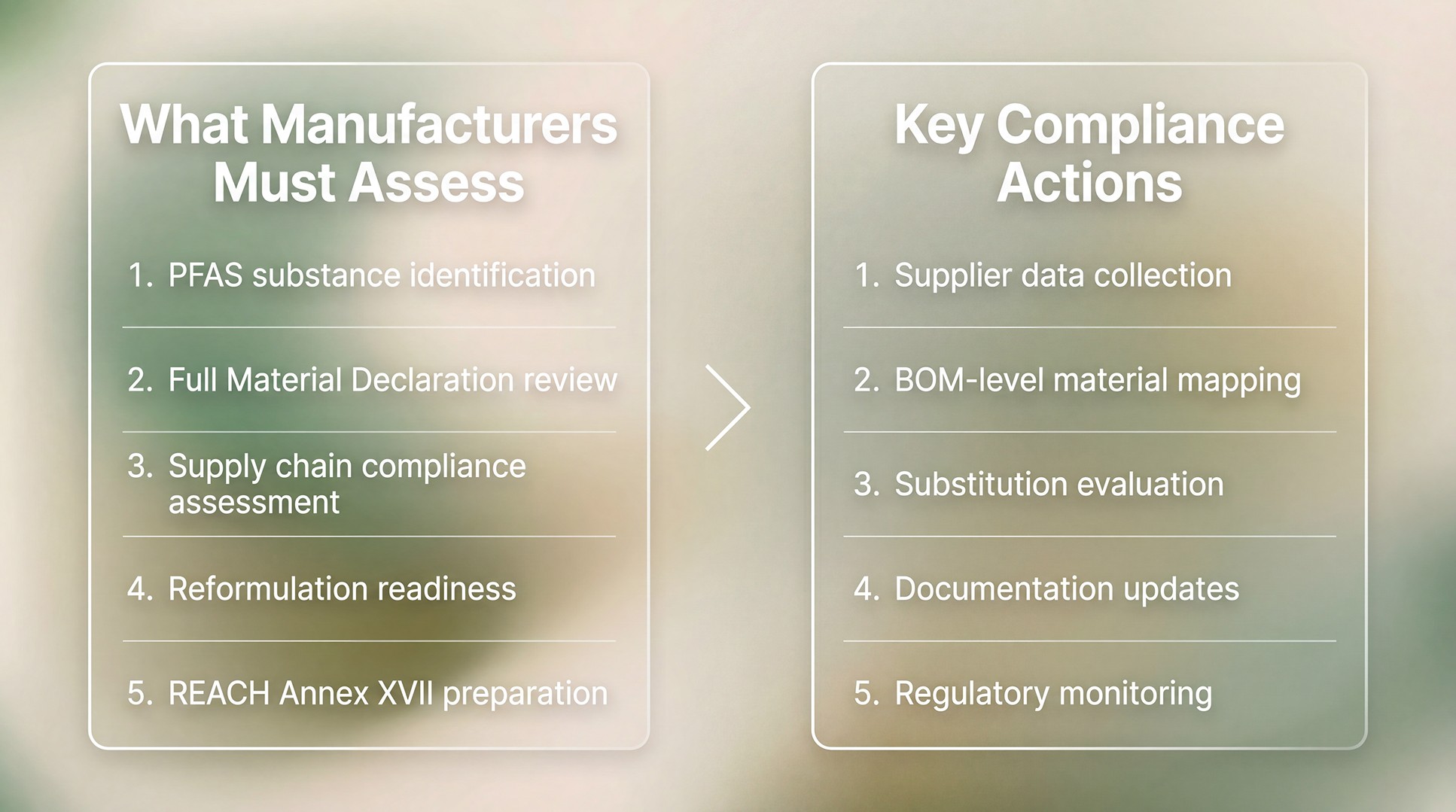
EU REACH PFAS restriction compliance impact areas and actions for manufacturers
Click on image to view full
Key Compliance Actions Manufacturers Must Take Now
Based on the SEAC draft opinion and the current state of the restriction proposal, compliance leaders should prioritize the following actions:
For a comprehensive operational guide, see How Certivo Manages PFAS Compliance Across 12,000 Substances and Multi-Tier Supply Chains.
Reporting, Documentation, and Data Challenges Under PFAS Restriction
The EU REACH PFAS restriction creates documentation and data challenges that are distinct from previous substance-specific restrictions:
Scale of Substance Coverage
PFAS encompasses more than 10,000 individual substances. Unlike managing a handful of REACH SVHCs, this restriction requires screening against an entire chemical class. Manual approaches—spreadsheets, email-based supplier queries, and periodic audits—cannot operate at this scale.
AI document parsing and certificate validation tools become necessary to process the volume of supplier documentation required for PFAS compliance.
Evidence Chain Integrity
For each PFAS declaration, compliance teams must track:
Who provided the evidence (supplier, testing lab, internal team)
When the evidence was provided (time-stamped declarations)
With what authority (certification scope, testing standard, declaration format)
Whether the evidence reflects current formulations (immutable audit logs prevent retroactive changes)
Historic state tracking—maintaining point-in-time queries on substance declarations—is a data versioning problem that requires a centralized compliance data backbone, not scattered files across email inboxes and shared drives.
Cross-Functional Coordination
PFAS compliance spans engineering, procurement, quality, EHS, and regulatory teams. Manufacturers that have established cross-functional compliance workflows will respond faster than organizations where these functions operate in silos.
Compliance Risks and Enforcement Exposure
⚠ Regulatory Enforcement — Once the restriction enters REACH Annex XVII, EU market surveillance authorities can take enforcement action against non-compliant products. This includes product withdrawals, import bans, and financial penalties.
⚠ Customer Audit Findings — OEM customers—particularly in automotive, electronics, and medical devices—will escalate PFAS compliance requirements through their supply chain audit programs. Non-compliance may result in corrective action requests, supply chain disqualification, or loss of preferred supplier status.
⚠ Reputational and ESG Risk — PFAS contamination and non-compliance attract increasing attention from investors, ESG rating agencies, and media. Companies that cannot demonstrate proactive PFAS management face reputational exposure beyond regulatory penalties.
No compliance software eliminates audit findings. The objective is to reduce surprises and response time. Organizations maintaining continuous audit-ready documentation can respond to customer audits, regulatory inspections, and certification audits with evidence packages assembled in hours rather than weeks.
Timeline and Future Enforcement Outlook
Milestone | Timing |
|---|---|
SEAC draft opinion published | March 2026 |
Public consultation closes | May 25, 2026 |
RAC and SEAC final opinions expected | 2026–2027 |
European Commission drafts restriction text | 2027 (estimated) |
REACH Annex XVII entry (with transition periods) | 2028–2030+ (estimated) |
Based on currently available regulatory guidance, transition periods and sector-specific derogations are expected. However, the breadth of the proposed restriction means that even with extended timelines, manufacturers must begin compliance preparation now. Material substitution in sectors like semiconductor manufacturing and medical devices requires multi-year development and qualification cycles.
For broader PFAS regulatory context, see The Global PFAS Reckoning: How to Prepare for Bans, Thresholds, and Substitution Requirements.
How AI Reduces the Burden of PFAS Compliance at Scale
Managing PFAS compliance across more than 10,000 substances, thousands of suppliers, and multiple product families is not a manual task. AI-native compliance automation addresses the structural challenges that a class-based PFAS restriction creates.
CORA-powered regulatory intelligence tracks the evolving PFAS restriction through ECHA's legislative process—alerting compliance teams to consultation deadlines, opinion publications, and scope changes before they take effect.
Automated supplier data collection through supplier self-service portals enables manufacturers to issue PFAS-specific questionnaires at scale, validate responses against substance databases, and flag incomplete or inconsistent submissions automatically.
BOM-level compliance intelligence maps PFAS substance data to specific products and bill-of-materials structures, enabling compliance teams to answer the critical question: which of our products contain PFAS, and which suppliers are the source?
For manufacturers already managing REACH SVHC, RoHS, and Prop 65 obligations, Certivo provides a centralized compliance data backbone that handles PFAS alongside existing regulatory frameworks—without building parallel compliance programs for each regulation.
Executive Conclusion
The ECHA SEAC draft opinion supporting the EU REACH PFAS restriction is a clear signal that the broadest chemical restriction in EU regulatory history is advancing. The 60-day public consultation closing May 25, 2026 is the immediate action item. The longer-term operational challenge—identifying PFAS across products, collecting supplier data at scale, evaluating substitution options, and building continuous audit-ready documentation—requires sustained investment in compliance infrastructure.
Manufacturers that treat this as a future problem will face compressed timelines, incomplete supplier data, and audit exposure when the restriction enters force. Those that invest now in PFAS and chemicals risk management capabilities, regulatory intelligence and horizon scanning, and multi-tier supply chain transparency will absorb the regulatory change with significantly less disruption.
📌 Book a demo to see how Certivo automates EU REACH PFAS compliance across your product portfolio and multi-tier supply chain—from substance identification through supplier data collection to continuous audit readiness.
FAQs
1. What is the current status of the EU REACH PFAS restriction proposal?
ECHA's Committee for Socio-Economic Analysis (SEAC) published its draft opinion in March 2026 supporting the broad PFAS restriction. A 60-day public consultation is open until May 25, 2026, after which RAC and SEAC will finalize their opinions before the European Commission drafts the restriction text. Certivo's CORA intelligence tracks these milestones automatically.
2. How many PFAS substances are covered by the proposed EU restriction?
The proposed restriction takes a class-based approach covering all per- and polyfluoroalkyl substances—more than 10,000 individual chemicals. This is fundamentally different from previous substance-specific REACH restrictions and requires BOM-level material mapping to identify exposure across products and supply chains.
3. When should manufacturers start preparing for EU PFAS compliance obligations?
Preparation should begin immediately. Material substitution in sectors like electronics, automotive, and medical devices requires 2–5 years of development and qualification. Supplier data collection campaigns, Full Material Declaration reviews, and reformulation assessments all require significant lead time before the restriction enters REACH Annex XVII.
4. How can manufacturers identify PFAS in products with complex multi-tier supply chains?
Identifying PFAS across multi-tier supply chains requires automated supplier data collection through self-service portals, substance-level questionnaires, and AI-powered document parsing to extract and validate PFAS declarations from supplier submissions. Manual email-based approaches cannot scale for 10,000+ substances across hundreds of suppliers.
5. Will there be sector-specific derogations or transition periods in the final PFAS restriction?
Based on currently available regulatory guidance, sector-specific derogations and transition periods are expected, particularly for applications where technically viable alternatives do not yet exist. However, the specific terms will be determined after the public consultation and Commission drafting process. Manufacturers should monitor the ECHA process through regulatory intelligence tools rather than assuming any exemption.
Lavanya
Lavanya is an accomplished Product Compliance Engineer with over four years of expertise in global environmental and regulatory frameworks, including REACH, RoHS, Proposition 65, POPs, TSCA, PFAS, CMRT, FMD, and IMDS. A graduate in Chemical Engineering from the KLE Institute, she combines strong technical knowledge with practical compliance management skills across diverse and complex product portfolios.
She has extensive experience in product compliance engineering, ensuring that materials, components, and finished goods consistently meet evolving international regulatory requirements. Her expertise spans BOM analysis, material risk assessments, supplier declaration management, and test report validation to guarantee conformity. Lavanya also plays a key role in design-for-compliance initiatives, guiding engineering teams on regulatory considerations early in the product lifecycle to reduce risks and streamline market access.
Her contributions further extend to compliance documentation, certification readiness, and preparation of customer deliverables, ensuring transparency and accuracy for global stakeholders. She is adept at leveraging compliance tools and databases to efficiently track regulatory changes and implement proactive risk mitigation strategies.
Recognized for her attention to detail, regulatory foresight, and collaborative approach, Lavanya contributes significantly to maintaining product compliance, safeguarding brand integrity, and advancing sustainability goals within dynamic, globally integrated manufacturing environments.