


Managing PFAS compliance has become one of the most complex regulatory challenges facing global manufacturers. With over 12,000 PFAS compounds now subject to reporting, phase-out, and threshold requirements across multiple jurisdictions, manufacturers face an unprecedented documentation and traceability burden. Traditional compliance methods—spreadsheets, manual supplier surveys, and disconnected data systems—cannot scale to meet the substance-level precision now required by PFAS regulations worldwide.
Certivo's AI-Native Compliance Automation platform provides manufacturers with BOM-Level Compliance Intelligence that tracks PFAS substances across every component, material, and supplier tier. Through CORA-powered regulatory intelligence, Certivo automates substance identification, threshold monitoring, and multi-jurisdiction reporting—transforming PFAS compliance from a reactive documentation exercise into a Continuous Compliance Monitoring & Audit Readiness system.
Book a free compliance assessment to understand your PFAS exposure across products and supply chains.
Table of Contents
Why PFAS Compliance Requires Substance-Level Precision Across 12,000+ Compounds
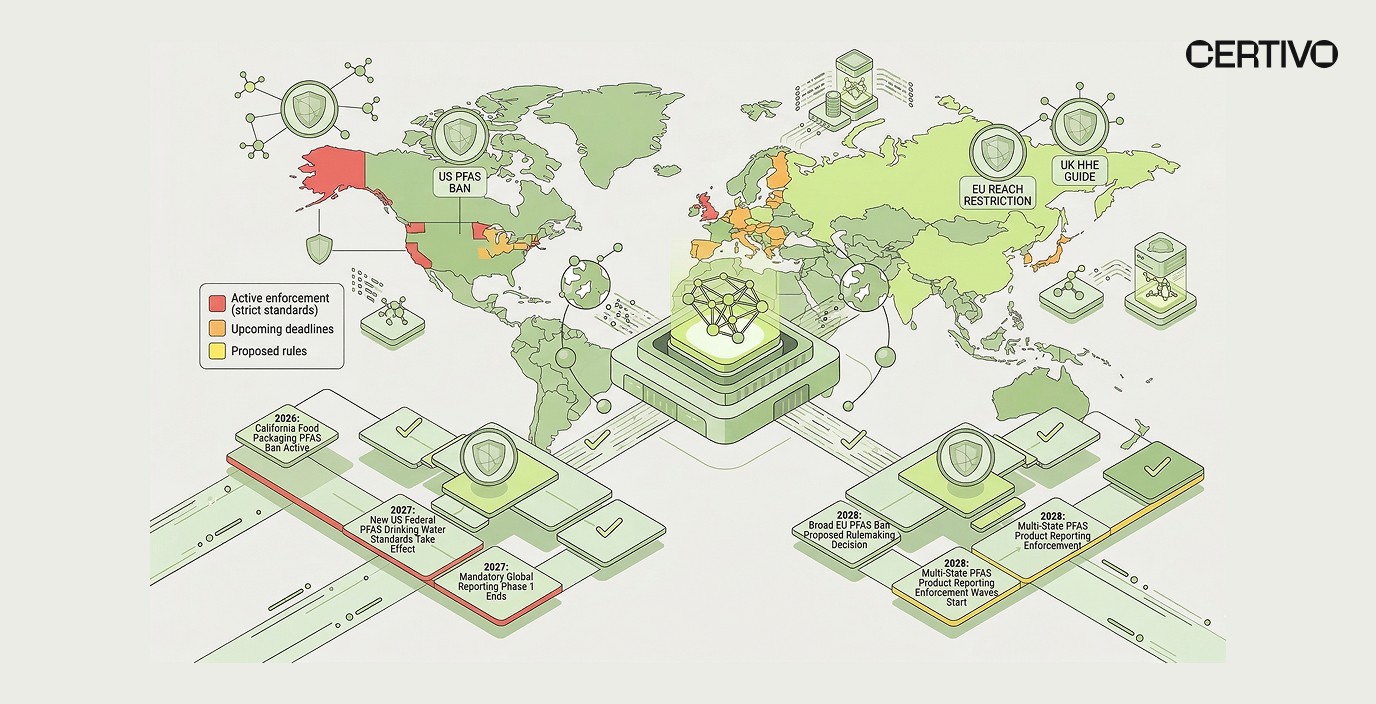
The Regulatory Landscape: Federal, State, and International PFAS Requirements
Key PFAS Reporting Thresholds and Documentation Requirements
The Multi-Tier Supply Chain Challenge in PFAS Tracking
Data Collection Barriers: Why Supplier Surveys Fail at Scale
How Certivo Automates PFAS Identification Across BOMs
BOM-Level Material Mapping and Substance Threshold Management
Automated Supplier Data Collection Through Self-Service Portals
Regulatory Intelligence and Horizon Scanning for PFAS Updates
Multi-Jurisdiction PFAS Compliance Management
Continuous Audit-Ready Documentation and Traceability
Strategic Preparation: Building a PFAS Compliance Infrastructure
Frequently Asked Questions
Why PFAS Compliance Requires Substance-Level Precision Across 12,000+ Compounds
PFAS (per- and polyfluoroalkyl substances) represent a class of over 12,000 synthetic chemicals characterized by strong carbon-fluorine bonds. Unlike traditional restricted substances with a handful of CAS numbers, PFAS compliance frameworks require manufacturers to track thousands of individual compounds across product categories, jurisdictions, and enforcement timelines.
The Scope Challenge
Manufacturers cannot rely on general material declarations. Compliance now demands:
✓ Substance-level identification of individual PFAS compounds in every component
✓ Concentration threshold tracking at part and assembly levels
✓ Multi-tier supplier traceability to raw material sources
✓ Jurisdiction-specific reporting across federal, state, and international frameworks
The EPA's TSCA Section 8(a)(7) PFAS reporting rule requires manufacturers and importers to report historical PFAS use dating back to 2011. State-level regulations like Minnesota's PFAS reporting law and California AB 1817 impose product category bans and disclosure requirements with different substance lists and thresholds.
Without Centralized Compliance Data Backbone architecture, manufacturers face fragmented substance data across suppliers, incomplete BOM-level visibility, and inability to respond to regulatory inquiries within required timeframes.
The Regulatory Landscape: Federal, State, and International PFAS Requirements
PFAS regulations have proliferated across jurisdictions, creating overlapping and sometimes conflicting requirements. Manufacturers operating globally must navigate federal frameworks, state-specific bans, and international restrictions simultaneously.
Federal Requirements
The EPA TSCA PFAS reporting rule mandates disclosure of all PFAS manufacturing, processing, and importing activities. Reporting obligations extend to articles containing PFAS, requiring detailed substance identification and use documentation.
State-Level Regulations
States have enacted increasingly stringent PFAS restrictions:
⚠ Minnesota PFAS reporting: Annual substance disclosure for products sold in-state
⚠ Washington State PFAS ban: Category-specific prohibitions beginning 2027
⚠ Connecticut PFAS labeling: Packaging and product disclosure requirements
⚠ Massachusetts PFAS compliance: Comprehensive reporting and notification obligations
International Frameworks
European Union restrictions include France PFAS phase-out proposals, EU packaging PFAS bans, and UK REACH PFAS restrictions. These regulations impose concentration limits, use restrictions, and documentation requirements that differ from US federal standards.
Explore how Certivo tracks regulatory changes across jurisdictions in real-time.
Key PFAS Reporting Thresholds and Documentation Requirements
PFAS compliance obligations vary significantly by jurisdiction, product category, and substance concentration. Manufacturers must track multiple threshold levels simultaneously and maintain documentation proving compliance across all applicable frameworks.
Federal Reporting Thresholds
The EPA TSCA PFAS reporting rule requires disclosure when:
📊 Any PFAS substance is present above 100 kg cumulative quantity manufactured or processed annually
📊 Articles containing PFAS exceed 10,000 kg of the article imported annually
📊 Historical records document PFAS use or presence since 2011
State-Specific Thresholds
State regulations impose product category thresholds that trigger disclosure or prohibition:
Jurisdiction | Threshold | Trigger |
|---|---|---|
Minnesota | 1% by weight | Intentionally added PFAS |
California | 100 ppm total organic fluorine | Textiles and apparel |
Washington | Presence detection | Priority product categories |
Connecticut | Intentional use | Packaging and consumer products |
Documentation Requirements
Compliance proof requires:
✓ Bill of materials with substance-level composition data
✓ Supplier declarations attesting to PFAS presence or absence
✓ Test reports validating substance concentrations
✓ Use documentation explaining functional necessity
✓ Alternative analysis for restricted PFAS applications
PFAS & Chemicals Risk Management systems must aggregate this documentation across thousands of parts and hundreds of suppliers to demonstrate compliance during audits or regulatory inquiries.
The Multi-Tier Supply Chain Challenge in PFAS Tracking
PFAS substances often enter products through third-tier and fourth-tier suppliers who provide raw materials, coatings, or processing chemicals. Direct suppliers may lack visibility into sub-tier PFAS sources, creating documentation gaps that expose manufacturers to compliance risk.
Supply Chain Visibility Barriers
Traditional supplier management approaches fail because:
⚠ Direct suppliers do not control sub-tier material selection
⚠ PFAS presence is not always intentional or known
⚠ Material safety data sheets often lack substance-level detail
⚠ Supplier declarations use inconsistent formats and definitions
⚠ Supply chain changes invalidate previous PFAS attestations
The Documentation Cascade Problem
Compliance requires documentation flowing upstream through every tier:
Tier 4 (raw material supplier) → substance composition data
Tier 3 (processing/coating) → PFAS presence declaration
Tier 2 (component manufacturer) → part-level PFAS disclosure
Tier 1 (direct supplier) → assembly-level compliance summary
OEM (manufacturer) → product-level regulatory reporting
Each tier adds documentation lag, interpretation variability, and potential data loss. Multi-Tier Supply Chain Transparency platforms must automate data collection and standardize reporting to eliminate these inefficiencies.
Without Automated Supplier Data Collection & Portals, manufacturers spend months chasing declarations for individual parts, receive inconsistent responses, and lack confidence in reported data accuracy.
Data Collection Barriers: Why Supplier Surveys Fail at Scale
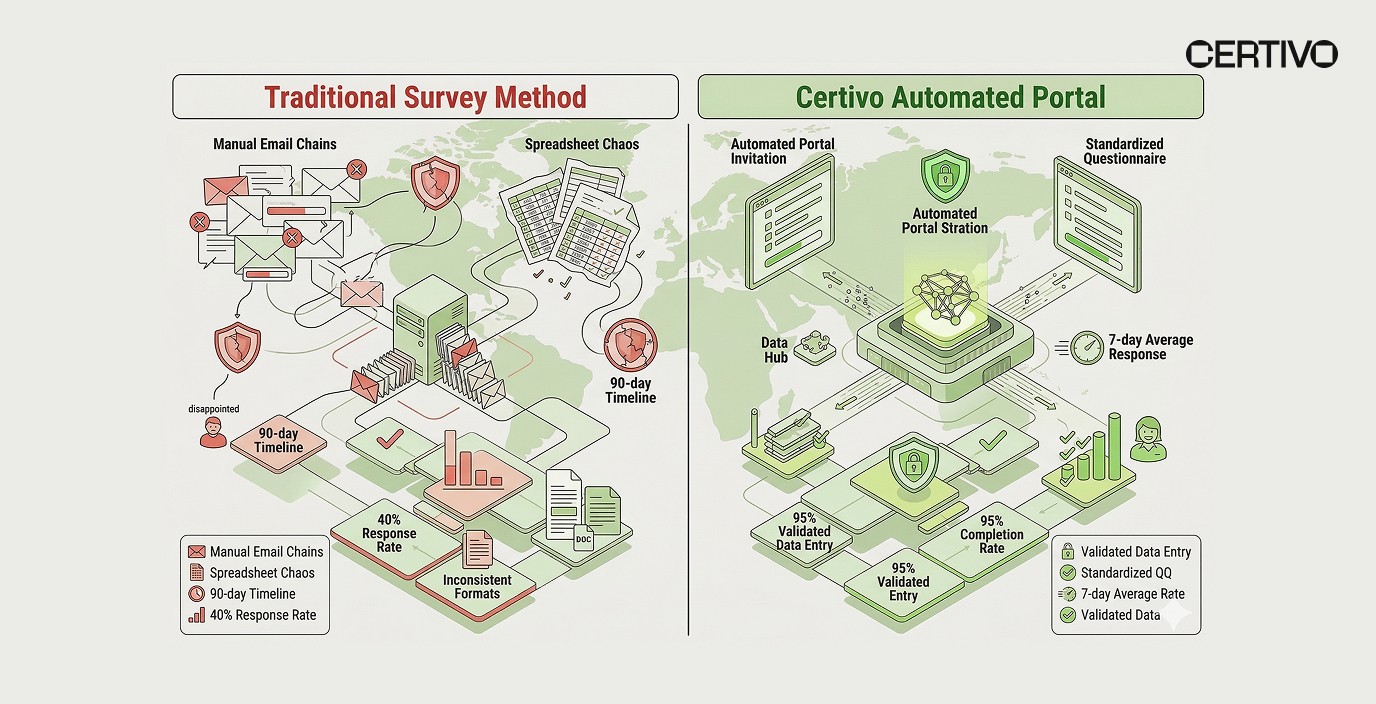
Manual supplier surveys—the traditional approach to PFAS data collection—cannot scale to meet current regulatory demands. Survey-based compliance faces systematic failures across response rates, data quality, and update frequency.
Survey Methodology Failures
Manual data collection suffers from:
⚠ Low response rates (typically 30-40% initial compliance)
⚠ Long cycle times (60-90 days for single-round surveys)
⚠ Inconsistent data formats preventing aggregation
⚠ Language and interpretation barriers with global suppliers
⚠ No verification mechanism for supplier-provided data
The Scale Problem
For manufacturers with complex BOMs:
📌 Average automotive product = 3,000+ unique parts
📌 Average electronics assembly = 500-1,000 components
📌 Each part may source from 2-5 qualified suppliers
📌 Survey requirement = 5,000-15,000 supplier responses per product
At this scale, manual survey methods require dedicated teams, consume months of calendar time, and still produce incomplete data sets. Supplier Self-Service Compliance Portals eliminate survey bottlenecks by enabling suppliers to submit substance data directly into structured formats.
See how Certivo automates supplier data collection without manual surveys.
How Certivo Automates PFAS Identification Across BOMs
Certivo's platform applies CORA-powered regulatory intelligence to automatically identify PFAS substances within bill of materials data. Rather than relying on suppliers to manually report every substance, Certivo's AI Document Parsing & Certificate Validation extracts substance information from technical documentation, safety data sheets, and composition reports.
Automated Substance Recognition
CORA intelligence analyzes:
✓ Material safety data sheets (SDS/MSDS)
✓ Technical data sheets (TDS)
✓ Composition reports and test certificates
✓ Supplier declarations and questionnaire responses
✓ Industry-standard reporting formats (IPC-1752, IMDS, CAMDS)
The system cross-references extracted substance data against comprehensive PFAS databases covering all 12,000+ compounds, including:
📊 EPA TSCA PFAS inventory
📊 OECD PFAS list
📊 State-specific regulated substance lists
📊 EU REACH candidate and restricted substances
📊 Industry PFAS tracking databases
BOM Integration and Mapping
Certivo maps identified PFAS substances to specific BOM line items, creating part-level substance profiles that roll up to assembly and product levels. This BOM-Level Material Mapping enables manufacturers to:
✓ Query PFAS presence by product, assembly, or component
✓ Calculate aggregate PFAS concentrations across multi-part assemblies
✓ Identify which specific parts contribute to threshold exceedances
✓ Track PFAS substances through engineering change orders
BOM-Level Compliance Intelligence transforms disconnected supplier data into structured, queryable substance information linked directly to product structures maintained in PLM and ERP systems.
BOM-Level Material Mapping and Substance Threshold Management
Managing PFAS thresholds requires continuous calculation across multiple regulatory frameworks, each with different concentration limits, calculation methods, and scope definitions. Certivo's BOM Substance & Threshold Management automates this complexity through real-time threshold monitoring.
Multi-Framework Threshold Tracking
Certivo simultaneously monitors:
📌 Federal thresholds: EPA TSCA annual quantity calculations
📌 State concentration limits: Weight percentage and total organic fluorine
📌 EU restrictions: REACH Annex XVII concentration limits
📌 Industry standards: Customer-specific PFAS requirements
The platform calculates thresholds at multiple BOM levels:
✓ Component level: Individual part PFAS concentration
✓ Assembly level: Aggregate PFAS across subassemblies
✓ Product level: Total PFAS content for regulatory reporting
✓ Portfolio level: Enterprise-wide PFAS usage tracking
Threshold Alert System
When substance concentrations approach or exceed regulatory limits, Certivo's Continuous Compliance Monitoring & Audit Readiness system generates automated alerts to:
⚠ Compliance teams requiring immediate investigation
⚠ Engineering teams responsible for part selection
⚠ Procurement teams managing supplier relationships
⚠ Product management teams overseeing affected SKUs
Threshold monitoring operates continuously, recalculating compliance status when:
📊 Supplier updates substance declarations
📊 Regulatory agencies modify threshold values
📊 Engineering implements design changes
📊 New suppliers are qualified for existing parts
Explore Certivo's threshold management capabilities for multi-substance regulatory frameworks.
Automated Supplier Data Collection Through Self-Service Portals
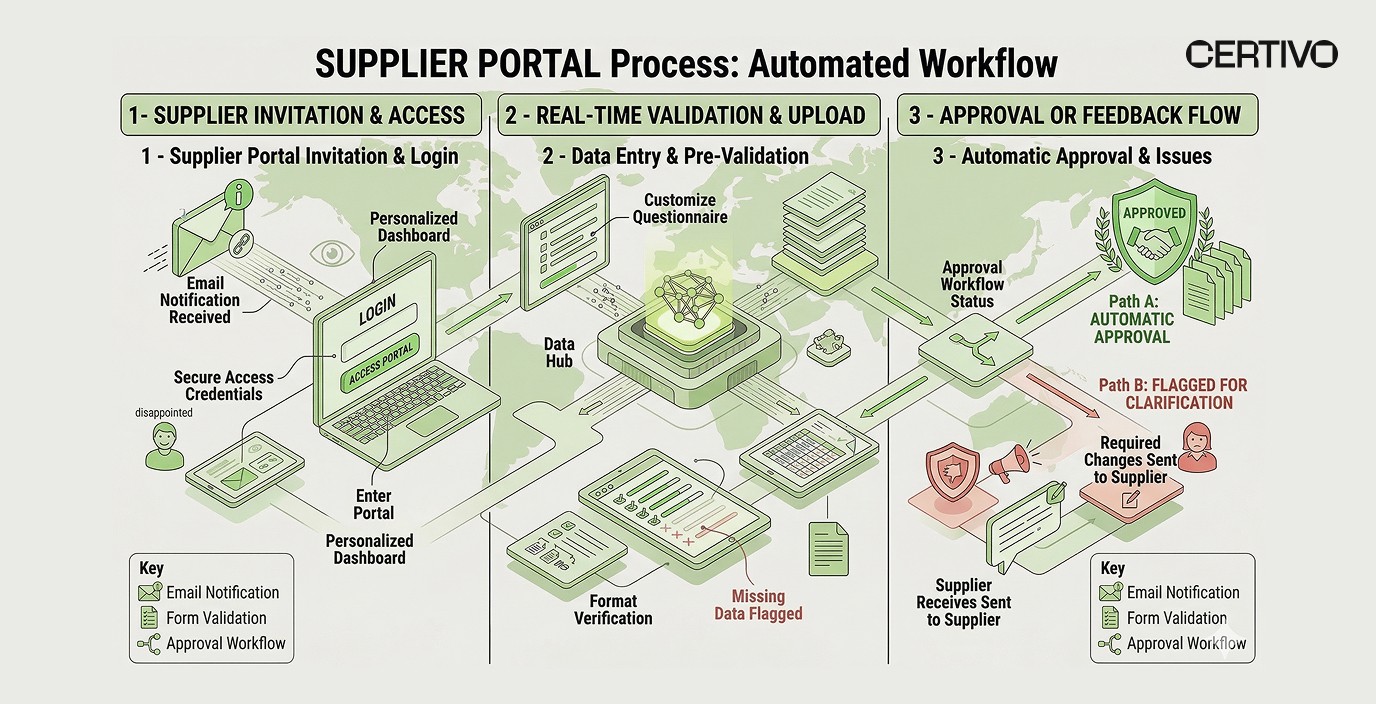
Certivo replaces manual supplier surveys with Centralized Supplier Self-Service Portals that enable suppliers to submit substance data directly, reducing response times from months to days while improving data quality and completeness.
Standardized Supplier Questionnaire Frameworks
Suppliers access customized questionnaires through secure portals, with questions automatically generated based on:
✓ Part categories being supplied
✓ Applicable regulatory frameworks
✓ Material types and substance risks
✓ Previous supplier response history
Questionnaires use Standardized Supplier Questionnaire Frameworks aligned with industry formats, reducing supplier confusion and enabling data reuse across customers. Suppliers provide:
📋 PFAS presence declarations (yes/no/unknown)
📋 Specific PFAS substances and CAS numbers
📋 Concentration ranges or exact values
📋 Supporting documentation (SDS, test reports, composition data)
📋 Alternative substance information if PFAS is present
Automated Data Validation
CORA intelligence validates supplier responses in real-time:
✓ Completeness checks: All required fields submitted
✓ Format validation: CAS numbers and substance names verified
✓ Cross-reference verification: Declarations match uploaded documentation
✓ Threshold calculations: Concentration values trigger compliance flags
✓ Consistency analysis: Current responses align with historical data
Invalid or incomplete submissions generate immediate feedback to suppliers, eliminating multi-week clarification cycles. Supplier Risk Scoring & Due Diligence functionality tracks supplier response quality, identifying high-risk suppliers requiring additional scrutiny.
Regulatory Intelligence and Horizon Scanning for PFAS Updates
PFAS regulations evolve continuously, with new substance additions, threshold modifications, and jurisdictional expansions announced regularly. Manufacturers cannot rely on periodic compliance reviews when regulations change monthly. Certivo's Regulatory Intelligence & Horizon Scanning monitors regulatory developments globally and automatically maps changes to affected products and suppliers.
Automated Regulatory Monitoring
CORA's regulatory intelligence layer tracks:
📊 Federal agency actions: EPA proposed rules, final rules, guidance documents
📊 State legislative activity: Bills, regulations, enforcement guidance
📊 International developments: EU REACH updates, member state restrictions
📊 Industry announcements: Trade association alerts, customer requirements
The system monitors official sources including:
✓ EPA Federal Register notices for TSCA updates
✓ ECHA REACH database for EU restrictions
✓ State environmental agency websites for local requirements
✓ Legislative tracking services for proposed regulations
Impact Analysis and SKU Mapping
When regulatory changes are detected, Certivo automatically:
✓ Identifies affected substance lists and thresholds
✓ Queries internal databases for products containing affected substances
✓ Calculates compliance gap for impacted SKUs
✓ Generates prioritized action lists for compliance teams
✓ Notifies relevant suppliers of new requirements
This CORA-driven compliance intelligence eliminates the lag between regulatory publication and internal compliance action. Rather than discovering new requirements during customer audits, manufacturers receive advance notice enabling proactive response.
Stay ahead of regulatory changes with automated horizon scanning.
Multi-Jurisdiction PFAS Compliance Management
Manufacturers selling into multiple markets face the challenge of simultaneously complying with federal, state, and international PFAS frameworks that use different substance lists, thresholds, and reporting formats. Certivo's Multi Jurisdiction EHS & ESG Management capabilities enable single-system compliance across all applicable frameworks.
Jurisdiction-Specific Compliance Views
Certivo maintains parallel compliance assessments for each jurisdiction:
📋 US Federal: TSCA Section 8(a)(7) reporting status
📋 Minnesota: PRISM portal reporting compliance
📋 California: AB 1817 textile ban compliance
📋 Washington: Priority product category restrictions
📋 EU: REACH Annex XVII and national restrictions
Each jurisdiction view shows:
✓ Applicable substance lists and thresholds
✓ Products requiring reporting or restriction compliance
✓ Current compliance status (compliant / at-risk / non-compliant)
✓ Documentation gaps requiring supplier follow-up
✓ Upcoming deadlines and enforcement dates
Automated Report Generation
Certivo generates jurisdiction-specific compliance reports using templates aligned with regulatory agency requirements:
📊 EPA CDR reporting formats for TSCA submissions
📊 State portal uploads for Minnesota PRISM and similar systems
📊 Customer disclosure formats for OEM requirements
📊 Audit documentation packages with supporting evidence
Reports automatically populate from centralized substance data, eliminating manual compilation and reducing reporting errors. Multi-framework reporting capabilities enable compliance teams to respond to regulatory inquiries and customer requests within hours rather than weeks.
Continuous Audit-Ready Documentation and Traceability
Regulatory audits and customer inquiries require manufacturers to prove PFAS compliance with detailed documentation tracing substances through supply chains to raw materials. Certivo's Continuous Audit-Ready Documentation maintains compliance evidence automatically, eliminating scrambling when audit requests arrive.
Documentation Requirements
Auditors and customers require:
✓ Part-level substance declarations from direct suppliers
✓ Sub-tier traceability to raw material sources
✓ Test reports validating declared concentrations
✓ Supplier certificates attesting to PFAS absence
✓ Change history documenting when substances were introduced or removed
✓ Alternative analysis for permitted PFAS uses
Automated Evidence Assembly
When audit requests arrive, Certivo automatically assembles documentation packages containing:
📋 Product BOM with substance composition data
📋 Supplier declarations for all components
📋 Supporting test reports and certificates
📋 Regulatory framework compliance summaries
📋 Exception justifications for permitted uses
The platform maintains Digital Passports & Traceability IDs linking each part to its complete compliance history, enabling rapid response to targeted inquiries about specific substances or suppliers.
Supplier Accountability Trail
Certivo documents supplier data submission history:
📌 When declarations were received
📌 Who at the supplier organization submitted data
📌 What documentation was provided
📌 How data was validated
📌 When updates were requested and received
This audit trail protects manufacturers by demonstrating due diligence in supplier data collection, even when suppliers provide inaccurate information. Replace spreadsheets with audit-ready systems that maintain compliance evidence automatically.
Strategic Preparation: Building a PFAS Compliance Infrastructure
Manufacturers preparing for long-term PFAS compliance must establish infrastructure that scales beyond current regulatory requirements. As jurisdictions expand substance lists and lower thresholds, reactive compliance becomes increasingly untenable.
Infrastructure Requirements
Sustainable PFAS compliance requires:
✓ Centralized substance database: Single source of truth for PFAS data across products
✓ Automated supplier integration: Continuous data flow eliminating survey cycles
✓ BOM-level intelligence: Substance visibility at component and assembly levels
✓ Multi-framework tracking: Parallel compliance across federal, state, international rules
✓ Regulatory monitoring: Automated scanning for new requirements and deadlines
✓ Audit documentation: Continuous evidence assembly without manual compilation
Implementation Approach
Organizations transitioning from reactive to systematic PFAS compliance typically follow this progression:
Phase 1: Baseline Assessment
Document current PFAS exposure across product portfolio using rapid risk assessment tools to prioritize highest-risk products and jurisdictions.
Phase 2: Supplier Engagement
Deploy Supplier Self-Service Compliance Portals enabling suppliers to submit substance data directly, replacing manual survey processes.
Phase 3: BOM Integration
Connect substance data to product structures, enabling BOM-Level Compliance Intelligence for threshold calculations and impact analysis.
Phase 4: Regulatory Monitoring
Implement Regulatory Intelligence & Horizon Scanning to detect new requirements before enforcement begins.
Phase 5: Continuous Compliance
Establish Continuous Compliance Monitoring & Audit Readiness eliminating point-in-time compliance checks.
Launch products faster by building PFAS compliance into product development workflows.
How AI-Native Compliance Automation Transforms PFAS Management
Traditional compliance software requires manual data entry, interpretation, and analysis. Certivo's AI-Native Compliance Automation fundamentally changes this model by applying artificial intelligence throughout the compliance workflow—from document ingestion to regulatory analysis to report generation.
CORA-Powered Intelligence Capabilities
CORA (Certivo's embedded AI) delivers:
✓ Document parsing: Automatic extraction of substance data from supplier documents
✓ Substance identification: Recognition of PFAS compounds across naming variations
✓ Regulatory mapping: Connection of substances to applicable frameworks and thresholds
✓ Gap analysis: Identification of missing or insufficient supplier data
✓ Risk prioritization: Flagging of highest-exposure products and suppliers
AI-Enabled Efficiency Gains
Organizations implementing Certivo's AI-powered compliance management report:
📊 90% reduction in manual data entry time
📊 75% faster supplier response cycles
📊 60% improvement in data completeness
📊 85% reduction in audit preparation time
📊 50% fewer compliance-related delays in product launches
AI automation eliminates the scaling limitations of manual compliance approaches. As product portfolios grow, regulatory frameworks multiply, and supplier networks expand, CORA-enabled analysis maintains consistent compliance without proportional headcount increases.
Discover how AI transforms compliance from documentation burden to competitive advantage.
Conclusion: From PFAS Complexity to Compliance Confidence
Managing PFAS compliance across 12,000+ substances and multi-tier supply chains requires infrastructure purpose-built for substance-level precision, supplier data automation, and continuous regulatory monitoring. Spreadsheet-based approaches and manual supplier surveys cannot scale to meet the documentation demands imposed by overlapping federal, state, and international PFAS frameworks.
Certivo's AI-Native Compliance Automation platform provides manufacturers with BOM-Level Compliance Intelligence that transforms PFAS from a reactive reporting burden into a managed, audit-ready capability. Through CORA-powered regulatory intelligence, Automated Supplier Data Collection & Portals, and Multi Jurisdiction EHS & ESG Management, organizations achieve compliance confidence even as regulations expand and thresholds tighten.
The manufacturers succeeding in the current PFAS regulatory environment treat compliance as enterprise infrastructure rather than periodic documentation exercises. They deploy Centralized Compliance Data Backbone systems linking substance data directly to product structures, enabling real-time threshold monitoring and immediate response to regulatory changes.
As PFAS regulations continue to evolve, the documentation and traceability requirements will only intensify. Organizations establishing systematic PFAS management infrastructure today position themselves to absorb future regulatory expansions without operational disruption.
Book a demo to see how Certivo automates PFAS compliance across your product portfolio and supply chain—or get a free compliance risk assessment to understand your current PFAS exposure across products and jurisdictions.
Frequently Asked Questions
What platforms track PFAS regulations and automate product compliance across regions?
Certivo monitors PFAS regulatory developments across federal, state, and international jurisdictions through CORA-powered regulatory intelligence. The platform automatically maps regulatory changes to affected products, calculates compliance gaps, and generates jurisdiction-specific reports aligned with EPA TSCA, state reporting portals, and EU REACH requirements.
How do digital compliance solutions help manufacturers manage emerging PFAS restrictions?
Certivo's AI-Native Compliance Automation continuously scans regulatory sources for new PFAS restrictions, automatically identifies impacted products using BOM-Level Compliance Intelligence, and deploys Automated Supplier Data Collection & Portals to gather required substance documentation. This eliminates the lag between regulation publication and internal compliance action.
What tools monitor substance thresholds across BOMs to prevent regulatory limit exceedances?
Certivo's BOM Substance & Threshold Management calculates PFAS concentrations at component, assembly, and product levels across multiple regulatory frameworks simultaneously. The system generates automated alerts when concentrations approach limits, enabling proactive reformulation before threshold violations occur.
How do companies adapt to rapid changes in global chemical regulations?
Organizations implement Regulatory Intelligence & Horizon Scanning systems that monitor official regulatory sources continuously rather than relying on periodic manual reviews. Certivo's CORA intelligence tracks federal agencies, state legislatures, and international bodies, automatically mapping new requirements to internal product portfolios.
What software monitors global regulatory updates and maps them to specific SKUs?
Certivo maintains Multi Jurisdiction EHS & ESG Management views showing compliance status for each SKU across applicable frameworks. When regulations change, the platform queries substance databases, identifies affected SKUs, calculates new compliance requirements, and generates prioritized action lists for compliance teams.
Vasanth
Vasanth is a skilled Compliance Engineer with over five years of experience specializing in global environmental regulations, including REACH, RoHS, Proposition 65, POPs, TSCA, PFAS, CMRT, EMRT, FMD, and IMDS. With a strong academic foundation in Chemical Engineering from Anna University, he brings a deep technical understanding to compliance processes across complex product lines.
Vasanth excels in analyzing Bills of Materials (BOMs), evaluating supplier declarations, and ensuring regulatory conformity through meticulous review and risk assessment. He is highly proficient in supplier engagement, adept at interpreting material disclosures, and experienced in preparing customer-ready compliance documentation tailored to diverse global standards.
Known for his attention to detail, up-to-date regulatory knowledge, and proactive communication style, Vasanth plays a critical role in maintaining product compliance and advancing sustainability goals within fast-paced, globally integrated manufacturing environments.