


Minnesota PFAS Reporting 2026: What the MPCA Webinar Means for Manufacturers Selling Products in Minnesota
On February 26, 2026, the Minnesota Pollution Control Agency (MPCA) hosted a pivotal public webinar that delivered long-awaited clarity on Minnesota PFAS reporting obligations under Amara's Law. For every manufacturer selling PFAS-containing products in the state, the message was unambiguous: the July 1, 2026 reporting deadline is final, the PRISM system has been updated, and the path toward the 2032 total ban is now taking formal shape.
This is not a future-state discussion. The Minnesota PFAS reporting requirements are active, the compliance fees are finalized, and the enforcement timeline leaves no room for delay. For compliance and regulation managers responsible for state-level chemical disclosure, this webinar confirmed every critical detail needed to plan and execute.
This article breaks down the full scope of the MPCA's announcements — from the Currently Unavoidable Use (CUU) exemption framework to the PRISM 1.1 reporting system changes, fee structures, internal component clarifications, and actionable steps manufacturers must take before the deadline.
📌 Table of Contents
The 2032 PFAS Ban and the "Currently Unavoidable Use" Exemption Framework
PRISM System 1.1: What Changed for Complex Product Reporting
Reporting Deadlines, Annual Updates, and Compliance Fees
Critical Clarification: Internal Components Are NOT Exempt from Reporting
Compliance Timeline at a Glance
Industries and Products Affected
Compliance Risks and Penalties
Operational and Supply Chain Impact
Compliance Readiness Checklist
The Role of AI in Minnesota PFAS Compliance
FAQs
Executive Conclusion
1. The 2032 PFAS Ban and the "Currently Unavoidable Use" Exemption Framework
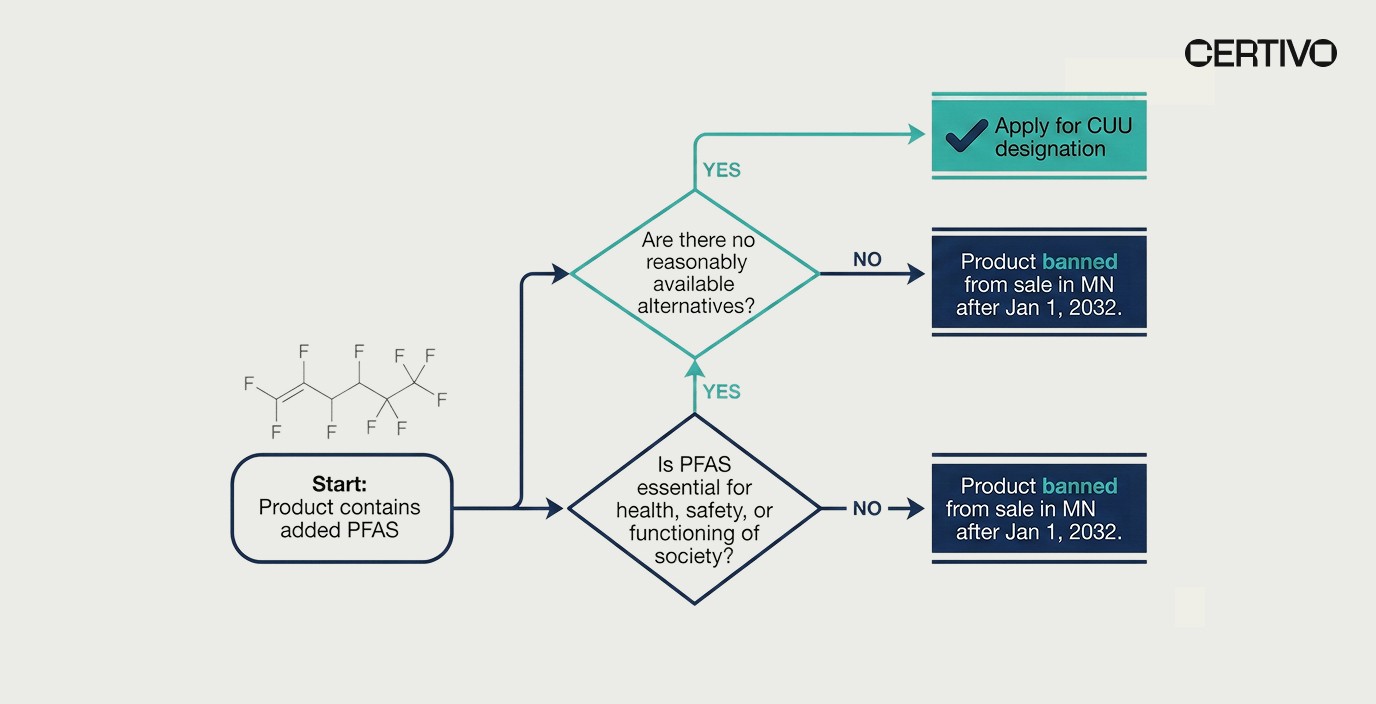
The most consequential announcement from the MPCA webinar addressed the total ban on PFAS-containing products taking effect January 1, 2032. Starting on that date, all products containing intentionally added PFAS will be prohibited from sale in Minnesota — unless they receive a Currently Unavoidable Use (CUU) designation. For background on how Minnesota's framework fits within the broader U.S. PFAS regulatory landscape, see this global PFAS regulations master guide for manufacturers.
What qualifies as a CUU designation:
To qualify, a manufacturer must prove two conditions simultaneously:
✓ The use of PFAS is "essential for health, safety, or the functioning of society"
✓ There are no reasonably available alternatives
⚠ This is not an automatic exemption. The MPCA confirmed this will be a rigorous, evidence-based application process. The agency is currently developing the formal criteria through a dedicated rulemaking process. Manufacturers relying on any assumption of blanket exemption should reassess immediately. Building proactive compliance risk management processes now will be critical for CUU application preparedness.
📌 30-Day Public Comment Window: The MPCA opened a formal feedback period running from February 26 to March 29, 2026. Industry stakeholders are encouraged to submit comments on the proposed "Essentiality" framework. This is a direct opportunity to influence how CUU criteria are defined. Organizations that manufacture products where PFAS serves critical safety or performance functions should engage in this comment period through their regulatory intelligence and horizon scanning workflows.
2. PRISM System 1.1: What Changed for Complex Product Reporting
Manufacturers of complex, multi-component products received meaningful updates regarding the PFAS Reporting and Information System for Manufacturers (PRISM). Following feedback from the January soft launch, the MPCA has transitioned to Version 1.1 with several improvements designed to accommodate real-world product complexity. Organizations managing diverse product portfolios should understand how these changes affect their BOM-level compliance intelligence workflows.
Key changes in PRISM 1.1:
Feature | Previous Version | PRISM 1.1 Update |
|---|---|---|
Data entry format | Rigid drop-down menus | Open text fields for custom descriptions |
Component descriptions | Limited predefined categories | Manufacturers can describe custom components and specific functions |
Product grouping | Each product reported individually | Similar products can be grouped into a single report if they share the same PFAS components and concentrations |
Reporting level | Component-level required | Still required at the "lowest practical component level" |
✓ Open text fields allow manufacturers to accurately describe components and functions that did not fit into previous predefined categories. This is particularly important for semiconductor and PCB manufacturers and industrial electronics companies where PFAS is used in highly specialized applications.
✓ Product grouping significantly reduces the administrative reporting burden. If multiple SKUs share identical PFAS components and concentrations, they can be consolidated into a single report entry. For organizations managing thousands of products, the ability to replace spreadsheets with a scalable compliance system becomes essential for efficient grouping and submission.
⚠ The "lowest practical component level" standard remains. Manufacturers must report at the specific component level — for example, a PFAS-coated gasket within an engine, not just the engine itself. This requires granular BOM-level material mapping across all product lines sold in Minnesota.
3. Reporting Deadlines, Annual Updates, and Compliance Fees
The MPCA reiterated that statutory deadlines are fixed. There will be no further extensions to the initial reporting window. For context on how these Minnesota-specific deadlines intersect with other PFAS reporting obligations, see the 2025–2026 PFAS compliance countdown.
📌 Key dates:
July 1, 2026 — Final deadline for all manufacturers to submit initial PFAS product reports via PRISM
February 1, 2027 — First annual update / recertification due
Annually thereafter — Updates due every February 1
📌 Compliance fee:
Fee Element | Detail |
|---|---|
Amount | $800 per manufacturer |
Structure | Flat rate — regardless of the number of products reported |
Timing | Due with initial filing |
The flat-rate fee structure means that organizations with large product portfolios pay the same as those with a single product — making early, comprehensive reporting the most cost-efficient approach. Operations leaders should factor this fee into compliance budgeting alongside the operational cost of data collection and report preparation.
⚠ Annual recertification creates an ongoing obligation. This is not a one-time report. Every year, manufacturers must update or recertify their PFAS product disclosures. Building continuous audit-ready documentation processes now avoids rebuilding data from scratch each cycle.
4. Critical Clarification: Internal Components Are NOT Exempt from Reporting
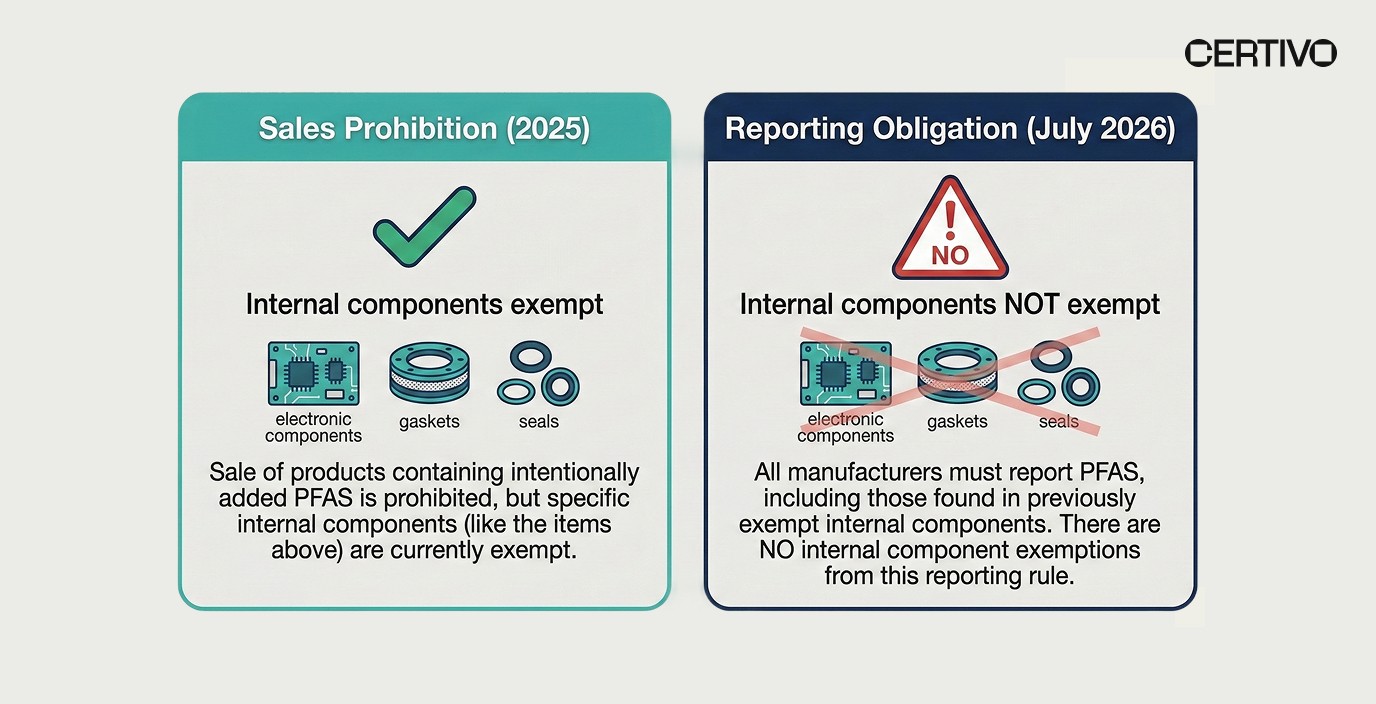
The MPCA addressed a widespread point of confusion that carries significant compliance risk. Many manufacturers had assumed that products containing PFAS only in internal or electronic components were fully exempt. This assumption is incorrect. Understanding this distinction is critical for quality directors overseeing product compliance declarations.
📊 The distinction is between sales prohibitions and reporting:
Obligation | Internal/Electronic PFAS Components |
|---|---|
2025 Sales Prohibitions | ✓ Exempt — products with PFAS only in internal components are not subject to current sales bans |
July 1, 2026 Reporting | ⚠ NOT Exempt — all intentionally added PFAS in internal components must be disclosed |
This means a product that is currently legal to sell in Minnesota because its PFAS is confined to internal electronic parts must still be reported in PRISM by July 1, 2026. Failure to report constitutes non-compliance regardless of sales exemption status. Manufacturers in the automotive sector and aerospace and defense industry — where PFAS is commonly used in internal seals, gaskets, and electronic coatings — are particularly affected by this clarification.
Every component using PFAS for lubrication, water resistance, heat management, or dielectric properties must be identified, mapped, and reported. Supplier collaboration and documentation workflows are essential for obtaining PFAS data from component-level suppliers who may not be aware of Minnesota's reporting scope.
5. Compliance Timeline at a Glance
Date | Milestone | Action Required |
|---|---|---|
March 29, 2026 | Deadline for public comments on CUU rulemaking | Submit feedback on "Essentiality" framework |
July 1, 2026 | Initial reporting deadline for all PFAS-containing products | Submit complete report via PRISM + $800 fee |
February 1, 2027 | First annual update / recertification due | Update or recertify all PFAS product disclosures |
January 1, 2032 | Full ban on PFAS in products (except CUU-designated) | Reformulate, substitute, or secure CUU designation |
Organizations managing compliance across multiple U.S. states should coordinate Minnesota deadlines with Massachusetts PFAS compliance requirements, Kentucky HB 196 reporting obligations, and Connecticut PFAS labelling requirements to avoid duplicated effort.
6. Industries and Products Affected
The Minnesota PFAS reporting requirement applies broadly to any manufacturer selling products with intentionally added PFAS in the state. Based on the MPCA's guidance, the following sectors face the highest compliance exposure. For a deeper look at why no manufacturer can consider themselves "out of scope," see PFAS compliance in 2026: why out-of-scope no longer exists.
Industry | Common PFAS Applications | Reporting Exposure |
|---|---|---|
Electronics & Semiconductors | Dielectric coatings, solder resists, thermal management | ⚠ High — internal component clarification applies |
Automotive | Gaskets, seals, fuel system components, wire insulation | ⚠ High — PFAS in internal parts must be reported |
Aerospace & Defense | Hydraulic fluids, anti-corrosion coatings, fire suppression | ⚠ High — both internal and external PFAS |
Medical Devices | Tubing, coatings, implant components | ⚠ High — likely CUU candidates for 2032 |
Industrial Automation | Lubricants, seals, heat-resistant components | ⚠ Moderate to High |
Consumer Goods & Textiles | Water-resistant coatings, stain-resistant treatments | ⚠ High — already subject to 2025 sales bans |
Cosmetics | Ingredient formulations with PFAS compounds | ⚠ Moderate — depends on formulation |
Medical device manufacturers and industrial automation companies should pay particular attention to the CUU framework, as many of their PFAS applications may qualify as essential for health or safety — but qualification is not guaranteed and requires formal application.
7. Compliance Risks and Penalties
While the MPCA webinar focused on guidance rather than enforcement specifics, Minnesota's Amara's Law establishes the legal authority for penalties related to non-compliance with PFAS reporting requirements. Manufacturers should approach these obligations with the same rigor applied to federal reporting. Organizations that have historically relied on manual processes should evaluate why people-only compliance cannot scale in the context of state-level reporting mandates.
Key compliance risks include:
⚠ Failure to report by July 1, 2026 — constitutes statutory non-compliance regardless of product sales exemption status
⚠ Incomplete reporting — failing to disclose PFAS in internal components when they contain intentionally added PFAS
⚠ Missed annual recertification — the February 1 annual update is a recurring obligation, not optional
⚠ Inaccurate product grouping — grouping products that do not share identical PFAS components and concentrations
⚠ Failure to prepare for 2032 ban — manufacturers without CUU designation or reformulation plans face market access loss
The risk is not limited to fines. Non-compliance with Minnesota reporting creates market access risk — products that are not properly reported may face sales prohibitions or enforcement actions. Procurement and supply chain leaders should treat Minnesota PFAS reporting as a market readiness requirement, not just a regulatory checkbox.
8. Operational and Supply Chain Impact
The MPCA's clarifications — particularly regarding internal components and the "lowest practical component level" reporting standard — create specific operational demands across the supply chain. For a broader perspective on how documentation workloads are increasing, see how tariffs and reshoring are increasing material compliance workloads.
Immediate operational requirements:
✓ Component-level PFAS mapping — identify every part using PFAS for lubrication, water resistance, heat management, or dielectric function
✓ Supplier data collection — request PFAS content declarations from all component-level suppliers, including those providing internal and electronic parts
✓ Product grouping analysis — determine which products share identical PFAS components and concentrations to leverage PRISM 1.1's grouping feature
✓ PRISM account registration — the MPCA recommends registering early to avoid system traffic congestion in June
Supply chain data gaps represent the most significant operational bottleneck. Many tier-2 and tier-3 suppliers may not have visibility into PFAS content at the component level. Streamlining supplier documentation through centralized portals and standardized questionnaires accelerates data collection.
For organizations managing PFAS compliance across federal TSCA obligations alongside multiple state-level requirements, the ability to standardize compliance across plants and regions prevents duplicated effort. Coordination with TSCA Section 8(a)(7) reporting is particularly important since much of the substance-level data overlaps.
9. Compliance Readiness Checklist
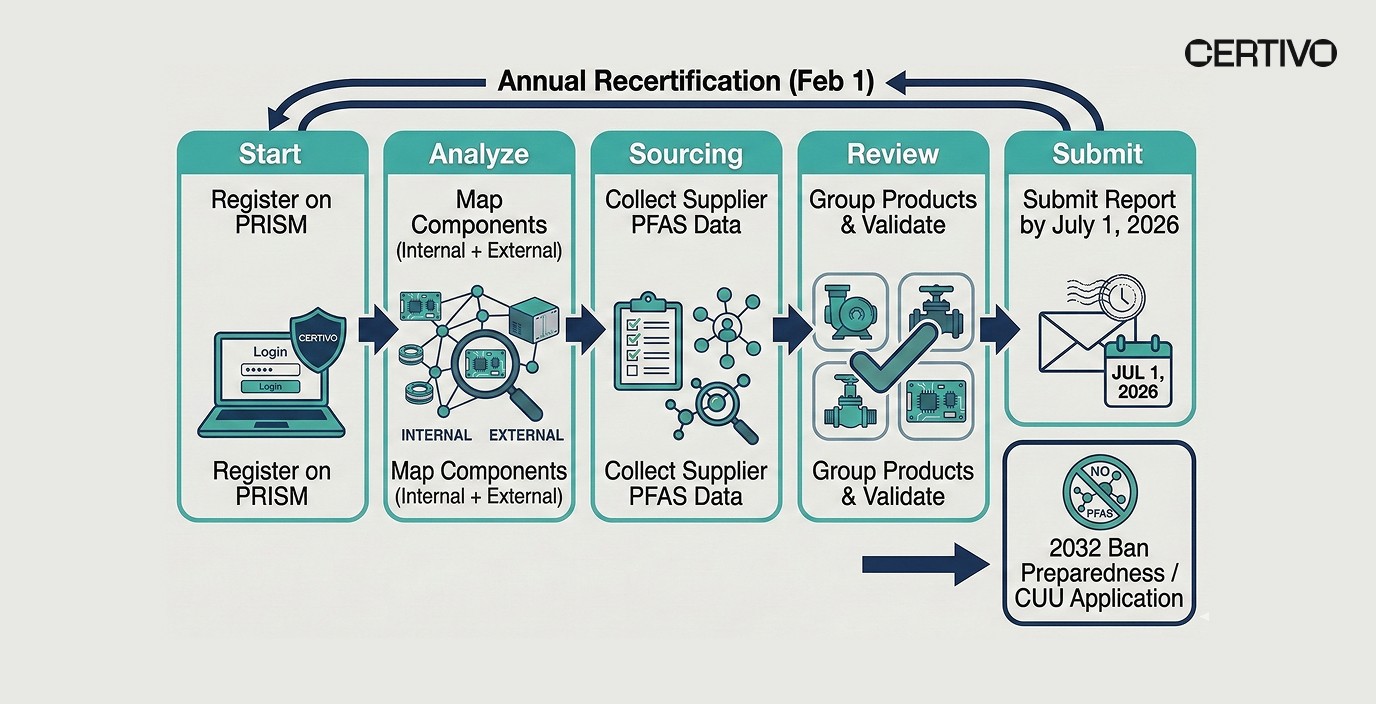
📌 Use this checklist to prepare for the Minnesota PFAS reporting deadline:
# | Action Item | Deadline | Status |
|---|---|---|---|
1 | Register on the PRISM portal (even if data is incomplete) | Immediately | ☐ |
2 | Map all product components using PFAS (internal and external) | By May 2026 | ☐ |
3 | Issue supplier data requests for PFAS content at the component level | By April 2026 | ☐ |
4 | Identify products eligible for grouping under PRISM 1.1 rules | By May 2026 | ☐ |
5 | Submit public comments on CUU framework (if products may qualify) | By March 29, 2026 | ☐ |
6 | Prepare and validate PRISM report entries at lowest practical component level | By June 2026 | ☐ |
7 | Submit initial PFAS product report via PRISM + $800 fee | By July 1, 2026 | ☐ |
8 | Establish annual recertification process for February 1 cycle | Ongoing | ☐ |
9 | Begin 2032 ban preparedness: evaluate CUU eligibility or reformulation options | 2026–2030 | ☐ |
10 | Coordinate with federal TSCA and other state PFAS reporting to avoid duplication | Ongoing | ☐ |
For organizations evaluating whether their current systems can handle this level of reporting, this guide on building a future-ready compliance infrastructure provides a practical assessment framework. IT and systems leaders should be directly involved in PRISM integration planning.
10. The Role of AI in Minnesota PFAS Compliance
Minnesota's reporting requirements — component-level PFAS mapping, product grouping validation, multi-tier supplier data collection, and annual recertification — create a compliance workload that exceeds what manual processes can reliably sustain. For a detailed look at how AI transforms daily compliance operations, see a compliance engineer's week with and without AI.
The operational demands include:
Component-level substance identification across complex multi-part assemblies
Supplier data aggregation from dozens or hundreds of component suppliers who may lack PFAS visibility
Product grouping analysis validating that grouped products genuinely share identical PFAS compositions
Annual recertification data management ensuring year-over-year consistency and accuracy
Multi-state coordination aligning Minnesota reporting with federal TSCA and other state PFAS obligations
AI-native compliance platforms address these challenges by:
✓ Scanning BOM and product composition data to identify PFAS presence at the component level
✓ Automating supplier data requests through centralized supplier self-service portals with standardized questionnaire frameworks
✓ Validating product grouping eligibility by comparing PFAS components and concentrations across SKUs
✓ Maintaining continuous audit-ready documentation that supports both initial filing and annual recertification
✓ Providing regulatory horizon scanning to track CUU rulemaking progress and 2032 ban preparedness milestones
For organizations managing PFAS compliance across the PFAS framework at both federal and state levels, the ability to consolidate substance data, supplier declarations, and regulatory reporting in a single system eliminates fragmentation. See also the complete guide to AI tools for compliance management and how AI automates compliance across 12,000+ PFAS compounds.
11. Frequently Asked Questions (FAQs)
Q1: What is the deadline for Minnesota PFAS reporting under Amara's Law?
The final deadline for initial PFAS product reporting via PRISM is July 1, 2026. The MPCA has confirmed there will be no further extensions. Following the initial report, annual updates are due every February 1, starting in 2027. For a complete view of upcoming PFAS deadlines, see the PFAS compliance countdown for 2025–2026.
Q2: Are internal electronic components exempt from Minnesota PFAS reporting?
No. While products with PFAS only in internal or electronic components are exempt from the 2025 sales prohibitions, they are not exempt from reporting. All intentionally added PFAS in internal components must be disclosed in the July 1, 2026 PRISM report. This clarification from the MPCA applies to all industrial electronics and complex product manufacturers.
Q3: How much does Minnesota PFAS reporting cost?
The reporting fee is a flat $800 per manufacturer for the initial filing, regardless of the number of products reported. This fee structure applies equally to organizations with one product or thousands. CEOs and founders should factor this into compliance budgeting alongside internal data collection costs.
Q4: What is the Currently Unavoidable Use (CUU) exemption?
CUU is the only pathway to continue selling PFAS-containing products in Minnesota after the January 1, 2032 total ban. To qualify, manufacturers must prove that PFAS use is essential for health, safety, or societal function AND that no reasonably available alternatives exist. The MPCA is developing formal criteria through rulemaking, with public comments accepted through March 29, 2026. Access MPCA guidance via the MPCA PFAS rulemaking and reporting archive.
Q5: Can similar products be grouped into a single PRISM report?
Yes. PRISM Version 1.1 now allows manufacturers to group "similar products" into a single report entry — provided they share the same PFAS components and concentrations. This significantly reduces the administrative reporting burden for organizations with large product portfolios. Effective product grouping requires BOM-level compliance tracking to verify that grouped products genuinely share identical PFAS profiles.
12. Executive Conclusion
The MPCA's February 26 webinar removed any remaining ambiguity about Minnesota PFAS reporting obligations. The July 1, 2026 deadline is final. The PRISM 1.1 system is live with meaningful improvements for complex products. The $800 flat reporting fee is confirmed. And critically, internal electronic components containing PFAS are not exempt from disclosure.
For manufacturers selling products in Minnesota, the compliance imperative under the Minnesota PFAS reporting requirements is clear: map your components now, engage your suppliers immediately, register on PRISM early, and submit your report before the window closes. The 2032 total ban and CUU rulemaking add long-term strategic urgency to what is already an immediate operational obligation.
Organizations managing PFAS compliance across multiple jurisdictions — federal TSCA, EU REACH, and a growing patchwork of U.S. state requirements — need compliance infrastructure that can consolidate substance data, automate supplier engagement, and maintain continuous reporting readiness. For broader context on how the global PFAS landscape is evolving, see the global PFAS reckoning: bans, thresholds, and substitution requirements.
📌 Official MPCA Resources:
To explore how AI-driven compliance platforms like Certivo support continuous regulatory readiness across federal and state PFAS obligations, connect with the Certivo team.
Lavanya
Lavanya is an accomplished Product Compliance Engineer with over four years of expertise in global environmental and regulatory frameworks, including REACH, RoHS, Proposition 65, POPs, TSCA, PFAS, CMRT, FMD, and IMDS. A graduate in Chemical Engineering from the KLE Institute, she combines strong technical knowledge with practical compliance management skills across diverse and complex product portfolios.
She has extensive experience in product compliance engineering, ensuring that materials, components, and finished goods consistently meet evolving international regulatory requirements. Her expertise spans BOM analysis, material risk assessments, supplier declaration management, and test report validation to guarantee conformity. Lavanya also plays a key role in design-for-compliance initiatives, guiding engineering teams on regulatory considerations early in the product lifecycle to reduce risks and streamline market access.
Her contributions further extend to compliance documentation, certification readiness, and preparation of customer deliverables, ensuring transparency and accuracy for global stakeholders. She is adept at leveraging compliance tools and databases to efficiently track regulatory changes and implement proactive risk mitigation strategies.
Recognized for her attention to detail, regulatory foresight, and collaborative approach, Lavanya contributes significantly to maintaining product compliance, safeguarding brand integrity, and advancing sustainability goals within dynamic, globally integrated manufacturing environments.