


Connecticut has finalized technical requirements for one of the most comprehensive state-level PFAS labelling frameworks in the United States, creating immediate Connecticut PFAS labelling compliance obligations for manufacturers across 12 product categories. Public Act No. 24-59, codified as Connecticut General Statutes Section 22a-903c, establishes mandatory notification and labelling requirements effective July 1, 2026, with a complete sales ban following on January 1, 2028.
The December 1, 2025 administrative order from the Commissioner of the Department of Energy and Environmental Protection finalizes approved labelling phrases and technical specifications that manufacturers must implement. Organizations without robust regulatory change monitoring capabilities face significant compliance exposure as the July deadline approaches. Understanding these requirements now enables strategic preparation rather than reactive scrambling during the transition period.
Table of Contents
Understanding Connecticut Public Act 24-59
Key Compliance Deadlines and Timeline
Mandatory Product Categories Under Regulation
Approved Labelling Phrases and Technical Requirements
Notification Obligations to Connecticut DEEP
Exemptions and Special Provisions
Business and Supply Chain Implications
Strategic Preparation Checklist
How AI Transforms PFAS Compliance Management
Understanding Connecticut Public Act 24-59
Connecticut has positioned itself among leading US states addressing PFAS contamination through comprehensive product regulations. Public Act 24-59, signed into law on June 5, 2024, establishes a phased approach that begins with mandatory labelling and notification before transitioning to complete sales prohibitions for products containing intentionally added PFAS.
The Connecticut DEEP PFAS in Products Portal provides authoritative guidance on compliance requirements. The regulation targets the manufacture, sale, and distribution of covered products within Connecticut, creating obligations for manufacturers regardless of where production occurs.
Connecticut PFAS labelling compliance requires manufacturers to provide written notification to DEEP and ensure products display approved labelling before the July 2026 deadline. This transitional phase allows market adjustment while ensuring consumers receive information about PFAS presence in products they purchase.
The regulation reflects growing state-level action on PFAS as federal frameworks continue developing. Organizations selling into Connecticut must understand that state PFAS regulations manufacturers face vary significantly, requiring jurisdiction-specific compliance strategies. Building future-ready compliance infrastructure enables systematic management across multiple regulatory frameworks.

Key Compliance Deadlines and Timeline
The Connecticut PFAS framework establishes multiple deadlines that organizations must track to maintain compliance. Missing these milestones triggers enforcement exposure affecting Connecticut market access.
Regulatory Development Timeline
Milestone | Date | Requirement |
|---|---|---|
Public Act 24-59 Signed | June 5, 2024 | Law establishing PFAS restrictions enacted |
Technical Labelling Rules Issued | December 1, 2025 | Administrative order finalizing compliance specifications |
Severe Weather Gear Disclosure | January 1, 2026 | Separate disclosure requirement already in effect |
Labelling and Notification Deadline | July 1, 2026 | Mandatory compliance for 12 product categories |
Full Sales Ban | January 1, 2028 | Prohibition on sale of PFAS-containing products |
July 1, 2026: Labelling and Notification Deadline
This date marks enforcement commencement for Connecticut PFAS labelling compliance across all 12 mandatory product categories. Manufacturers must have completed notification submissions to DEEP and implemented approved labelling on all covered products by this deadline.
PFAS notification requirements manufacturers must meet include product descriptions, PFAS function explanations, and Chemical Abstracts Service numbers for all intentionally added PFAS. Organizations should begin notification preparation immediately to ensure timely submission.
January 1, 2028: Full Sales Ban
The transitional labelling period concludes with complete prohibition on manufacture, sale, or distribution of PFAS-containing products in covered categories. This deadline transforms Connecticut PFAS labelling compliance from documentation requirement to market access prerequisite.
Proactive compliance risk management enables organizations to plan reformulation timelines ensuring product availability continues beyond the 2028 deadline.
Mandatory Product Categories Under Regulation
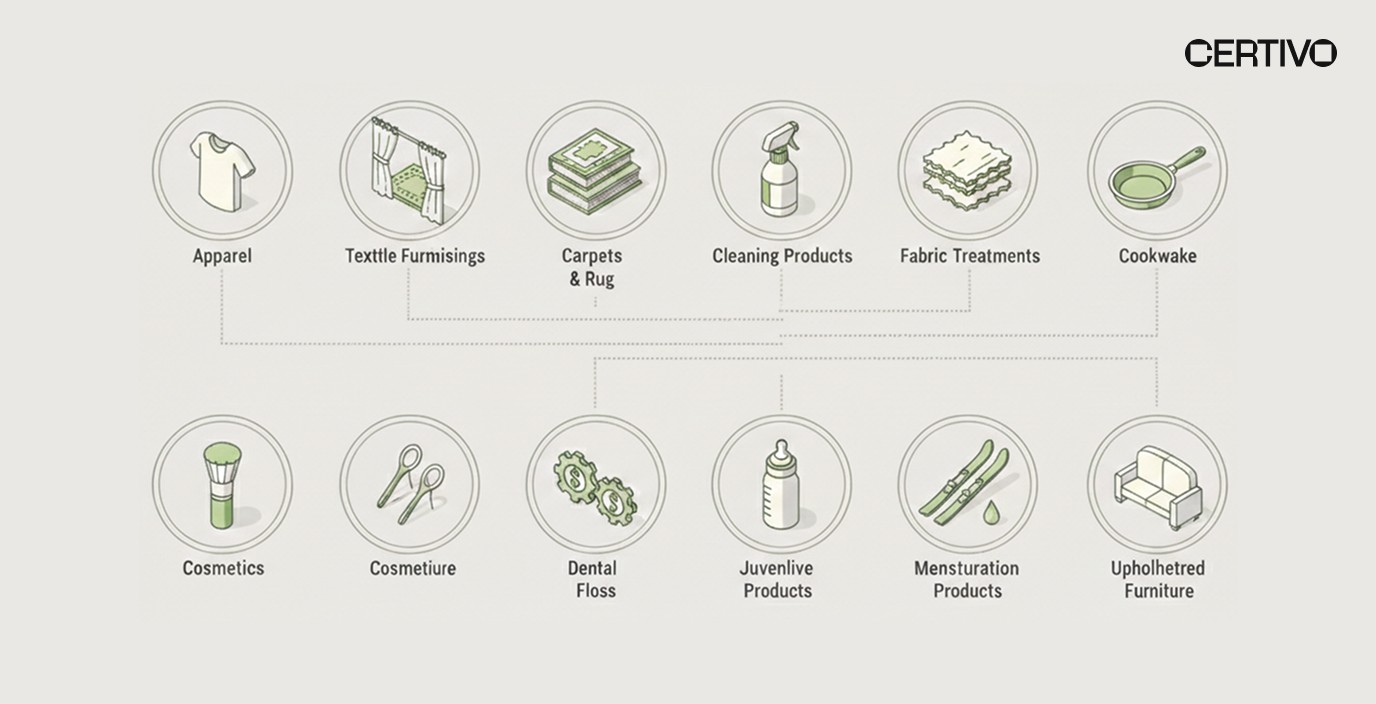
Connecticut DEEP PFAS regulations apply to 12 specific product categories where intentionally added PFAS face labelling requirements and eventual sales prohibition. Organizations must evaluate product portfolios against these categories to determine compliance obligations.
The 12 Covered Categories
Category | Examples | Compliance Status |
|---|---|---|
Apparel | Clothing, outerwear, sportswear | Labelling required July 2026 |
Textile Furnishings | Curtains, bedding, table linens | Labelling required July 2026 |
Carpets & Rugs | Floor coverings, area rugs | Labelling required July 2026 |
Cleaning Products | Household cleaners, stain removers | Labelling required July 2026 |
Fabric Treatments | Waterproofing sprays, stain guards | Labelling required July 2026 |
Cookware | Non-stick pans, bakeware | Labelling required July 2026 |
Cosmetics | Makeup, skincare, personal care | Labelling required July 2026 |
Dental Floss | Oral care products | Labelling required July 2026 |
Juvenile Products | Baby items, children's products | Labelling required July 2026 |
Menstruation Products | Feminine hygiene items | Labelling required July 2026 |
Ski Wax | Winter sports products | Labelling required July 2026 |
Upholstered Furniture | Sofas, chairs, cushioned items | Labelling required July 2026 |
Component Rule Implications
Connecticut PFAS labelling compliance extends beyond standalone products to components incorporated into larger items. If a covered product category item becomes a component of a larger product, the final assembled product must display required labelling. This rule creates supply chain documentation requirements that effective supplier collaboration must address.
Organizations manufacturing products containing components from covered categories must verify supplier PFAS content and ensure appropriate labelling on finished goods regardless of where component manufacturing occurs.
Approved Labelling Phrases and Technical Requirements
The December 1, 2025 administrative order from Connecticut DEEP finalizes specific labelling phrases manufacturers must use to achieve Connecticut PFAS labelling compliance. Understanding these technical requirements prevents rejection of non-conforming labels.
Five Approved Labelling Phrases
Manufacturers must use one of the following phrases on covered products:
"Contains PFAS"
"Made with PFAS"
"Made with PFAS chemicals"
"Made with intentionally added PFAS"
"This product contains PFAS chemicals"
Alternative Language Petition Process
Manufacturers seeking to use alternative words or symbols may petition DEEP by emailing DEEP.PFASInProduct@ct.gov. This provision enables brand-appropriate messaging while maintaining regulatory compliance. Organizations should submit petitions well in advance of the July 2026 deadline to allow processing time.
Technical Label Specifications
PFAS product labelling requirements include specific technical standards:
Visibility: Labels must be clearly visible to purchasers prior to sale. This requirement extends to physical packaging and online product listings, affecting both retail and e-commerce channels.
Durability: Label materials must remain legible for the useful life of the product. This specification prevents label degradation that could leave products non-compliant during their market presence.
Placement: Labels must enable consumer awareness before purchase decisions. For online sales, product listings must include required PFAS disclosure language.
Streamlined supplier documentation processes help organizations collect labelling compliance evidence across product portfolios and distribution channels.
Notification Obligations to Connecticut DEEP
Beyond labelling requirements, Connecticut PFAS labelling compliance includes mandatory written notification to DEEP containing specific technical information about PFAS-containing products.
Required Notification Content
PFAS notification requirements manufacturers must satisfy include:
Product Description: Detailed identification of the product subject to regulation
PFAS Function: Explanation of the purpose served by intentionally added PFAS
Chemical Identification: CAS numbers for all intentionally added PFAS substances
Alternative Identification: Where CAS numbers are unavailable, molecular formulas or molecular weights
Notification Submission Process
Manufacturers must submit written notifications to DEEP before placing covered products on Connecticut markets after July 1, 2026. Organizations should establish notification tracking systems ensuring all covered products receive appropriate documentation before the compliance deadline.
AI compliance software PFAS tracking capabilities enable systematic notification management across extensive product portfolios. Manual tracking becomes impractical for organizations with hundreds or thousands of SKUs requiring individual notification submissions.
Compliance and regulation managers should coordinate notification preparation activities to ensure complete submissions meeting DEEP requirements.
Exemptions and Special Provisions
The Connecticut PFAS framework includes specific exemptions that organizations may leverage where applicable. Understanding these provisions enables compliance strategies maximizing market access while meeting regulatory obligations.
Medical Product Exemptions
Products regulated by the FDA receive exemption from Connecticut PFAS labelling compliance requirements:
FDA-regulated drugs
Medical devices
Prosthetic devices
Organizations claiming this exemption must ensure products genuinely meet FDA regulatory classification. Claiming exemption for products not meeting definitions creates enforcement exposure exceeding compliance costs.
Used Goods Exemption
The sale or resale of previously used products falls outside Connecticut DEEP PFAS regulations scope. This provision enables secondary markets and consignment sales without labelling obligations for pre-owned items.
Severe Weather Gear Special Requirement
"Outdoor apparel for severe wet conditions" faces a separate disclosure requirement that began January 1, 2026, prior to the broader July 2026 deadline. Required labelling for this category specifies the phrase "Made with PFAS chemicals."
Organizations selling severe weather apparel should verify current compliance with this already-effective requirement. Staying audit-ready across frameworks ensures organizations track multiple compliance deadlines within the same regulatory framework.

Business and Supply Chain Implications
Connecticut PFAS labelling compliance creates business consequences extending beyond direct regulatory obligations. Organizations must understand these implications to secure executive support for compliance investments.
Market Access and Commercial Continuity
Products failing to meet labelling and notification requirements face market exclusion from Connecticut. For manufacturers with significant Connecticut revenue exposure, non-compliance threatens commercial continuity in a state representing substantial consumer purchasing power.
The July 2026 deadline provides limited time for organizations to complete product assessments, implement labelling changes, and submit notifications. Consumer goods PFAS restrictions US are expanding rapidly, making Connecticut compliance investments applicable to emerging requirements in other states.
Supply Chain Documentation Requirements
The component rule creates supply chain visibility requirements extending beyond internal manufacturing operations. Organizations must verify PFAS content in components sourced from suppliers and ensure appropriate labelling on finished goods incorporating covered category components.
Supply chain PFAS compliance automation becomes essential for organizations managing complex supplier networks. Procurement and supply chain leaders should evaluate supplier capabilities for providing PFAS content documentation and CAS number identification.
Inventory and Packaging Implications
Existing inventory and packaging materials may require modification to meet labelling requirements. Organizations should assess current inventory levels and packaging stock to determine transition timing that minimizes waste while ensuring compliant products reach Connecticut markets by July 2026.
Multi-State Compliance Complexity
Connecticut joins growing list of states implementing PFAS product restrictions. Organizations selling nationally face increasing compliance complexity as state PFAS regulations manufacturers must meet multiply across jurisdictions. Understanding PFAS compliance frameworks helps organizations develop scalable approaches addressing multi-jurisdictional requirements.
Strategic Preparation Checklist
Organizations should implement systematic preparation activities to achieve Connecticut PFAS labelling compliance before the July 2026 deadline. The following checklist provides framework for compliance program development.
Product Portfolio Assessment
Identify all products distributed in Connecticut markets
Screen products against 12 mandatory categories
Evaluate formulations for intentionally added PFAS
Document PFAS function and CAS numbers for each substance
Prioritize products by revenue exposure and reformulation complexity
Labelling Implementation
Select approved labelling phrase for each product line
Evaluate alternative language petition if brand requirements exist
Design label specifications meeting visibility and durability requirements
Update online product listings with required disclosure language
Establish label inventory ensuring adequate supply for production needs
Notification Preparation
Compile required information for each covered product
Verify CAS number accuracy for all intentionally added PFAS
Prepare written notification documents meeting DEEP specifications
Establish submission tracking system for confirmation documentation
Plan submission timeline allowing adequate processing time before deadline
Supplier Coordination
Survey suppliers regarding PFAS content in components
Collect CAS numbers and molecular formulas from supplier documentation
Verify component supplier compliance with labelling requirements
Establish ongoing monitoring for supplier PFAS content changes
Replacing spreadsheets with scalable systems enables systematic checklist management across extensive product portfolios and supplier networks.
How AI Transforms PFAS Compliance Management
Manual compliance approaches cannot scale to address the complexity of Connecticut PFAS labelling compliance across extensive product portfolios and multi-state regulatory frameworks. AI compliance software PFAS tracking capabilities fundamentally transform organizational capacity for regulatory monitoring, notification management, and documentation maintenance.
Intelligent Regulatory Monitoring
PFAS regulatory landscapes evolve continuously across state and federal jurisdictions. Automated regulatory monitoring chemicals capabilities track developments across relevant markets, alerting compliance teams to changes requiring response. Understanding why people-only compliance cannot scale helps executives appreciate strategic value of AI-powered monitoring.
Automated Product Screening
Product portfolios spanning thousands of items require systematic screening against category definitions and PFAS content requirements. AI platforms enable automated screening identifying products requiring labelling or notification within hours rather than weeks of manual review.
Supplier Data Collection
Supply chain PFAS compliance automation extends organizational visibility beyond internal operations to encompass supplier practices and component compositions. Certivo's platform incorporates CORA, an intelligent assistant that automates supplier follow-ups and data completion workflows, reducing administrative burden while improving data completeness for CAS number collection.
Notification and Documentation Management
Notification submissions require accurate, complete documentation for each covered product. AI platforms maintain audit-ready records that support notification requirements and enable rapid response to DEEP information requests. Global PFAS regulations compliance guidance provides frameworks applicable to Connecticut and other state requirements.
Multi-Jurisdictional Coordination
State PFAS regulations manufacturers face continue expanding across the United States. AI platforms enable coordinated compliance management across multiple state requirements, preventing fragmented approaches that increase costs and create compliance gaps. CEOs and founders should evaluate AI compliance investments against multi-state regulatory trends.
Conclusion: Strategic Imperatives for July 2026 Readiness
Connecticut Public Act 24-59 establishes comprehensive PFAS labelling and notification requirements affecting manufacturers across 12 product categories. The July 1, 2026 deadline creates immediate Connecticut PFAS labelling compliance obligations, with complete sales prohibition following on January 1, 2028.
The December 2025 administrative order finalizing approved labelling phrases and technical specifications provides clarity that manufacturers need to implement compliant labelling programs. Five approved phrases offer flexibility while ensuring consumer awareness of PFAS presence in covered products.
Organizations maintaining Connecticut PFAS labelling compliance must address product assessment, labelling implementation, notification preparation, and supplier coordination across potentially extensive product portfolios. The component rule extends compliance obligations throughout supply chains, requiring visibility into PFAS content in sourced components.
The business consequences of non-compliance extend beyond regulatory penalties to include Connecticut market exclusion and supply chain disruption. As consumer goods PFAS restrictions US continue expanding across states, Connecticut compliance investments position organizations for emerging requirements in other jurisdictions.
Executive leadership must recognize that state PFAS regulations manufacturers face represent ongoing operational reality rather than one-time project. Building robust PFAS compliance infrastructure today positions organizations to address not only Connecticut requirements but continuing evolution of state and federal PFAS restrictions.
The complexity of managing compliance across multiple product categories, labelling specifications, notification requirements, and supplier documentation exceeds what manual processes can reliably manage. AI compliance software PFAS tracking capabilities provide systematic approaches ensuring Connecticut market access while reducing operational burden.
Explore how AI-driven compliance platforms can help your organization achieve Connecticut PFAS labelling compliance readiness and develop scalable strategies for emerging state PFAS regulations across the United States.
Lavanya
Lavanya is an accomplished Product Compliance Engineer with over four years of expertise in global environmental and regulatory frameworks, including REACH, RoHS, Proposition 65, POPs, TSCA, PFAS, CMRT, FMD, and IMDS. A graduate in Chemical Engineering from the KLE Institute, she combines strong technical knowledge with practical compliance management skills across diverse and complex product portfolios.
She has extensive experience in product compliance engineering, ensuring that materials, components, and finished goods consistently meet evolving international regulatory requirements. Her expertise spans BOM analysis, material risk assessments, supplier declaration management, and test report validation to guarantee conformity. Lavanya also plays a key role in design-for-compliance initiatives, guiding engineering teams on regulatory considerations early in the product lifecycle to reduce risks and streamline market access.
Her contributions further extend to compliance documentation, certification readiness, and preparation of customer deliverables, ensuring transparency and accuracy for global stakeholders. She is adept at leveraging compliance tools and databases to efficiently track regulatory changes and implement proactive risk mitigation strategies.
Recognized for her attention to detail, regulatory foresight, and collaborative approach, Lavanya contributes significantly to maintaining product compliance, safeguarding brand integrity, and advancing sustainability goals within dynamic, globally integrated manufacturing environments.