

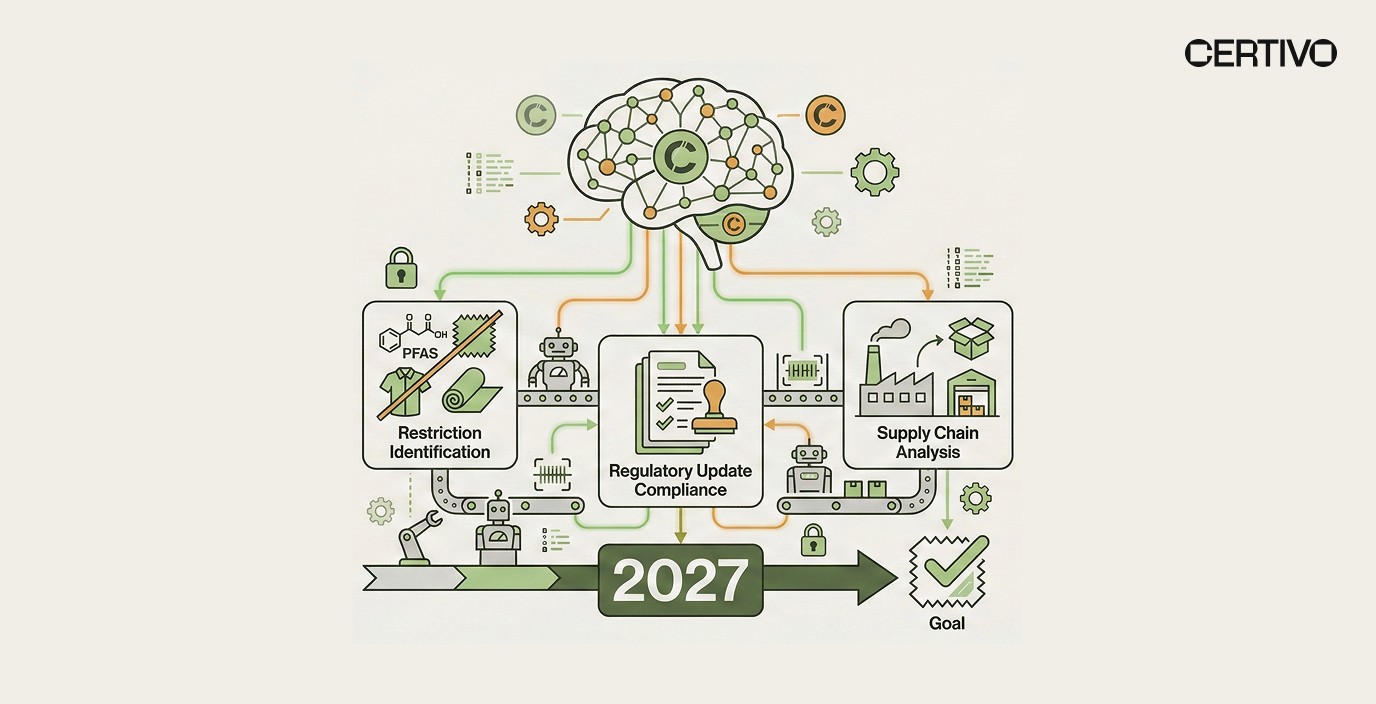
California is tightening the regulatory noose on PFAS in textiles — and the next compliance cliff is closer than most manufacturers realize. Under AB 1817, the Safer Clothes and Textiles Act, the state has already banned the manufacture, distribution, or sale of any new textile articles containing regulated PFAS above 100 ppm (measured as Total Organic Fluorine). That first threshold took effect on January 1, 2025. But the California AB 1817 PFAS textile ban doesn't stop there.
Effective January 1, 2027, the allowable PFAS limit drops to 50 ppm TOF — cutting the permissible concentration in half. By January 1, 2028, even the temporary exemption for outdoor apparel designed for severe wet conditions will expire, bringing those products under the same 50 ppm ceiling. Manufacturers are also legally required to use the "least toxic alternative" when reformulating and must provide a Certificate of Compliance to all retail partners.
For compliance directors, product development teams, and executive leadership at global textile and consumer goods companies, this is a regulation that demands immediate operational planning — not a wait-and-see approach. This guide covers every material obligation under AB 1817, including who is affected, what must change, and how to prepare before the 2027 step-down takes effect.
Table of Contents
What Is AB 1817 and Why It Matters Now
What Changed: The Phased PFAS Threshold Step-Down
Regulated Thresholds and Scope
Key Compliance Obligations and Certificate Requirements
Industries and Products Affected
Compliance Risks and Enforcement
Operational and Supply Chain Impact
Compliance Readiness Checklist
The Role of AI in PFAS Textile Compliance
FAQs
Executive Conclusion
1. What Is AB 1817 and Why It Matters Now
AB 1817, the Safer Clothes and Textiles Act, amends the California Health and Safety Code (Section 108970) to prohibit the manufacture, distribution, or sale of any new textile articles containing "regulated PFAS" in the state of California. It is one of the most aggressive state-level PFAS regulatory actions in the United States.
The law targets PFAS — per- and polyfluoroalkyl substances — commonly used in textiles for water resistance, stain repellency, and durability. While these chemical treatments improve product performance, PFAS are persistent environmental contaminants linked to serious health concerns. California's approach is not to regulate disclosure alone but to ban the substances outright, with increasingly strict concentration thresholds over a defined timeline.
⚠ Why this matters now: The initial 100 ppm threshold is already in effect. But the 2027 step-down to 50 ppm represents a materially different compliance challenge. Products that currently pass at 100 ppm may fail at 50 ppm — requiring reformulation, supplier changes, and new testing protocols. Organizations tracking the broader PFAS landscape should also review the global PFAS regulations master guide for manufacturers for cross-jurisdictional context.
The law applies to any entity in the textile supply chain — from manufacturers to distributors to retailers — that sells covered products in California. Given California's market size and its history of setting regulatory precedents that other states follow, AB 1817 effectively functions as a national compliance standard for any brand with California market exposure.
2. What Changed: The Phased PFAS Threshold Step-Down
AB 1817 was signed into law in 2022 and structured as a phased implementation. The regulation did not impose a single-date ban but instead created a declining threshold schedule that progressively tightens over time. Understanding this phased structure is essential for managing compliance risk proactively rather than reacting to each deadline individually.
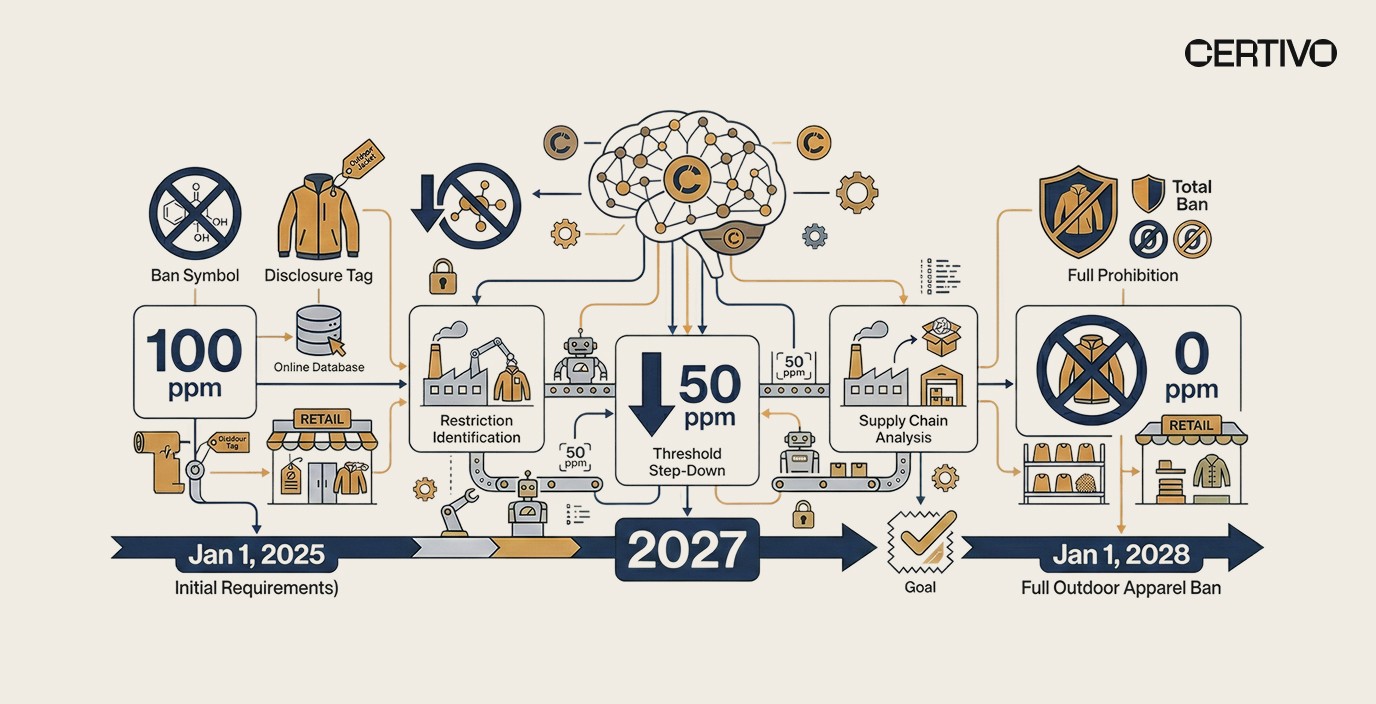
Phase 1 — January 1, 2025:
Ban on manufacture, distribution, or sale of textile articles with PFAS above 100 ppm TOF (Total Organic Fluorine)
Mandatory disclosure labeling — "Made with PFAS chemicals" — required for outdoor apparel designed for severe wet conditions (temporarily exempt from the ban itself)
Phase 2 — January 1, 2027:
The TOF threshold drops to 50 ppm for all general textile articles
Products that passed compliance at 100 ppm must now meet the stricter 50 ppm standard
Phase 3 — January 1, 2028:
The temporary exemption for outdoor apparel for severe wet conditions expires
Complete ban on PFAS in outdoor apparel — same 50 ppm TOF ceiling applies
📌 Critical operational note: The step-down from 100 ppm to 50 ppm is not merely a numerical adjustment. It fundamentally changes the testing sensitivity required, the range of PFAS-containing treatments that must be eliminated, and the depth of supply chain transparency needed to verify compliance across all product inputs.
3. Regulated Thresholds and Scope
The measurement standard under AB 1817 is Total Organic Fluorine (TOF) — a broad analytical method that captures the cumulative presence of all organofluorine compounds, not just individually named PFAS substances. This makes the regulation more comprehensive and harder to circumvent through chemical substitution of one PFAS for another.
Date Effective | TOF Threshold | Scope |
|---|---|---|
January 1, 2025 | 100 ppm | General textile articles |
January 1, 2027 | 50 ppm | General textile articles (revised) |
January 1, 2028 | 50 ppm | Outdoor apparel for severe wet conditions |
The term "textile articles" under AB 1817 is defined broadly. It includes any product made in whole or in part of textile fibers, yarns, or fabrics intended for consumer use. This encompasses clothing, home textiles, accessories, upholstery, and more. The scope extends far beyond traditional apparel — a point many consumer goods and retail compliance teams initially underestimate.
⚠ The TOF measurement approach matters. Unlike substance-specific thresholds (which test for individual PFAS chemicals), TOF captures total fluorine content from all organic sources. This means even trace-level PFAS from multiple treatment stages can aggregate to push a product over the threshold. BOM-level material mapping is essential for identifying every potential fluorine source across components.
4. Key Compliance Obligations and Certificate Requirements
AB 1817 imposes several distinct obligations on manufacturers, distributors, and retailers. Meeting these requirements demands more than reformulating products — it requires structured documentation, supplier engagement, and ongoing verification.
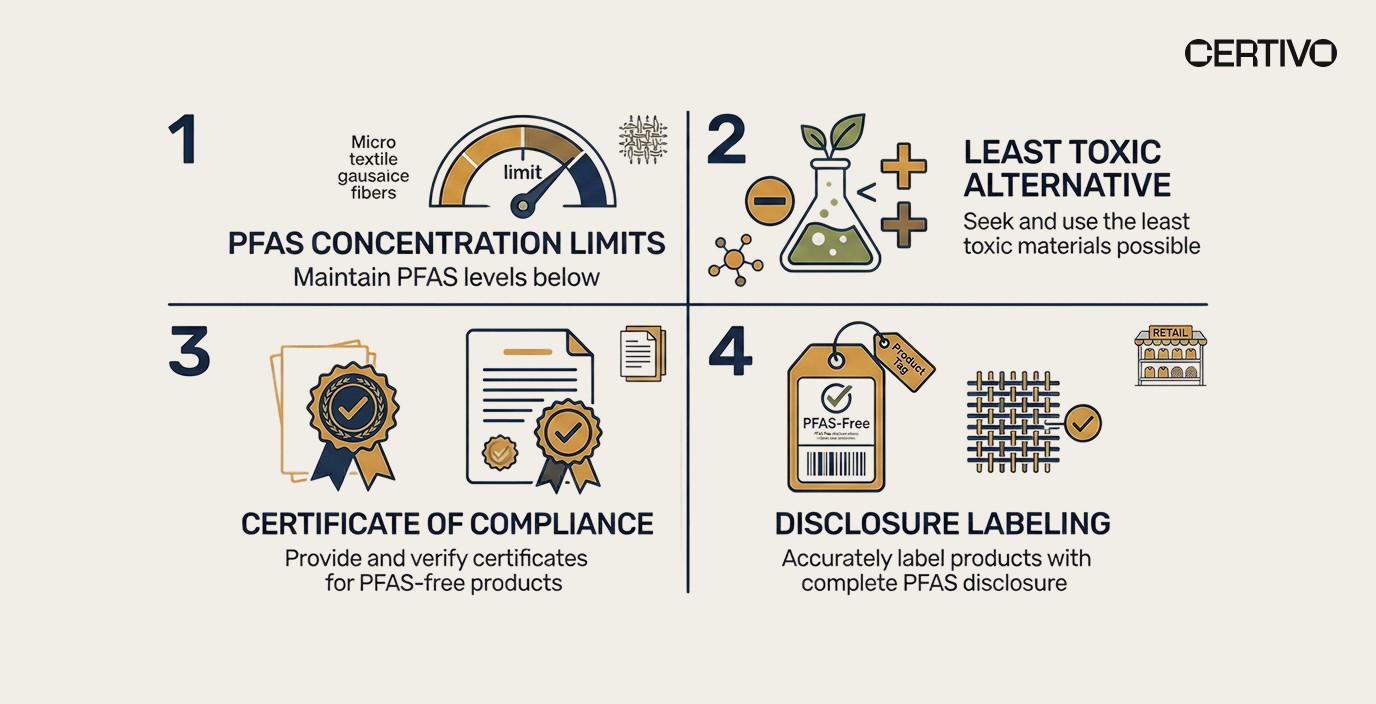
Obligation 1: PFAS Concentration Limits
All new textile articles manufactured, distributed, or sold in California must contain PFAS below the applicable TOF threshold (currently 100 ppm; dropping to 50 ppm in 2027). There is no grandfathering — products on shelves must comply by the effective date. Expanding into the California market requires verified compliance before distribution.
Obligation 2: Least Toxic Alternative Requirement
When reformulating products to eliminate PFAS, manufacturers are legally required to use the "least toxic alternative" available. This is not merely a recommendation — it is a statutory mandate. Organizations cannot simply replace one harmful chemistry with another. Design-for-compliance workflows must be integrated into product development to evaluate alternative chemistries against toxicity criteria.
Obligation 3: Certificate of Compliance
Manufacturers must provide a Certificate of Compliance to all downstream retail partners confirming that products meet AB 1817 requirements. This certificate serves as the legal transfer of compliance accountability through the supply chain. Maintaining continuous audit-ready documentation is essential for generating these certificates at scale.
Obligation 4: Disclosure Labeling (Outdoor Apparel)
Until January 1, 2028, outdoor apparel designed for severe wet conditions is exempt from the ban but must carry a mandatory disclosure label stating "Made with PFAS chemicals." After 2028, the exemption expires and these products must also comply with the 50 ppm limit. Brands should review how PFAS restrictions are tightening across regions and product categories to coordinate labeling and reformulation timelines.
5. Industries and Products Affected
AB 1817 covers a broad range of textile-based products and affects multiple industry segments. Any entity that manufactures, distributes, or sells covered textile articles in California is within scope — regardless of where the products are manufactured.
Industry Segment | Products in Scope | Impact Level |
|---|---|---|
Apparel & Fashion | Clothing, diapers, athletic wear, sports uniforms | ⚠ High — direct reformulation required |
Home Goods | Bedding, towels, draperies, tablecloths, napkins | ⚠ High — PFAS treatments common in stain resistance |
Accessories | Handbags, backpacks, footwear | ⚠ Moderate-High — water-resistant treatments affected |
Furniture | Upholstery, indoor furnishings | ⚠ Moderate — stain-guard and water-repellent finishes |
Retail & Distribution | Any entity selling covered goods in California | ⚠ High — must obtain Certificates of Compliance |
For apparel and fashion brands, PFAS has been widely used in performance textiles, outerwear, and athletic wear for water and stain resistance. The 50 ppm threshold will require reformulation of many product lines. Companies managing multiple product categories should evaluate what tools support end-to-end product compliance from design through shipment.
For home goods manufacturers, PFAS-based stain-resistant and water-repellent treatments are common in bedding, tablecloths, and upholstery fabrics. The global PFAS reckoning and substitution requirements provide additional context on replacement chemistries and testing approaches.
For retailers and distributors, compliance liability does not rest solely with the manufacturer. Retailers selling non-compliant products in California face direct enforcement risk. Streamlining supplier documentation and requiring upstream Certificates of Compliance is essential for protecting downstream retail operations.
6. Compliance Risks and Enforcement
While AB 1817 does not specify a standalone penalty schedule in the same way as some federal regulations, non-compliance exposes organizations to enforcement under existing California consumer protection and environmental statutes. The California Department of Toxic Substances Control (DTSC) oversees implementation.
Key risk areas include:
⚠ Market access denial — Non-compliant products cannot be legally sold in California after effective dates
⚠ Retailer liability — Retailers selling non-compliant goods are directly liable, incentivizing aggressive upstream compliance requirements
⚠ Consumer litigation — California's active plaintiffs' bar and consumer protection framework create significant exposure for brands marketing products as "PFAS-free" without adequate testing
⚠ Brand and reputational damage — PFAS is a high-visibility consumer and media issue; non-compliance carries outsized reputational risk
Organizations relying on manual compliance tracking should understand why people-only compliance approaches cannot scale when facing state-by-state chemical regulations with different thresholds and timelines.
Additionally, companies selling in multiple U.S. states should monitor parallel PFAS textile restrictions emerging in Washington State, Connecticut, and New Jersey — each with distinct thresholds, timelines, and product scope.
7. Operational and Supply Chain Impact
The 50 ppm step-down creates several operational challenges that go well beyond simple product testing. Organizations need to centralize compliance from silos into a single source of truth to manage these demands efficiently.
Reformulation and R&D:
Products currently between 50–100 ppm TOF will need reformulation before January 2027
Replacement chemistries must satisfy the "least toxic alternative" statutory requirement
R&D timelines for textile chemical reformulation typically run 12–18 months — making immediate action necessary
Supplier Engagement:
Upstream chemical suppliers and textile mills must be engaged to verify PFAS-free status of treatments, dyes, and finishes
Supplier self-service compliance portals enable structured data collection from Tier 1 and Tier 2 suppliers
Material declarations must cover all textile inputs, not just final garment-level testing
Testing and Verification:
TOF testing requires specialized analytical methods — not all existing PFAS test protocols are sufficient
Testing must be conducted at the 50 ppm sensitivity level to ensure products fall below the 2027 threshold
Standardized supplier questionnaire frameworks help ensure consistent data quality across the supply base
Certificate of Compliance Generation:
Certificates must be generated for every product line and provided to all retail partners
As product portfolios change and new materials are introduced, certificates require continuous updating
Replacing spreadsheets with scalable compliance systems becomes critical for managing certificate workflows at volume
8. Compliance Readiness Checklist
📌 Use this checklist to assess preparedness for the AB 1817 2027 threshold step-down:
# | Action Item | Status |
|---|---|---|
✓ | Inventory all textile products sold in California and identify PFAS-treated items | ☐ |
✓ | Test current product portfolio against the 50 ppm TOF threshold (not just 100 ppm) | ☐ |
✓ | Identify products in the 50–100 ppm range requiring reformulation | ☐ |
✓ | Engage chemical suppliers to source PFAS-free alternative treatments | ☐ |
✓ | Verify replacement chemistries against the "least toxic alternative" requirement | ☐ |
✓ | Issue structured supplier data requests for PFAS status of all textile inputs | ☐ |
✓ | Generate Certificates of Compliance for all compliant product lines | ☐ |
✓ | Distribute Certificates of Compliance to all California retail partners | ☐ |
✓ | Ensure outdoor apparel carries mandatory "Made with PFAS chemicals" disclosure (until 2028 ban) | ☐ |
✓ | Monitor parallel state-level PFAS textile bans (WA, CT, NJ, MN) for multi-state compliance | ☐ |
For VP-level operations leaders managing cross-functional compliance programs, items 2–5 require coordination between R&D, procurement, and compliance teams. Quality directors should own items 6–8 related to supplier verification and certificate workflows.
9. The Role of AI in PFAS Textile Compliance
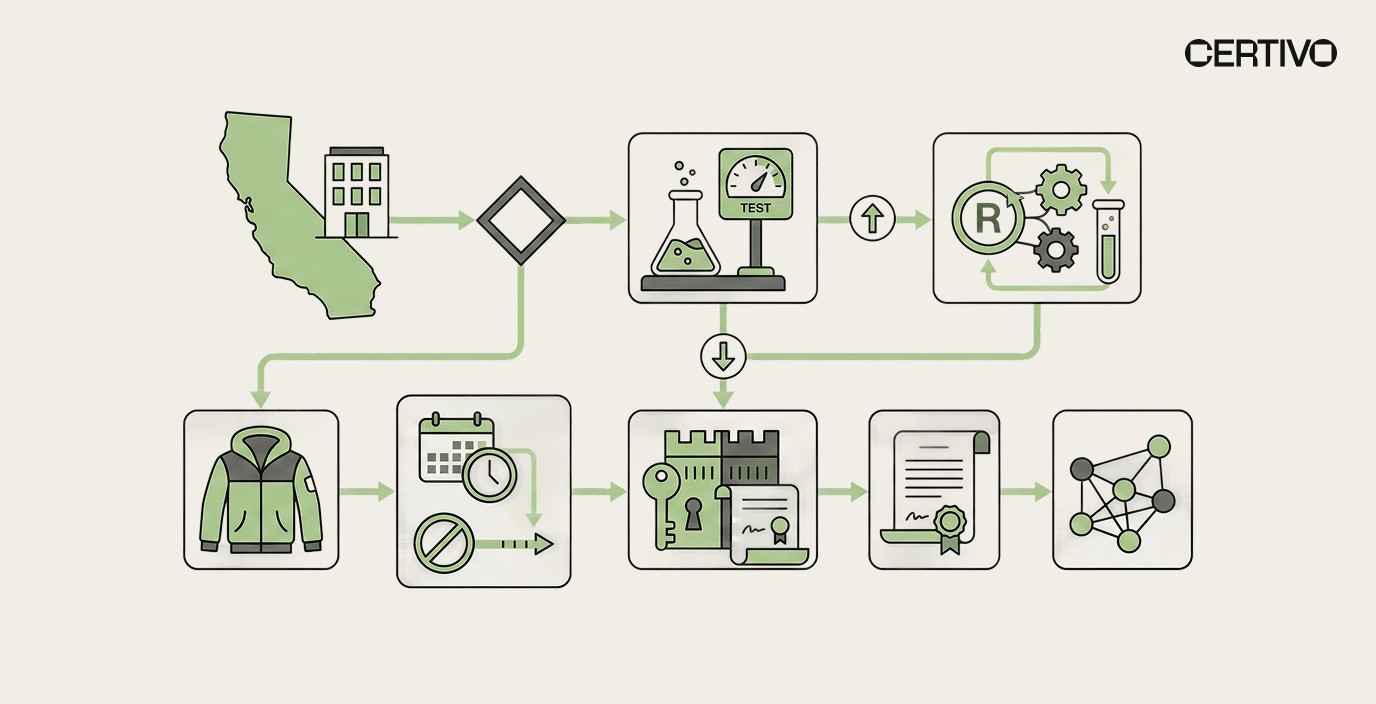
Managing AB 1817 compliance across large product portfolios, multi-tier supply chains, and multiple state-level PFAS regulations introduces complexity that exceeds manual tracking capabilities. For a practical look at how AI transforms daily compliance operations, see a compliance engineer's week with and without AI.
The specific demands of AB 1817 that benefit from AI-native compliance infrastructure include:
✓ BOM-level compliance intelligence — Scanning product bills of materials to identify every textile input where PFAS treatments may be present, down to fabric coatings, dye auxiliaries, and finishing agents
✓ Regulatory horizon scanning — Monitoring the California legislative calendar and parallel state PFAS regulations to provide advance notice of threshold changes and new product-category expansions
✓ Supplier risk scoring — Evaluating supplier PFAS-free status based on historical declarations, test data, and material composition records to prioritize high-risk supply chain nodes
✓ Certificate of Compliance automation — Generating, distributing, and tracking Certificates of Compliance across retail partner networks at scale
✓ Multi-jurisdictional compliance mapping — Harmonizing AB 1817 obligations with EU PFAS restrictions, France PFAS rules, and other state-level bans into a unified compliance view
For organizations evaluating compliance technology options, AI tools for compliance management: the complete guide provides a comprehensive framework. IT and systems leaders should lead platform evaluation alongside compliance teams.
The ability to respond faster to customer compliance RFQs — particularly from major retailers requiring PFAS-free certifications — becomes a competitive advantage, not just a compliance function.
10. Frequently Asked Questions (FAQs)
Q1: What is the PFAS threshold under AB 1817 starting January 1, 2027?
The allowable PFAS concentration in general textile articles drops from 100 ppm to 50 ppm Total Organic Fluorine (TOF) effective January 1, 2027. All products manufactured, distributed, or sold in California must meet this stricter limit. For a comprehensive view of PFAS thresholds globally, see the PFAS framework overview.
Q2: Does AB 1817 apply to companies manufacturing outside California?
Yes. The law applies to any entity that sells covered textile articles in California, regardless of where the products are manufactured. A manufacturer based in China, Vietnam, or any other country must ensure products sold into the California market comply. Procurement and supply chain leaders must communicate these requirements to all international suppliers.
Q3: What is the Certificate of Compliance requirement?
Manufacturers must provide a Certificate of Compliance to all downstream retail partners confirming that products meet AB 1817's PFAS limits and that any reformulation uses the "least toxic alternative." This is a continuous documentation requirement, not a one-time filing.
Q4: Are outdoor apparel products exempt?
Temporarily. Outdoor apparel designed for severe wet conditions is currently exempt from the ban but must carry a mandatory disclosure label stating "Made with PFAS chemicals." This exemption expires January 1, 2028, after which these products must also comply with the 50 ppm TOF limit. Planning for the 2028 deadline should begin now — see the PFAS compliance countdown for broader timeline context.
Q5: What does the "least toxic alternative" requirement mean in practice?
When reformulating products to eliminate PFAS, manufacturers must select the replacement chemistry that presents the lowest toxicity risk among available alternatives. This is a statutory mandate — not a recommendation. Organizations must document their alternative assessment process. Cost savings through proactive compliance with AI can help justify the R&D investment required for compliant reformulation.
11. Executive Conclusion
California's AB 1817 PFAS textile ban is not a future concern — it is a current legal reality with a rapidly approaching escalation. The 100 ppm threshold is already in effect. The 50 ppm step-down arrives on January 1, 2027 — giving manufacturers approximately 18 months from today to reformulate products, re-verify their supply chains, secure PFAS-free alternative treatments, and generate Certificates of Compliance for every product line sold into California.
The operational demands are significant: multi-tier supply chain transparency, TOF-level testing at 50 ppm sensitivity, least toxic alternative documentation, and ongoing certificate management across retail partners. And with parallel PFAS textile restrictions advancing in Washington, Connecticut, New Jersey, and at the federal level, the California AB 1817 PFAS textile ban is best understood as the leading edge of a national compliance standard.
The official legislative text is available on California Legislative Information: AB-1817. The DTSC factsheet is available at DTSC PFAS in Textiles Factsheet.
Organizations managing complex textile product portfolios, global supply chains, and multi-state PFAS obligations need compliance infrastructure that scales with regulatory complexity. Explore how AI-driven compliance platforms like Certivo support continuous regulatory readiness →
Lavanya
Lavanya is an accomplished Product Compliance Engineer with over four years of expertise in global environmental and regulatory frameworks, including REACH, RoHS, Proposition 65, POPs, TSCA, PFAS, CMRT, FMD, and IMDS. A graduate in Chemical Engineering from the KLE Institute, she combines strong technical knowledge with practical compliance management skills across diverse and complex product portfolios.
She has extensive experience in product compliance engineering, ensuring that materials, components, and finished goods consistently meet evolving international regulatory requirements. Her expertise spans BOM analysis, material risk assessments, supplier declaration management, and test report validation to guarantee conformity. Lavanya also plays a key role in design-for-compliance initiatives, guiding engineering teams on regulatory considerations early in the product lifecycle to reduce risks and streamline market access.
Her contributions further extend to compliance documentation, certification readiness, and preparation of customer deliverables, ensuring transparency and accuracy for global stakeholders. She is adept at leveraging compliance tools and databases to efficiently track regulatory changes and implement proactive risk mitigation strategies.
Recognized for her attention to detail, regulatory foresight, and collaborative approach, Lavanya contributes significantly to maintaining product compliance, safeguarding brand integrity, and advancing sustainability goals within dynamic, globally integrated manufacturing environments.