

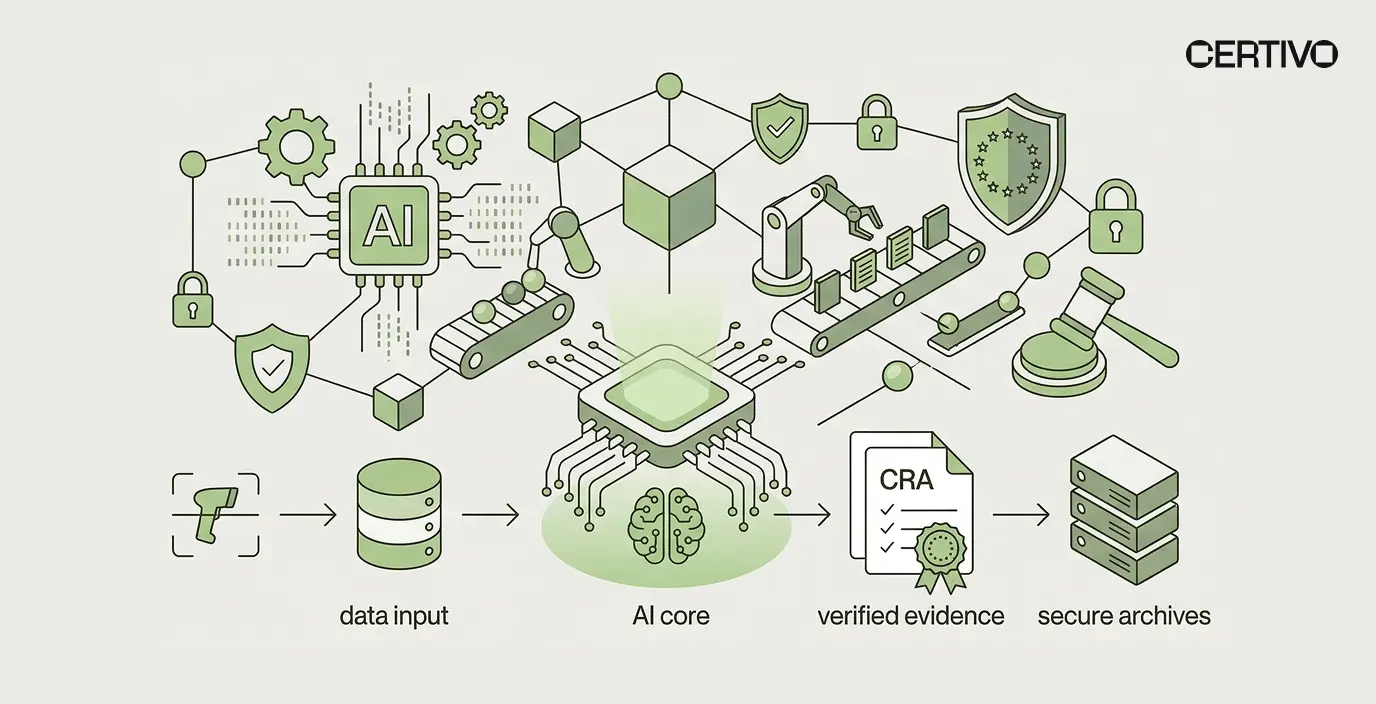
The EU Cyber Resilience Act (CRA) requires manufacturers to verify that digital products meet cybersecurity standards throughout their lifecycle. This obligation extends beyond internal design processes into supply chain verification, component traceability, and supplier evidence management.
For manufacturers sourcing semiconductors, embedded software, connectivity modules, and firmware from global suppliers, the CRA creates unprecedented documentation requirements. Compliance teams must collect Software Bill of Materials (SBOM) data, vulnerability assessments, security certifications, and conformity documentation from every supplier contributing digital elements to final products.
Manual supplier evidence collection processes cannot scale to meet CRA requirements. Spreadsheets, email chains, and decentralized systems create compliance gaps that expose manufacturers to enforcement risk before the 2027 deadline. Automated supplier data collection is no longer optional—it is a prerequisite for CRA compliance.
Table of Contents
Why CRA Compliance Depends on Supplier Evidence Quality
The Supplier Documentation Challenge Under EU CRA
What Evidence Manufacturers Must Collect from Suppliers
Industries and Product Categories Most Affected
Manual Supplier Data Collection Fails Under CRA
Compliance Risks and Enforcement Exposure
Multi-Tier Supply Chain Transparency Requirements
CRA Enforcement Timeline and Preparation Window
How Certivo Automates Supplier Evidence Collection for CRA
Building Continuous Audit-Ready Documentation
Strategic Compliance Preparation Checklist
Frequently Asked Questions
Conclusion
Why CRA Compliance Depends on Supplier Evidence Quality
The EU Cyber Resilience Act establishes manufacturer responsibility for cybersecurity across the entire product supply chain. Unlike traditional product safety regulations that focus on finished goods, CRA compliance requires visibility into every digital component, software library, firmware version, and connectivity module sourced from suppliers.
Manufacturers must demonstrate due diligence in supplier selection, maintain current security documentation for all digital inputs, and prove continuous monitoring of vulnerabilities affecting third-party components. This creates three interconnected compliance requirements:
✓ Verification of supplier cybersecurity practices before component procurement
✓ Collection and validation of security documentation for all digital elements
✓ Ongoing monitoring of supplier-provided components for newly disclosed vulnerabilities
Supplier risk scoring and due diligence processes must be embedded into procurement workflows, not treated as periodic audits. Traditional approaches that rely on supplier self-attestation without verification create enforcement risk that compounds as products move through distribution channels.
The evidence quality gap becomes critical during market surveillance enforcement. Regulators expect manufacturers to produce supplier documentation within 72 hours of formal requests. Centralized compliance data backbone systems enable this response capability by maintaining current, validated supplier evidence linked to specific product SKUs and component BOMs.
Book a free compliance assessment to understand your current CRA supplier evidence gaps across product lines and component categories.
The Supplier Documentation Challenge Under EU CRA
CRA implementation exposes structural weaknesses in traditional supplier management approaches. Most manufacturers maintain supplier documentation in fragmented systems: procurement databases, quality management platforms, email folders, and shared drives. This fragmentation prevents efficient evidence collection and creates compliance blind spots.
The documentation burden increases exponentially with product complexity. A connected industrial device may contain 200+ digital components sourced from 50+ suppliers across multiple tiers. Each component requires security documentation that includes:
📊 Software composition analysis showing all libraries and dependencies
📊 Vulnerability scanning results from the past 90 days
📊 Security certification status (IEC 62443, ISO 27001, Common Criteria)
📊 Incident response protocols and security contact information
📊 Conformity declarations specific to CRA requirements
Traditional supplier management systems lack the BOM-level compliance intelligence needed to map this evidence to final product configurations. Without component-level linkage, manufacturers cannot determine which products are affected when suppliers disclose new vulnerabilities or update security documentation.
The temporal dimension adds additional complexity. CRA requires evidence currency—documentation cannot be older than specific timeframes depending on component risk classification. Continuous compliance monitoring must replace periodic supplier audits to maintain evidence validity across product portfolios.
What Evidence Manufacturers Must Collect from Suppliers
The European Commission's implementing acts establish specific documentation requirements for products with digital elements. Manufacturers must collect and maintain supplier evidence packages that support conformity assessment and market surveillance responses.
Core Documentation Requirements by Component Category
Embedded Software and Firmware
⚠ Software Bill of Materials (SBOM) in CycloneDX or SPDX format
⚠ Source code security analysis results or equivalent attestation
⚠ Known vulnerability disclosures with remediation status
⚠ Update and patching mechanisms documentation
⚠ End-of-support timelines for security maintenance
Hardware Components with Digital Interfaces
⚠ Security architecture documentation for connectivity modules
⚠ Cryptographic implementation details and key management protocols
⚠ Secure boot and attestation capabilities technical specifications
⚠ Side-channel attack resistance testing results where applicable
⚠ Physical tampering protection mechanisms documentation
Cloud Services and External Dependencies
⚠ Data processing agreements aligned with CRA security requirements
⚠ Infrastructure security certifications (SOC 2, ISO 27001)
⚠ Incident response procedures and notification timelines
⚠ Data residency and sovereignty documentation
⚠ Third-party dependency mapping for nested service providers
Automated supplier data collection platforms eliminate manual evidence requests by providing suppliers with structured portals that map directly to CRA documentation requirements. This standardization reduces supplier confusion and improves evidence completeness.
Industries and Product Categories Most Affected
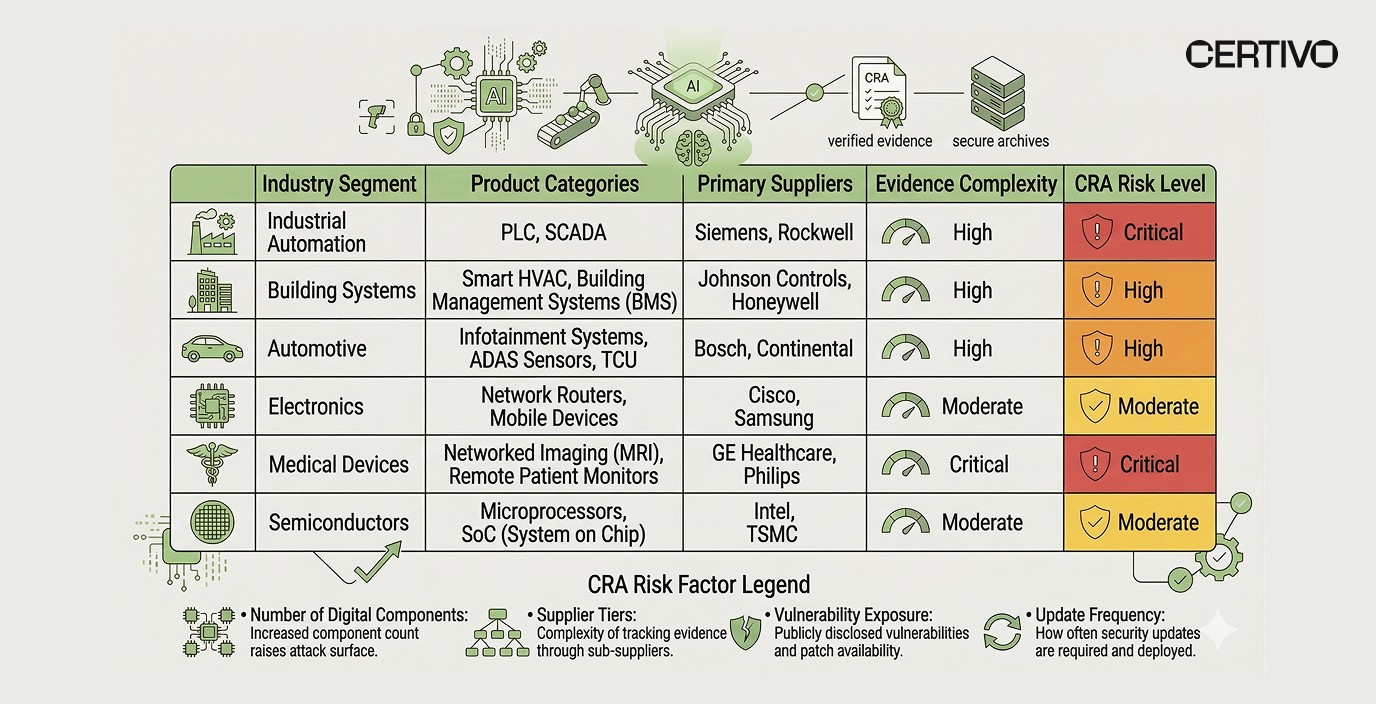
CRA applies to all products with digital elements placed on the EU market, but enforcement priorities focus on categories with elevated cybersecurity risk. Understanding industry-specific exposure helps manufacturers prioritize supplier evidence collection efforts.
High-Impact Industry Segments
Industrial Automation and Manufacturing Equipment
Connected machinery, programmable logic controllers (PLCs), industrial IoT sensors, and SCADA systems face stringent CRA requirements. Industrial machinery compliance teams must collect evidence from automation vendors, control system manufacturers, and sensor suppliers across multiple product lines.
Building Systems and Smart Infrastructure
HVAC controls, access management systems, building automation platforms, and energy management controllers require comprehensive supplier documentation. Building materials and construction manufacturers must verify cybersecurity practices for embedded control systems and connectivity modules.
Automotive and Transportation
Electronic control units (ECUs), telematics systems, infotainment platforms, and advanced driver assistance systems (ADAS) contain hundreds of software components. Automotive manufacturing supply chains must implement supplier evidence collection at unprecedented scale due to component diversity and safety-critical nature of products.
Electronics and Consumer Devices
Smartphones, tablets, smart home devices, wearables, and consumer IoT products face immediate CRA scrutiny. Electronics manufacturing compliance teams must manage supplier evidence for firmware, operating systems, applications, and cloud service integrations.
Medical Devices with Network Connectivity
Connected diagnostic equipment, patient monitoring systems, and implantable devices with data transmission capabilities require medical device-specific cybersecurity evidence. Medical devices and equipment manufacturers must align supplier documentation with both CRA and medical device regulation (MDR) requirements.
Semiconductor and high-tech manufacturers face unique challenges as both suppliers and product manufacturers, requiring bidirectional evidence exchange across the semiconductor value chain.
Manual Supplier Data Collection Fails Under CRA
Traditional supplier management approaches create systemic compliance gaps that become enforcement liabilities under CRA. Email-based evidence requests, spreadsheet tracking, and periodic supplier questionnaires cannot maintain the evidence currency and completeness required by the regulation.
Critical Failure Points in Manual Processes
Evidence Request Latency
Manual processes introduce delays of 30-90 days between initial evidence requests and supplier response. This latency prevents manufacturers from identifying compliance gaps during product development, when design changes remain cost-effective. Launch new products faster by eliminating evidence collection bottlenecks through automated supplier portals.
Documentation Validation Burden
Compliance teams receive unstructured evidence packages in varied formats that require manual review, interpretation, and validation. A single product line may generate 500+ supplier evidence documents annually, each requiring verification against CRA technical requirements. AI document parsing and certificate validation reduces this burden while improving validation accuracy.
Version Control and Currency Tracking
Suppliers update security documentation as vulnerabilities are patched, certifications are renewed, and products are revised. Manual tracking systems cannot maintain evidence currency across hundreds of supplier relationships. Continuous audit-ready documentation requires automated evidence refresh mechanisms.
Component-to-Evidence Linkage Gaps
Spreadsheet-based systems cannot map supplier evidence to specific product BOMs, making it impossible to determine which products are affected when supplier documentation changes. BOM-level material mapping establishes the traceability required for CRA conformity assessment.
Multi-Language Documentation Complexity
Global supply chains generate evidence in multiple languages, creating interpretation challenges and validation delays. Multi-jurisdiction EHS and ESG management platforms with AI translation capabilities reduce this friction.
Compliance Risks and Enforcement Exposure
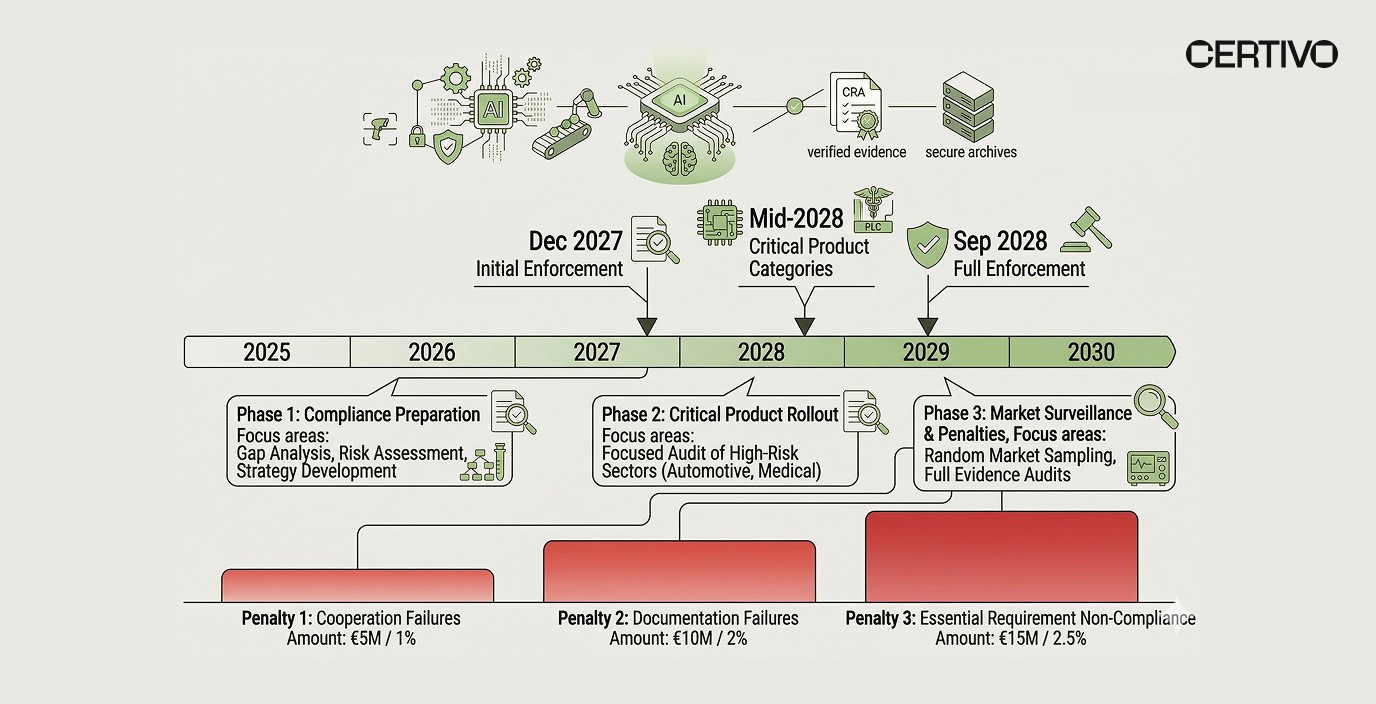
CRA establishes significant financial penalties for non-compliance, with enforcement mechanisms modeled on GDPR-style tiered sanctions. Manufacturers face two categories of enforcement risk: conformity assessment failures and market surveillance violations.
Financial Penalty Structure
Essential Cybersecurity Requirements Violations
Non-compliance with essential security requirements can result in fines up to €15 million or 2.5% of global annual turnover, whichever is higher. Essential requirements include secure development practices, vulnerability handling, security updates, and conformity documentation.
Conformity Assessment and Documentation Failures
Inadequate or missing supplier evidence during conformity assessment proceedings can trigger fines up to €10 million or 2% of global annual turnover. These penalties apply when manufacturers cannot demonstrate due diligence in supplier verification and evidence collection.
Enforcement Triggers
Market surveillance authorities may initiate enforcement proceedings when:
📌 Consumer complaints about product security incidents
📌 Vulnerability disclosures affecting products already on the market
📌 Routine market surveillance testing reveals non-compliance
📌 Supplier security breaches that affect downstream products
📌 Cross-border intelligence sharing between EU member state authorities
Manage compliance risk proactively through continuous supplier evidence monitoring rather than reactive evidence collection during enforcement investigations.
Cascading Supply Chain Liability
CRA enforcement creates liability cascades where supplier non-compliance triggers manufacturer penalties. Manufacturers cannot delegate conformity responsibility to suppliers—they must verify and validate supplier evidence independently. Supplier risk scoring and ESG ratings help prioritize evidence collection efforts based on supplier cybersecurity maturity.
Multi-Tier Supply Chain Transparency Requirements
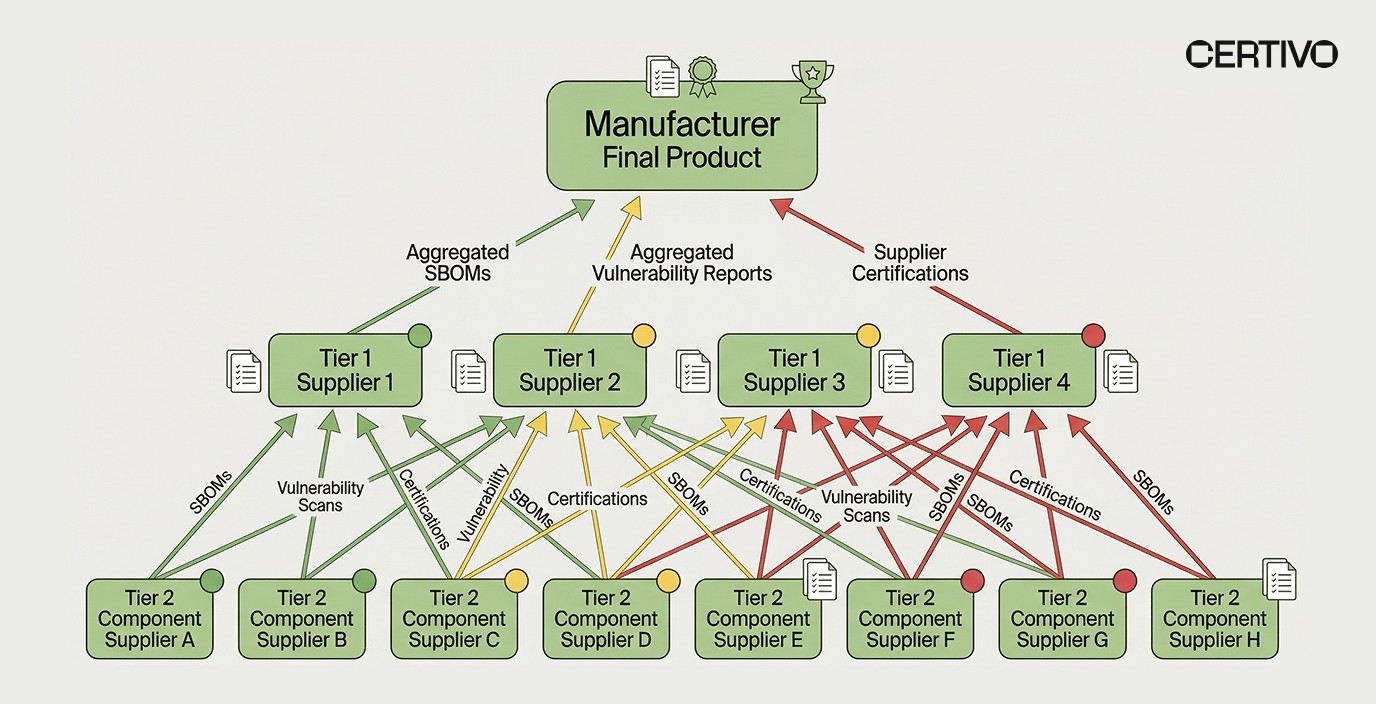
CRA creates transparency obligations that extend beyond direct supplier relationships into deeper supply chain tiers. Manufacturers must trace digital components to original equipment manufacturers (OEMs) and software authors, even when those entities are multiple tiers removed from procurement relationships.
Tier 1 Supplier Evidence Requirements
Direct suppliers must provide comprehensive evidence packages covering their own cybersecurity practices and the security characteristics of components they supply. This includes:
✓ Internal security development lifecycle documentation
✓ Vulnerability management process descriptions
✓ Incident response capabilities and contact procedures
✓ Sub-supplier security verification protocols
✓ Component provenance and chain of custody evidence
Supplier self-service compliance portals enable Tier 1 suppliers to submit structured evidence packages that align with manufacturer requirements.
Tier 2 and Tier 3 Component Transparency
When Tier 1 suppliers integrate components from deeper tiers, manufacturers must obtain evidence transparency through the supply chain. This creates three implementation approaches:
Pass-Through Evidence Collection
Tier 1 suppliers collect and forward evidence from Tier 2/3 suppliers to manufacturers. This approach places evidence management burden on intermediary suppliers but provides manufacturers with comprehensive documentation.
Cascading Portal Access
Manufacturers grant portal access to suppliers across multiple tiers, enabling direct evidence submission from component OEMs. Centralized supplier self-service portals facilitate this approach while maintaining evidence organization.
Supplier Network Verification
Manufacturers verify Tier 1 supplier processes for managing their own sub-supplier evidence collection, accepting summary evidence with audit rights for deeper tier documentation.
Software Supply Chain Special Considerations
Software components from open source libraries, commercial software vendors, and cloud service providers require additional transparency mechanisms. Digital passports and traceability IDs embedded in software artifacts enable automated evidence linking between code components and security documentation.
CRA Enforcement Timeline and Preparation Window
Understanding CRA implementation phases helps manufacturers prioritize supplier evidence collection infrastructure development. The regulation follows a staged enforcement approach with critical deadlines affecting different product categories.
Key Implementation Milestones
December 11, 2027: Initial Enforcement Begins
General cybersecurity requirements take effect for new products placed on the EU market. Manufacturers must have supplier evidence collection systems operational before this date. Expand into new markets faster by establishing evidence infrastructure that supports multi-jurisdiction compliance requirements.
Mid-2028: Critical Product Categories
Products classified as "important" or "critical" under CRA face enhanced conformity assessment requirements. Evidence documentation depth increases for these categories, requiring more comprehensive supplier verification.
September 11, 2028: Full Enforcement
All product categories and all aspects of CRA obligations reach full enforcement, including vulnerability management, security update delivery, and incident reporting requirements throughout product lifecycle.
Preparation Timeline for Manufacturers
18-24 Months Before Enforcement
Conduct CRA gap analysis across product portfolios
Identify all products with digital elements requiring supplier evidence
Map current supplier relationships and evidence collection capabilities
Select and implement supplier self-service compliance portals
Develop standardized supplier questionnaire frameworks aligned with CRA
12-18 Months Before Enforcement
Onboard suppliers to evidence collection platforms
Establish evidence validation and verification protocols
Implement BOM-level compliance intelligence linking
Conduct supplier cybersecurity capability assessments
Develop evidence refresh schedules based on component risk classification
6-12 Months Before Enforcement
Validate evidence completeness for all products
Conduct internal conformity assessment dry runs
Address evidence gaps identified during validation
Establish continuous compliance monitoring processes
Train procurement and engineering teams on CRA evidence requirements
Book a demo to see how Certivo accelerates CRA supplier evidence infrastructure development across these preparation phases.
How Certivo Automates Supplier Evidence Collection for CRA
Certivo transforms manual supplier documentation processes into automated, continuous evidence collection workflows that align with CRA technical requirements. The platform provides manufacturers with centralized compliance data backbone capabilities specifically designed for cybersecurity supply chain transparency.
Automated Supplier Portal Infrastructure
Certivo establishes supplier self-service compliance portals that guide suppliers through CRA-specific evidence submission workflows. Suppliers receive automated requests for security documentation tied to specific components and products, eliminating email-based evidence collection.
The portal infrastructure includes:
✓ Role-based access control for different supplier types and tiers
✓ Document template libraries aligned with CRA requirements
✓ Automated evidence request triggers based on procurement activities
✓ Multi-language support for global supplier networks
✓ Evidence expiration tracking and renewal reminders
CORA-Powered Document Intelligence
Certivo's CORA intelligence layer applies AI document parsing and certificate validation to supplier-submitted evidence. CORA automatically:
📊 Extracts security-relevant data from unstructured documents
📊 Validates compliance with CRA requirements for each evidence type
📊 Identifies missing or incomplete information requiring supplier follow-up
📊 Maps evidence to specific product BOMs and components
📊 Flags expired certifications and outdated vulnerability assessments
This automation reduces manual evidence review burden by 80-90% while improving validation accuracy through consistent, rule-based assessment.
Component-Level Evidence Mapping
Certivo establishes BOM-level compliance intelligence that links supplier evidence to specific components across product portfolios. When suppliers submit SBOM data, vulnerability assessments, or updated certifications, Certivo automatically:
Identifies all products containing affected components
Triggers alerts for products with evidence gaps
Updates conformity status across SKU-level records
Maintains audit trails showing evidence currency
Generates product-specific evidence packages for conformity assessment
Continuous Evidence Monitoring
Continuous audit-ready documentation replaces periodic supplier audits through automated monitoring mechanisms. Certivo tracks evidence validity periods, supplier certification renewals, and newly disclosed vulnerabilities affecting supplier-provided components.
The platform integrates with regulatory intelligence and horizon scanning systems to alert manufacturers when CRA implementing acts or guidance documents modify supplier evidence requirements.
Multi-Framework Integration
CRA compliance rarely exists in isolation. Manufacturers must simultaneously manage REACH, RoHS, conflict minerals, and other product compliance frameworks. Certivo provides unified supplier engagement infrastructure where cybersecurity evidence collection coexists with materials declaration requests, enabling standardize compliance across plants and regions.
Internal Design Note: Emphasize cyclical, continuous nature of the process rather than linear workflow. CORA branding should be subtle but recognizable.
Building Continuous Audit-Ready Documentation
Market surveillance authorities expect manufacturers to produce supplier evidence within 72 hours of formal requests. This response capability requires transition from reactive evidence collection to proactive, continuously maintained documentation systems.
Audit Response Readiness Requirements
Manufacturers must maintain evidence packages that support rapid responses to:
⚠ Conformity verification requests from notified bodies
⚠ Market surveillance authority inquiries regarding specific products
⚠ Post-incident investigations following security breaches
⚠ Cross-border enforcement actions initiated by any EU member state
⚠ Supply chain transparency demands from downstream customers
Continuous audit-ready documentation means evidence packages exist before audit requests arrive, not assembled in response to enforcement actions.
Evidence Refresh Protocols
Different evidence types require different refresh frequencies based on component risk classification and documentation type:
High-Risk Components (Critical/Important Products)
Vulnerability assessments: Updated quarterly
Security certifications: Verified monthly for validity
Incident response protocols: Reviewed semi-annually
SBOM data: Refreshed with each product revision
Standard Risk Components
Vulnerability assessments: Updated semi-annually
Security certifications: Verified quarterly
Conformity declarations: Annual verification
Supplier security practices: Annual assessment
Certivo automates evidence refresh scheduling through CORA-powered regulatory intelligence that adapts refresh frequencies based on component risk profiles and regulatory guidance evolution.
Customer Trust Center Integration
Customer trust centers and self-service reporting enable manufacturers to share appropriate supplier evidence with downstream customers requiring CRA conformity verification. This capability reduces RFQ response time while maintaining confidentiality of sensitive supplier information through granular access controls.
Strategic Compliance Preparation Checklist
Manufacturers should complete these implementation steps before CRA enforcement begins in December 2027:
Months 18-24 Before Enforcement
✓ Conduct comprehensive CRA gap analysis across product portfolios
✓ Identify all products with digital elements requiring supplier evidence
✓ Map current supplier relationships and existing evidence collection capabilities
✓ Select AI-native compliance automation platform with CRA-specific capabilities
✓ Develop internal governance structure for cybersecurity compliance
✓ Establish cross-functional teams spanning procurement, engineering, compliance, legal
Months 12-18 Before Enforcement
✓ Deploy supplier self-service compliance portals
✓ Develop standardized supplier questionnaire frameworks aligned with CRA
✓ Begin supplier onboarding with prioritization based on component risk
✓ Implement BOM-level compliance intelligence infrastructure
✓ Establish evidence validation and verification protocols
✓ Conduct supplier cybersecurity capability assessments for critical components
Months 6-12 Before Enforcement
✓ Validate evidence completeness for all products planned for EU market
✓ Conduct internal conformity assessment dry runs
✓ Address evidence gaps identified during validation exercises
✓ Implement continuous compliance monitoring processes
✓ Train procurement teams on CRA-specific supplier qualification requirements
✓ Update supplier contracts to include CRA evidence obligations
✓ Establish incident response protocols for supplier security breach notifications
Months 0-6 Before Enforcement
✓ Complete evidence collection for all products launching before December 2027
✓ Finalize conformity documentation and technical files
✓ Conduct executive briefings on CRA compliance status and residual risks
✓ Establish market surveillance response protocols
✓ Test customer evidence sharing through customer trust centers
✓ Document supplier evidence collection processes for audit defense
Get a free compliance assessment to benchmark your organization's CRA supplier evidence readiness against these preparation milestones.
Frequently Asked Questions
What methods exist to validate supplier material declarations against known risk lists?
Certivo uses CORA-driven compliance intelligence to automatically validate supplier declarations against CRA vulnerability databases, CISA Known Exploited Vulnerabilities (KEV) catalog, and National Vulnerability Database (NVD). The platform cross-references supplier-submitted SBOMs with real-time threat intelligence feeds to identify components with known security risks, eliminating manual validation workflows.
What systems support ongoing due diligence for supply-chain cybersecurity compliance?
Continuous compliance monitoring systems like Certivo provide automated due diligence through supplier risk scoring, certification expiration tracking, and vulnerability disclosure monitoring. The platform maintains evidence currency through scheduled refresh protocols and alerts compliance teams when supplier documentation requires updates.
What tools support continuous monitoring of supplier certifications and expirations?
Certivo's supplier self-service compliance portals automatically track certification validity periods, issue renewal reminders to suppliers before expiration, and flag products containing components from suppliers with expired certifications. CORA intelligence validates certificate authenticity and maps certifications to specific product BOMs.
How do platforms handle both compliance management and supplier engagement workflows?
AI-native compliance automation platforms like Certivo unify evidence collection, validation, BOM mapping, and audit documentation within single systems. This integration eliminates data silos between procurement, engineering, and compliance teams while maintaining centralized compliance data backbone infrastructure accessible across organizational functions.
How can companies benchmark supplier compliance performance and responsiveness?
Certivo provides supplier risk scoring and ESG ratings based on evidence submission timeliness, documentation completeness, certification status, and vulnerability disclosure responsiveness. These metrics enable procurement teams to compare supplier cybersecurity maturity and prioritize evidence collection efforts based on component risk levels.
Conclusion
The EU Cyber Resilience Act creates supplier evidence collection requirements that exceed the capacity of manual documentation processes. With enforcement beginning in December 2027, manufacturers face a narrow window to implement automated supplier evidence collection infrastructure before compliance obligations take effect.
Automated supplier data collection through supplier self-service compliance portals transforms reactive evidence requests into continuous, validated documentation workflows. This infrastructure eliminates evidence gaps that create enforcement exposure while reducing compliance team workload through AI document parsing and certificate validation automation.
Manufacturers that establish continuous audit-ready documentation systems now will maintain competitive advantage as CRA compliance becomes baseline requirement for EU market access. The alternative—manual supplier evidence collection at scale—creates operational bottlenecks that delay product launches and expose organizations to financial penalties during market surveillance enforcement.
Certivo's centralized compliance data backbone with CORA-powered intelligence provides manufacturers with the infrastructure needed to manage CRA supplier evidence requirements alongside existing materials and environmental compliance frameworks. This integration enables unified supplier engagement rather than fragmented evidence collection across regulatory domains.
The strategic imperative is clear: organizations must transition from spreadsheet-based supplier management to automated evidence collection platforms before CRA enforcement begins. Book a demo to see how Certivo accelerates supplier evidence infrastructure implementation and reduces CRA compliance risk across your product portfolio and supply chain operations.
Hari Prasanth
Hariprasanth is a Chemical Compliance Specialist with nearly four years of experience, underpinned by a degree in Chemical Engineering. He brings in-depth expertise in global product compliance, working across key regulations such as REACH, RoHS, TSCA, Proposition 65, POPs, FMD, and PFCMRT.
Hariprasanth specializes in reviewing technical documentation, validating supplier inputs, and ensuring that products consistently meet regulatory standards. He works closely with cross-functional teams and suppliers to collect accurate material data and deliver clear, audit-ready compliance reports that stand up to scrutiny.
Through his strong analytical skills and regulatory insight, Hariprasanth enables organizations to navigate evolving compliance challenges while aligning with sustainability initiatives in an increasingly dynamic regulatory environment.