


The California Office of Environmental Health Hazard Assessment (OEHHA) has finalized a health-protective concentration (HPC) for noncancer effects of hexavalent chromium (Cr(VI)) in drinking water. Published on April 7, 2026, as part of OEHHA's ongoing update to California's Public Health Goal for Cr(VI), this benchmark establishes a science-based threshold that compliance leaders, manufacturers, and supply chain executives must evaluate immediately.
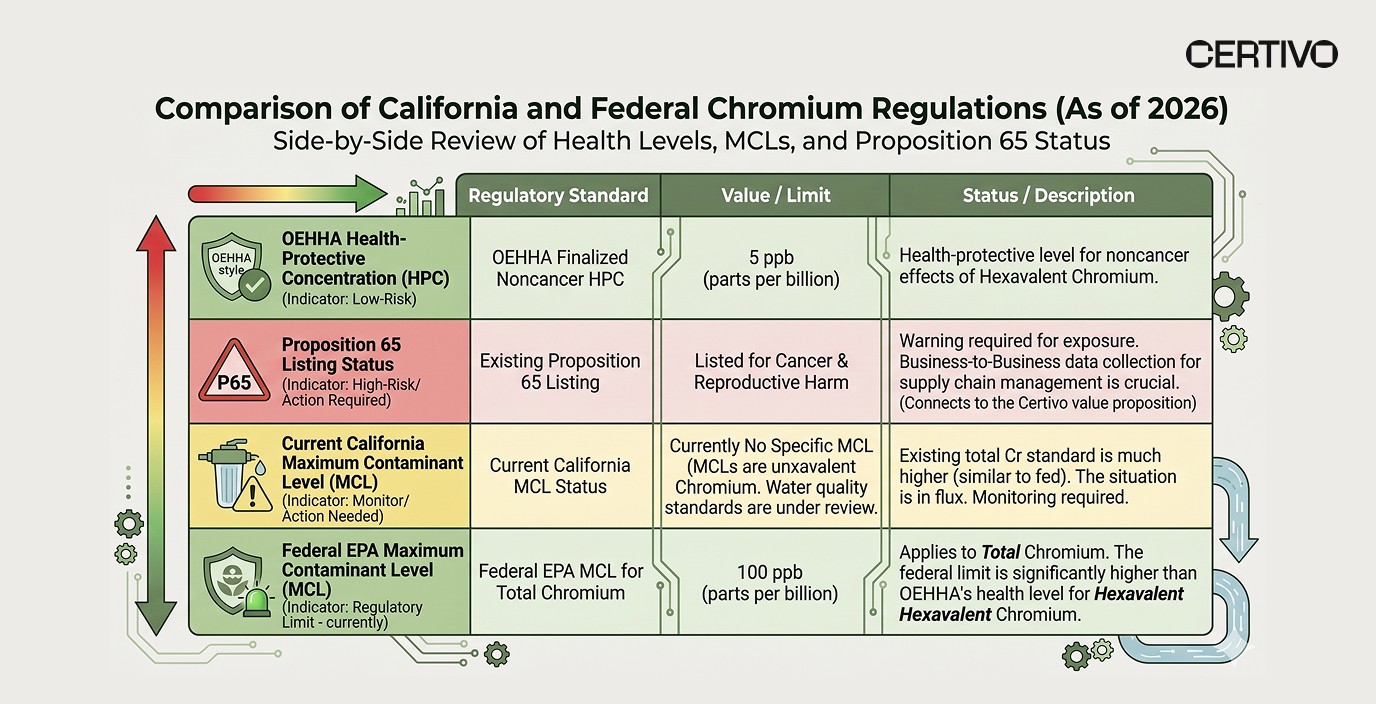
While this update does not impose new direct compliance limits under Proposition 65, it introduces a health benchmark of 5 parts per billion (ppb) for noncancer effects — a figure derived from the latest toxicological and exposure data. For manufacturers in metal processing, electronics, construction, and industrial equipment, this finalized HPC signals a trajectory toward stricter regulatory standards, expanded risk assessments, and heightened Proposition 65 enforcement scrutiny around hexavalent chromium.
📊 Book a free compliance assessment to understand your hexavalent chromium exposure across products and supply chains.
📌 Table of Contents
Executive Regulatory Overview
What Is OEHHA's Health-Protective Concentration for Hexavalent Chromium?
Framework Background: Proposition 65 and Cr(VI) Legal Scope
Key Thresholds and Requirements for Manufacturers
Which Industries Are Affected by the Cr(VI) HPC Update?
Reporting, Documentation, and Data Challenges
Compliance Risks, Penalties, and Enforcement Exposure
Supply Chain and Operational Impact
Timeline and Future Enforcement Outlook
Strategic Compliance Preparation Checklist
How AI Enables Hexavalent Chromium Compliance at Scale
Conclusion: What This Means for Your Business
FAQs
Executive Regulatory Overview
On April 7, 2026, OEHHA published a finalized health-protective concentration (HPC) of 5 parts per billion (ppb) for noncancer effects of hexavalent chromium in drinking water. Based on currently available regulatory guidance, this HPC was derived from chronic liver inflammation observed in female rats exposed to Cr(VI) in drinking water, reflecting OEHHA's evaluation of the latest toxicological and exposure data.
This update is part of OEHHA's process to revise California's drinking water Public Health Goal (PHG) for Cr(VI). A separate cancer-effects HPC document will be released at a later date.
For CEOs, compliance leaders, and board members, the significance is clear: while this HPC does not immediately impose new enforceable limits, it serves as the scientific benchmark that will influence future regulatory standards, enforcement interpretations, and Proposition 65 risk assessments. Manufacturers that use chromium in plating, coatings, alloys, electronics components, or construction materials must treat this as an early signal requiring proactive evaluation.
Certivo's CORA-powered regulatory intelligence enables compliance teams to track updates like this across frameworks and jurisdictions in real time — shifting organizations from reactive compliance to continuous compliance monitoring and audit readiness.
What Is OEHHA's Health-Protective Concentration for Hexavalent Chromium?
OEHHA defines a health-protective concentration as the level of a contaminant in drinking water that is not anticipated to cause adverse noncancer health effects over a lifetime of exposure. The finalized HPC for Cr(VI) establishes:
Parameter | Detail |
|---|---|
Chemical | Hexavalent Chromium (Cr(VI)) |
HPC Value | 5 parts per billion (ppb) |
Basis | Chronic liver inflammation in female rats |
Effect Category | Noncancer health effects |
Published | April 7, 2026 |
Issuing Body | California OEHHA |
Framework | California Proposition 65 / Public Health Goal Update |
The 5 ppb noncancer HPC is intended to protect against adverse health effects associated with long-term ingestion of Cr(VI) in drinking water. Based on currently available regulatory guidance, this concentration reflects OEHHA's updated toxicological evaluation and will serve as a scientific benchmark for future standard-setting.
Manufacturers and compliance regulation managers must recognize that health-protective concentrations often precede enforceable Maximum Contaminant Levels (MCLs) set by the California State Water Resources Control Board.
Framework Background: Proposition 65 and Cr(VI) Legal Scope
California's Proposition 65 — officially the Safe Drinking Water and Toxic Enforcement Act of 1986 — requires businesses to warn Californians about significant exposures to chemicals known to cause cancer, birth defects, or reproductive harm. The law applies to any business with 10 or more employees selling products in California.
Hexavalent chromium compounds have been listed under Proposition 65 since the program's inception, classified as both carcinogenic and causing reproductive harm. The chemical is widely used in industrial processes including chrome plating, stainless steel production, pigment manufacturing, and anticorrosion coatings.
How the HPC Connects to Proposition 65 Obligations
The finalized HPC for noncancer effects does not directly create a new compliance obligation. However, its implications for manufacturers extend across three dimensions:
✓ Risk Assessment Benchmark: The 5 ppb HPC provides a quantifiable reference point that private enforcers, regulatory bodies, and risk assessors may use to evaluate product and process compliance.
✓ Enforcement Signal: Proposition 65 enforcement is primarily driven by private lawsuits. With over 700 enforcement actions filed annually, the availability of updated scientific benchmarks like this HPC often correlates with increased enforcement activity targeting specific chemicals.
✓ Future Standard Influence: Health-protective concentrations developed by OEHHA are a foundational step toward establishing updated Public Health Goals, which in turn inform enforceable drinking water standards.
For VPs and Directors of Quality managing product portfolios, this means that hexavalent chromium compliance documentation and supplier declarations require immediate review — even before new limits become enforceable.
Key Thresholds and Requirements for Manufacturers
Understanding the threshold landscape around hexavalent chromium is essential for compliance planning. Based on currently available regulatory guidance, the following thresholds are relevant:
Proposition 65 Thresholds
⚠ No Significant Risk Level (NSRL): OEHHA has established an NSRL for hexavalent chromium (cancer endpoint). Products with exposures below the NSRL do not require Proposition 65 warnings for cancer effects.
⚠ Maximum Allowable Dose Level (MADL): A MADL applies for reproductive toxicity. Products with exposures below the MADL do not require warnings for reproductive harm.
⚠ Noncancer HPC (5 ppb): While currently applicable to drinking water Public Health Goal development, this benchmark may influence how risk assessments are conducted for product compliance.
Federal and State Drinking Water Standards
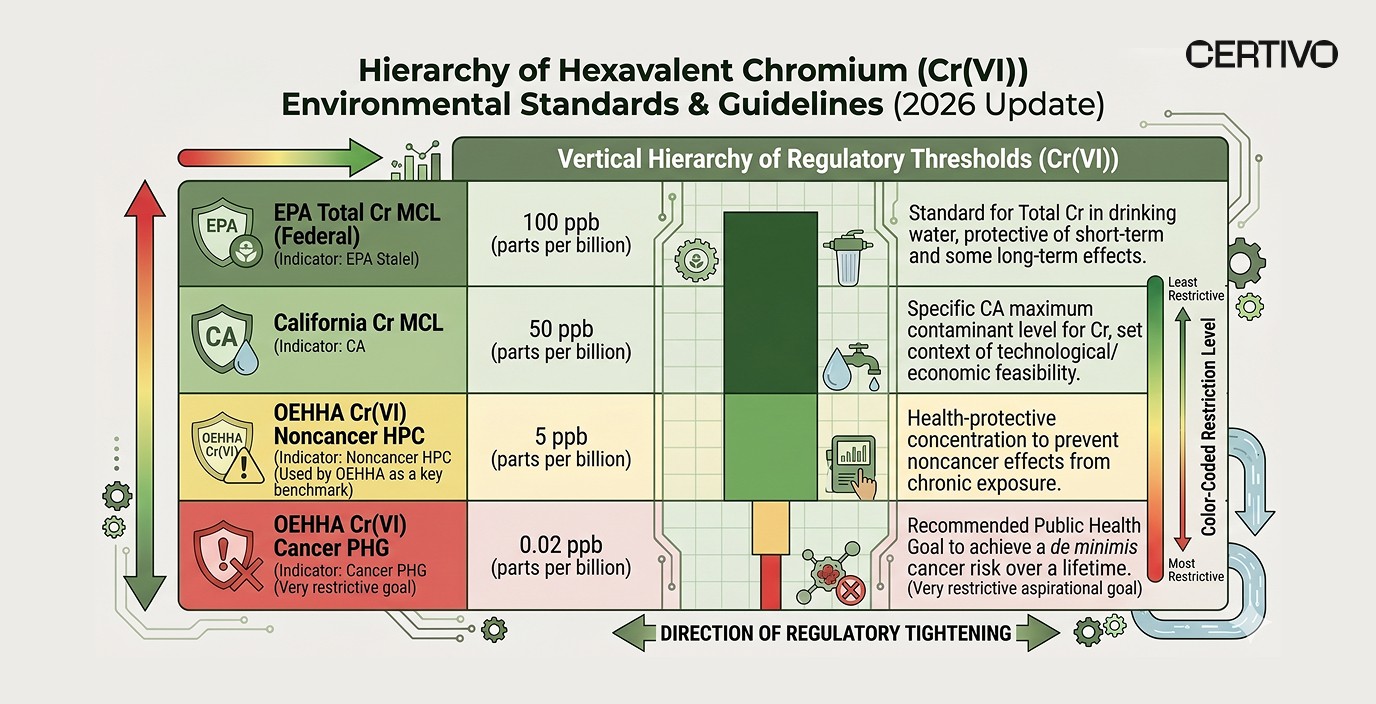
Standard | Value | Authority |
|---|---|---|
OEHHA Noncancer HPC | 5 ppb (Cr(VI)) | California OEHHA |
California PHG (Cancer) | 0.02 ppb (Cr(VI)) | California OEHHA (2011) |
California MCL (Total Chromium) | 50 ppb | CA State Water Board |
US EPA MCL (Total Chromium) | 100 ppb | US EPA |
For procurement and supply chain leaders managing chromium-containing materials, these thresholds must be mapped against BOM-level substance data to determine exposure risk across product lines.
Certivo enables BOM substance and threshold management by automatically mapping chemical constituents against regulatory limits, including Proposition 65 NSRLs, MADLs, and evolving health benchmarks.
Which Industries Are Affected by the Cr(VI) HPC Update?
Based on the regulation document, the following industries face direct or indirect compliance impact from OEHHA's updated hexavalent chromium health-protective concentration:
Water and Utilities
Drinking water treatment and monitoring operations must evaluate the 5 ppb noncancer HPC against current treatment capabilities. Water utilities in California will likely face pressure to align with this benchmark as Public Health Goals are updated.
Manufacturing and Metal Processing
Chromium use in plating, coatings, and alloys places industrial machinery and heavy equipment manufacturers at the center of this update. Facilities using hexavalent chromium in surface treatments, corrosion protection, or specialty alloy production must evaluate workplace discharge, product residue, and supply chain exposure.
Electronics and Industrial Equipment
Electronics manufacturers using chromium-containing components — including circuit boards, connectors, and plating on hardware — should assess BOM-level substance presence. The intersection of this update with existing RoHS compliance obligations creates a multi-framework documentation requirement.
Construction and Building Materials
Cement, coatings, and treated materials in the building materials and construction sector may contain hexavalent chromium as a byproduct of production. Construction products sold in California face both Proposition 65 warning requirements and evolving public health benchmarks.
Environmental and Waste Management
Contamination control and remediation operations managing Cr(VI) in soil, groundwater, and industrial waste will use the 5 ppb HPC as a reference for site assessment and remediation targets.
📊 Struggling with multi-framework chromium compliance? Book a demo to see how Certivo maps Cr(VI) obligations across Proposition 65, RoHS, REACH, and OSHA simultaneously.
Reporting, Documentation, and Data Challenges
The hexavalent chromium HPC update amplifies existing documentation and data collection challenges for compliance teams:
Substance-Level Data Gaps
Most manufacturers do not have substance-level visibility into hexavalent chromium presence across their product portfolios. Cr(VI) can be present as a deliberate additive (chrome plating, pigments) or as a contaminant formed during manufacturing processes. Without automated supplier data collection and portals, identifying Cr(VI) exposure across multi-tier supply chains is resource-intensive and error-prone.
Multi-Framework Reporting Burden
Hexavalent chromium is regulated under multiple frameworks simultaneously:
📌 California Proposition 65 (cancer + reproductive harm warnings) 📌 REACH SVHC Candidate List (EU authorization obligations) 📌 RoHS Directive (restricted substance in electronics) 📌 OSHA Permissible Exposure Limits (workplace safety) 📌 TSCA (US chemical reporting)
Each framework has different thresholds, reporting formats, and documentation requirements. Compliance teams managing hexavalent chromium obligations across these frameworks face a centralized compliance data backbone challenge — without a single system of record, data fragmentation creates audit risk and enforcement exposure.
Supplier Declaration Complexity
Obtaining accurate Cr(VI) declarations from suppliers requires more than a simple questionnaire. It demands standardized supplier questionnaire frameworks that map to specific regulatory requirements, combined with validation against material composition data.
Certivo's AI document parsing and certificate validation capabilities enable compliance teams to extract substance data from mill test reports, certificates of conformance, and supplier declarations — then automatically map that data against Proposition 65 and other applicable frameworks.
Compliance Risks, Penalties, and Enforcement Exposure
Proposition 65 Penalty Structure
Proposition 65 carries significant financial exposure for non-compliant businesses:
⚠ $2,500 per violation per day — applicable to any business that fails to provide required warnings for Proposition 65 listed chemicals, including hexavalent chromium compounds.
⚠ Private enforcement lawsuits — over 700 Proposition 65 enforcement actions are filed annually, primarily by private enforcers and plaintiffs' attorneys. Hexavalent chromium has been a target of enforcement, particularly in consumer products containing leather treated with chromium compounds.
⚠ Settlement costs — typical Proposition 65 settlements range from $50,000 to $100,000, with consent judgments often requiring reformulation or enhanced warning programs.
How the HPC Increases Enforcement Risk
The availability of a finalized noncancer HPC at 5 ppb provides private enforcers with an updated scientific reference point. Based on currently available regulatory guidance, enforcement trends suggest that:
✓ Products or processes involving Cr(VI) at or above the HPC may face increased scrutiny in enforcement actions.
✓ Manufacturers without documented substance-level data demonstrating Cr(VI) levels below applicable thresholds will have limited defense options.
✓ Continuous audit-ready documentation becomes essential — not optional — for businesses selling chromium-containing products in California.
For IT and systems leaders, the enforcement landscape demands systems that maintain real-time compliance documentation, not quarterly spreadsheet reviews.
Supply Chain and Operational Impact
Multi-Tier Supply Chain Transparency
Hexavalent chromium compliance requires visibility beyond Tier 1 suppliers. Cr(VI) can be introduced at multiple points in a supply chain — from raw material sourcing through surface treatment processes to final assembly. Multi-tier supply chain transparency is non-negotiable for manufacturers seeking to verify that their products meet Proposition 65 requirements.
Operational Adjustments
Manufacturers may need to:
📌 Audit existing chrome plating and coating processes for Cr(VI) generation or residue 📌 Request updated material declarations from suppliers using chromium-containing inputs 📌 Evaluate alternative materials or processes that reduce Cr(VI) exposure (e.g., trivalent chromium plating) 📌 Update product labeling and warning programs for California-bound products
Supplier Risk Scoring
Organizations with mature compliance programs are moving toward supplier risk scoring and due diligence models that flag suppliers with high Cr(VI) exposure risk based on industry, geography, and material profiles. Certivo enables this through CORA-driven compliance intelligence that scores supplier risk across substance, framework, and jurisdiction dimensions.
For VPs of Operations managing production across multiple plants and regions, the ability to standardize compliance across plants and regions is critical to avoid inconsistent Cr(VI) management practices that create enterprise-wide exposure.
Timeline and Future Enforcement Outlook
Key Dates
Date | Event |
|---|---|
February 9, 2026 | OEHHA finalizes noncancer HPC of 5 ppb for Cr(VI) |
April 7, 2026 | Update published in Prop 65 Roundup (ArentFox Schiff / JDSupra) |
TBD | OEHHA releases cancer-effects HPC document for Cr(VI) |
TBD | Updated Public Health Goal incorporating both noncancer and cancer HPCs |
TBD | Potential revision to California's Maximum Contaminant Level for Cr(VI) |
What Comes Next
Based on currently available regulatory guidance, the timeline for enforceable changes remains uncertain. However, the regulatory trajectory is directional:
✓ OEHHA will release a cancer-effects HPC at a later date, likely establishing a separate (and potentially lower) concentration based on carcinogenic risk.
✓ The combined noncancer and cancer HPCs will form the basis of an updated Public Health Goal for Cr(VI) in drinking water.
✓ California's State Water Resources Control Board may use the updated PHG to revise the enforceable Maximum Contaminant Level for Cr(VI).
✓ Private enforcement activity targeting hexavalent chromium in products is likely to increase as new scientific benchmarks become available.
Regulatory intelligence and horizon scanning is essential for staying ahead of these developments. CORA's regulatory intelligence layer continuously monitors OEHHA actions, enforcement filings, and regulatory proposals — alerting compliance teams before obligations take effect.
Strategic Compliance Preparation Checklist
For compliance leaders and executives evaluating their hexavalent chromium readiness, the following preparation steps are recommended:
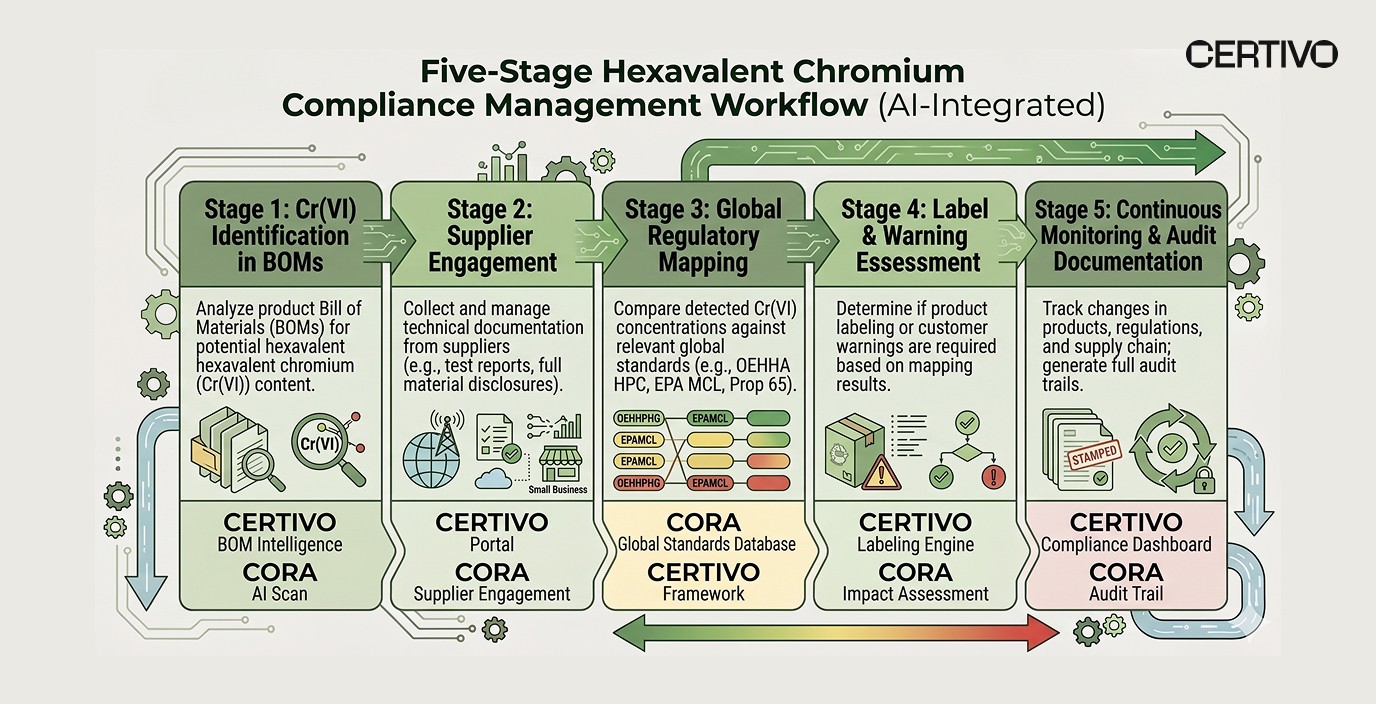
✅ Inventory Cr(VI) presence across product BOMs — Use BOM-level compliance intelligence to identify all products containing hexavalent chromium, whether as a deliberate additive or manufacturing byproduct.
✅ Collect updated supplier declarations — Deploy centralized supplier self-service portals to request Cr(VI)-specific material disclosures and certificates of conformance from all relevant suppliers.
✅ Map thresholds across frameworks — Ensure that your compliance system maps Cr(VI) levels against Proposition 65 NSRLs/MADLs, REACH authorization thresholds, RoHS limits, and the new OEHHA noncancer HPC simultaneously.
✅ Review Proposition 65 warning programs — Evaluate whether current warning labels and online disclosures for California-bound products adequately cover hexavalent chromium exposure.
✅ Establish audit-ready documentation — Build and maintain a compliance evidence trail that demonstrates Cr(VI) management across products, suppliers, and jurisdictions — prepared for both regulatory audits and private enforcement actions.
✅ Monitor OEHHA cancer-effects HPC release — The forthcoming cancer-effects document may establish a significantly lower threshold, requiring additional compliance adjustments.
✅ Evaluate alternative materials — Assess feasibility of transitioning from hexavalent chromium to trivalent chromium or other alternatives in plating, coating, and surface treatment processes.
How AI Enables Hexavalent Chromium Compliance at Scale
Managing hexavalent chromium compliance across products, suppliers, frameworks, and jurisdictions manually is unsustainable at enterprise scale. AI-native compliance automation transforms how manufacturers approach Cr(VI) obligations:
Automated Substance Identification
CORA-enabled analysis can parse mill test reports, safety data sheets, and supplier certificates to identify hexavalent chromium presence and concentration data — replacing manual document review that takes days per product line.
Multi-Framework Threshold Mapping
AI-powered systems automatically map Cr(VI) levels against applicable thresholds across Proposition 65, REACH, RoHS, TSCA, and OSHA — delivering integrated PLM ERP compliance thread visibility in a single dashboard.
Supplier Data Collection at Scale
Automated supplier data collection through standardized portals eliminates the manual email-and-spreadsheet cycle. CORA intelligence validates incoming supplier declarations against expected substance profiles and flags discrepancies.
Continuous Regulatory Monitoring
CORA's regulatory intelligence layer monitors OEHHA publications, PHG updates, enforcement filings, and threshold changes — delivering horizon scanning alerts that keep compliance teams ahead of enforceable deadlines.
Conclusion: What This Means for Your Business
OEHHA's finalized health-protective concentration of 5 ppb for noncancer effects of hexavalent chromium is a regulatory signal, not a compliance finish line. For manufacturers, importers, and supply chain leaders, this update means:
📌 The scientific benchmark for Cr(VI) noncancer risk is now formalized — and a cancer-effects HPC will follow.
📌 Private enforcement of Proposition 65 targeting hexavalent chromium will likely intensify as updated scientific data becomes available to plaintiffs.
📌 Multi-framework Cr(VI) compliance — spanning Proposition 65, REACH, RoHS, TSCA, and OSHA — requires centralized, substance-level data infrastructure that most organizations do not currently have.
📌 Proactive preparation now — including BOM-level substance mapping, supplier data collection, and continuous monitoring — will determine whether organizations face manageable adjustments or emergency remediation when enforceable standards arrive.
The organizations that treat this HPC as a starting point for systematic Cr(VI) management — not a distant regulatory signal — will be best positioned when California's enforcement landscape tightens.
Get complete visibility into your hexavalent chromium compliance risk. Book a demo to see how Certivo automates Proposition 65 substance tracking across your product portfolio and supply chain — or get a free compliance risk assessment to understand your current Cr(VI) exposure across products and jurisdictions.
FAQs
1. Does the new 5 ppb hexavalent chromium HPC create immediate compliance obligations for manufacturers?
No. Based on currently available regulatory guidance, the finalized HPC of 5 ppb for noncancer effects does not impose new enforceable limits. It serves as a scientific benchmark that may influence future regulatory standards, risk assessments, and enforcement interpretations under Proposition 65. However, manufacturers should treat it as an early signal and begin evaluating their Cr(VI) exposure using tools like Certivo's CORA-powered BOM-level compliance intelligence.
2. How does OEHHA's Cr(VI) update affect companies already compliant with RoHS and REACH?
RoHS and REACH address hexavalent chromium under different thresholds and scopes than Proposition 65. A product compliant with the EU's RoHS restriction of 0.1% by weight may still face Proposition 65 warning obligations in California, which are based on exposure levels (NSRLs and MADLs), not concentration limits. Certivo's multi-framework threshold mapping enables compliance teams to manage Cr(VI) obligations across all applicable frameworks simultaneously.
3. When will California establish an enforceable MCL for hexavalent chromium based on this HPC?
The timeline remains uncertain. OEHHA must first release a cancer-effects HPC, then finalize an updated Public Health Goal. The State Water Resources Control Board would then use the PHG to propose a revised Maximum Contaminant Level. CORA's regulatory intelligence and horizon scanning continuously monitors these developments and alerts compliance teams as milestones approach.
4. What types of supplier data should manufacturers collect for hexavalent chromium compliance?
Manufacturers should collect Cr(VI)-specific material declarations, mill test reports, certificates of conformance, and safety data sheets from suppliers of chromium-containing materials. Certivo's automated supplier data collection portals standardize this process and use AI document parsing to validate incoming data against expected substance profiles.
5. Can AI help track hexavalent chromium obligations across multiple regulatory frameworks and jurisdictions?
Yes. Certivo's AI-native compliance automation platform, powered by CORA intelligence, maps hexavalent chromium data against Proposition 65, REACH, RoHS, TSCA, and OSHA thresholds simultaneously. This eliminates the manual cross-referencing that causes compliance gaps and provides continuous audit-ready documentation across jurisdictions.
Lavanya
Lavanya is an accomplished Product Compliance Engineer with over four years of expertise in global environmental and regulatory frameworks, including REACH, RoHS, Proposition 65, POPs, TSCA, PFAS, CMRT, FMD, and IMDS. A graduate in Chemical Engineering from the KLE Institute, she combines strong technical knowledge with practical compliance management skills across diverse and complex product portfolios.