

The Build America, Buy America Act (BABA) imposes strict domestic content requirements on manufacturers supplying products for federally funded infrastructure projects. With enforcement now active across transportation, water, broadband, and energy projects, manufacturers face complex documentation burdens, multi-tier supply chain verification, and project-level compliance tracking that manual processes cannot sustain.
Buy America Act compliance in 2026 requires manufacturers to demonstrate that iron, steel, manufactured products, and construction materials meet statutory domestic content thresholds. For manufacturers serving public sector clients, the compliance burden extends beyond initial qualification to continuous documentation, supplier attestations, and project-specific reporting that must be audit-ready throughout the project lifecycle.
Unlike commercial procurement, public infrastructure procurement compliance demands transparent material origin tracking, supplier certifications, and evidence-based documentation for every component in the bill of materials. Manufacturers must prove compliance at the part level, maintain records for federal audit, and respond to agency requests within strict timelines.
Table of Contents
Understanding BABA's Regulatory Framework
Domestic Content Requirements and Thresholds
Documentation and Certification Requirements
Affected Industries and Product Categories
Multi-Tier Supply Chain Verification Challenges
Compliance Risks and Federal Enforcement
Managing Region-Specific Requirements Across Projects
Strategic Compliance Preparation for Federal Procurement
How Certivo Automates Buy America Compliance
Frequently Asked Questions
Understanding BABA's Regulatory Framework
The Build America, Buy America Act mandates that federal infrastructure spending prioritize domestically produced materials. Enacted in November 2021 as part of the Infrastructure Investment and Jobs Act, BABA applies to projects funded by federal financial assistance across transportation, water, broadband, and energy infrastructure programs.
The Office of Management and Budget (OMB) issued initial implementation guidance in April 2022, establishing compliance timelines and waiver procedures. Federal agencies began enforcement in May 2022, with phased implementation allowing manufacturers to build compliance infrastructure before full enforcement.
BABA consolidates and expands existing Buy America provisions, creating uniform requirements across federal programs. Manufacturers previously complying with sector-specific rules now face standardized documentation requirements, broader product coverage, and stricter supply chain verification obligations.
Building materials compliance under BABA extends beyond traditional Buy America categories. The law defines manufactured products broadly, covering thousands of components used in infrastructure projects. Manufacturers must track domestic content at the BOM level and maintain documentation proving material origin and processing location.
Federal agencies enforce BABA through project-level oversight, contractor certifications, and post-award audits. Manufacturers supplying non-compliant products risk contract termination, debarment, and federal funding clawbacks that cascade through the supply chain.
Domestic Content Requirements and Thresholds
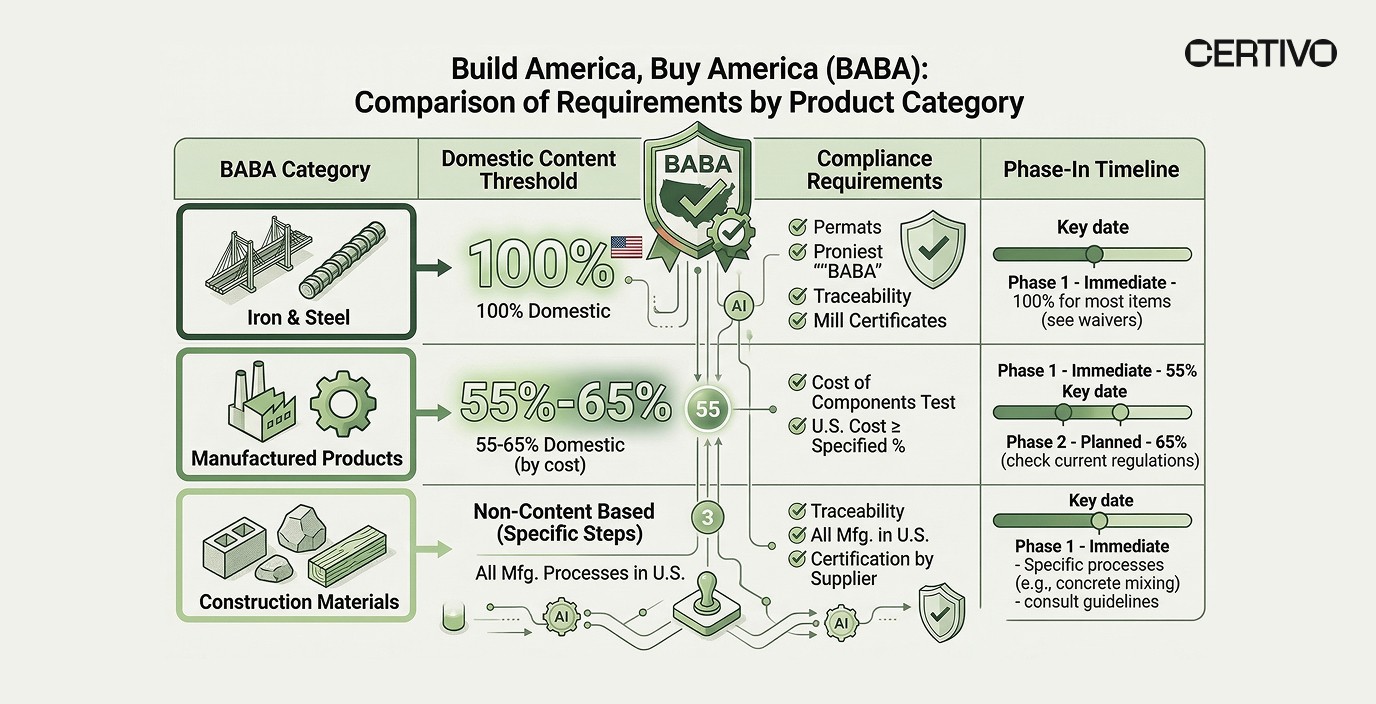
BABA establishes three distinct compliance categories, each with specific domestic content thresholds. Iron and steel products must be produced entirely in the United States, including all manufacturing processes from initial melting through final product formation. This requirement applies to construction materials and covers structural steel, rebar, pipe, and fabricated steel components.
Manufactured products must meet a minimum domestic content threshold of 55% as of the implementation date, increasing to 65% over time. Domestic content is calculated based on the cost of components, excluding labor and overhead. Manufacturers must track the origin of every component in their BOM and calculate domestic content percentage for each product variant.
Construction materials include non-ferrous metals, plastic and polymer-based products, glass, lumber, and drywall. These materials must be manufactured in the United States, meaning that all manufacturing processes must occur domestically, regardless of the origin of constituent materials.
Multi-tier supply chain transparency becomes critical when calculating domestic content. Manufacturers cannot rely on supplier declarations alone. They must verify the origin of sub-components, track processing locations, and maintain documentation proving each manufacturing step occurred in the United States.
De minimis waivers exist for components constituting less than 5% of total product cost, but manufacturers must document and justify these exclusions. Federal agencies review waiver requests on a project-specific basis, requiring detailed cost breakdowns and material sourcing evidence.
BOM-level compliance intelligence enables manufacturers to calculate domestic content automatically, flag non-compliant components, and generate project-specific documentation. Without automated tracking, manufacturers face manual spreadsheet reconciliation across thousands of parts and hundreds of suppliers.
Documentation and Certification Requirements
Manufacturers supplying products for BABA-covered projects must provide detailed certifications demonstrating compliance. These certifications require evidence-based documentation, not supplier self-declarations. Federal agencies expect manufacturers to maintain records proving every compliance claim made in certification documents.
Supplier attestations must include specific information: material origin, processing location, domestic content calculations, and supporting documentation. Manufacturers cannot accept generic compliance statements. They must collect detailed questionnaires covering material composition, manufacturing processes, and component sourcing for every supplier in their chain.
Automated supplier data collection reduces the manual burden of gathering attestations from dozens or hundreds of suppliers. Traditional email-based collection creates bottlenecks, version control issues, and incomplete submissions. Structured data collection through supplier self-service compliance portals ensures completeness, maintains audit trails, and enables automated validation.
Certificate of conformance documents must reference specific purchase orders, lot numbers, and project identifiers. Generic certifications covering broad product families do not satisfy BABA requirements. Manufacturers must generate project-specific documentation linking each product to verified supplier data.
Continuous audit-ready documentation requires maintaining records for the duration of the project plus retention periods specified by federal agencies. Manufacturers must organize documentation by project, product, and supplier, enabling rapid response to agency audit requests.
Mill test reports, material composition analyses, and supplier certifications must be validated and version-controlled. AI document parsing and certificate validation tools extract structured data from supplier certificates, flag inconsistencies, and maintain document lineage throughout the compliance process.
Affected Industries and Product Categories
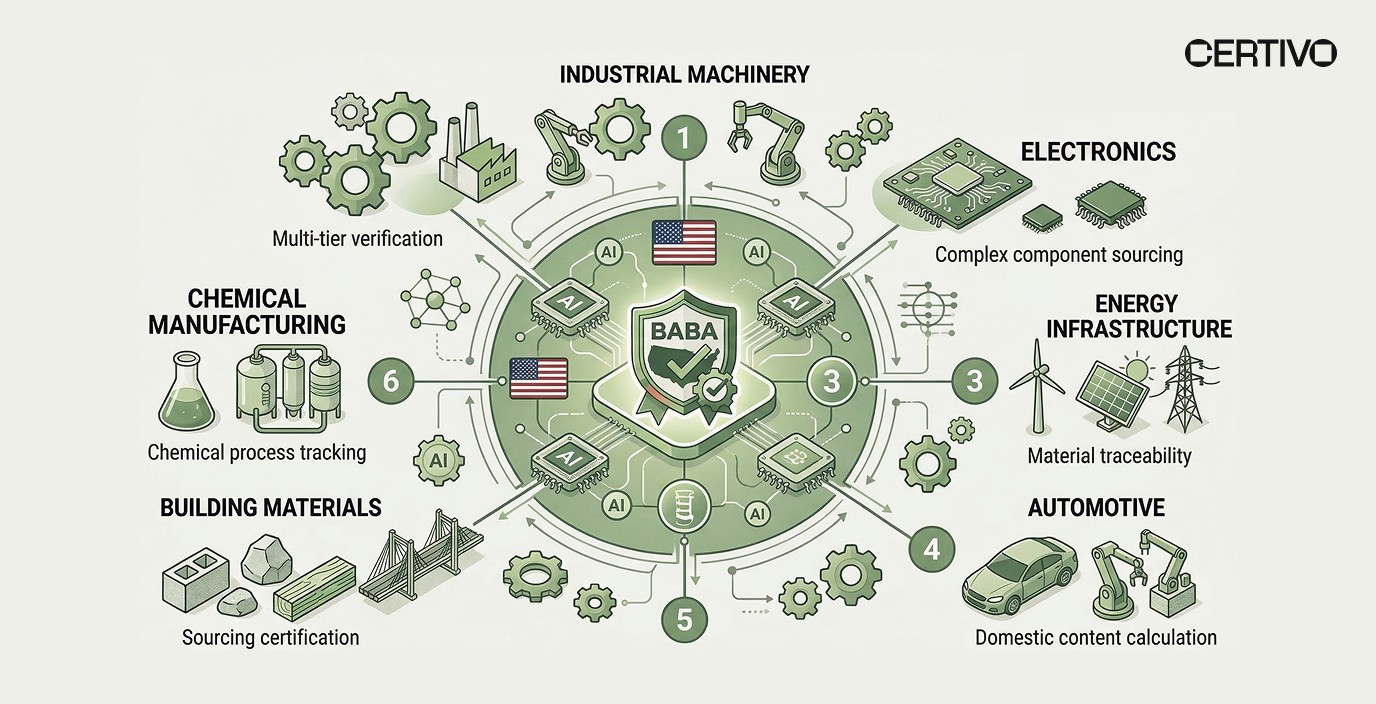
BABA applies broadly to manufacturers supplying products for federally funded infrastructure. Industrial machinery and heavy equipment manufacturers face significant compliance obligations, particularly for construction equipment, material handling systems, and infrastructure maintenance machinery used in federal projects.
Electronics manufacturing companies supplying broadband infrastructure components must track domestic content for circuit boards, electronic assemblies, and telecommunications equipment. The complexity increases when products contain imported semiconductors or specialized components unavailable from domestic sources.
Energy infrastructure projects require BABA compliance for electrical equipment, power generation components, and energy storage systems. Manufacturers of transformers, switchgear, and renewable energy equipment must verify domestic content across complex multi-tier supply chains.
Automotive manufacturing suppliers providing vehicles for federal fleets and transit agencies face dual compliance burdens: traditional automotive regulations plus BABA domestic content requirements. Components manufactured for commercial vehicles cannot automatically be certified for federal procurement without additional verification.
Building materials and construction manufacturers supply products across all BABA-covered project types. Structural steel, concrete components, HVAC systems, electrical fixtures, and finishing materials must meet domestic content thresholds, creating widespread compliance obligations across the construction supply chain.
Chemical manufacturing companies supplying water treatment chemicals, coatings, adhesives, and specialty materials must document domestic production and raw material sourcing. Chemical products used in infrastructure projects fall under construction materials requirements, mandating domestic manufacturing regardless of raw material origin.
Multi-Tier Supply Chain Verification Challenges
BABA compliance extends beyond direct suppliers to sub-tier component manufacturers. Manufacturers must trace material origin through multiple supply chain tiers, verify manufacturing locations, and maintain documentation for components they do not purchase directly.
Supplier risk scoring and due diligence identifies suppliers likely to pose compliance risks. Suppliers with complex international supply chains, frequent material substitutions, or incomplete documentation history require enhanced verification. Risk-based approaches enable manufacturers to focus resources on high-risk suppliers while maintaining baseline verification for lower-risk partners.
Centralized supplier self-service portals enable sub-tier suppliers to submit documentation directly into the manufacturer's compliance system. This eliminates manual data aggregation and ensures all supply chain participants contribute to the compliance record.
Material substitutions create compliance disruptions. When a supplier changes component sourcing, manufacturers must reverify domestic content calculations and update project-specific certifications. Continuous compliance monitoring detects supplier changes in near-real-time, triggering reverification workflows before non-compliant products ship to federal projects.
Supplier consolidation and business changes require updated attestations. When suppliers merge, change ownership, or relocate manufacturing facilities, existing certifications become invalid. Manufacturers must maintain current supplier profiles and trigger recertification when business changes occur.
Standardized supplier questionnaire frameworks ensure consistent data collection across all suppliers. Custom questionnaires create comparison challenges and incomplete data sets. Standardized templates aligned to BABA requirements enable automated compliance calculation and reduce supplier confusion.
Compliance Risks and Federal Enforcement
Federal agencies enforce BABA through multiple mechanisms. Project-level audits verify that installed materials meet domestic content requirements. Agencies may request documentation at any point during project execution or after completion, requiring manufacturers to maintain records long after product delivery.
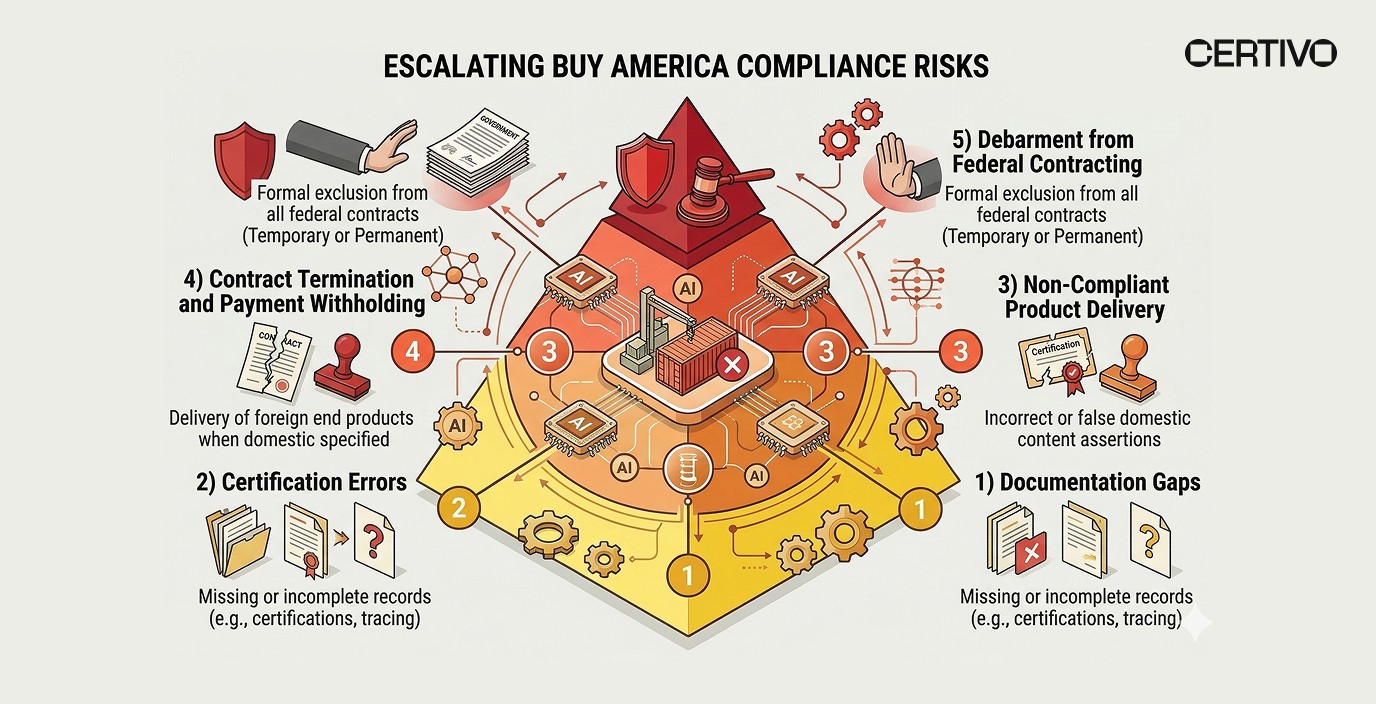
False certification penalties include contract termination, payment withholding, and debarment from federal contracting. Manufacturers who certify products as BABA-compliant without adequate verification face significant legal and financial consequences. Debarment affects a manufacturer's ability to participate in any federal procurement, not just infrastructure projects.
Regulatory intelligence and horizon scanning alerts manufacturers to enforcement actions, waiver decisions, and agency guidance updates. Federal agencies continue refining BABA implementation, issuing product-specific interpretations and clarifying documentation requirements. Manufacturers must track these developments to maintain compliant documentation practices.
Contractor claims risk extends to manufacturers. When general contractors certify BABA compliance based on manufacturer documentation, incorrect certifications expose both parties to enforcement action. Manufacturers bear responsibility for accuracy of their certifications regardless of how contractors use that documentation.
Supply chain disruptions create compliance exposure. When manufacturers cannot source domestic alternatives for critical components, they must request product-specific waivers. Waiver applications require detailed technical justifications, domestic supply market analyses, and evidence of good-faith sourcing efforts.
Continuous audit-ready documentation ensures manufacturers can respond to federal audits within required timeframes. Agencies expect complete documentation packages within days of request. Manual documentation systems cannot support this response speed across multiple concurrent projects.
Managing Region-Specific Requirements Across Projects
BABA establishes federal baseline requirements, but state and local governments may impose additional domestic content obligations for projects using combined funding sources. Manufacturers must track both federal BABA requirements and state-specific provisions that vary by jurisdiction.
What tools help manage region-specific labeling and documentation requirements? Compliance platforms with multi-jurisdiction EHS and ESG management capabilities enable manufacturers to maintain separate documentation sets for projects with layered requirements. Systems must track which projects require BABA-only compliance versus those with additional state provisions.
Materials and environmental compliance systems integrate BABA domestic content tracking with other regulatory requirements. Infrastructure projects often require simultaneous compliance with environmental regulations, material restrictions, and safety certifications. Integrated systems prevent siloed documentation and enable comprehensive project-level compliance records.
State departments of transportation may require additional certifications beyond federal BABA documentation. Manufacturers supplying products for state-funded portions of federal projects must maintain dual certification pathways, tracking which products fall under which funding stream.
Digital passports and traceability IDs enable product-level compliance tracking across multiple jurisdictions. Each product carries a unique identifier linking to comprehensive compliance documentation including domestic content calculations, supplier attestations, and project-specific certifications.
Regional material availability affects sourcing strategies. Manufacturers with plants in multiple states must determine optimal sourcing patterns that maximize domestic content while meeting delivery timelines. BOM-level material mapping enables scenario analysis comparing domestic content across different sourcing configurations.
Strategic Compliance Preparation for Federal Procurement
Manufacturers entering the federal infrastructure market must build compliance infrastructure before bidding on projects. Reactive compliance approaches create project delays, increase costs, and generate enforcement risk. Strategic preparation enables manufacturers to compete effectively while managing compliance obligations.
Supplier qualification programs establish baseline compliance requirements for all suppliers. Manufacturers must communicate BABA requirements clearly, provide suppliers with documentation templates, and verify compliance before adding suppliers to approved vendor lists. Supplier risk scoring and ESG ratings prioritize suppliers with demonstrated domestic content capabilities.
BOM analysis identifies products requiring design modifications to meet domestic content thresholds. Manufacturers may need to redesign products, qualify alternative suppliers, or develop domestic sourcing for components currently imported. Early analysis prevents mid-project compliance failures that disrupt delivery schedules.
Centralized compliance data backbone maintains supplier attestations, material origin data, and domestic content calculations in a single system of record. Fragmented data across spreadsheets, email, and document repositories prevents efficient project-level certification and creates audit response delays.
Cross-functional alignment between procurement, engineering, and compliance teams ensures everyone understands BABA requirements. What platforms support collaboration between compliance, engineering, and procurement teams? Integrated compliance platforms enable real-time visibility into sourcing decisions, design changes, and supplier qualifications that affect domestic content calculations.
Design-for-compliance PLM workflows incorporate BABA requirements into product development processes. Engineers receive real-time feedback on domestic content implications of design decisions, enabling proactive compliance rather than post-design verification.
Documentation standardization creates efficiency across multiple projects. Manufacturers bidding on numerous federal infrastructure projects cannot maintain custom documentation approaches for each project. Standardized certification templates, supplier questionnaires, and calculation methodologies enable scalable compliance across growing federal opportunity pipelines.
How Certivo Automates Buy America Compliance
Certivo provides manufacturers with an AI-native compliance automation platform that addresses BABA's unique challenges. The system manages domestic content calculations, supplier data collection, and project-specific certification generation through integrated workflows that eliminate manual spreadsheet reconciliation.
CORA-powered regulatory intelligence monitors federal agency guidance, waiver decisions, and enforcement actions, alerting manufacturers to changes affecting their compliance obligations. The platform maintains updated product category interpretations and domestic content calculation methodologies aligned to current agency requirements.
Automated supplier data collection portals enable manufacturers to gather attestations from hundreds of suppliers without email-based manual processes. Suppliers receive customized questionnaires aligned to BABA requirements, submit documentation directly into the compliance system, and update information when business changes occur.
BOM-level compliance intelligence calculates domestic content automatically based on component origin data, supplier attestations, and cost information. The system identifies non-compliant products before they ship, flags components requiring alternative sourcing, and generates project-specific certifications linking products to verified supplier data.
Continuous compliance monitoring detects supplier changes, material substitutions, and business events that affect existing certifications. Automated alerts trigger reverification workflows, ensuring manufacturers maintain accurate compliance records throughout long-duration infrastructure projects.
AI document parsing extracts structured data from supplier certificates, mill test reports, and attestation documents. The system validates document completeness, flags inconsistencies between supplier declarations and product specifications, and maintains version-controlled document lineage for audit purposes.
Multi-framework compliance management enables manufacturers to track BABA requirements alongside conflict minerals, REACH, RoHS, and other obligations within a single system. Infrastructure projects often require simultaneous compliance with multiple frameworks, and siloed documentation creates inefficiency and error risk.
Project-level compliance dashboards provide executive visibility into certification status across active federal infrastructure bids and contracts. Leadership teams can identify projects requiring additional supplier verification, track documentation completion rates, and monitor compliance posture without navigating spreadsheets or email threads.
Certivo shifts manufacturers from reactive compliance verification to continuous audit-ready documentation that scales across growing federal infrastructure opportunity. The platform maintains the centralized compliance data backbone necessary to support multiple concurrent projects while reducing manual documentation burden on compliance and procurement teams.
Replace spreadsheets with a scalable system purpose-built for federal procurement compliance obligations that extend across years-long project lifecycles and involve hundreds of suppliers and thousands of components.
Frequently Asked Questions
What platforms help track and manage product registrations for federal infrastructure projects?
Certivo maintains centralized records of product certifications, project-specific compliance documentation, and supplier attestations within a single system. The platform tracks which products are certified for which projects, monitors certification expiration dates, and triggers renewal workflows when supplier data requires updates. CORA intelligence ensures manufacturers maintain current certifications aligned to evolving federal agency requirements.
What systems help manage compliance for both commercial and federal infrastructure product lines?
Certivo's centralized compliance data backbone manages commercial regulatory obligations alongside BABA requirements without creating duplicate documentation workflows. The platform calculates domestic content for federal projects while tracking REACH, RoHS, and PFAS compliance for commercial products using shared BOM data and supplier information.
What solutions help manage compliance-related tasks between global and local teams?
Certivo enables role-based access for global compliance teams, regional procurement groups, and plant-level engineering staff. The platform maintains audit trails showing who accessed documentation, approved certifications, and made supplier qualification decisions. Standardize compliance across plants and regions through consistent workflows and centralized data regardless of team location.
How do manufacturers handle domestic content calculation when suppliers change materials?
Certivo's continuous compliance monitoring detects supplier material changes through automated data collection and triggers reverification workflows. The platform recalculates domestic content based on updated component information, flags products falling below thresholds, and generates alerts enabling manufacturers to address compliance gaps before shipping to federal projects.
What tools support automated alerts when federal procurement requirements change?
Certivo's CORA intelligence layer monitors federal agency guidance, waiver decisions, and product-specific interpretations. The system maps regulatory changes to affected products and projects, alerting compliance teams to documentation updates required to maintain BABA certification. Regulatory intelligence and horizon scanning prevents compliance gaps from emerging due to evolving requirements.
Conclusion
Public infrastructure procurement compliance under Buy America rules requires manufacturers to establish systematic documentation processes, verify multi-tier supply chain data, and maintain audit-ready records throughout project lifecycles. Manual approaches cannot scale across multiple concurrent federal projects while managing domestic content calculations for thousands of components and hundreds of suppliers.
Manufacturers supplying public infrastructure procurement must shift from reactive certification to continuous compliance posture built on automated supplier data collection, BOM-level compliance intelligence, and integrated documentation workflows. The federal infrastructure investment creates significant market opportunity for manufacturers prepared to demonstrate BABA compliance through evidence-based documentation and transparent supply chain verification.
Certivo enables manufacturers to compete effectively for federal infrastructure contracts through AI-native compliance automation that manages domestic content calculation, supplier attestation collection, and project-specific certification generation within a single platform. Contact Certivo to see how leading manufacturers maintain continuous audit readiness for Buy America compliance across growing federal infrastructure project portfolios.
Kunal Chopra
Kunal Chopra is the CEO of Certivo, an AI-driven compliance management platform revolutionizing how manufacturers navigate regulatory challenges. With a career spanning over two decades, Kunal is a seasoned technology leader, 3x tech CEO, product innovator, and board member with a passion for driving transformative growth and innovation.
Before leading Certivo, Kunal spearheaded successful transformations at renowned companies like Beckett Collectibles, Kaspien, Amazon, and Microsoft. His strategic vision and operational excellence have led to achievements such as a 25x EBITDA valuation increase at Beckett Collectibles and a 450% shareholder return at Kaspien. He has a track record of turning challenges into opportunities, delivering operational efficiencies, and driving market expansions.
Kunal’s deep expertise lies in blending technology and business strategy to create scalable solutions. At Certivo, he applies this expertise to empower manufacturers, using AI to turn product compliance from an operational burden into a strategic advantage.
Kunal holds an MBA from The University of Chicago Booth School of Business, an MS in Computer Science from Clemson University, and a BE in Computer Engineering from The University of Mumbai. When he’s not transforming businesses, Kunal is an advocate for innovation, growth, and building cultures that inspire excellence.
Stay tuned for insights from Kunal on how technology can redefine compliance, drive efficiency, and create opportunities for growth in the manufacturing sector.