


The Government of Canada has brought the Prohibition of Certain Toxic Substances Regulations, 2025 into force with an effective date of June 30, 2026. Developed through Environment and Climate Change Canada (ECCC) and Health Canada, these regulations establish restrictions on the manufacture, use, sale, offer for sale, and import of certain toxic substances, including per- and polyfluoroalkyl substances (PFAS) as a class.
This is not an incremental update. Canada is shifting from regulating individual PFAS substances toward a class-based regulatory approach, applying restrictions across the entire PFAS chemical family rather than targeting specific compounds one at a time. In parallel, the government has introduced a public Watch List registry that identifies substances capable of becoming toxic in the future, creating an early warning mechanism for compliance teams.
For manufacturers, importers, and distributors selling into or sourcing from Canada, the June 30, 2026 deadline creates immediate obligations around product portfolio assessment, supplier disclosure, and substance-level documentation.
📌 Book a free compliance assessment to understand your exposure to Canada's PFAS restrictions across products and supply chains.
Key Takeaways
📌 Canada's Prohibition of Certain Toxic Substances Regulations, 2025 takes effect June 30, 2026, restricting the manufacture, use, sale, and import of PFAS as a chemical class.
⚠️ The class-based PFAS approach means manufacturers cannot rely on individual substance exemptions alone and must assess entire product portfolios for PFAS content.
⏳ The June 30, 2026 effective date leaves a narrow compliance window for organizations that have not yet begun product and supply chain assessments.
🏭 Industries spanning electronics, automotive, aerospace, consumer products, textiles, food packaging, and firefighting equipment face direct compliance impact.
🔗 Multi-tier supply chain transparency becomes essential, as PFAS content often originates in upstream raw materials and intermediate components.
📄 Canada's new Watch List registry signals future substance restrictions, requiring regulatory intelligence capabilities to track emerging obligations.
🤖 AI-driven compliance platforms enable faster PFAS substance identification, supplier data collection, and audit-ready documentation at scale.
What Is the Prohibition of Certain Toxic Substances Regulations, 2025
The Prohibition of Certain Toxic Substances Regulations, 2025 is a Canadian federal regulation that strengthens the country's chemical management framework by establishing regulatory restrictions on specific toxic substances, including PFAS. The regulation was developed under the Canadian Environmental Protection Act (CEPA) and is administered by Environment and Climate Change Canada (ECCC) and Health Canada.
The restrictions apply to four key activities: manufacture, use, sale (including offer for sale), and import of regulated substances. The regulation targets persistent, bioaccumulative, and toxic substances, with a stated objective of reducing environmental and human exposure while encouraging safer alternatives.
For a broader view of PFAS regulatory developments across jurisdictions, see the Global PFAS Regulations Master Guide on Certivo.
Why Canada's Class-Based PFAS Approach Changes Compliance Strategy
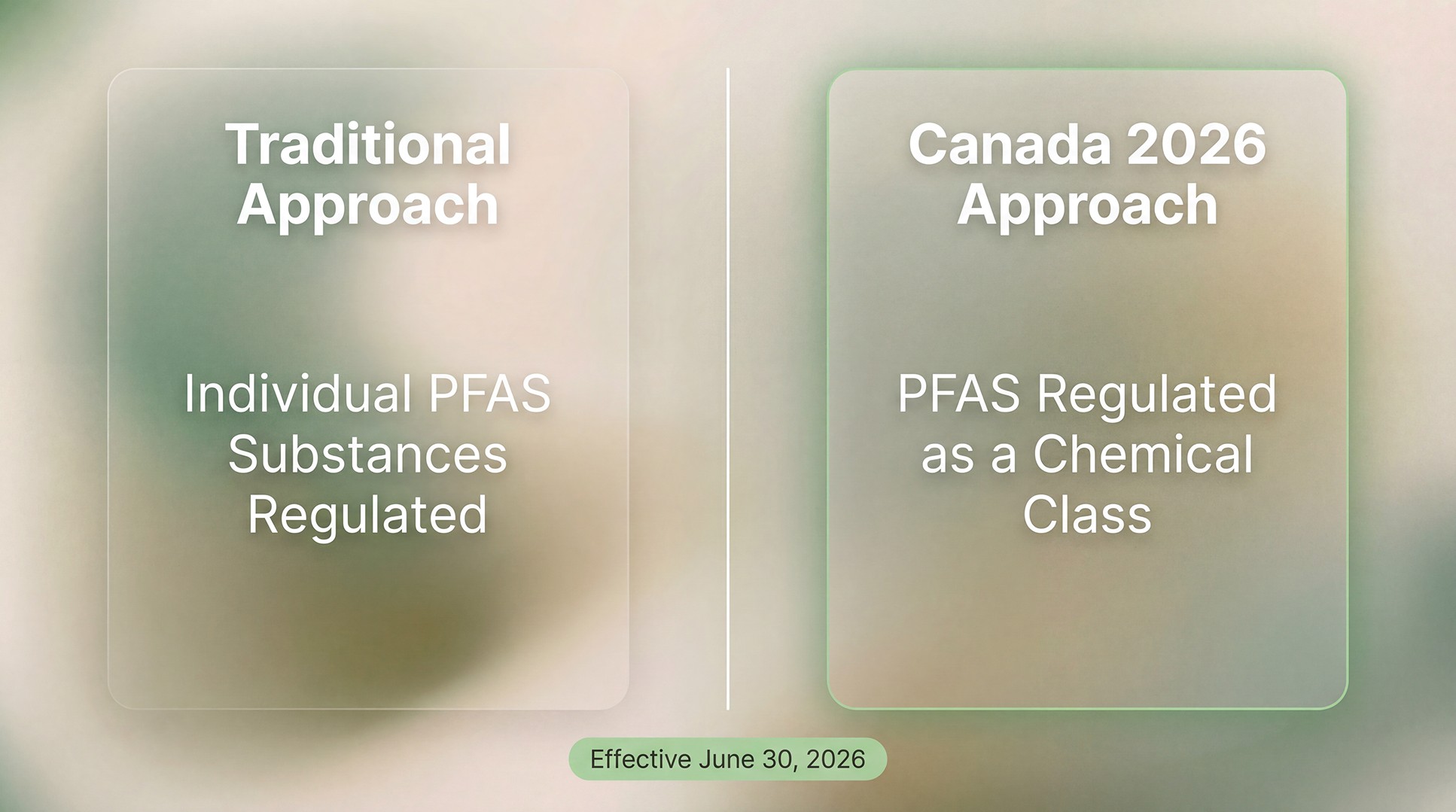
The most significant aspect of this regulation is the treatment of PFAS as a chemical class rather than as individual substances. This represents a fundamental shift in how Canada regulates fluorinated chemicals.
What Class-Based Regulation Means in Practice
Under traditional substance-by-substance regulation, manufacturers could assess compliance by checking products against a defined list of restricted PFAS compounds. If a specific PFAS was not on the list, the product was considered compliant, even if it contained other PFAS substances.
Under Canada's class-based approach, the restriction applies broadly to PFAS as a group. This means:
✓ Products containing any PFAS substance may fall within the scope of the restriction
✓ Manufacturers cannot rely solely on matching individual CAS numbers against a finite list
✓ Compliance assessments must consider the broader presence of fluorinated chemistries in materials, coatings, and components
✓ Supplier declarations must address PFAS content at a class level, not just for individually named substances
For compliance engineers managing PFAS and chemicals risk management programs, this shift demands a more comprehensive approach to substance identification across product portfolios and supply chains. Screening for a handful of named PFAS compounds is no longer sufficient.
Organizations tracking PFAS developments across North America should also review state-level PFAS regulations in the US to understand the broader continental compliance landscape.
What Is Canada's Watch List Approach
In parallel with the toxic substances regulations, the Government of Canada has introduced a Watch List Approach, a public registry that identifies substances determined to be capable of becoming toxic under CEPA.
Purpose and Compliance Implications
The Watch List is designed to provide greater transparency and early awareness of substances that may become subject to future risk assessments, restrictions, or regulatory actions. Based on currently available regulatory guidance, the Watch List serves as a forward-looking signal to industry rather than an immediate compliance obligation.
However, compliance leaders should treat Watch List inclusions as actionable intelligence:
⚠ Substances on the Watch List may progress toward formal restriction over time
⚠ Early identification allows manufacturers to begin substitution planning and supplier engagement before restrictions take effect
⚠ Proactive tracking of Watch List substances demonstrates due diligence during audits and customer inquiries
For organizations investing in regulatory intelligence and horizon scanning capabilities, the Watch List provides a structured data source for anticipating future compliance requirements rather than reacting after restrictions are finalized.
More detail on Canada's Watch List approach is available from Bergeson & Campbell, P.C..
Which Industries Are Affected
The Prohibition of Certain Toxic Substances Regulations, 2025 affects a broad cross-section of manufacturing and distribution sectors due to the widespread use of PFAS in industrial applications.
Industry | Primary PFAS Exposure Areas |
|---|---|
Chemical Manufacturing | Raw material production, fluorinated intermediates |
Electronics & Electrical Equipment | Coatings, solder materials, wire insulation |
Automotive & Transportation | Fuel system components, seals, gaskets, coatings |
Aerospace & Defense | High-performance coatings, lubricants, sealants |
Consumer Products Manufacturing | Non-stick coatings, water-resistant treatments |
Textiles & Apparel | Stain-resistant and water-repellent finishes |
Food Packaging | Grease-resistant coatings, food contact materials |
Industrial Manufacturing | Hydraulic fluids, anti-corrosion treatments |
Firefighting Equipment | Aqueous film-forming foam (AFFF), protective gear |
Importers & Distributors | Products containing PFAS from global supply chains |
Manufacturers in electronics, automotive, aerospace and defense, and consumer goods sectors face the broadest impact given the prevalence of PFAS across their material supply chains.
For a detailed look at PFAS in electronics specifically, see PFAS in Electronics Manufacturing on Certivo.
Canada PFAS class-based regulation 2026 versus individual substance approach
Click on image to view full
Key Compliance Requirements for Manufacturers and Importers
Based on currently available regulatory guidance, the Prohibition of Certain Toxic Substances Regulations, 2025 establishes the following core compliance requirements:
Restrictions on Key Activities
The regulations restrict four activities for covered toxic substances, including PFAS:
✓ Manufacture of regulated substances within Canada
✓ Use of regulated substances in manufacturing processes or products
✓ Sale and offer for sale of products containing regulated substances in the Canadian market
✓ Import of products or materials containing regulated substances into Canada
Documentation and Evidence Expectations
While the specific reporting mechanisms will depend on enforcement guidance from ECCC, manufacturers and importers should prepare for:
📄 Product-level PFAS content assessments across active portfolios
📄 Supplier declarations addressing PFAS content at the class level
📄 Evidence of substitution efforts or alternative material evaluations where applicable
📄 Records supporting due diligence in supply chain assessments
Organizations managing materials and environmental compliance across multiple jurisdictions should incorporate Canada's PFAS requirements into existing compliance workflows rather than treating them as a standalone program.
📌 Managing PFAS compliance across multiple jurisdictions? See how Certivo centralizes substance tracking. Book a Demo
Supply Chain and Operational Impact
The class-based PFAS restriction creates supply chain challenges that compound as they flow upstream through multiple tiers.
Upstream Challenges
PFAS content often originates not in finished products but in upstream raw materials, coatings, adhesives, and chemical intermediates. Tier 1 suppliers may not have visibility into PFAS usage at Tier 2 or Tier 3 levels. This makes multi-tier supply chain transparency essential for compliance with Canada's regulation.
Specific challenges include:
⚠ Suppliers unfamiliar with class-level PFAS declarations may submit incomplete or inaccurate data
⚠ Many existing supplier questionnaires are designed for individual substance reporting and must be updated
⚠ Smaller suppliers may lack the technical capability to assess PFAS content without guidance
Downstream Challenges
Manufacturers selling into the Canadian market must provide assurance that finished products meet the regulation's requirements. Customer audits, particularly from Canadian OEMs and retailers, are likely to increase scrutiny on PFAS documentation.
For organizations already using automated supplier data collection portals, updating questionnaires to include class-level PFAS queries is a configuration change. For those still relying on email and spreadsheets, the data collection burden increases significantly.
Certivo's supplier self-service compliance portals enable suppliers to submit PFAS declarations directly, with built-in validation to flag incomplete responses before they reach compliance teams.
Compliance Risks and Enforcement Exposure
Failure to comply with the Prohibition of Certain Toxic Substances Regulations, 2025 exposes organizations to multiple risk categories:
Regulatory Penalties — Violations of regulations under CEPA can result in enforcement actions, including fines and orders to cease non-compliant activities. The class-based scope of the PFAS restriction broadens the range of potential non-compliance findings.
Market Access Disruption — Products found to contain restricted substances may be barred from sale or import into Canada, disrupting revenue and customer relationships.
Customer Audit Findings — Canadian OEMs and brand customers are expected to incorporate the regulation into their supplier qualification requirements. Suppliers unable to demonstrate compliance risk corrective action requests or removal from approved supplier lists.
Reputational Exposure — Investors, ESG rating agencies, and civil society organizations increasingly scrutinize PFAS exposure. Non-compliance with Canadian regulations adds to cumulative reputational risk.
Organizations maintaining continuous audit-ready documentation are better positioned to respond to enforcement inquiries without scrambling to assemble evidence retroactively. The goal is not to be audit-proof, as no system eliminates audit findings entirely, but to be audit-ready, with structured evidence and fast retrieval times.
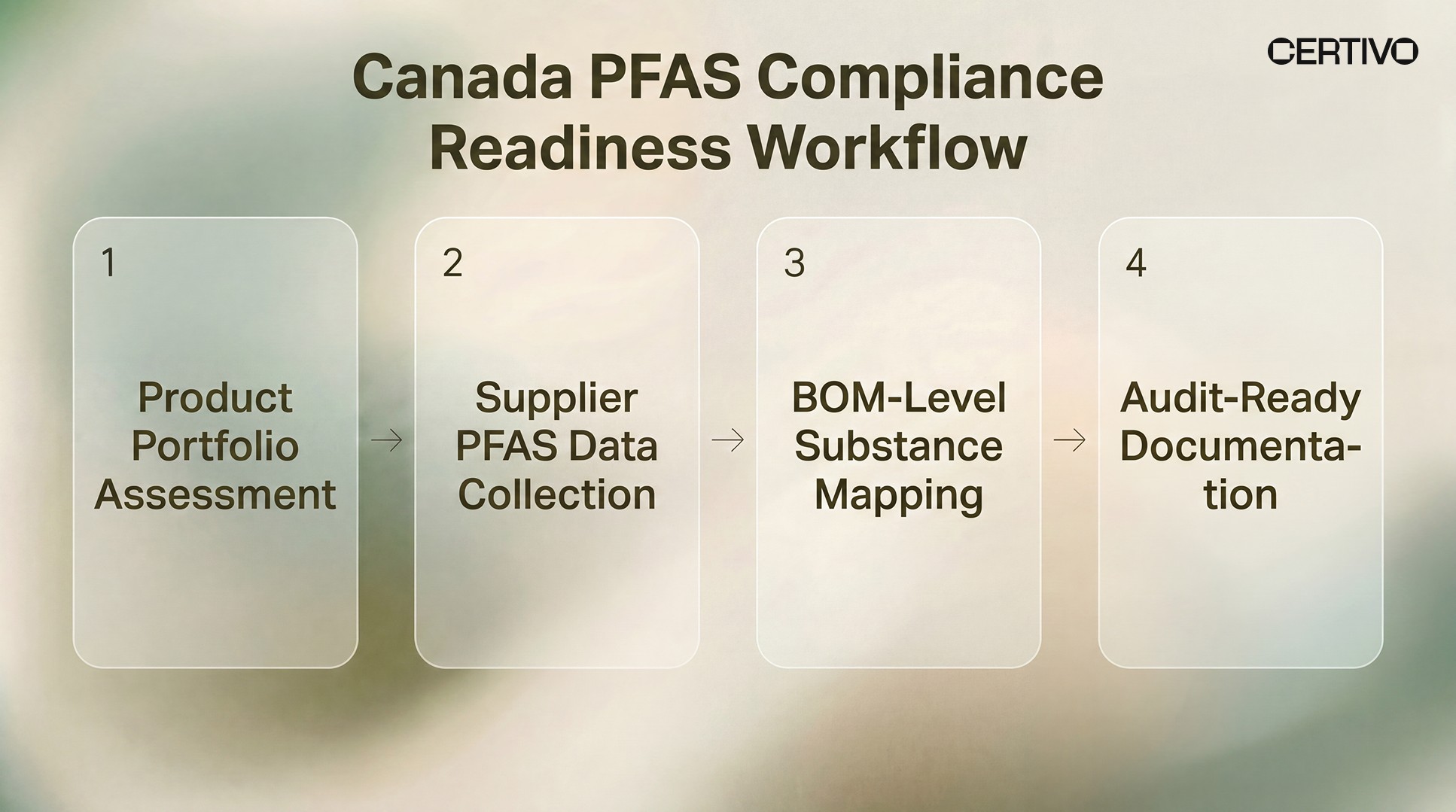
How to Prepare: Strategic Compliance Checklist
Canada PFAS compliance preparation workflow for manufacturers and importers
Click on image to view full
How AI and Automation Support Canada PFAS Compliance
Class-based PFAS regulation fundamentally changes the scale of compliance effort. Instead of screening for a defined list of individual substances, compliance teams must assess broad PFAS content across thousands of materials, components, and supplier relationships. Manual processes cannot absorb this scale increase without proportional headcount growth.
AI-Powered Substance Identification
CORA-powered regulatory intelligence enables automated identification of PFAS-relevant materials across product portfolios and supplier submissions. CORA's AI document parsing and certificate validation capabilities extract substance data from supplier declarations, test reports, and safety data sheets, flagging potential PFAS content that manual review might miss.
Automated Supplier Data Collection
Certivo's supplier self-service compliance portals allow suppliers to submit class-level PFAS declarations directly, with built-in validation to ensure completeness before data reaches compliance teams. This eliminates the manual chase cycle of email follow-ups and version confusion.
Centralized Compliance Data Backbone
Managing PFAS compliance alongside REACH, RoHS, Prop 65, TSCA, and other frameworks requires a centralized compliance data backbone that normalizes substance data across regulations and links it to specific products and BOMs. Certivo provides this single source of truth for organizations managing compliance across multiple jurisdictions and frameworks.
Regulatory Horizon Scanning
CORA's regulatory intelligence layer monitors developments including Canada's Watch List additions, enabling compliance teams to anticipate future restrictions rather than react after they take effect. This supports the shift from reactive compliance toward continuous compliance monitoring and audit readiness.
For a deeper perspective on AI in compliance, see AI Tools for Compliance Management: The Complete Guide.
Executive Conclusion
Canada's Prohibition of Certain Toxic Substances Regulations, 2025 represents one of the most significant shifts in North American chemical regulation. By treating PFAS as a chemical class rather than restricting individual substances, Canada is raising the bar for product portfolio transparency, supplier engagement, and substance-level documentation. The introduction of the Watch List registry further signals that the regulatory scope will continue to expand.
For manufacturers, importers, and distributors with exposure to the Canadian market, the June 30, 2026 effective date is not distant. Organizations that have not yet begun product assessments, supplier outreach, and BOM-level PFAS mapping face compressed timelines and elevated audit risk.
Investing in AI-native compliance automation, centralized supplier self-service portals, and regulatory intelligence and horizon scanning capabilities is the most effective strategy for managing Canada's PFAS requirements alongside the growing patchwork of global PFAS regulations without proportional increases in manual effort.
📌 Book a demo to see how Certivo automates PFAS compliance across your product portfolio and multi-tier supply chain, or get a free compliance risk assessment to evaluate your current exposure to Canada's toxic substances regulations.
FAQs
1. What is the effective date for Canada's Prohibition of Certain Toxic Substances Regulations, 2025?
The regulation takes effect on June 30, 2026. Manufacturers, importers, and distributors must comply with restrictions on the manufacture, use, sale, and import of regulated substances, including PFAS, by that date. CORA-powered regulatory intelligence can track compliance deadlines across jurisdictions automatically.
2. How does Canada's class-based PFAS approach differ from US PFAS regulations?
Canada restricts PFAS as an entire chemical class, while US federal regulations under TSCA currently focus on individual PFAS substances and reporting obligations. This means Canadian compliance requires broader substance screening. Certivo's centralized compliance data backbone supports both class-level and substance-specific PFAS tracking across jurisdictions.
3. What is the Watch List and does it create immediate compliance obligations?
Based on currently available regulatory guidance, the Watch List is a public registry of substances capable of becoming toxic under CEPA. It does not create immediate restrictions but serves as an early warning for potential future regulation. Compliance teams should monitor Watch List additions as part of their regulatory horizon scanning programs.
4. Which products are most likely to contain PFAS under Canada's regulation?
PFAS is commonly found in non-stick coatings, water-resistant textiles, food packaging, electronic components, hydraulic fluids, firefighting foams, and industrial sealants. Any product using fluorinated chemistries for performance properties should be assessed. Certivo supports BOM-level material mapping to identify PFAS across complex product structures.
5. How can manufacturers manage class-level PFAS supplier declarations at scale?
Manual email-based data collection cannot scale for class-level PFAS assessments across hundreds of suppliers. Automated supplier self-service portals with built-in validation enable suppliers to submit PFAS declarations directly, reducing follow-up cycles and ensuring data completeness before compliance review.
Lavanya
Lavanya is an accomplished Product Compliance Engineer with over four years of expertise in global environmental and regulatory frameworks, including REACH, RoHS, Proposition 65, POPs, TSCA, PFAS, CMRT, FMD, and IMDS. A graduate in Chemical Engineering from the KLE Institute, she combines strong technical knowledge with practical compliance management skills across diverse and complex product portfolios.
She has extensive experience in product compliance engineering, ensuring that materials, components, and finished goods consistently meet evolving international regulatory requirements. Her expertise spans BOM analysis, material risk assessments, supplier declaration management, and test report validation to guarantee conformity. Lavanya also plays a key role in design-for-compliance initiatives, guiding engineering teams on regulatory considerations early in the product lifecycle to reduce risks and streamline market access