


U.S. state-level PFAS regulations are accelerating faster than many manufacturers anticipated. In 2026, Connecticut, Vermont, Maine, Massachusetts, and New Jersey are each enforcing new or expanded restrictions on per- and polyfluoroalkyl substances — the persistent "forever chemicals" found across consumer products, packaging, textiles, and industrial applications. These state PFAS regulations 2026 create a fragmented compliance landscape that demands immediate attention from compliance directors, supply chain leaders, and executive teams.
Unlike a single federal mandate, these state-by-state rules introduce different bans, labeling requirements, wastewater monitoring standards, and drinking water thresholds — all with overlapping but distinct timelines. For manufacturers selling across multiple U.S. states, the operational burden is substantial. Organizations that have not yet mapped their PFAS exposure across product portfolios risk enforcement action, lost market access, and reputational damage.
This regulatory update covers every material obligation across all five states, what has changed, who is affected, and how to prepare.
Table of Contents
What Changed: The 2026 State PFAS Regulatory Wave
Key State-by-State Requirements and Obligations
Affected Industries and Product Categories
Chemicals in Scope: Understanding the PFAS Universe
Compliance Risks and Penalties
Timeline and Enforcement Dates
Operational and Supply Chain Impact
Compliance Readiness Checklist
The Role of AI in Multi-State PFAS Compliance
FAQs
Executive Conclusion
1. What Changed: The 2026 State PFAS Regulatory Wave
The regulatory approach to PFAS in the United States has shifted decisively from federal-level rulemaking to aggressive state-level action. While the EPA continues to develop federal PFAS frameworks, five states have moved ahead with enforceable restrictions that take effect in 2026. For context on how federal PFAS reporting obligations interact with these state rules, see the TSCA Section 8(a)(7) PFAS reporting requirements.
These state-level measures fall into four categories:
Product sales bans — outright prohibition of PFAS in specific consumer product categories
Labeling and disclosure requirements — mandatory identification of PFAS presence on product packaging
Wastewater monitoring guidance — updated testing protocols for treatment facilities handling PFAS
Drinking water standards — enforceable maximum contaminant levels for PFAS in public water systems
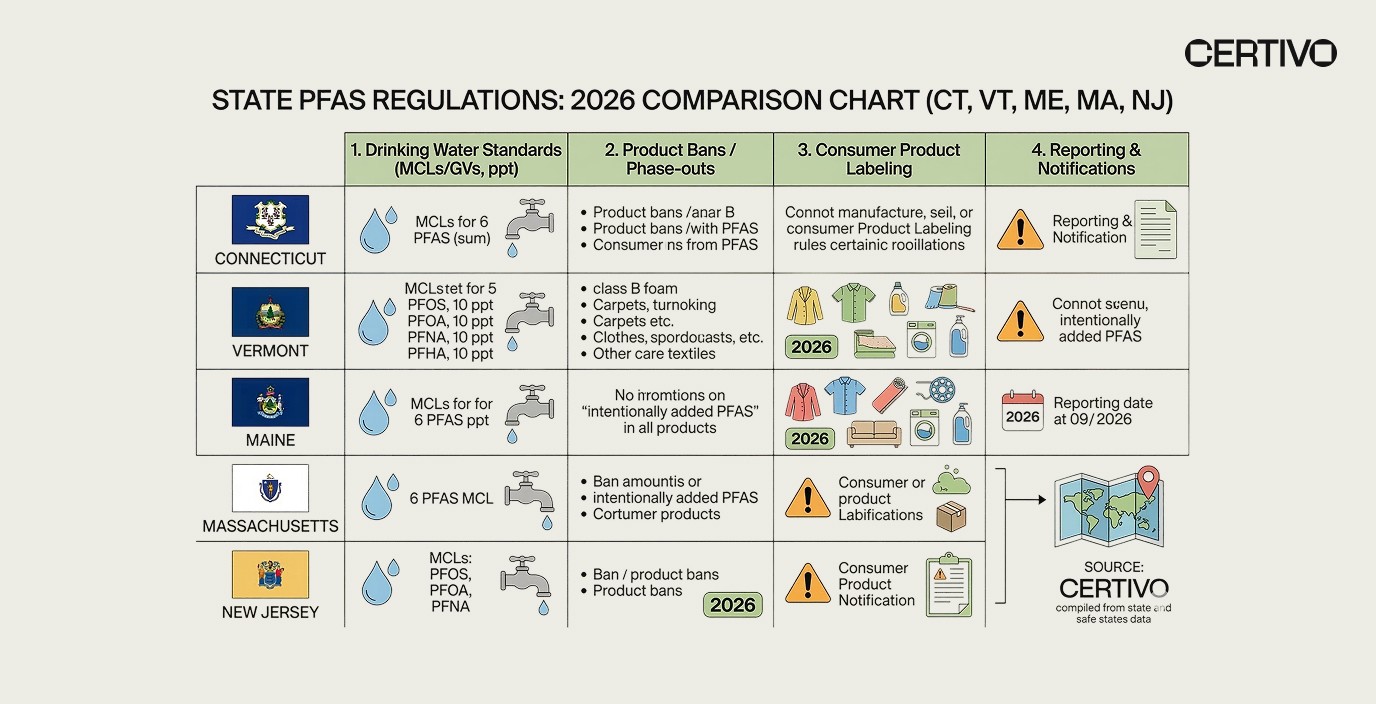
⚠ The critical compliance challenge: Each state defines scope, thresholds, product categories, and timelines differently. A product compliant in Massachusetts may violate Connecticut's labeling rules or Maine's sales ban. Organizations selling nationally must track and comply with the strictest applicable standard across every state where they operate.
This fragmentation makes centralizing compliance from silos to a single source of truth an operational necessity rather than an efficiency preference.
Preview & Download this image ⏬
2. Key State-by-State Requirements and Obligations
Each state's PFAS regulation carries distinct requirements. Manufacturers, importers, and brands must evaluate obligations at the state level — not just nationally. Understanding the complete PFAS regulatory frameworks is essential for mapping overlapping obligations.
Connecticut
Connecticut has enacted a phased approach to PFAS in consumer products:
Requirement | Detail |
|---|---|
Labeling mandate | Products containing intentionally added PFAS must carry disclosure labels |
Effective date | July 1, 2026 |
Future sales ban | Full sales ban on PFAS in covered product categories effective January 1, 2028 |
Scope | Consumer products including cookware, textiles, cleaning products |
The labeling requirement beginning July 2026 is the immediate compliance trigger. Manufacturers must identify whether their products contain intentionally added PFAS and update packaging accordingly. For detailed guidance, refer to Connecticut DEEP's PFAS in Products page. Companies managing complex label variations across states should explore how to launch new products faster while maintaining compliance.
Vermont
Vermont's PFAS restrictions represent some of the broadest product-category bans in the United States:
Requirement | Detail |
|---|---|
Sales ban | PFAS prohibited in textiles, furniture, cookware, and other consumer product categories |
Effective date | Phased implementation through 2026 |
Scope | Broad consumer product categories with intentionally added PFAS |
Vermont's approach eliminates the option of labeling as an alternative — products containing intentionally added PFAS simply cannot be sold. This requires manufacturers to either reformulate or withdraw affected products from the Vermont market. Compliance regulation managers must evaluate product portfolios immediately to identify at-risk SKUs.
Maine
Maine has adopted one of the most comprehensive PFAS product ban frameworks in the country:
Requirement | Detail |
|---|---|
Sales ban | Broad prohibition on PFAS in all consumer products |
Effective date | Phased, with key milestones in 2026 |
Scope | All products containing intentionally added PFAS unless an exemption is granted |
Maine's law is notable for its breadth — it applies to virtually all consumer products, not just specific categories. Manufacturers must demonstrate that any PFAS present is not intentionally added, or secure an exemption. This makes BOM-level material mapping critical for documenting substance presence at the component level.
Massachusetts
Massachusetts has focused its 2026 PFAS actions on environmental monitoring rather than product bans:
Requirement | Detail |
|---|---|
Wastewater testing guidance | Updated PFAS testing protocols for wastewater treatment facilities |
Effective date | March 4, 2026 |
Scope | Wastewater treatment plants and industrial dischargers |
While this primarily affects utilities and industrial facilities, manufacturers that discharge wastewater containing PFAS — even indirectly through municipal systems — must assess their exposure. For official guidance, refer to Massachusetts PFAS in Drinking Water information. Industrial manufacturers should evaluate how ESG and sustainability compliance obligations intersect with these water quality requirements.
New Jersey
New Jersey continues to enforce some of the strictest PFAS drinking water standards in the nation:
Requirement | Detail |
|---|---|
Drinking water MCLs | Maximum contaminant levels for PFOA, PFOS, and PFNA among the lowest nationally |
Enforcement | Ongoing, with continued monitoring and enforcement |
Scope | Public water systems, industrial dischargers, contaminated sites |
New Jersey's standards apply primarily to water utilities and industrial sites, but manufacturers operating facilities in the state must ensure their operations do not contribute to PFAS contamination. For regulatory details, see New Jersey DEP PFAS page. Organizations managing multi-state facility compliance should review how to standardize compliance across plants and regions.
3. Affected Industries and Product Categories
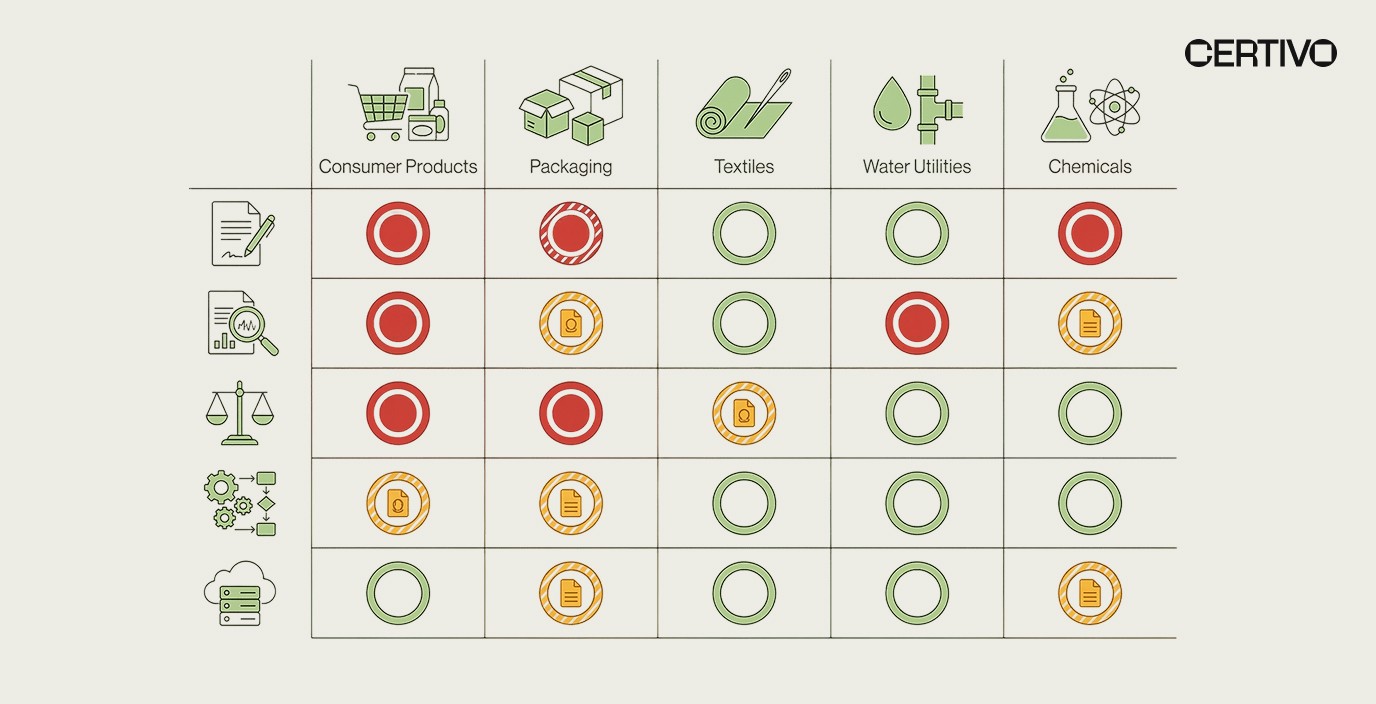
The combined effect of these five state regulations impacts multiple manufacturing sectors. The breadth of coverage means that proactive compliance risk management is essential for any company selling consumer products in the United States.
Industry | Impact | Key States |
|---|---|---|
Consumer Products & Retail | ⚠ High — cosmetics, cleaning products, cookware, and textiles face bans and labeling requirements | CT, VT, ME |
Packaging Industry | ⚠ High — food packaging and coated materials containing PFAS face restrictions | CT, VT, ME |
Textile Manufacturing | ⚠ High — water- and stain-resistant fabrics are a primary target | CT, VT, ME |
Water & Wastewater Utilities | ⚠ Medium — monitoring and treatment requirements expanding | MA, NJ |
Chemical & Materials Industry | ⚠ High — PFAS-containing formulations and additives face downstream demand reduction | All states |
For manufacturers in the cosmetics sector, PFAS-free reformulation is now a market access requirement in multiple states — not just a brand differentiator. Companies producing industrial electronics or automotive components should also evaluate whether PFAS-containing coatings or treatments in their products trigger state-level obligations.
4. Chemicals in Scope: Understanding the PFAS Universe
PFAS are a large group of synthetic fluorinated chemicals — numbering over 12,000 identified compounds — used across manufacturing for their unique properties. For an in-depth look at how these compounds are tracked at scale, see managing 12,000 PFAS compounds with AI-powered compliance.
Common applications targeted by these state regulations include:
✓ Water-resistant coatings — outdoor apparel, footwear, furniture
✓ Non-stick cookware — consumer kitchen products
✓ Food packaging barriers — grease-resistant wrappers, containers, trays
✓ Textile stain repellents — carpets, upholstery, clothing
✓ Industrial surfactants — processing aids in manufacturing
⚠ Key challenge: Most state regulations target "intentionally added" PFAS, but the definition and threshold for "intentionally added" varies. Some states define it by detectable concentration, others by function. Manufacturers need substance-level data — not just category-level assumptions — to determine compliance status. Multi-regulation substance coverage capabilities are critical for mapping PFAS presence against the specific definitions used by each state.
5. Compliance Risks and Penalties
Non-compliance with state PFAS regulations carries escalating consequences. Each state has its own enforcement mechanism, and penalties can compound across jurisdictions for companies selling nationally. Organizations that rely on manual tracking should understand why people-only compliance cannot scale in a multi-state environment.
Product sales bans — non-compliant products may be pulled from shelves or blocked at point of sale
Labeling violations — failure to disclose PFAS presence triggers state consumer protection enforcement
Civil penalties — state environmental agencies can impose fines per violation, per product, per day
Market access loss — retailers increasingly require PFAS-free certification as a procurement condition
Reputational damage — public enforcement actions and consumer litigation create brand risk
⚠ Even where a state has not yet enacted its own PFAS law, retailers operating in restricted states may require suppliers to meet the strictest standard. Compliance teams should use customer trust centers and self-service reporting capabilities to proactively demonstrate compliance to buyers.
6. Timeline and Enforcement Dates
📊 Critical dates for 2026 and beyond:
State | Action | Effective Date |
|---|---|---|
Connecticut | PFAS labeling requirements for covered products | July 1, 2026 |
Connecticut | Full PFAS sales ban in covered product categories | January 1, 2028 |
Vermont | PFAS sales bans across broad consumer product categories | Phased through 2026 |
Maine | Comprehensive PFAS product ban (all consumer products) | Phased, key milestones 2026 |
Massachusetts | Updated PFAS wastewater testing guidance | March 4, 2026 |
New Jersey | Continued PFAS drinking water MCL enforcement | Ongoing |
📌 Planning note: Connecticut's July 2026 labeling deadline is the most immediate product compliance trigger. However, Vermont and Maine's broader bans require reformulation or market withdrawal — actions that require significantly longer lead times. VP and Directors of Quality should ensure product reformulation timelines are aligned with these enforcement dates.
Companies managing PFAS alongside other regulatory deadlines should also monitor Minnesota's PFAS reporting requirements and Kentucky's PFAS compliance requirements for 2027 as additional state deadlines approach.
7. Operational and Supply Chain Impact
The multi-state nature of these PFAS regulations creates several operational challenges that go beyond simple product compliance. Procurement and supply chain leaders must take a leading role in executing these readiness actions.
For product manufacturers and brands:
✓ Audit all product formulations and materials for PFAS presence — including coatings, treatments, and additives
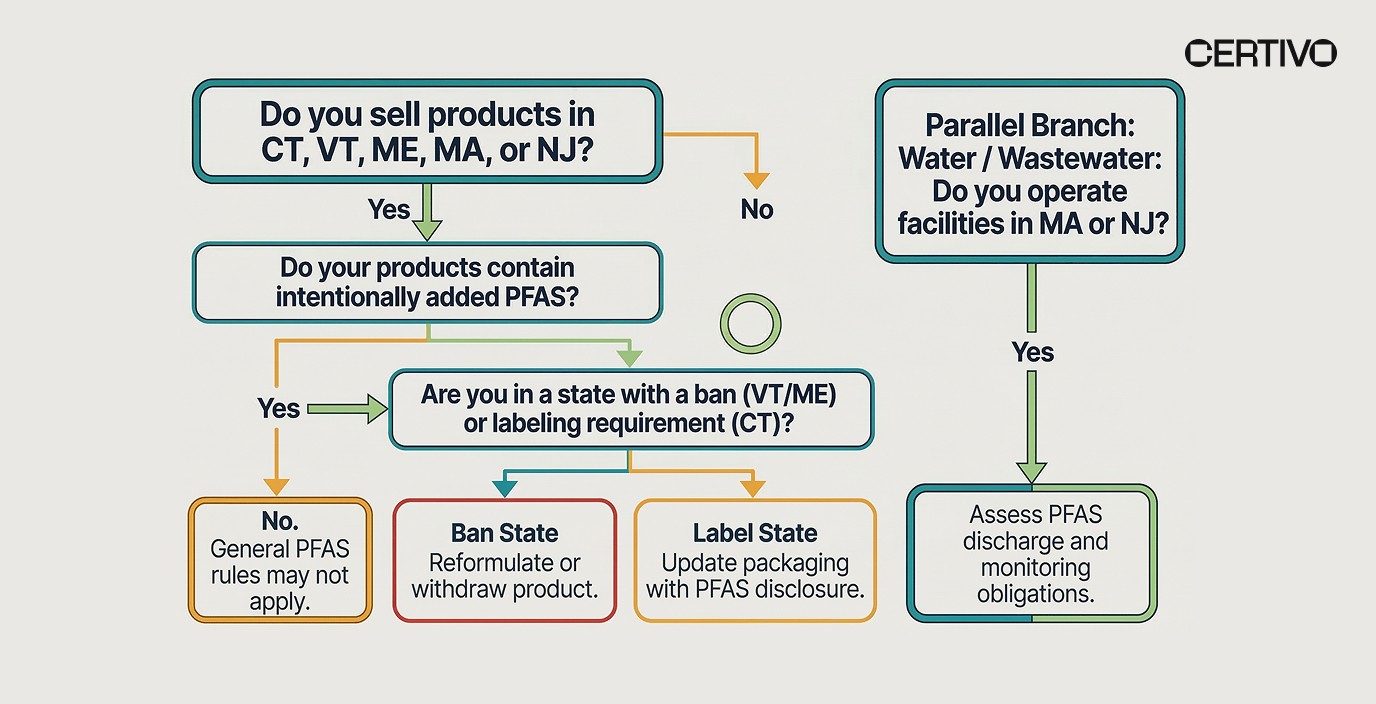
✓ Map each product against state-specific bans and labeling requirements
✓ Initiate reformulation programs for products sold in states with sales bans (VT, ME)
✓ Update packaging and labeling for products sold in states with disclosure requirements (CT)
✓ Establish documentation trails that prove "no intentionally added PFAS" status
For supply chain and procurement teams:
⚠ Issue structured supplier declarations requesting PFAS substance data at the material and component level
⚠ Evaluate supplier alternatives for PFAS-free materials and coatings
⚠ Update procurement specifications to prohibit PFAS-containing inputs where state bans apply
⚠ Establish ongoing monitoring for supplier material changes that could reintroduce PFAS
Supply chain data gaps are the most common compliance bottleneck. Many manufacturers lack granular PFAS substance data from upstream suppliers — especially for coatings, treatments, and processing aids that may not appear on standard material data sheets. Streamlining supplier documentation at scale is essential for meeting these requirements across multiple state jurisdictions simultaneously.
For companies also navigating EU PFAS restrictions, coordinating U.S. state-level compliance with European PFAS regulatory developments avoids duplication and reduces total compliance cost.
8. Compliance Readiness Checklist
📌 Use this checklist to assess your organization's preparedness for 2026 state PFAS regulations:
# | Action Item | Status |
|---|---|---|
1 | Identify all U.S. states where your products are sold or distributed | ☐ |
2 | Map applicable PFAS bans, labeling rules, and environmental standards by state | ☐ |
3 | Audit product formulations for intentionally added PFAS across all product lines | ☐ |
4 | Collect PFAS substance declarations from suppliers at the material and component level | ☐ |
5 | Evaluate reformulation options for products sold in states with sales bans (VT, ME) | ☐ |
6 | Update product labeling and packaging for Connecticut's July 2026 disclosure deadline | ☐ |
7 | Assess wastewater discharge for PFAS content at manufacturing facilities (MA, NJ relevance) | ☐ |
8 | Establish internal documentation proving "no intentionally added PFAS" status per product | ☐ |
9 | Update procurement specifications to restrict PFAS-containing supplier inputs | ☐ |
10 | Assign internal ownership for multi-state PFAS compliance tracking and monitoring | ☐ |
For organizations still managing compliance across spreadsheets, this is the moment to evaluate building a future-ready compliance infrastructure that can scale with the pace of state-level regulatory change.
9. The Role of AI in Multi-State PFAS Compliance
Managing PFAS compliance across five states — each with different product categories, thresholds, labeling formats, and timelines — pushes manual processes beyond their limits. For a practical look at how AI changes daily compliance operations, see a compliance engineer's week with and without AI.
The operational demands include:
Product-level substance identification across thousands of SKUs and materials
State-by-state regulatory mapping that changes as new rules take effect
Supplier data collection and validation at the material and component level
Labeling and packaging updates that must align with jurisdiction-specific requirements
Continuous monitoring as additional states introduce PFAS restrictions
AI-native compliance platforms address these challenges through:
✓ PFAS compliance intelligence — scanning product BOMs to identify PFAS presence against each state's specific definitions and thresholds
✓ Regulatory intelligence and horizon scanning — tracking new state PFAS bills, amendments, and enforcement actions in real time
✓ Supplier self-service compliance portals — enabling suppliers to submit PFAS declarations directly, reducing manual data collection cycles
✓ Continuous audit-ready documentation — generating state-specific compliance records that are always current
✓ Multi-regulation substance coverage — mapping PFAS data simultaneously against state, federal, and international requirements
For a comprehensive evaluation of how these capabilities work across regulatory frameworks, see AI tools for compliance management: the complete guide. IT and systems leaders should evaluate platform readiness now — before the July 2026 Connecticut deadline compresses preparation time further.
10. Frequently Asked Questions
Q1: Which states have new PFAS regulations taking effect in 2026?
Connecticut, Vermont, Maine, Massachusetts, and New Jersey all have new or expanded PFAS requirements in 2026. Connecticut introduces labeling rules effective July 1, 2026. Vermont and Maine enforce broad product sales bans. Massachusetts updates wastewater testing guidance effective March 4, 2026. New Jersey continues enforcing stringent drinking water standards. Certivo's regulatory intelligence and horizon scanning capabilities through CORA track these state-level developments in real time, ensuring compliance teams are alerted before deadlines arrive.
Q2: What products are affected by state PFAS bans?
Affected product categories include cosmetics, cleaning products, cookware, textiles, food packaging, and coated materials. Vermont and Maine apply the broadest bans — covering most consumer products with intentionally added PFAS. Connecticut initially requires labeling, with a full ban following in 2028. CORA's PFAS compliance intelligence enables organizations to map their full product portfolio against each state's specific scope and product category definitions.
Q3: How is "intentionally added PFAS" defined under these state regulations?
Definitions vary by state. Generally, "intentionally added" means PFAS was deliberately used in a product or its manufacturing process for a functional purpose — as opposed to being present as a contaminant or impurity at trace levels. The specific concentration thresholds and functional definitions differ. Certivo's BOM-level compliance intelligence helps manufacturers trace PFAS presence down to the component level to substantiate whether PFAS is intentionally added or incidentally present.
Q4: Do these state laws affect manufacturers located outside these states?
Yes. These regulations apply to products sold in these states, regardless of where the manufacturer is located. If your products reach Connecticut, Vermont, Maine, Massachusetts, or New Jersey retailers or consumers, you must comply with that state's PFAS requirements. Certivo helps organizations expand into new markets while maintaining full compliance across all applicable jurisdictions.
Q5: How can manufacturers track PFAS regulations across multiple states efficiently?
Manual tracking across multiple states is unsustainable as PFAS regulations proliferate. AI-native platforms like Certivo provide continuous regulatory monitoring that aggregates state-level PFAS developments, maps obligations to specific products and materials, and generates audit-ready documentation automatically. CORA's regulatory intelligence engine consolidates federal, state, and international PFAS requirements into a single compliance view — replacing fragmented spreadsheets with a scalable compliance system.
11. Executive Conclusion
The 2026 wave of state PFAS regulations marks a turning point for U.S. product compliance. Connecticut's labeling mandate, Vermont and Maine's broad product bans, Massachusetts' wastewater guidance, and New Jersey's drinking water enforcement collectively create a compliance environment where "one-size-fits-all" approaches fail. Manufacturers must now manage state PFAS regulations 2026 at the product level, the substance level, and the jurisdiction level — simultaneously.
The compliance imperative is clear: audit your product portfolios for PFAS, collect substance data from suppliers, align labeling and reformulation programs with state-specific deadlines, and establish monitoring infrastructure for the additional state PFAS laws expected in 2027 and beyond. For a broader view of the PFAS compliance trajectory, review the 2025–2026 PFAS compliance countdown.
📌 Official state regulatory sources:
Organizations managing complex product portfolios across multiple U.S. states need compliance infrastructure that scales with regulatory fragmentation. To explore how AI-driven compliance platforms like Certivo support continuous multi-state regulatory readiness, connect with the Certivo team.
Lavanya
Lavanya is an accomplished Product Compliance Engineer with over four years of expertise in global environmental and regulatory frameworks, including REACH, RoHS, Proposition 65, POPs, TSCA, PFAS, CMRT, FMD, and IMDS. A graduate in Chemical Engineering from the KLE Institute, she combines strong technical knowledge with practical compliance management skills across diverse and complex product portfolios.
She has extensive experience in product compliance engineering, ensuring that materials, components, and finished goods consistently meet evolving international regulatory requirements. Her expertise spans BOM analysis, material risk assessments, supplier declaration management, and test report validation to guarantee conformity. Lavanya also plays a key role in design-for-compliance initiatives, guiding engineering teams on regulatory considerations early in the product lifecycle to reduce risks and streamline market access.
Her contributions further extend to compliance documentation, certification readiness, and preparation of customer deliverables, ensuring transparency and accuracy for global stakeholders. She is adept at leveraging compliance tools and databases to efficiently track regulatory changes and implement proactive risk mitigation strategies.
Recognized for her attention to detail, regulatory foresight, and collaborative approach, Lavanya contributes significantly to maintaining product compliance, safeguarding brand integrity, and advancing sustainability goals within dynamic, globally integrated manufacturing environments.