

The New York State Department of Environmental Conservation (NYSDEC) has centralized all state PFAS regulations into a single dedicated portal and enacted restrictions on intentionally added PFAS in apparel products. The general apparel restrictions became effective January 1, 2025. Additional restrictions covering apparel designed for severe wet conditions take effect January 1, 2028.
For compliance engineers, regulatory directors, and supply chain leaders at manufacturers selling into New York, this regulation triggers immediate obligations around PFAS apparel compliance New York — including supplier disclosure campaigns, BOM-level material reviews, and reformulation planning for affected product lines.
📌 Book a free compliance assessment to map your PFAS exposure across apparel products and supplier networks before enforcement intensifies.
What Is New York's PFAS Apparel Regulation
New York's PFAS apparel restrictions are part of the state's broader initiative to reduce consumer exposure to per- and polyfluoroalkyl substances in textiles and clothing. The regulation targets the intentional addition of PFAS in apparel products — substances commonly used for water resistance, oil repellency, and stain resistance in fabrics.
The NYSDEC has consolidated all state-level PFAS regulations, guidance documents, and compliance resources into the NYSDEC PFAS Information Portal, providing a single reference point for manufacturers and retailers navigating New York's evolving PFAS landscape.
This regulation does not operate in isolation. It aligns with a growing wave of state-level PFAS restrictions across the United States — including California, Connecticut, Massachusetts, and Minnesota — creating a multi-jurisdictional compliance challenge for any manufacturer selling apparel nationally.
New York PFAS apparel compliance timeline 2025 to 2028 for manufacturers
Click on image to view full
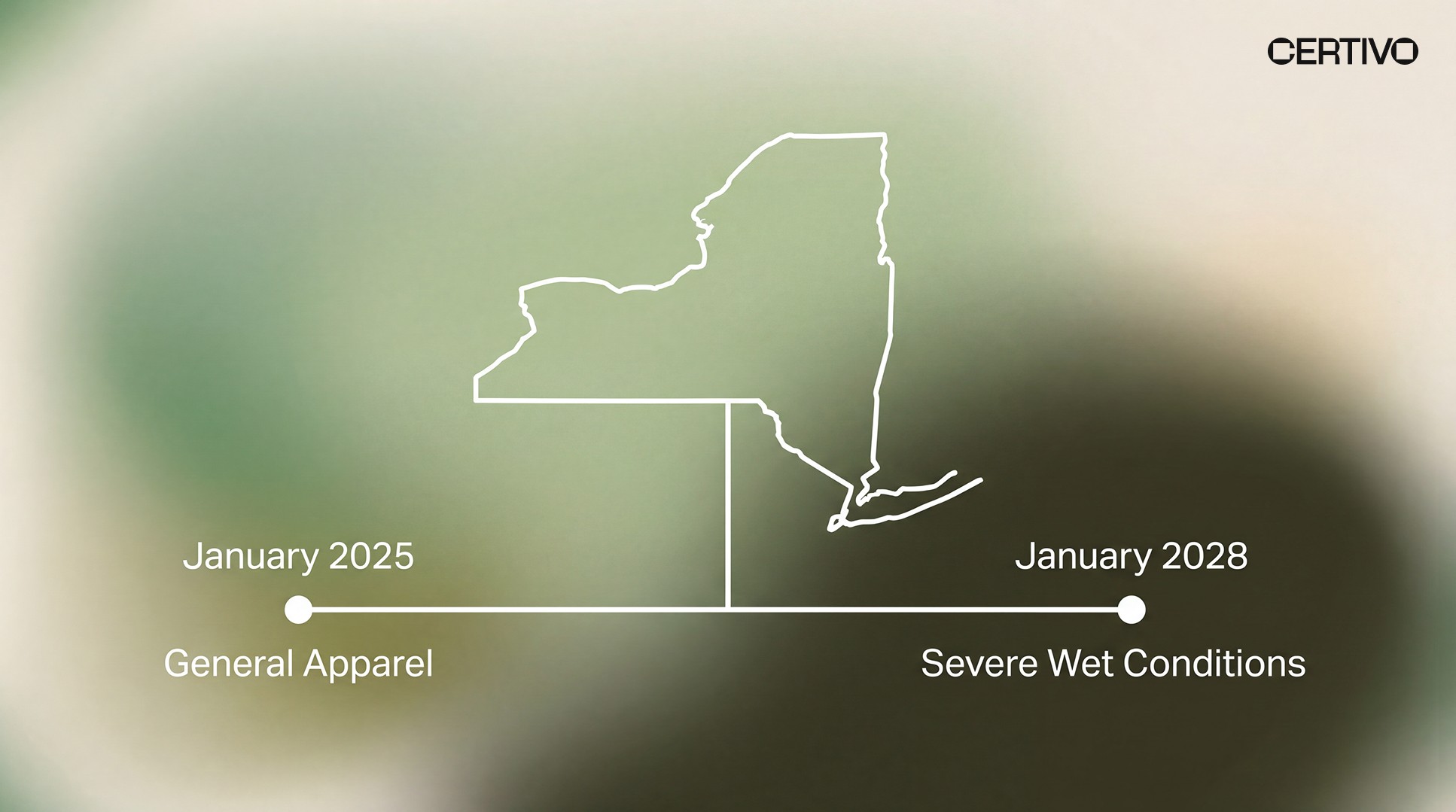
Key Compliance Deadlines and Enforcement Timeline
Milestone | Date | Scope |
|---|---|---|
General apparel PFAS restrictions effective | January 1, 2025 | All apparel products with intentionally added PFAS |
Severe wet conditions apparel restrictions effective | January 1, 2028 | Apparel specifically designed for severe wet conditions |
NYSDEC PFAS portal centralization | Active | Consolidated regulatory guidance and compliance resources |
⚠ The January 2025 deadline has already passed. Manufacturers, distributors, and retailers currently selling non-compliant apparel products in New York face enforcement exposure today.
The 2028 deadline provides a defined runway for companies manufacturing outdoor apparel, technical sportswear, and professional-grade rain gear to identify PFAS-free alternatives and complete reformulation programs.
For manufacturers tracking PFAS deadlines across multiple states and frameworks, regulatory intelligence and horizon scanning capabilities are essential to avoid missed enforcement dates.
Which Apparel Products Are Affected
The regulation distinguishes between two product categories with separate enforcement timelines:
Phase 1 — Effective January 1, 2025
✓ General apparel products containing intentionally added PFAS ✓ Includes treated fabrics, coated textiles, and PFAS-finished clothing ✓ Covers products sold, distributed, or offered for sale in New York
Phase 2 — Effective January 1, 2028
✓ Apparel specifically designed for severe wet conditions ✓ Includes technical outerwear, professional rain gear, and specialized protective clothing ✓ Provides an extended compliance window for products where PFAS alternatives are currently limited
This phased approach recognizes that PFAS substitution in high-performance applications (severe wet conditions) requires longer development timelines. However, for general apparel, the compliance window is closed.
Industries and Product Categories in Scope
📊 Apparel and Textiles — Outdoor apparel, sportswear, treated fabrics, and any clothing incorporating PFAS-based water or stain resistance. Manufacturers in this category should review every product line for PFAS presence through BOM-level material mapping.
📊 Consumer Goods — PFAS-treated clothing and textile products sold directly to consumers or through retail channels in New York.
📊 Retailers and Distributors — Any entity selling affected apparel products in New York carries compliance responsibility, regardless of where the product was manufactured.
📊 Chemical Manufacturers — Producers of PFAS-based coatings, durable water repellent (DWR) finishes, and textile treatment chemicals face downstream demand shifts as customers reformulate.
📊 Footwear and Accessories — Water-resistant and stain-resistant products using PFAS treatments fall within scope.
For companies managing consumer goods compliance across multiple state jurisdictions, New York's regulation adds another layer to an already complex patchwork of PFAS restrictions.
What Does "Intentionally Added PFAS" Mean for Manufacturers
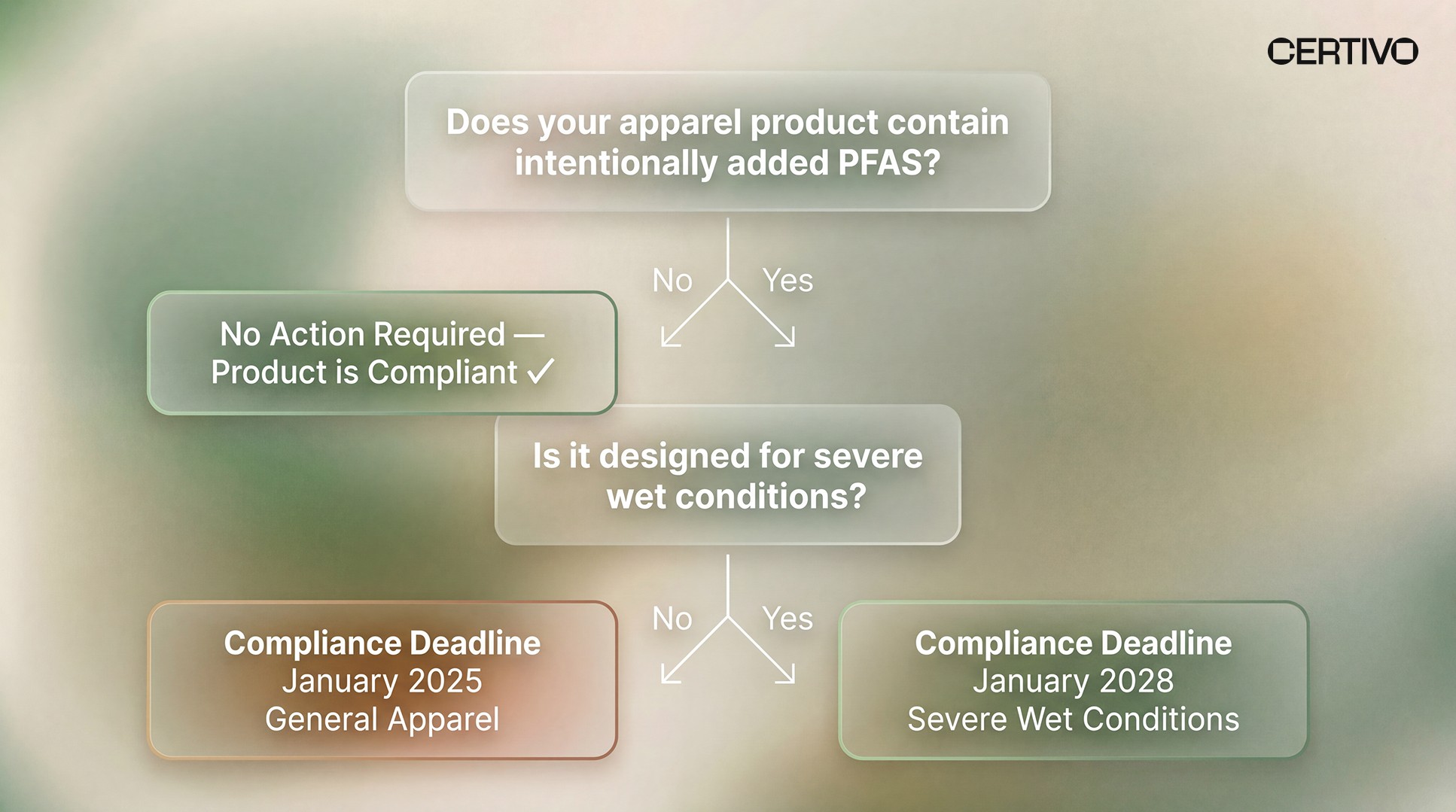
The regulation targets PFAS that are deliberately introduced during manufacturing — as opposed to trace contamination from environmental sources or processing equipment.
Key distinctions:
✓ Intentionally added — PFAS used as a functional ingredient in fabric coatings, DWR treatments, or stain-resistant finishes ✓ Not in scope — Incidental trace PFAS contamination that occurs without deliberate use
⚠ Manufacturers must be able to demonstrate that PFAS was not intentionally added to their products. This requires documented evidence from suppliers confirming PFAS-free formulations — not simply the absence of PFAS testing results.
This distinction makes supplier PFAS disclosure and material data collection a critical compliance activity. Without verifiable supplier declarations, manufacturers cannot credibly demonstrate that their products meet New York's requirements.
For deeper context on managing the scope of PFAS across product portfolios, see PFAS Compliance in 2026: Why "Out of Scope" No Longer Exists.
PFAS apparel compliance New York decision tree for manufacturer products
Click on image to view full
Supplier PFAS Disclosure and Data Collection Requirements
Compliance with New York's PFAS apparel restrictions depends entirely on the quality and completeness of supplier data. Manufacturers must:
✓ Issue PFAS-specific disclosure requests to all textile and chemical suppliers ✓ Collect written declarations confirming PFAS-free formulations or identifying PFAS-containing materials ✓ Validate supplier claims against product formulation data and material safety information ✓ Maintain an auditable evidence chain — documenting who provided the data, when it was provided, and with what authority
⚠ Supplier self-declarations alone may not be sufficient. Verification through testing or third-party certification strengthens the evidence chain.
Organizations still relying on email-based supplier communication for PFAS data collection face significant scalability challenges. Automated supplier data collection portals reduce follow-up cycles and create centralized, time-stamped records of every supplier response.
📌 Managing PFAS supplier data across hundreds of products? See how Certivo automates this → Get a compliance risk assessment
How to Review Apparel BOMs for PFAS Compliance
A systematic BOM review is the operational foundation of PFAS apparel compliance New York. The process involves:
Identify all textile and coating components in each apparel product BOM
Flag materials with known PFAS applications — DWR finishes, fluoropolymer coatings, stain-resistant treatments
Cross-reference supplier declarations with BOM component data to confirm PFAS status at the material level
Document compliance status per SKU — compliant, non-compliant, or pending supplier response
Track historic compliance states using immutable audit logs and time-stamped declarations that support point-in-time queries during audits
This is fundamentally a data versioning problem. Every BOM change, supplier declaration update, or reformulation activity must be captured with full traceability — who changed what, when, and based on what evidence.
Certivo's BOM-level compliance intelligence connects substance data to individual product structures, enabling compliance teams to answer audit queries at the SKU level rather than relying on aggregate company-level declarations.
Compliance Risks and Enforcement Exposure
Manufacturers and retailers failing to comply with New York's PFAS apparel restrictions face several categories of risk:
⚠ Regulatory enforcement — NYSDEC has consolidated oversight through its centralized PFAS portal, signaling increased monitoring capacity
⚠ Product recall and market removal — Non-compliant products may be subject to recall or removal from New York distribution channels
⚠ Customer audit findings — Major retailers increasingly require PFAS-free declarations from suppliers. Inability to provide documentation creates supply chain qualification risk
⚠ Reputational exposure — Consumer awareness of PFAS ("forever chemicals") continues to increase, amplifying brand risk for non-compliant products
⚠ Multi-state liability — Non-compliance in New York often signals exposure in other states with similar or pending PFAS restrictions
No compliance management system eliminates audit findings entirely. The objective is to reduce surprises and minimize response time when regulatory inquiries or customer audits occur. Organizations maintaining continuous audit-ready documentation are better positioned to respond.
Supply Chain and Operational Impact
The operational impact of New York's PFAS apparel regulation extends well beyond the compliance team:
Procurement — Sourcing decisions must now incorporate PFAS status as a qualification criterion. Suppliers unable to provide PFAS-free declarations or credible reformulation timelines may need to be replaced.
Product Development — Reformulation programs for PFAS-containing products require coordination between R&D, compliance, and sourcing. Design-for-compliance PLM workflows help ensure that reformulated products meet both performance and regulatory requirements.
Quality and Testing — Verification testing may be required for products transitioning to PFAS-free formulations, particularly for performance attributes like water repellency and durability.
Distribution — Retailers and distributors must verify that incoming apparel inventory meets New York requirements before placement on shelves or in fulfillment centers.
For companies managing compliance across multiple states, the PFAS landscape resembles the early days of REACH and RoHS in Europe — a fragmented patchwork that increasingly demands centralized, systematic management.
Strategic Compliance Preparation Checklist
How AI Reduces PFAS Compliance Burden for Apparel Manufacturers
Manual PFAS compliance management — tracking supplier declarations via spreadsheets, chasing email responses, and manually mapping PFAS status to individual SKUs — does not scale across product portfolios or multi-state regulatory environments.
CORA-powered regulatory intelligence automates the critical workflows that make PFAS apparel compliance New York manageable at enterprise scale:
✓ Automated supplier data collection — Centralized self-service portals enable suppliers to submit PFAS declarations directly, with version control and time-stamped audit trails
✓ AI document parsing and certificate validation — CORA extracts and validates data from supplier certificates, test reports, and material declarations, flagging inconsistencies before they become audit findings
✓ BOM-level PFAS mapping — Links substance data to individual product structures, enabling SKU-level compliance status tracking across the entire portfolio
✓ Regulatory horizon scanning — CORA's regulatory intelligence layer monitors emerging PFAS restrictions across states and jurisdictions, alerting compliance teams to upcoming deadlines and scope changes
For manufacturers already managing PFAS compliance across multi-tier supply chains, New York's apparel restrictions add another compliance thread that benefits from centralized, AI-native management.
Executive Conclusion
New York's PFAS apparel restrictions are already in effect for general apparel products, with a second enforcement phase covering severe wet conditions apparel arriving on January 1, 2028. The NYSDEC's centralization of PFAS regulatory guidance signals increasing state-level oversight and enforcement capacity.
For manufacturers, retailers, and distributors selling apparel into New York, PFAS apparel compliance New York requires immediate action: supplier PFAS disclosures, BOM-level material reviews, reformulation planning, and auditable documentation of compliance status per product.
The operational challenge is not unique to New York. With similar PFAS restrictions active or pending in California, Connecticut, Massachusetts, Minnesota, and other states, the manufacturers best positioned are those building centralized, scalable PFAS compliance infrastructure rather than addressing each state restriction individually.
📌 Book a demo to see how Certivo automates PFAS apparel compliance across your product portfolio and multi-tier supply chain — from supplier data collection through BOM-level reporting and continuous audit readiness.
FAQs
1. What types of apparel are covered by New York's PFAS restrictions?
The regulation covers all apparel products containing intentionally added PFAS sold in New York. General apparel restrictions became effective January 1, 2025. Apparel designed for severe wet conditions has an extended deadline of January 1, 2028. Certivo's CORA intelligence helps manufacturers map PFAS exposure across product categories.
2. How should manufacturers document PFAS-free status for New York compliance?
Manufacturers need verifiable supplier declarations confirming PFAS-free formulations, supported by material data and, where appropriate, third-party testing. Documentation should include immutable audit logs with time-stamped records of who provided the evidence and when. Certivo's automated supplier portals create this evidence chain at scale.
3. Does New York's PFAS regulation affect retailers and distributors as well?
Yes. Any entity selling affected apparel products in New York carries compliance responsibility, regardless of where the product was manufactured. Retailers should require PFAS-free documentation from their supply base and maintain auditable records of product compliance status.
4. How does New York's PFAS apparel regulation relate to other state PFAS restrictions?
New York's regulation is part of a broader wave of state-level PFAS restrictions across the US. California, Connecticut, Massachusetts, and Minnesota have enacted similar or overlapping requirements. Manufacturers benefit from centralized PFAS compliance management that covers multiple jurisdictions simultaneously.
5. What is the risk of non-compliance with New York's PFAS apparel restrictions?
Non-compliance may result in regulatory enforcement by NYSDEC, product removal from New York distribution channels, customer audit findings, and reputational risk. The operational goal is to maintain continuous audit-ready documentation that reduces response time when inquiries occur.
Lavanya
Lavanya is an accomplished Product Compliance Engineer with over four years of expertise in global environmental and regulatory frameworks, including REACH, RoHS, Proposition 65, POPs, TSCA, PFAS, CMRT, FMD, and IMDS. A graduate in Chemical Engineering from the KLE Institute, she combines strong technical knowledge with practical compliance management skills across diverse and complex product portfolios.
She has extensive experience in product compliance engineering, ensuring that materials, components, and finished goods consistently meet evolving international regulatory requirements. Her expertise spans BOM analysis, material risk assessments, supplier declaration management, and test report validation to guarantee conformity. Lavanya also plays a key role in design-for-compliance initiatives, guiding engineering teams on regulatory considerations early in the product lifecycle to reduce risks and streamline market access.