


The EU Packaging and Packaging Waste Regulation (PPWR), formally adopted as Regulation 2025/40, replaces the 30-year-old Packaging Directive with directly applicable obligations across all 27 member states. August 12, 2026 is not a target. It is a hard enforcement date. Every packaging unit placed on the EU market after that date requires a valid Declaration of Conformity, backed by documented evidence of substance compliance, material composition, and conformity assessment.
For Directors of Packaging Compliance, Heads of Regulatory Affairs, and Supply Chain Compliance Managers at FMCG, cosmetics, food, pharmaceutical, e-commerce, and CPG manufacturers, this deadline collapses several regulatory obligations into a single date: PFAS restrictions on food-contact packaging, heavy metals thresholds, substances of concern limits, and mandatory conformity documentation. Penalty exposure ranges from €100,000 to €500,000+ per violation, with the added consequence of market exclusion.
📌 Book a compliance risk assessment to understand your current PPWR exposure across packaging formats and supply chains before the August 12 deadline.
Key Takeaways
📌 PPWR (Regulation 2025/40) replaces the EU Packaging Directive with directly applicable rules, eliminating member-state transposition gaps that previously allowed flexibility.
⚠️ August 12, 2026 is a hard enforcement date for Declaration of Conformity requirements, with no grace period, no transitional provisions, and penalty exposure of €100K to €500K+ per violation.
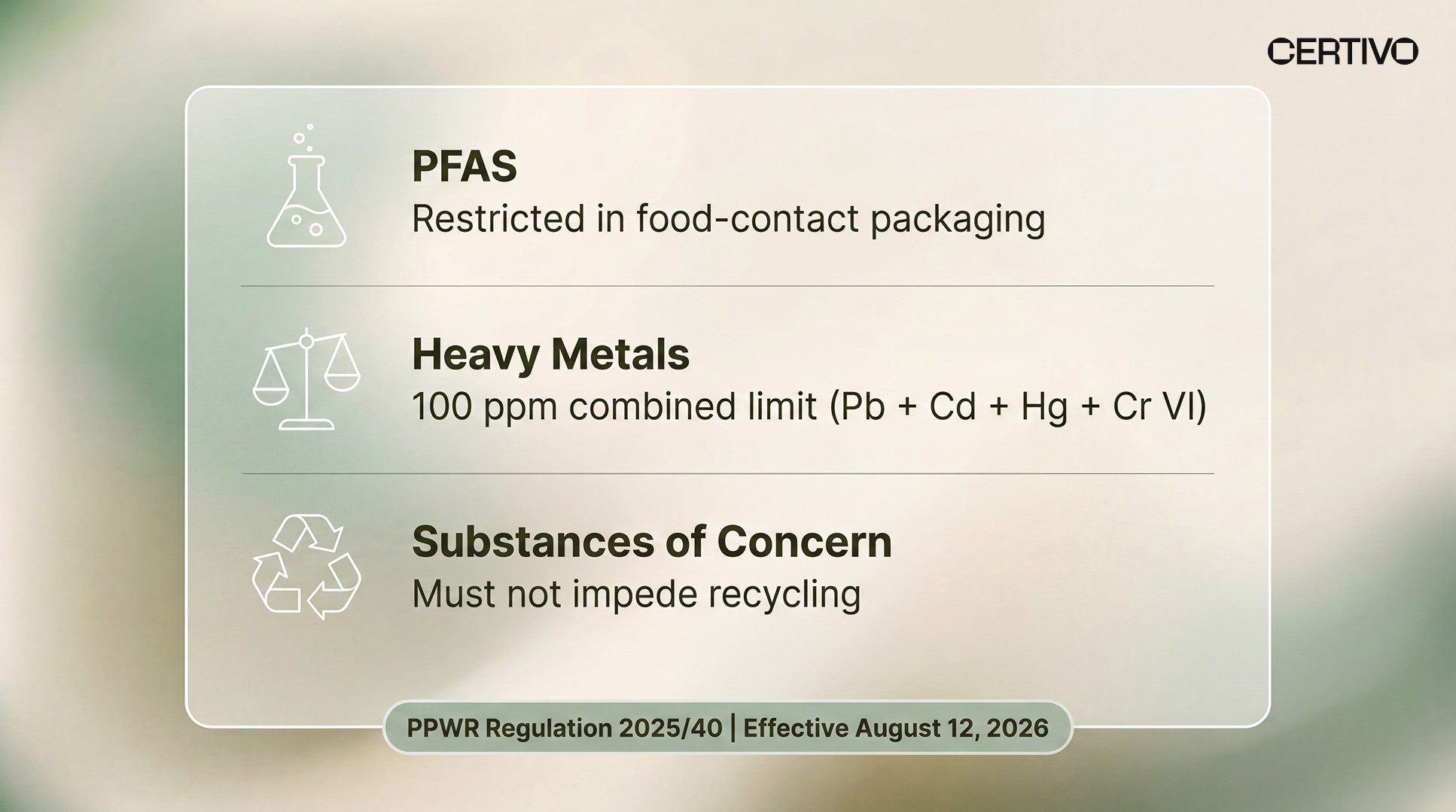
📊 Substance restrictions on PFAS in food-contact packaging, heavy metals (lead, cadmium, mercury, hexavalent chromium at 100 ppm combined), and substances of concern take effect simultaneously on the same date.
⏳ Substance testing lead times of 4 to 8 weeks mean that manufacturers beginning compliance preparation in Q2 2026 are already operating without margin for error.
🏭 Article 21 of the PPWR reclassifies importers as manufacturers when they modify packaging or place it under their own name, triggering full conformity assessment obligations.
🔗 Every role in the packaging supply chain, from material producers to e-commerce fulfillment operators, carries specific documentation and conformity responsibilities under the regulation.
🤖 AI-powered compliance platforms enable automated PFAS substance scanning at BOM level, supplier evidence collection, and substance threshold management across packaging portfolios.
Why PPWR Replaces the Packaging Directive
The original EU Packaging Directive (94/62/EC) operated as a directive, meaning each member state transposed it into national law with local variations. This created a patchwork of compliance requirements that manufacturers navigated differently depending on destination market.
PPWR eliminates that fragmentation. As a regulation, it applies directly and uniformly across all EU member states from the date of application. There is no transposition period. There are no national implementation variations to wait for. The rules are the rules, and they apply the same way in Germany, France, Italy, Poland, and every other EU market.
For manufacturers managing EU packaging compliance across multiple destination countries, this is both a simplification and an acceleration. One standard replaces 27 national interpretations, but the compliance bar is higher, the documentation requirements are more granular, and the enforcement exposure is more direct.
This shift is consistent with the EU's broader regulatory trajectory visible in the EU ESPR, Digital Product Passport requirements, and REACH substance restrictions, all of which are moving toward product-level, evidence-backed compliance documentation.
PPWR Declaration of Conformity August 2026 EU packaging compliance deadline
Click on image to view full

What the Declaration of Conformity Requires
The Declaration of Conformity under PPWR is not a single certificate. It is a structured documentation package that must be prepared, maintained, and made available to market surveillance authorities on request.
Core Components
✓ Identification of the packaging unit including type, material composition, format, and intended use
✓ Reference to applicable PPWR requirements including substance restrictions, recyclability criteria, and labeling obligations
✓ Evidence of conformity assessment demonstrating that the packaging meets all applicable requirements at the time of market placement
✓ Substance compliance documentation covering PFAS content (for food-contact), heavy metals concentrations, and substances of concern
✓ Responsible economic operator identification with name, address, and role in the supply chain (manufacturer, importer, or authorized representative)
✓ Date and signature from the person authorized to bind the economic operator
This is not a self-declaration in name only. Market surveillance authorities can request the supporting evidence, including test reports, supplier declarations, material composition data, and substance analysis certificates. If the evidence does not exist or does not support the declaration, the packaging is non-compliant.
Organizations already managing continuous audit-ready documentation for other regulatory frameworks will recognize the structure. Those building documentation from scratch have limited time.
Substance Restrictions Taking Effect August 12, 2026
Three categories of substance restrictions become enforceable simultaneously with the Declaration of Conformity requirement.
PFAS in Food-Contact Packaging
PPWR restricts per- and polyfluoroalkyl substances (PFAS) in food-contact packaging materials. This includes coatings, barriers, and treatments applied to paper, board, and molded fiber packaging used for direct food contact.
For manufacturers already tracking PFAS compliance across product portfolios, the PPWR restriction adds a packaging-specific layer. For those that have not yet mapped PFAS presence in packaging materials, this is a gating compliance requirement that demands substance-level testing and supplier verification.
Heavy Metals
The combined concentration of lead, cadmium, mercury, and hexavalent chromium in packaging or packaging components must not exceed 100 parts per million (ppm) by weight. This is a combined threshold, not a per-substance limit.
Substance | Threshold |
|---|---|
Lead (Pb) | Combined total: |
Cadmium (Cd) | 100 ppm by weight |
Mercury (Hg) | (all four substances) |
Hexavalent Chromium (Cr VI) |
This threshold applies to inks, adhesives, coatings, closures, labels, and every other packaging component, not just the primary packaging material.
Substances of Concern (SoCs)
PPWR introduces restrictions on substances of concern present in packaging at concentrations that may impede recycling, contaminate recycled material streams, or pose environmental or health risks during the packaging lifecycle.
For a broader view of substance-level compliance management, see Certivo's materials and environmental compliance solution.
PPWR substance restrictions August 2026 PFAS heavy metals packaging compliance
Click on image to view full
The Article 21 Importer Reclassification Trap
Article 21 of the PPWR contains a provision that catches importers off guard. If an importer modifies packaging already placed on the market, or places packaging on the EU market under their own name or trademark, that importer is reclassified as the manufacturer for PPWR purposes.
This reclassification triggers the full scope of manufacturer obligations, including:
⚠ Conducting the conformity assessment
⚠ Preparing and maintaining the Declaration of Conformity
⚠ Ensuring substance compliance across all packaging components
⚠ Bearing direct enforcement liability for non-compliance
For e-commerce brands, private-label CPG companies, and any business that rebrands or modifies supplier-provided packaging before placing it on the EU market, this is not a theoretical risk. It is an operational reality that shifts the compliance burden upstream.
Companies managing supplier and contractor management programs should audit their packaging supply chains specifically for Article 21 exposure. The question is simple: are you modifying or rebranding packaging? If yes, you are the manufacturer under PPWR.
Conformity Assessment Obligations by Supply Chain Role
PPWR assigns specific obligations to each economic operator in the packaging supply chain.
Role | Key Obligations |
|---|---|
Manufacturer | Conduct conformity assessment, prepare Declaration of Conformity, maintain technical documentation, ensure substance compliance |
Importer | Verify manufacturer has performed conformity assessment, keep Declaration available, check labeling and marking compliance |
Distributor | Verify required markings and documentation are present before making packaging available on the market |
Authorized Representative | Act on behalf of manufacturer for specific regulatory tasks within the EU |
Fulfillment Service Provider | Ensure packaging handled meets applicable requirements during storage and shipment |
Every role carries documentation obligations. No participant in the packaging supply chain is exempt from responsibility. This chain-of-custody approach to compliance accountability means that gaps at any point in the supply chain create enforcement exposure for multiple parties.
For organizations looking to standardize compliance across plants and regions, PPWR's role-based structure provides a clear framework for assigning internal accountability.
Substance Testing Lead Times and the Q2 2026 Problem
Substance testing is the gating activity for PPWR Declaration of Conformity. Without verified test results for PFAS, heavy metals, and substances of concern, the Declaration cannot be completed.
Typical Lead Times
📊 PFAS testing (targeted analysis per packaging component): 4 to 6 weeks
📊 Heavy metals testing (ICP-MS or similar): 3 to 5 weeks
📊 Full substance screening (broad panel): 6 to 8 weeks
📊 Re-testing after supplier reformulation: additional 3 to 4 weeks
These timelines assume laboratory capacity is available. As August 12, 2026 approaches, accredited testing laboratories will experience demand surges. Manufacturers that have not yet commissioned testing are competing for capacity with every other company facing the same deadline.
The arithmetic is unforgiving. Organizations beginning PPWR substance compliance work in Q2 2026 are already operating with zero margin for delays, failed tests, supplier reformulations, or laboratory backlogs.
📌 Not sure where your packaging portfolio stands on PFAS and heavy metals? Request a compliance review to identify gaps before testing capacity tightens further.
Industries and Product Categories Most Exposed
📊 Food and Beverage — Direct food-contact packaging triggers PFAS restrictions. Every wrapper, tray, cup, container, and bag in contact with food must be verified.
📊 Cosmetics and Personal Care — Primary and secondary packaging for EU-bound products requires full substance documentation, particularly for printed and coated formats.
📊 Pharmaceuticals — Blister packs, vials, bottles, and outer packaging must meet PPWR substance thresholds in addition to existing pharma packaging regulations.
📊 E-Commerce and Fulfillment — Branded mailer bags, void fill, and protective packaging placed on the EU market under the seller's brand trigger Article 21 manufacturer obligations.
📊 Consumer Packaged Goods (CPG) — High SKU counts multiply the compliance documentation burden. Every packaging format requires its own conformity evidence.
For a cross-industry view of how product compliance management is evolving, Certivo's pillar guide covers the broader landscape.
Compliance Risks, Penalties, and Enforcement Exposure
PPWR enforcement operates through EU market surveillance authorities with direct penalty powers.
⚠ Financial penalties: €100,000 to €500,000+ per violation, depending on member state implementation of penalty provisions
⚠ Market exclusion: Non-compliant packaging can be prohibited from the EU market entirely
⚠ Product withdrawal: Authorities can order recall or withdrawal of packaging already placed on the market
⚠ Supply chain liability: Multiple economic operators (manufacturer, importer, distributor) can face enforcement action for the same non-compliant packaging
⚠ Reputational exposure: Public enforcement actions and product notifications are visible to customers, retailers, and investors
Organizations maintaining proactive compliance risk management programs are better positioned to demonstrate due diligence during regulatory inspections and customer audits.
Pre-Deadline Compliance Checklist
How AI and Automation Reduce PPWR Compliance Burden
Managing PPWR compliance across hundreds or thousands of packaging SKUs, each with its own material composition, substance profile, supplier base, and conformity documentation, cannot scale through manual processes.
PFAS Substance Scanning at BOM Level
Certivo's CORA-powered regulatory intelligence enables automated scanning of packaging bills of materials for PFAS-containing components. Rather than manually reviewing every material data sheet, CORA identifies PFAS exposure across packaging portfolios and flags components that require testing or supplier verification. This is particularly critical for organizations managing PFAS compliance across multi-tier supply chains.
Supplier Evidence Collection Automation
Collecting substance declarations, test reports, and material composition data from packaging material suppliers is the largest operational bottleneck in PPWR preparation. Certivo's supplier self-service compliance portals allow suppliers to submit documentation directly, with built-in validation that ensures completeness and currency.
Substance Threshold Management
CORA-enabled analysis tracks substance concentrations against PPWR thresholds at the component level. When a packaging component approaches or exceeds the 100 ppm combined heavy metals limit, or when PFAS is detected in a food-contact material, the system flags the issue before it becomes an enforcement finding.
Regulatory Intelligence and Horizon Scanning
PPWR is not a static regulation. Implementing acts, delegated acts, and member state enforcement guidance will continue to evolve. CORA's regulatory intelligence layer monitors these developments and alerts compliance teams to changes that affect their packaging portfolios, supporting continuous compliance monitoring rather than periodic manual reviews.
For a deeper look at how AI transforms compliance management, see the AI Tools for Compliance Management guide on Certivo.
Conclusion
August 12, 2026 is a fixed enforcement date with no transitional relief. Every packaging unit placed on the EU market after that date must have a valid Declaration of Conformity backed by substance test results, material composition evidence, and documented conformity assessment. PFAS restrictions on food-contact packaging, the 100 ppm combined heavy metals threshold, and substances of concern limits all take effect simultaneously.
The compliance preparation window is measured in weeks, not months. Substance testing lead times, laboratory capacity constraints, and supplier data collection timelines mean that organizations starting now are operating at the outer edge of feasibility. Article 21's importer reclassification provision adds an additional layer of exposure for brands that modify or rebrand supplier-provided packaging.
Investing in automated PFAS BOM scanning, supplier evidence collection platforms, and substance threshold management is the most effective strategy for achieving PPWR compliance at scale without proportional increases in headcount or manual effort.
📌 Speak with a compliance specialist to evaluate your PPWR readiness across packaging formats, substance restrictions, and supplier documentation before the August 12, 2026 deadline.
FAQs
1. What happens if packaging is placed on the EU market after August 12, 2026 without a valid Declaration of Conformity?
Market surveillance authorities can impose financial penalties ranging from €100,000 to €500,000+ per violation, order product withdrawal, and prohibit future market placement. There is no grace period under PPWR. Certivo's CORA intelligence helps organizations track compliance status across packaging portfolios to prevent non-compliant market placement.
2. Does the 100 ppm heavy metals threshold apply to each substance individually or as a combined total?
The threshold applies as a combined total across lead, cadmium, mercury, and hexavalent chromium. This means that even if no single substance exceeds safe limits individually, the combined concentration across all four must remain below 100 ppm by weight for the entire packaging unit and its components.
3. How does Article 21 affect e-commerce brands that rebrand packaging from overseas suppliers?
If an e-commerce brand places packaging on the EU market under its own name or trademark, or modifies the packaging in any way, Article 21 reclassifies that brand as the manufacturer. This triggers full conformity assessment obligations, including preparing the Declaration of Conformity and ensuring substance compliance. Certivo's supplier management capabilities help brands document and verify compliance across their packaging supply chains.
4. Which PFAS restrictions apply specifically to packaging under PPWR?
PPWR restricts PFAS in food-contact packaging materials, including coatings, barriers, and surface treatments on paper, board, and molded fiber. This is separate from broader EU REACH PFAS restriction proposals. Organizations managing both packaging and product-level PFAS compliance can explore Certivo's PFAS compliance framework for cross-regulatory coverage.
5. Can substance testing results from previous years satisfy the PPWR Declaration of Conformity requirement?
Based on currently available regulatory guidance, the Declaration of Conformity must reflect the compliance status of packaging at the time of market placement. Testing results should be current and representative of the materials and suppliers in use at the time. If material compositions or suppliers have changed since prior testing, new testing is required.
Hari prasanth
Hariprasanth is a Chemical Compliance Specialist with nearly four years of experience, underpinned by a degree in Chemical Engineering. He brings in-depth expertise in global product compliance, working across key regulations such as REACH, RoHS, TSCA, Proposition 65, POPs, FMD, and PFCMRT.
Hariprasanth specializes in reviewing technical documentation, validating supplier inputs, and ensuring that products consistently meet regulatory standards. He works closely with cross-functional teams and suppliers to collect accurate material data and deliver clear, audit-ready compliance reports that stand up to scrutiny.