


August 12, 2026 is the hardest packaging compliance deadline this year — and there is no grace period. The EU Packaging and Packaging Waste Regulation (PPWR) requires every economic operator placing packaging on the EU market to have a valid PPWR declaration of conformity on file and available for market surveillance authorities from that date forward.
This is not a reporting cycle with a soft-launch window. It is an enforceable market access requirement with penalty exposure exceeding €500,000 and potential market exclusion for non-compliant packaging. For FMCG, cosmetics, and food manufacturers managing EU packaging compliance across hundreds or thousands of SKUs, the operational challenge is immediate.
This checklist covers the declaration of conformity requirements, the PFAS ban in food-contact packaging, Article 21 importer-to-manufacturer reclassification, substance testing lead times, and enforcement exposure — everything compliance leaders need to act on before the deadline.
📌 Book a free compliance assessment to evaluate your PPWR packaging readiness before the August 2026 deadline.
What Is the PPWR Declaration of Conformity
The PPWR declaration of conformity is a formal written statement by the responsible economic operator confirming that specific packaging meets every essential requirement established under the EU packaging regulation. This is not a self-certification in the informal sense — it is a legally binding document that must:
✓ Identify the packaging by type, material composition, and intended use
✓ Reference the applicable PPWR articles and conformity assessment procedures
✓ Confirm compliance with recyclability, recycled content, substance restriction, and minimization requirements
✓ Be maintained in the technical file and available to market surveillance authorities upon request
Without a valid declaration, packaging cannot legally enter or remain on the EU market after August 12, 2026. For organizations managing materials and environmental compliance across product families, this adds a packaging-specific compliance layer on top of existing product-level obligations.
PPWR declaration of conformity EU packaging compliance deadline 2026
Click on image to view full

Why August 12, 2026 Has No Grace Period
Unlike many EU regulations that include transitional periods or phased enforcement, the PPWR declaration of conformity requirement takes effect as a hard cutover. After August 12, 2026:
⚠ Every packaging unit placed on the EU market must have an associated declaration of conformity
⚠ Market surveillance authorities in all 27 EU member states can request documentation at any time
⚠ There is no "best effort" defense — the declaration either exists and is compliant, or it does not
This means manufacturers cannot rely on partial documentation, draft declarations, or pending supplier data submissions. The compliance posture required is continuous audit-ready documentation — declarations and supporting evidence retrievable within hours, not weeks.
Companies relying on regulatory intelligence and horizon scanning should already have this date flagged. Those discovering this deadline now face compressed timelines that demand immediate prioritization.
PFAS Ban in Food-Contact Packaging Under PPWR
One of the most operationally challenging provisions is the restriction on PFAS (per- and polyfluoroalkyl substances) in food-contact packaging. The PPWR's substance restrictions intersect directly with the broader EU PFAS restriction proposal under REACH, but the packaging-specific provisions apply independently.
What This Means Operationally
📊 Grease-resistant coatings on food packaging — paperboard takeaway containers, microwave popcorn bags, fast-food wrappers — commonly use PFAS-based treatments. These must be identified, tested, and replaced or documented as compliant.
📊 Fluorinated barriers in flexible packaging for oils, fats, and moisture-sensitive food products are under scrutiny.
📊 Testing requirements — Manufacturers must verify that food-contact packaging does not contain PFAS above applicable thresholds. This requires analytical testing, not just supplier declarations.
For organizations already managing PFAS compliance across multi-tier supply chains, the PPWR adds a packaging-specific layer. The challenge is that PFAS in packaging is often introduced through coatings and treatments applied by converters and secondary suppliers — not the primary material manufacturer. This makes multi-tier supply chain transparency essential.
See also: How to Track PFAS Regulations Across the US and EU for a broader roadmap.
Article 21: When Importers Become Manufacturers
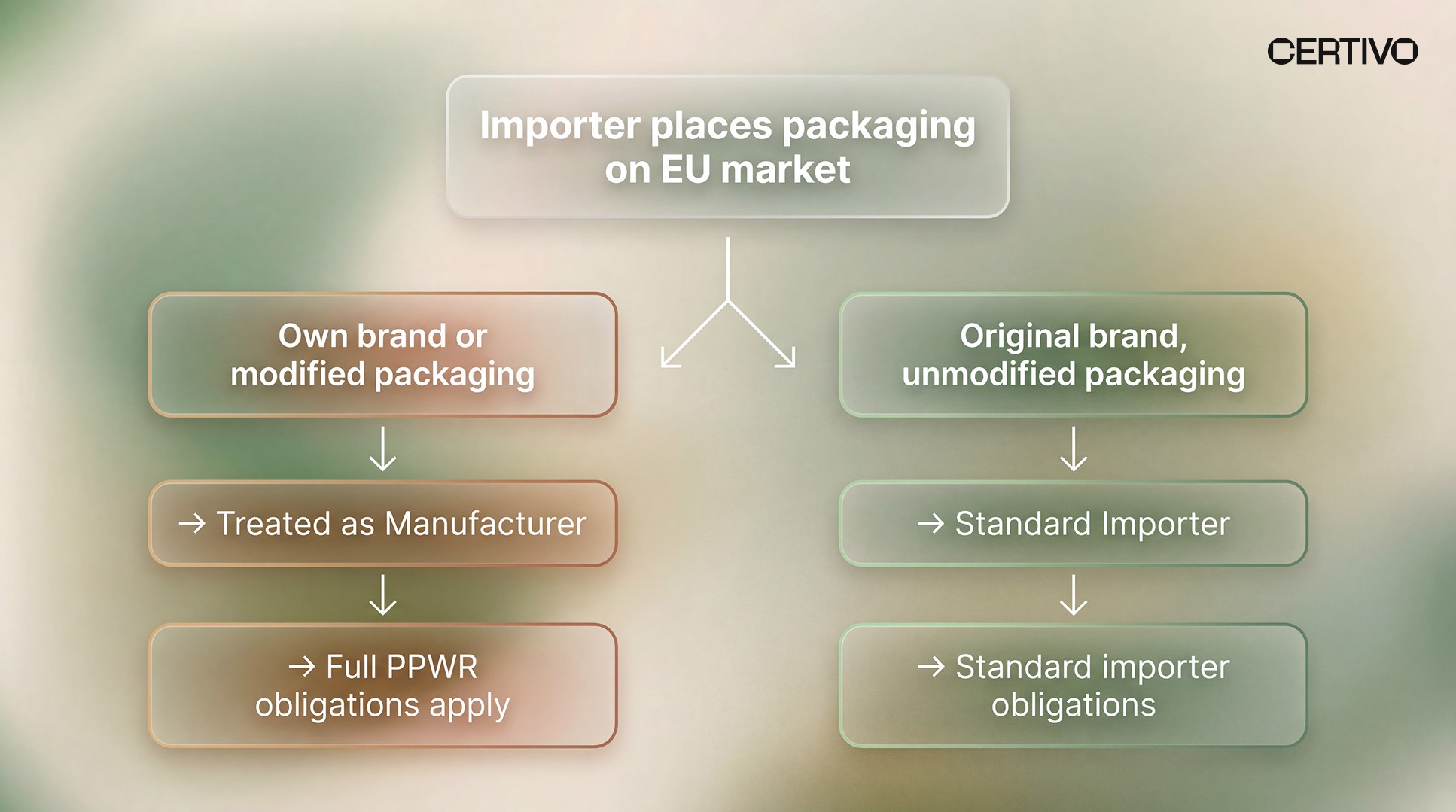
Article 21 of the PPWR introduces an underestimated compliance risk: importer-to-manufacturer reclassification. Under this provision, an importer is treated as a manufacturer — and assumes all manufacturer obligations — when:
⚠ The importer places packaging on the EU market under its own name or trademark
⚠ The importer modifies packaging already placed on the market in a way that may affect compliance with PPWR requirements
Why This Matters
For private-label brands, white-label importers, and companies that rebrand third-party packaging for the EU market, Article 21 means full manufacturer-level responsibility for:
Conducting the conformity assessment
Drafting and maintaining the declaration of conformity
Maintaining the technical file
Cooperating with market surveillance authorities
This reclassification catches many importers by surprise. Companies that source packaging from non-EU suppliers and apply their own branding must verify whether Article 21 applies — and if so, build the documentation infrastructure of a manufacturer, not an importer.
Certivo supports this through supplier and contractor management workflows that distinguish between supplier-provided data and self-generated compliance documentation.
PPWR Article 21 importer manufacturer reclassification decision flow for EU packaging
Click on image to view full
Substance Testing Lead Times and Lab Capacity
The PPWR declaration of conformity is only as credible as the analytical data supporting it. For substance restrictions — particularly PFAS and heavy metals — manufacturer self-declarations are insufficient. Third-party analytical testing is the expected standard of evidence.
Current Reality
📊 Lead times for PFAS testing at accredited EU laboratories have extended to 8–14 weeks in many cases, driven by demand from REACH, TSCA, and state-level PFAS regulations.
📊 Heavy metals testing (cadmium, lead, mercury, hexavalent chromium) for packaging materials remains faster, but lab capacity tightens around regulatory deadlines.
📊 Recyclability assessments — design-for-recycling evaluations against EU-defined criteria — require specialized testing that not all labs offer.
What This Means for the August 2026 Deadline
If you have not already submitted packaging samples for PFAS and substance testing, you are operating on a compressed timeline. Testing submitted in June 2026 may not return results before the August 12 enforcement date. This is not a software problem — it is a physics and logistics problem that no automation can bypass. However, AI document parsing and certificate validation can accelerate the processing of results once they arrive, reducing the internal review bottleneck.
📌 Need to understand your packaging PFAS exposure? Get a compliance risk assessment to map testing gaps before lab capacity tightens further.
EU Packaging Compliance Requirements and Thresholds
The declaration of conformity must attest to compliance with several interconnected PPWR requirements:
Recycled Content Minimums (Plastic Packaging)
Packaging Type | By 2030 | By 2040 |
|---|---|---|
Contact-sensitive plastic | 10% | 50% |
Non-contact-sensitive plastic | 35% | 65% |
Single-use plastic beverage bottles | 30% | 65% |
Recyclability Grades
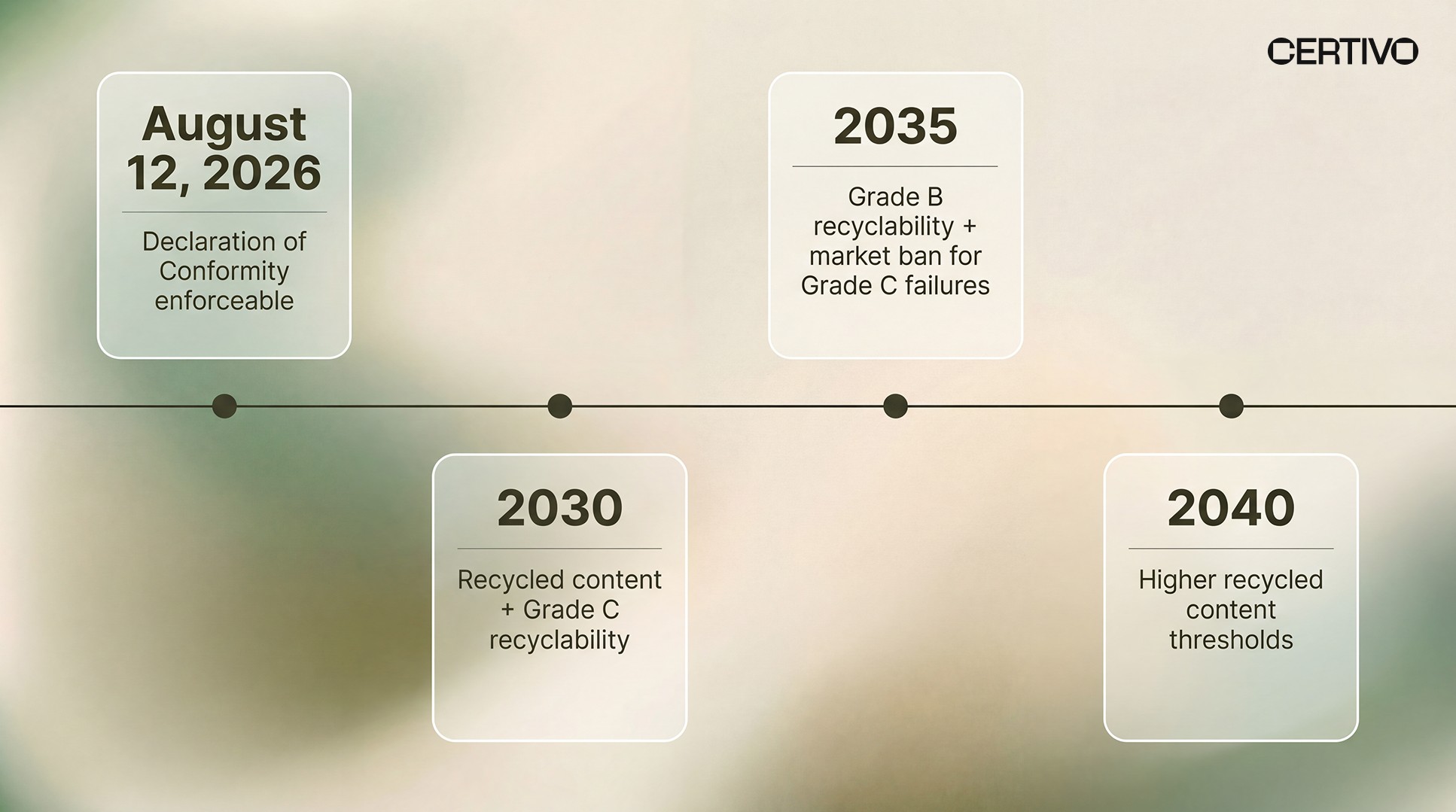
All EU-bound packaging must be designed for recycling. The PPWR establishes recyclability grades (A through E). By 2030, packaging must achieve at least Grade C. By 2035, packaging below Grade C faces a market ban.
Substance Restrictions
Packaging must comply with concentration limits for substances that impede recycling — including heavy metals under existing EU rules and PFAS under the new food-contact packaging provisions. This intersects directly with REACH substance restrictions and PFAS regulatory tracking.
For manufacturers already managing BOM substance and threshold management for product compliance, the PPWR extends that same discipline to packaging materials — requiring a centralized compliance data backbone that links packaging declarations to product-level data.
Industries and Packaging Categories Most Exposed
FMCG
High-volume, multi-format packaging (pouches, films, rigid plastics, composite cartons). Each format requires a separate conformity assessment. Thousands of SKUs means thousands of declarations.
Food and Beverage
Dual compliance burden: PPWR packaging requirements plus EU food contact materials regulations. Recycled content must satisfy both sustainability thresholds and food safety migration limits.
Cosmetics and Personal Care
Multi-material packaging (pumps, applicators, mixed-plastic components) complicates recyclability assessments. Combined with Prop 65 and REACH obligations on product contents, cosmetics brands face compliance on both the product and its packaging.
E-commerce
E-commerce packaging — corrugated boxes, void fill, protective packaging — is explicitly within PPWR scope. Companies managing quality management systems for fulfillment operations must integrate PPWR requirements into packing specifications.
Penalty Exposure: €500K+ and Market Exclusion
The PPWR mandates that EU member states establish penalties that are "effective, proportionate, and dissuasive." Based on currently available regulatory guidance and member state precedent for packaging and product regulation violations:
⚠ Financial penalties — Fines of €500,000 or more per violation are within the expected range for systematic non-compliance by enterprise manufacturers.
⚠ Market exclusion — Packaging without a valid declaration of conformity can be blocked from entering the EU market entirely. Customs authorities can refuse clearance.
⚠ Recall and withdrawal orders — Market surveillance authorities can mandate removal of non-compliant packaging already on the market.
⚠ Public disclosure — Non-compliance findings are published through the EU Safety Gate and national surveillance databases, creating reputational exposure.
For companies that have invested in continuous compliance monitoring and audit readiness, the enforcement exposure is manageable. For those still operating on spreadsheets and email-based supplier communications, the risk is material.
PPWR EU packaging regulation compliance deadline timeline 2026 to 2040
Click on image to view full
PPWR Pre-Deadline Compliance Checklist
How AI Reduces PPWR Compliance Burden at Scale
Manual PPWR compliance management — spreadsheets, email-based supplier collection, and ad hoc testing coordination — collapses under the weight of thousands of packaging specifications across multiple EU markets.
CORA-powered regulatory intelligence within Certivo addresses the structural challenges:
✓ Automated supplier data collection — Packaging suppliers submit composition data, recycled content certificates, and substance declarations through centralized supplier self-service portals with built-in validation. Incomplete or inconsistent submissions are flagged at intake — not during audit.
✓ AI document parsing — CORA extracts and validates data from supplier certificates, test reports, and material declarations. This reduces the manual data entry that consumes compliance engineering hours.
✓ Regulatory horizon scanning — CORA's regulatory intelligence layer tracks PPWR delegated acts, recyclability criteria updates, and PFAS threshold changes as they are published, ensuring declarations stay current.
✓ BOM-level material mapping — For companies managing both product compliance and packaging compliance, Certivo links packaging data to product-level BOMs — creating a single compliance thread from material to market.
No compliance system eliminates audit findings. The objective is to reduce surprises and compress response time. Organizations using AI tools for compliance management produce declarations and evidence packages in hours, not weeks.
Conclusion
The PPWR declaration of conformity deadline on August 12, 2026 is the hardest EU packaging compliance milestone this year. There is no grace period, no transitional window, and no "best effort" defense. For FMCG, cosmetics, food, and e-commerce manufacturers, the requirements span recyclability, recycled content, PFAS restrictions in food-contact packaging, substance testing, and — for many importers — full manufacturer-level obligations under Article 21.
Penalty exposure exceeding €500,000 and outright market exclusion make this a board-level risk, not a compliance department task. Organizations that invest now in continuous compliance monitoring, automated supplier data collection, and AI-native compliance automation will absorb this deadline and every subsequent PPWR threshold tightening through 2040 without proportional increases in headcount.
📌 Book a demo to see how Certivo automates PPWR packaging compliance across your product portfolio and multi-tier supply chain.
FAQs
1. What is the penalty for missing the PPWR declaration of conformity deadline?
EU member states set specific penalty levels, but the PPWR mandates fines that are "effective, proportionate, and dissuasive." Enterprise manufacturers face financial penalties exceeding €500,000, market exclusion for non-compliant packaging, and mandatory product recalls. Certivo's continuous audit-ready documentation ensures declarations are retrievable on demand.
2. Does the PPWR PFAS ban apply to all food packaging or only specific types?
The PFAS restrictions under PPWR target food-contact packaging specifically — particularly grease-resistant coatings on paperboard, flexible film barriers, and fast-food wrappers. Manufacturers must verify compliance through analytical testing, not supplier self-declarations alone. CORA-driven compliance intelligence tracks PFAS thresholds across both PPWR and REACH.
3. How does Article 21 affect private-label brands importing packaging into the EU?
Under Article 21, importers who place packaging on the EU market under their own name or trademark — or who modify packaging in a way that affects compliance — are reclassified as manufacturers. This means full responsibility for the conformity assessment, declaration, technical file, and market surveillance cooperation.
4. How long does PFAS testing take for packaging materials in 2026?
Based on currently available regulatory guidance and lab capacity reports, PFAS testing at accredited EU laboratories has lead times of 8 to 14 weeks. Manufacturers who have not yet submitted samples should act immediately — testing submitted in June 2026 may not return results before the August 12 enforcement date.
5. Can a single declaration of conformity cover multiple packaging formats?
Each distinct packaging type — defined by material composition, design, and intended use — requires its own declaration. A pouch, a rigid tray, and a corrugated box serving the same product are three separate declarations. Certivo's centralized platform manages declarations at the packaging-specification level, linked to SKUs and BOMs.
Hariprasanth
Hariprasanth is a Chemical Compliance Specialist with nearly four years of experience, underpinned by a degree in Chemical Engineering. He brings in-depth expertise in global product compliance, working across key regulations such as REACH, RoHS, TSCA, Proposition 65, POPs, FMD, and PFCMRT.
Hariprasanth specializes in reviewing technical documentation, validating supplier inputs, and ensuring that products consistently meet regulatory standards. He works closely with cross-functional teams and suppliers to collect accurate material data and deliver clear, audit-ready compliance reports that stand up to scrutiny.