


The Vermont Department of Environmental Conservation (DEC) has released draft solid waste rules that introduce PFAS screening thresholds for biosolids management. With a public comment deadline of June 19, 2026, these proposed rules signal a significant shift in how Vermont regulates per- and polyfluoroalkyl substances in sewage sludge and biosolids land application activities. For manufacturers, wastewater treatment operators, and environmental services companies, the Vermont PFAS biosolids rules carry direct implications for waste handling, supply chain accountability, and environmental reporting obligations.
📌 Book a free compliance risk assessment to evaluate your organization's PFAS exposure across waste streams and supply chain operations.
What the Vermont DEC Draft Solid Waste Rules Propose
The Vermont Department of Environmental Conservation has drafted amendments to the state's solid waste management framework. The proposed rules establish PFAS screening requirements specifically targeting biosolids — the treated residuals from wastewater treatment processes.
The core regulatory intent is to reduce environmental contamination and potential PFAS exposure risks arising from biosolids land application and waste management activities. Vermont joins a growing number of US states that are moving beyond general PFAS awareness toward enforceable screening and monitoring obligations tied to specific waste categories.
Key elements of the draft rules include:
✓ Introduction of PFAS screening thresholds for biosolids ✓ Strengthened oversight of sewage sludge management ✓ Potential restrictions on biosolids land application activities ✓ Enhanced environmental reporting requirements for waste operators
Stakeholders may submit comments on the proposed rules until June 19, 2026. Organizations that generate, handle, or apply biosolids should evaluate the draft requirements now — before the comment period closes and final rules are adopted.
For organizations already managing PFAS compliance across product portfolios, the Vermont biosolids rules represent another jurisdiction-specific obligation that must be tracked alongside federal TSCA requirements and emerging state-level restrictions.
Vermont PFAS biosolids rules 2026 environmental compliance overview
Click on image to view full

PFAS Screening Thresholds for Biosolids: Key Requirements
The draft rules introduce screening requirements for per- and polyfluoroalkyl substances in biosolids. Based on currently available regulatory guidance, the key compliance requirements include:
Screening and Monitoring Obligations
⚠ PFAS Testing — Facilities generating or handling biosolids may be required to conduct PFAS screening as part of routine waste characterization
⚠ Threshold-Based Management — The proposed rules establish screening thresholds that would determine how biosolids can be managed, disposed of, or applied to land
⚠ Land Application Restrictions — Biosolids exceeding defined PFAS thresholds may face restrictions or prohibitions on land application activities
⚠ Enhanced Waste Management Oversight — Sludge treatment and disposal operations may require additional PFAS monitoring and documentation
These requirements align with broader national trends. States like Maine, Michigan, and Massachusetts have already implemented or proposed PFAS restrictions on biosolids. Vermont's draft rules strengthen the state's position within this regulatory trend.
For companies tracking PFAS obligations across jurisdictions, this is another data point that reinforces the need for regulatory intelligence and horizon scanning capabilities. Each state-level rule introduces unique thresholds, timelines, and reporting formats that must be managed alongside federal PFAS reporting requirements under TSCA.
Which Industries Are Affected by Vermont PFAS Biosolids Rules
The draft rules carry direct implications for multiple sectors:
📊 Wastewater Treatment Facilities — The primary entities affected. Facilities generating biosolids must implement PFAS screening and potentially modify disposal or land application practices.
📊 Environmental Services & Waste Management — Companies involved in sludge treatment, hauling, and disposal must evaluate PFAS monitoring capabilities and adjust handling protocols.
📊 Agriculture & Land Application — Operations receiving biosolids for soil amendment may face restrictions if applied materials exceed PFAS screening thresholds. This directly affects farming operations that rely on biosolids-based fertilizers.
📊 Chemical & Industrial Manufacturing — Manufacturers that discharge to wastewater treatment systems are potential PFAS contributors to biosolids. Source evaluation and industrial pretreatment obligations could increase.
📊 Environmental Remediation Services — Companies managing PFAS contamination assessment and mitigation will see expanded demand for screening and monitoring services tied to biosolids.
For chemical manufacturers and industrial facilities that discharge wastewater, the Vermont rules create an indirect but significant compliance obligation. If biosolids at downstream treatment facilities exceed PFAS thresholds, regulators may trace contamination back to industrial sources — triggering source evaluation requirements.
How Do Manufacturers Manage PFAS Compliance in Waste Streams
This is one of the most operationally challenging questions for compliance leaders at manufacturing companies. PFAS contamination in waste streams is not always the result of direct manufacturing processes. PFAS can enter wastewater through:
Process chemicals and cleaning agents
Surface coatings and treatments
Packaging materials
Raw materials containing trace PFAS contamination
Managing PFAS compliance in waste streams requires multi-tier supply chain transparency — understanding not just what materials are used in production, but how those materials behave through the entire waste lifecycle.
Manufacturers should consider:
✓ Inventory PFAS-containing inputs — Identify all products, chemicals, and materials that contain or may contain PFAS compounds entering your waste streams
✓ Evaluate wastewater discharge — Assess whether your facility's discharge contributes PFAS to downstream wastewater treatment operations
✓ Coordinate with treatment facilities — Understand whether your wastewater treatment provider is subject to Vermont's draft biosolids rules
✓ Document PFAS management practices — Maintain records demonstrating due diligence in identifying and managing PFAS sources
For manufacturers already managing PFAS compliance across supply chains, the Vermont biosolids rules add another downstream compliance dimension that connects product-level substance data to waste management obligations.
📌 Need visibility into your PFAS exposure across waste streams and supply chains? → Get a compliance risk assessment
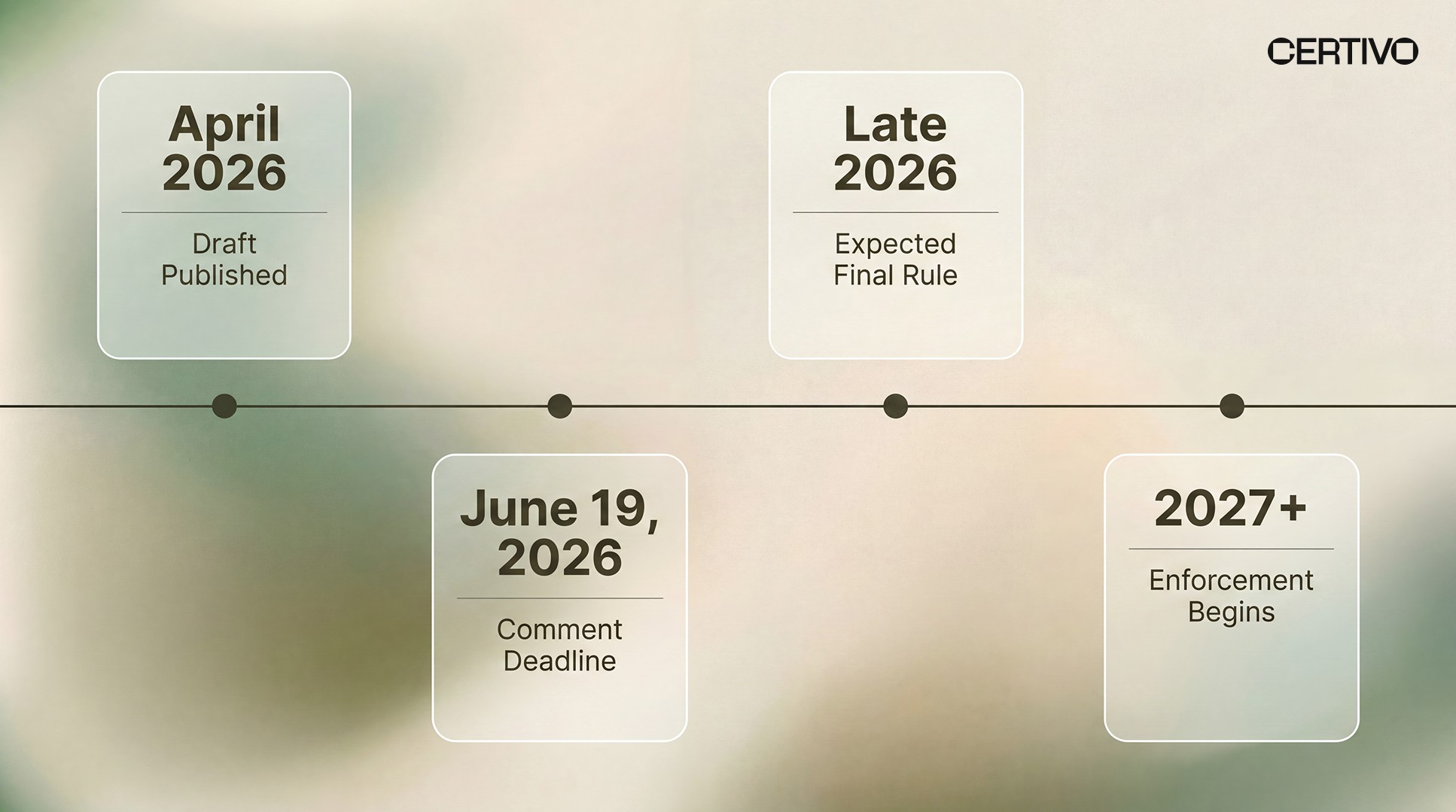
Vermont PFAS biosolids rules 2026 compliance timeline for manufacturers
Click on image to view full
Reporting and Documentation Challenges Under the Draft Rules
The Vermont PFAS biosolids rules introduce several documentation and data management challenges:
Testing and Record-Keeping
Facilities will need to establish PFAS testing protocols, retain analytical results, and maintain documentation that demonstrates compliance with screening thresholds. For organizations without existing PFAS monitoring programs, this creates a new operational workload.
Multi-Jurisdiction Complexity
Vermont's draft rules do not exist in isolation. Companies operating across multiple states must track:
Vermont's biosolids screening thresholds
State-level PFAS regulations in other jurisdictions
Federal TSCA PFAS reporting requirements
EPA guidance on PFAS in biosolids
Managing this regulatory patchwork manually is unsustainable. Organizations that rely on spreadsheets and email for compliance tracking face growing risk as each jurisdiction introduces unique requirements.
Evidence Chain Integrity
For PFAS compliance specifically, regulators and auditors increasingly expect documentation that demonstrates:
Who provided the testing evidence
When the testing was conducted
Under what analytical methods and authority
How results were interpreted against applicable thresholds
This is fundamentally a data versioning problem — requiring immutable audit logs, time-stamped declarations, and point-in-time query capabilities. No software eliminates audit findings entirely, but maintaining continuous audit-ready documentation significantly reduces response time and surprises during regulatory inspections.
Compliance Risks and Enforcement Exposure
⚠ Regulatory Penalties — Once finalized, non-compliance with Vermont's biosolids rules could result in enforcement actions, fines, and operational restrictions under Vermont's solid waste management authority.
⚠ Land Application Prohibitions — Facilities that fail to screen biosolids for PFAS may lose authorization to apply biosolids to land, creating waste disposal bottlenecks and increased costs.
⚠ Source Tracing — Industrial facilities contributing PFAS to wastewater streams may face source evaluation requirements, potentially triggering pretreatment obligations and capital investment in PFAS removal technologies.
⚠ Reputational and ESG Exposure — Companies linked to PFAS contamination through biosolids face reputational risk with investors, communities, and ESG rating agencies.
Organizations maintaining proactive compliance risk management programs are better positioned to absorb new state-level PFAS obligations without operational disruption.
Supply Chain and Operational Impact
The Vermont PFAS biosolids rules create ripple effects that extend beyond wastewater treatment facilities:
Upstream — Manufacturers and industrial facilities that discharge to municipal wastewater systems may face increased scrutiny. Wastewater treatment operators are likely to push source identification requirements upstream to identify PFAS contributors.
Operational — Facilities that generate biosolids will need to evaluate testing capabilities, adjust waste handling procedures, and potentially redirect biosolids from land application to alternative disposal methods. Alternative disposal (landfill, incineration) carries higher costs and its own regulatory constraints.
Supplier Accountability — Manufacturers sourcing raw materials or process chemicals that contain PFAS may need to evaluate and document these inputs as part of their waste compliance programs. This connects product-level PFAS and chemicals risk management to downstream waste obligations.
Timeline and Future Enforcement Outlook
Date | Event |
|---|---|
April 2026 | Vermont DEC publishes draft solid waste rules with PFAS biosolids screening thresholds |
June 19, 2026 | Public comment deadline |
Late 2026 (expected) | Final rule adoption (based on currently available regulatory guidance) |
2027+ | Enforcement and compliance monitoring ramp-up |
Vermont's action follows a broader national pattern. EPA has published interim guidance on PFAS in biosolids, and multiple states have already enacted or proposed restrictions. The regulatory trajectory points toward tighter PFAS biosolids standards across more jurisdictions.
For a comprehensive view of PFAS regulatory developments, see the Global PFAS Regulations Master Guide on Certivo.
Strategic Compliance Preparation Checklist
How AI Supports PFAS Compliance in Biosolids Management
Managing PFAS compliance across biosolids, waste streams, and multi-jurisdiction regulations requires capabilities that exceed manual tracking methods.
CORA-powered regulatory intelligence monitors state-level PFAS developments — including draft rules like Vermont's — and alerts compliance teams before obligations take effect. This regulatory intelligence and horizon scanning capability ensures organizations are aware of emerging requirements during comment periods, not after enforcement begins.
For manufacturers managing PFAS across products, supply chains, and waste streams simultaneously, AI-native compliance automation connects substance-level data to regulatory thresholds across frameworks. Certivo's centralized compliance data backbone links product-level PFAS data to downstream waste management obligations, providing a single system of record that supports both product compliance and environmental compliance programs.
AI document parsing and certificate validation capabilities reduce the manual burden of processing analytical test reports, waste characterization documents, and supplier declarations related to PFAS content.
Executive Conclusion
The Vermont DEC's draft solid waste rules introducing PFAS screening thresholds for biosolids represent the latest in an accelerating series of state-level PFAS regulations. With a public comment deadline of June 19, 2026, affected organizations — wastewater treatment facilities, waste management companies, agricultural operations, and industrial manufacturers — have a narrow window to evaluate the draft requirements and prepare compliance strategies.
The Vermont PFAS biosolids rules do not exist in isolation. They add to a growing patchwork of federal and state PFAS obligations that must be managed together. Organizations that invest in scalable PFAS compliance infrastructure — connecting product-level substance data to waste management and environmental reporting — will absorb these requirements more efficiently than those relying on manual processes.
📌 Book a demo to see how Certivo automates PFAS compliance tracking across products, supply chains, and waste management obligations — connecting regulatory intelligence to operational readiness across every jurisdiction.
FAQs
1. What PFAS screening thresholds does Vermont's draft biosolids rule propose?
The Vermont DEC's draft solid waste rules introduce PFAS screening thresholds for biosolids management and land application activities. Based on currently available regulatory guidance, specific threshold values are defined in the draft rules available through the Vermont DEC. Organizations should review the full proposed rules and submit comments by June 19, 2026.
2. How does Vermont's PFAS biosolids rule affect industrial manufacturers?
Manufacturers that discharge wastewater to municipal treatment systems may face indirect compliance obligations. If downstream biosolids exceed PFAS thresholds, regulators may trace contamination to industrial sources, triggering source evaluation and pretreatment requirements. Certivo's CORA intelligence helps manufacturers map PFAS inputs across operations.
3. Are there federal PFAS biosolids regulations in addition to Vermont's rules?
EPA has published interim guidance on PFAS in biosolids but has not yet finalized federal biosolids PFAS limits. Vermont's draft rules operate under state solid waste authority. Organizations must track both federal and state PFAS requirements. CORA-driven compliance intelligence monitors developments across jurisdictions automatically.
4. What is the deadline for commenting on Vermont's draft biosolids rules?
The public comment period closes on June 19, 2026. Stakeholders including wastewater treatment operators, manufacturers, agricultural operations, and waste management companies can submit comments through the Vermont Department of Environmental Conservation.
5. How can organizations prepare for Vermont's PFAS biosolids compliance requirements?
Start by reviewing the draft rules, assessing PFAS sources in your waste streams, and establishing analytical testing protocols. Coordinate with downstream wastewater treatment providers and integrate Vermont-specific obligations into your broader PFAS compliance strategy. Certivo's platform centralizes PFAS tracking across frameworks and jurisdictions.
Lavanya
Lavanya is an accomplished Product Compliance Engineer with over four years of expertise in global environmental and regulatory frameworks, including REACH, RoHS, Proposition 65, POPs, TSCA, PFAS, CMRT, FMD, and IMDS. A graduate in Chemical Engineering from the KLE Institute, she combines strong technical knowledge with practical compliance management skills across diverse and complex product portfolios.
She has extensive experience in product compliance engineering, ensuring that materials, components, and finished goods consistently meet evolving international regulatory requirements. Her expertise spans BOM analysis, material risk assessments, supplier declaration management, and test report validation to guarantee conformity. Lavanya also plays a key role in design-for-compliance initiatives, guiding engineering teams on regulatory considerations early in the product lifecycle to reduce risks and streamline market access.