


The state of Connecticut is implementing PFAS notification and labeling requirements for apparel products, with enforcement beginning July 1, 2026. Manufacturers, distributors, and retailers selling apparel containing intentionally added PFAS in Connecticut must now prepare for supplier disclosure campaigns, product formulation reviews, and labeling obligations that directly affect how textile products reach the Connecticut market.
This regulation is part of an accelerating wave of state-level PFAS restrictions across the United States. For compliance leaders managing Connecticut PFAS labeling requirements alongside federal TSCA reporting and other state-specific mandates, the operational challenge is not awareness—it is execution across a fragmented regulatory landscape.
📌 Book a free compliance assessment to evaluate your current PFAS exposure across apparel products and supply chains before the July 2026 deadline.
What Connecticut's PFAS Apparel Regulation Requires
The Connecticut Department of Energy and Environmental Protection (DEEP) is enforcing PFAS notification and labeling obligations for apparel products sold in the state. Beginning July 1, 2026, companies selling apparel containing intentionally added PFAS may be required to:
✓ Provide notifications to the state regarding PFAS presence in apparel products
✓ Comply with labeling requirements that disclose PFAS content to consumers
✓ Collect and maintain supplier PFAS disclosure documentation
This regulation targets per- and polyfluoroalkyl substances commonly used in water-resistant, stain-resistant, and performance textile applications. The scope covers the full range of treated apparel—from outdoor performance wear to uniforms and everyday garments with durable water repellent (DWR) finishes.
For companies already managing PFAS compliance across multiple jurisdictions, Connecticut's requirements add another layer of state-specific obligation that must be tracked at the product and SKU level.
Connecticut PFAS labeling requirements 2026 for apparel manufacturers compliance
Click on image to view full

Which Industries and Products Are Affected
The Connecticut PFAS apparel regulation affects multiple segments of the textile and consumer goods supply chain:
📊 Apparel and Textiles — Outdoor wear, sportswear, uniforms, workwear, and any fabric treated with fluorinated coatings for water or stain resistance. This is the primary impact zone.
📊 Consumer Goods — Clothing and textile-based consumer products sold through retail and e-commerce channels serving Connecticut customers.
📊 Retailers and Distributors — Any entity placing apparel products into the Connecticut market, regardless of where the product was manufactured.
📊 Chemical Manufacturers — Companies producing PFAS-containing textile treatments, DWR coatings, and fluorochemical finishing agents used in apparel supply chains.
📊 Footwear and Accessories — Products incorporating water-resistant or stain-resistant materials that rely on PFAS-based treatments.
Companies selling into Connecticut through e-commerce channels should pay particular attention. If the product reaches a Connecticut consumer, the labeling and notification obligations apply—regardless of where the seller is based.
For manufacturers managing compliance across consumer goods product lines, this regulation requires product-level PFAS tracking that ties directly to BOM substance and threshold management systems.
What Qualifies as Intentionally Added PFAS in Textiles
The regulation targets intentionally added PFAS—substances deliberately introduced into apparel products or their components to achieve specific performance characteristics. This distinction is critical for compliance engineers evaluating product formulations.
Common applications of intentionally added PFAS in apparel include:
⚠ Durable water repellent (DWR) finishes on outerwear and performance fabrics
⚠ Stain-resistant treatments on uniforms and workwear
⚠ Oil-resistant coatings on industrial and protective garments
⚠ Fluorinated membranes in waterproof-breathable fabric laminates
The compliance challenge lies in determining PFAS presence across multi-tier supply chains where textile treatments may be applied at the fiber, yarn, fabric, or garment finishing stage. Manufacturers must collect supplier PFAS disclosure data at each tier to confirm whether PFAS was intentionally added.
Based on currently available regulatory guidance, trace contamination or incidental PFAS presence below intentional-addition thresholds may be treated differently. However, the burden of proof rests with the manufacturer or distributor to demonstrate that PFAS was not intentionally introduced.
This is where multi-tier supply chain transparency becomes operationally essential—not aspirational.
Key Compliance Obligations Before July 1, 2026
Manufacturers and distributors must address four core compliance obligations ahead of the enforcement date:
1. Supplier PFAS Disclosure Collection
Contact all suppliers involved in textile treatment, fabric finishing, and garment manufacturing. Collect written declarations confirming whether PFAS was intentionally added to any component or treatment process. This requires standardized supplier questionnaire frameworks distributed through centralized supplier self-service portals to ensure consistent, auditable responses.
2. Product and BOM Evaluation
Review all apparel products sold or distributed in Connecticut. Evaluate BOMs and material specifications to identify products containing PFAS-treated components. Companies managing large product portfolios need BOM-level material mapping to flag affected SKUs efficiently.
3. Labeling Assessment and Implementation
Determine labeling requirements for each affected product. Assess whether current product labels, hangtags, or packaging meet Connecticut's disclosure standards. Coordinate with packaging and marketing teams to implement label changes within production timelines.
4. Notification to Connecticut DEEP
Prepare and submit required notifications to Connecticut DEEP regarding PFAS-containing apparel products. Maintain records of all notifications, supplier disclosures, and labeling actions as part of continuous audit-ready documentation.
📌 Managing PFAS supplier data across hundreds of SKUs? See how Certivo automates this → Book a Demo
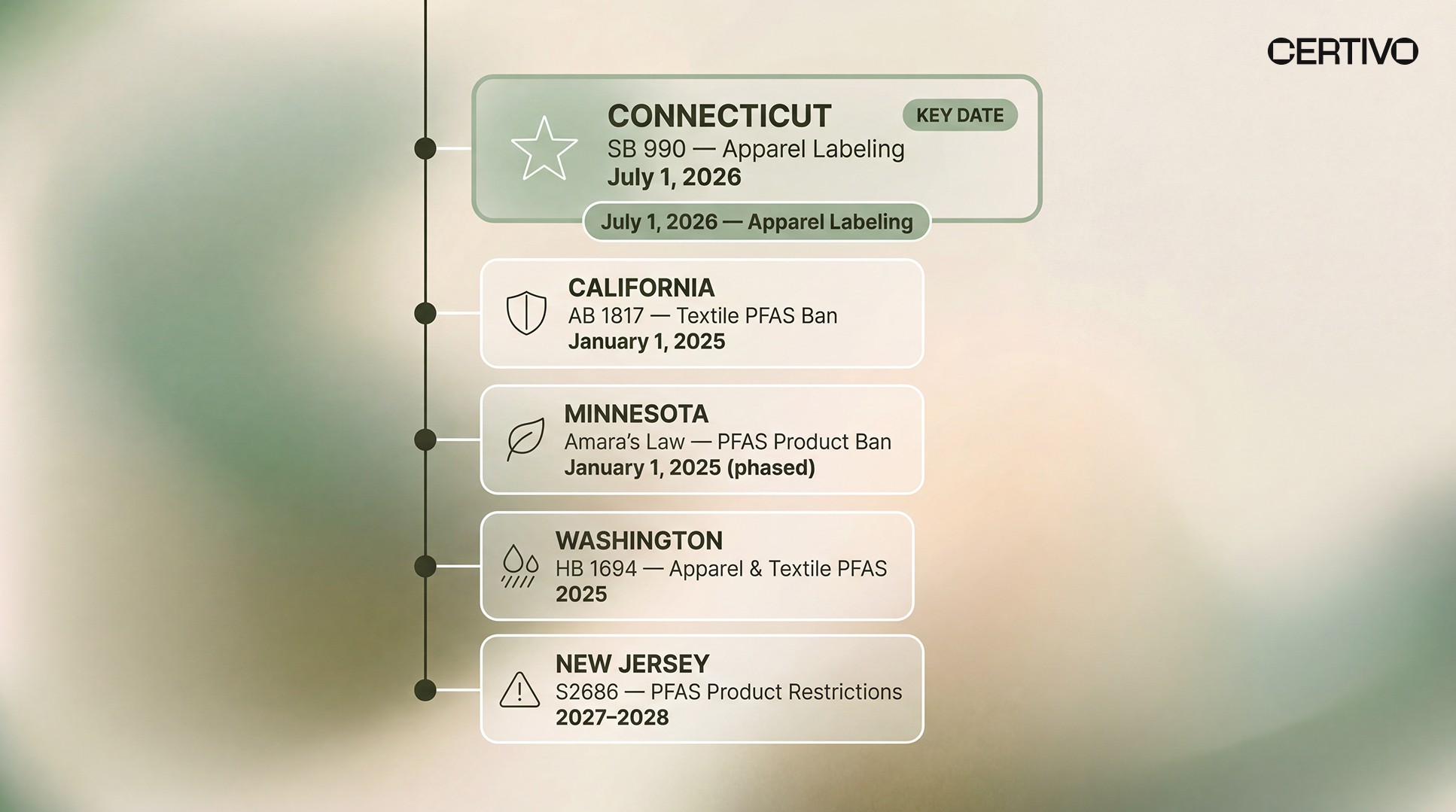
How This Fits Into the Broader US PFAS Regulatory Landscape
Connecticut's apparel PFAS regulation does not exist in isolation. It is part of an expanding patchwork of state-level PFAS restrictions that compliance teams must track simultaneously.
State | PFAS Focus | Key Deadline |
|---|---|---|
Connecticut | Apparel notification and labeling | July 1, 2026 |
California (AB 1817) | Textiles PFAS ban | January 1, 2025 (in effect) |
Minnesota | PFAS reporting (Amara's Law) | July 1, 2026 |
Massachusetts | PFAS product notification | 2026–2027 phased |
Washington State | Safer Products PFAS bans | 2027 phased |
New Jersey | Broad PFAS product ban | 2028 |
For compliance leaders, the operational problem is clear: each state has different scope definitions, threshold approaches, notification mechanisms, and enforcement timelines. Managing this without a centralized system creates duplication, gaps, and audit exposure.
Certivo's PFAS frameworks library provides a structured reference for tracking these overlapping obligations. CORA-powered regulatory intelligence monitors changes across jurisdictions and alerts teams before deadlines shift—enabling regulatory intelligence and horizon scanning rather than reactive scrambling.
For deeper analysis of state-by-state PFAS requirements, see State PFAS Regulations 2026: Bans, Labeling, and Compliance for Manufacturers.
Connecticut PFAS labeling requirements 2026 timeline with US state PFAS regulations
Click on image to view full
Supply Chain and Operational Impact
The Connecticut PFAS apparel regulation creates upstream and downstream operational effects that extend well beyond a single state boundary.
Upstream: Supplier Engagement
Textile mills, fabric finishers, and chemical treatment suppliers must be queried for PFAS disclosure
Suppliers operating across multiple customer programs may provide inconsistent or incomplete data
Smaller Tier 2 and Tier 3 suppliers in apparel supply chains may lack systems to respond to structured PFAS questionnaires
Automated supplier data collection portals reduce friction and improve response rates compared to email-based campaigns
Downstream: Labeling and Market Access
Products failing to meet Connecticut labeling requirements cannot be legally sold in the state
Retailers may impose their own PFAS-free sourcing policies that exceed state requirements
Customer audit requests for PFAS documentation will increase, particularly from major retail buyers
Companies maintaining customer trust centers and self-service reporting capabilities can respond faster to buyer inquiries
Cross-Functional Coordination
Compliance, sourcing, product development, packaging, and legal teams must align on reformulation decisions, label changes, and supplier engagement timelines. This coordination is where centralized compliance data backbone infrastructure separates efficient organizations from those managing PFAS compliance through fragmented email threads and spreadsheets.
Compliance Risks and Enforcement Exposure
Failure to comply with Connecticut's PFAS apparel labeling requirements exposes companies to several risk categories:
⚠ State Enforcement Actions — Connecticut DEEP has authority to enforce notification and labeling violations. Penalties and enforcement specifics are subject to the state's regulatory framework.
⚠ Retail Buyer Consequences — Major retailers increasingly require PFAS compliance documentation. Non-compliant products risk delisting, order cancellations, or supply chain disqualification.
⚠ Reputational Exposure — Consumer awareness of PFAS in apparel is increasing. Companies without transparent labeling face reputational risk from advocacy organizations and media scrutiny.
⚠ Multi-State Compounding Risk — Non-compliance in Connecticut signals potential gaps in other state programs. Regulators and customers treat single-state failures as indicators of systemic compliance weakness.
Organizations that maintain continuous compliance monitoring and audit readiness across their PFAS-affected product lines are better positioned to absorb new state requirements without emergency-mode responses.
Strategic Compliance Preparation Checklist
How AI Reduces the Burden of State-Level PFAS Compliance
Managing PFAS compliance across a patchwork of US state regulations is a data problem at its core. Each state defines scope differently, targets different product categories, and imposes different disclosure mechanisms. Manual tracking across Connecticut, California, Minnesota, Washington, and emerging state programs is not sustainable at enterprise scale.
CORA-driven compliance intelligence automates the most labor-intensive elements of state-level PFAS compliance:
✓ AI document parsing and certificate validation — Automatically extracts PFAS-relevant data from supplier declarations, test reports, and material safety data sheets, reducing manual data entry.
✓ BOM-level compliance intelligence — Maps PFAS presence to specific products and SKUs, enabling product-level labeling decisions rather than blanket assessments.
✓ Regulatory intelligence and horizon scanning — CORA's regulatory intelligence layer monitors state-level PFAS regulatory developments and alerts compliance teams before deadlines or scope changes take effect.
✓ Centralized supplier self-service portals — Suppliers submit PFAS disclosures through guided, structured forms rather than unstructured email attachments, improving data quality and reducing back-and-forth.
For organizations managing PFAS and chemicals risk management across multiple frameworks, Certivo provides the centralized infrastructure to track obligations, collect supplier evidence, and maintain audit-ready records across every jurisdiction.
Executive Conclusion
Connecticut's PFAS notification and labeling requirements for apparel, effective July 1, 2026, represent another step in the expanding US state-level PFAS regulatory landscape. For manufacturers and distributors selling apparel products in Connecticut, the compliance path is clear: identify affected products, collect supplier PFAS disclosures, implement labeling changes, and file required notifications with Connecticut DEEP.
The broader challenge is not any single state regulation—it is managing Connecticut PFAS labeling requirements alongside California AB 1817, Minnesota's Amara's Law, and the growing list of state-specific obligations without proportional increases in manual effort. Companies that invest in AI-native compliance automation, centralized compliance data backbone infrastructure, and automated supplier data collection are positioned to absorb each new state mandate efficiently.
📌 Book a demo to see how Certivo automates PFAS compliance across your apparel product portfolio and multi-tier supply chain—including Connecticut-specific labeling, supplier data collection, and continuous regulatory monitoring.
FAQs
1. When do Connecticut's PFAS apparel labeling requirements take effect?
The notification and labeling requirements for apparel containing intentionally added PFAS take effect on July 1, 2026. Manufacturers and distributors should complete supplier disclosure campaigns and labeling assessments well ahead of this date. Certivo's CORA intelligence provides deadline tracking and automated alerts.
2. Which apparel products are covered under Connecticut's PFAS regulation?
The regulation covers apparel products containing intentionally added PFAS, including outdoor wear, sportswear, uniforms, and garments with water-resistant or stain-resistant treatments. Footwear and textile accessories using PFAS-based coatings may also be affected.
3. How can manufacturers determine if their apparel contains intentionally added PFAS?
Manufacturers must collect PFAS disclosure information from suppliers at each tier of the textile supply chain—including fabric finishers, coating applicators, and chemical treatment providers. Structured supplier questionnaires distributed through self-service portals improve data quality and response rates.
4. Does this regulation apply to e-commerce sellers shipping apparel to Connecticut?
Based on currently available regulatory guidance, products reaching Connecticut consumers are subject to the state's labeling and notification requirements regardless of the seller's location. E-commerce sellers should evaluate their Connecticut-bound apparel inventory for PFAS content.
5. How does Connecticut's PFAS apparel law compare to California's AB 1817 textiles ban?
California's AB 1817 prohibits intentionally added PFAS in textiles and took effect in 2025. Connecticut's regulation focuses on notification and labeling rather than an outright ban. Both require supplier PFAS disclosure, but the compliance actions differ—reformulation versus labeling. Managing both requires centralized, jurisdiction-specific tracking.