


The EU Packaging and Packaging Waste Regulation (PPWR) introduces binding requirements on recyclability, reuse targets, hazardous substance restrictions, and labeling obligations for all packaging placed on the EU market. With general application beginning 12 August 2026, manufacturers, importers, and brand owners across every sector face a compressed timeline to redesign packaging, update supplier documentation, and establish compliant reporting workflows.
This regulation represents a structural shift from the previous Packaging and Packaging Waste Directive (94/62/EC) to a directly applicable EU regulation — meaning uniform enforcement across all member states without national transposition variations. For compliance leaders managing materials and environmental compliance across global operations, PPWR demands immediate operational attention.
📌 Book a free compliance assessment to evaluate your packaging compliance readiness before the August 2026 deadline.
What Is the EU Packaging and Packaging Waste Regulation (PPWR)?
The PPWR — formally published as Regulation (EU) 2025/40 — replaces the existing EU Packaging and Packaging Waste Directive with a directly applicable regulation. Its core objective is to reduce the environmental impact of packaging waste by promoting circular economy principles across the EU market.
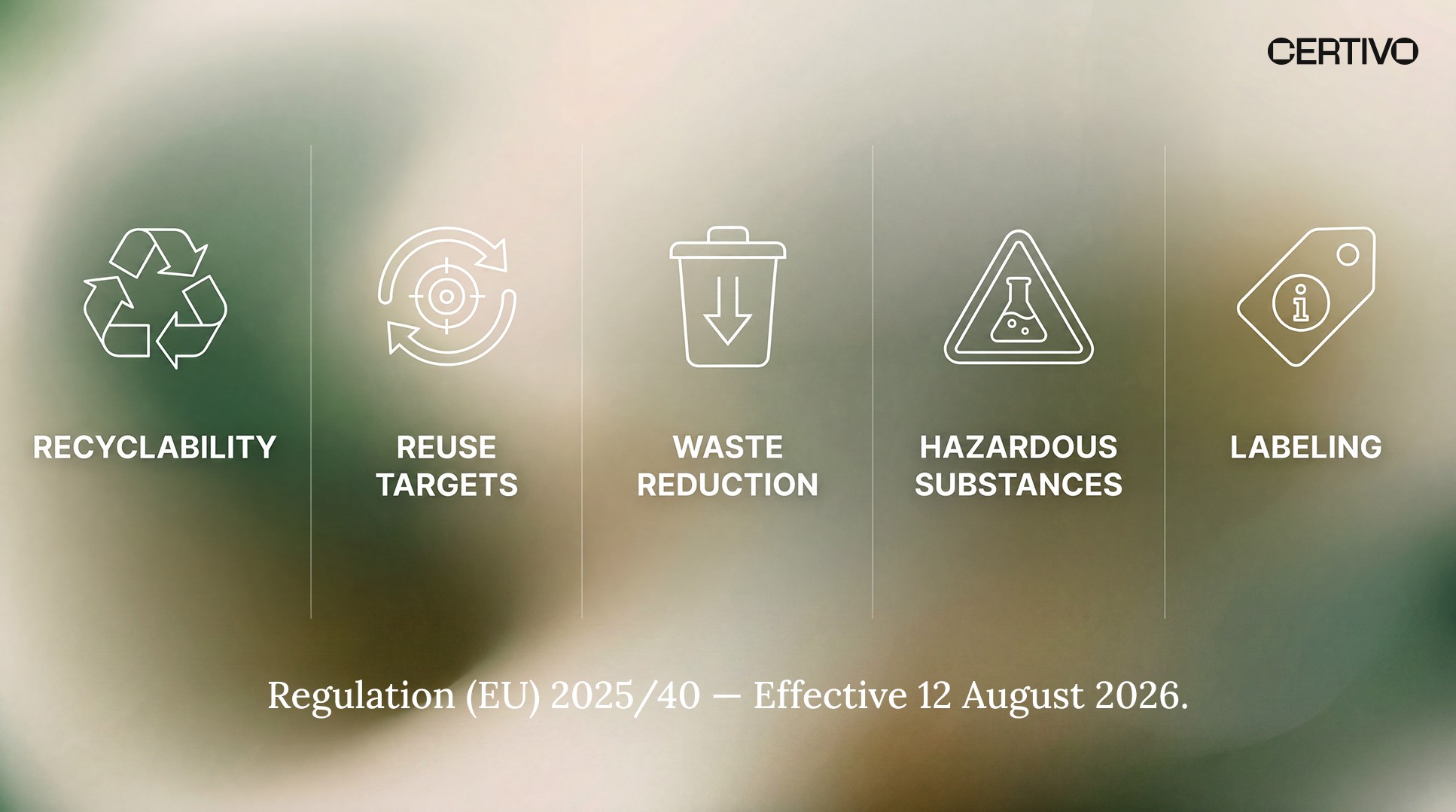
The regulation establishes mandatory requirements across five areas:
✓ Recyclability — All packaging must meet recyclability criteria, with escalating thresholds over time ✓ Reuse targets — Specific reuse and refill targets for defined packaging formats ✓ Waste reduction — Restrictions on excessive and unnecessary packaging ✓ Hazardous substances — Restrictions on substances of concern in packaging materials ✓ Labeling — Standardized labeling and consumer information requirements
For organizations already navigating REACH, RoHS, and PFAS restrictions, PPWR adds another layer of substance-level and material-level compliance obligations tied directly to packaging.
EU packaging waste regulation PPWR five core compliance requirements for manufacturers
Click on image to view full
Why PPWR Matters More Than the Previous Directive
The shift from directive to regulation is not procedural — it is structural.
Aspect | Previous Directive (94/62/EC) | PPWR (Regulation 2025/40) |
|---|---|---|
Legal form | Directive — national transposition required | Regulation — directly applicable across all EU states |
Enforcement | Varied by member state | Uniform enforcement |
Recyclability | Voluntary guidelines | Mandatory criteria with thresholds |
Substance restrictions | Limited | Explicit hazardous substance restrictions |
Labeling | Fragmented | Standardized EU-wide |
This means compliance teams can no longer rely on country-specific interpretations. A single set of requirements applies uniformly, raising the floor for all manufacturers placing packaging on the EU market.
Companies managing multi-jurisdiction EHS and ESG obligations should treat PPWR as a centralization event — one regulation replacing a patchwork of national implementations.
Key PPWR Requirements for Manufacturers
Mandatory Recyclability and Reusability Targets
PPWR establishes binding recyclability requirements for all packaging formats. Packaging that does not meet defined recyclability criteria will face market restrictions on escalating timelines.
⚠ Reuse targets apply to specific packaging categories, including transport packaging, e-commerce packaging, and grouped packaging.
Reduction of Excess and Unnecessary Packaging
The regulation introduces requirements to minimize packaging weight and volume relative to the product being packaged. Excessive void space and unnecessary secondary packaging layers are targeted.
Restrictions on Hazardous Substances in Packaging Materials
PPWR tightens restrictions on hazardous substances present in packaging materials, aligning with broader EU chemical safety frameworks. This is particularly relevant for manufacturers already tracking PFAS and chemicals risk management obligations, as PFAS-containing packaging materials face increasing scrutiny.
Labeling and Information Requirements
Standardized labeling requirements ensure consumers receive clear information about:
Material composition
Recyclability classification
Sorting and disposal instructions
This replaces the current fragmented landscape of national labeling schemes with a unified EU system. Compliance teams must update packaging artwork, supplier specifications, and documentation workflows to meet the new requirements.
Which Industries Are Affected by PPWR Compliance?
PPWR applies to all packaging placed on the EU market, regardless of origin, material, or sector. The industries facing the most significant operational impact include:
📊 Consumer Goods & FMCG — Food, beverage, and personal care brands with high packaging volumes face the broadest compliance exposure across recyclability, reuse, and labeling requirements.
📊 E-Commerce & Logistics — Shipping, transport, and protective packaging used in e-commerce fulfillment is subject to reuse targets and excess packaging restrictions. Companies managing supplier and contractor management programs for logistics partners must cascade PPWR requirements downstream.
📊 Electronics & Automotive — Industrial and component packaging, including ESD-protective materials, trays, and foam inserts, falls within scope. Electronics manufacturers and automotive manufacturers must evaluate packaging materials against both PPWR substance restrictions and existing WEEE and Extended Producer Responsibility obligations.
📊 Manufacturing & Industrial — Raw material suppliers and packaging producers are directly affected by recyclability design requirements and substance restrictions.
Hazardous Substance Restrictions in Packaging Under PPWR
One of the most operationally significant elements of PPWR is the explicit restriction on hazardous substances in packaging materials. This goes beyond traditional heavy metal limits (lead, cadmium, mercury, hexavalent chromium) already established under the previous directive.
Key points for compliance engineers:
PPWR reinforces and potentially expands substance restrictions in packaging
Alignment with REACH and CLP frameworks means that substances identified as SVHCs or subject to restriction under REACH Annex XVII may also trigger PPWR obligations
PFAS in packaging — particularly food-contact packaging — faces restrictions under parallel EU frameworks, and PPWR reinforces the requirement to eliminate substances of concern. See Certivo's analysis of the EU packaging PFAS ban for further detail.
Organizations using BOM substance and threshold management systems must extend tracking to packaging materials — not just product components.
📌 Managing substance restrictions across packaging and products? See how Certivo consolidates this → Map your regulatory exposure
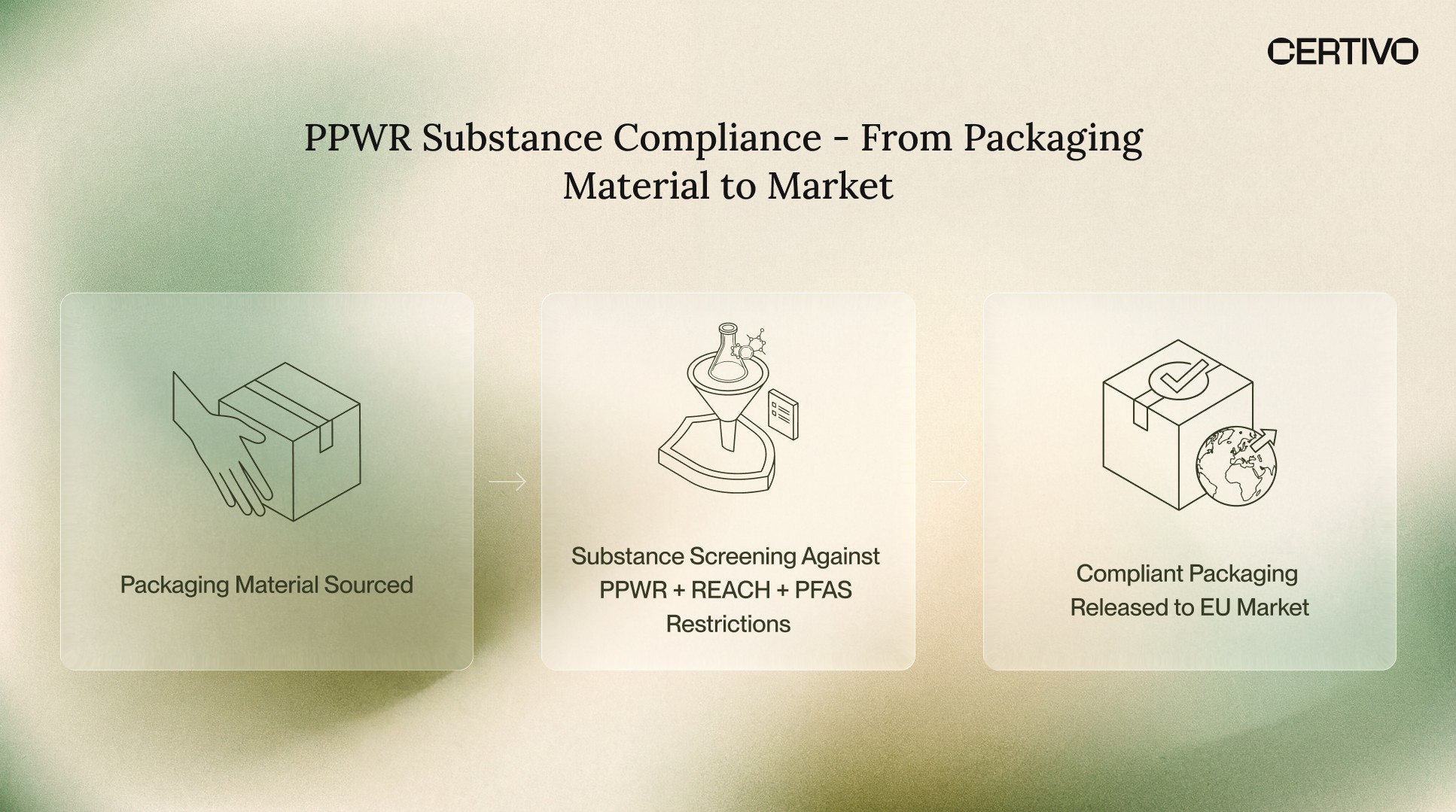
EU packaging waste regulation substance compliance workflow for packaging manufacturers
Click on image to view full
How Does PPWR Affect Labeling and Information Requirements?
PPWR mandates standardized labeling across the EU, replacing the current patchwork of national systems. Manufacturers must provide:
✓ Material identification markings on all packaging ✓ Recyclability classification aligned with EU-defined criteria ✓ Consumer sorting instructions for proper waste disposal ✓ Digital or physical labeling formats as specified
For companies selling across multiple EU markets, this is a simplification — but only if labeling workflows are updated in time. Compliance teams managing region-specific labeling and documentation requirements should audit current packaging artwork against PPWR requirements immediately.
⚠ Non-compliant labeling will result in packaging being barred from the EU market after enforcement begins.
Extended Producer Responsibility Under PPWR
PPWR strengthens Extended Producer Responsibility (EPR) obligations for all economic operators placing packaging on the EU market. Key changes include:
Enhanced financial contributions to waste management systems
Modulated fees based on packaging recyclability and environmental performance
Reporting obligations tied to packaging volumes, materials, and recyclability metrics
Alignment with EPR frameworks already in force across EU member states
Manufacturers and importers must maintain accurate records of packaging placed on the market, broken down by material type, format, and volume. This requires a centralized compliance data backbone that links packaging specifications to product-level data.
Reporting, Documentation, and Data Challenges
What Tools Help Manage Packaging Compliance Across Multiple Jurisdictions?
Despite PPWR being a single regulation, implementation creates reporting requirements that intersect with:
National EPR registries
REACH substance reporting
PFAS disclosure obligations
Customer-specific packaging sustainability requirements
Managing this data manually — across suppliers, packaging formats, product lines, and markets — is not scalable. Organizations need systems that support end-to-end product compliance from design through production and shipment.
Key Data Challenges
⚠ Packaging material composition data — Many manufacturers lack substance-level visibility into packaging materials supplied by third parties
⚠ Recyclability classification — Determining whether packaging meets PPWR recyclability criteria requires material-level testing data and design documentation
⚠ Supplier declarations — Packaging suppliers must provide compliant declarations, but many lack the systems or expertise to do so without structured guidance through supplier self-service compliance portals
⚠ Multi-framework overlap — The same packaging material may trigger obligations under PPWR, REACH, PFAS restrictions, and national EPR schemes simultaneously
What Are the Compliance Risks and Penalties for Non-Compliance?
Based on currently available regulatory guidance, PPWR enforcement will follow the standard EU regulatory model:
Market access restrictions — Non-compliant packaging cannot be placed on the EU market
Financial penalties — Member states will establish penalty frameworks for non-compliance
Supply chain disruption — OEMs and brand owners will cascade PPWR requirements to suppliers, creating deselection risk for non-compliant packaging providers
Reputational exposure — ESG-focused investors and customers increasingly scrutinize packaging sustainability
Organizations maintaining continuous audit-ready documentation are better positioned to demonstrate compliance during regulatory checks and customer audits.
Supply Chain and Operational Impact
How Can Manufacturers Manage Packaging Compliance Across Complex Supply Chains?
PPWR obligations flow through the entire packaging value chain:
Upstream — Packaging material suppliers must provide substance composition data, recyclability documentation, and compliance declarations. Many smaller suppliers will require automated supplier data collection portals to submit this data in a structured, validated format.
Midstream — Manufacturers and converters must verify that packaging designs meet recyclability criteria, substance restrictions, and labeling requirements before production.
Downstream — Brand owners and importers bear ultimate responsibility for ensuring all packaging placed on the EU market meets PPWR requirements. This requires multi-tier supply chain transparency across the packaging supply chain.
For companies already managing sustainability and carbon compliance alongside product-level regulations, PPWR adds packaging as a distinct compliance domain that must be integrated into existing workflows.
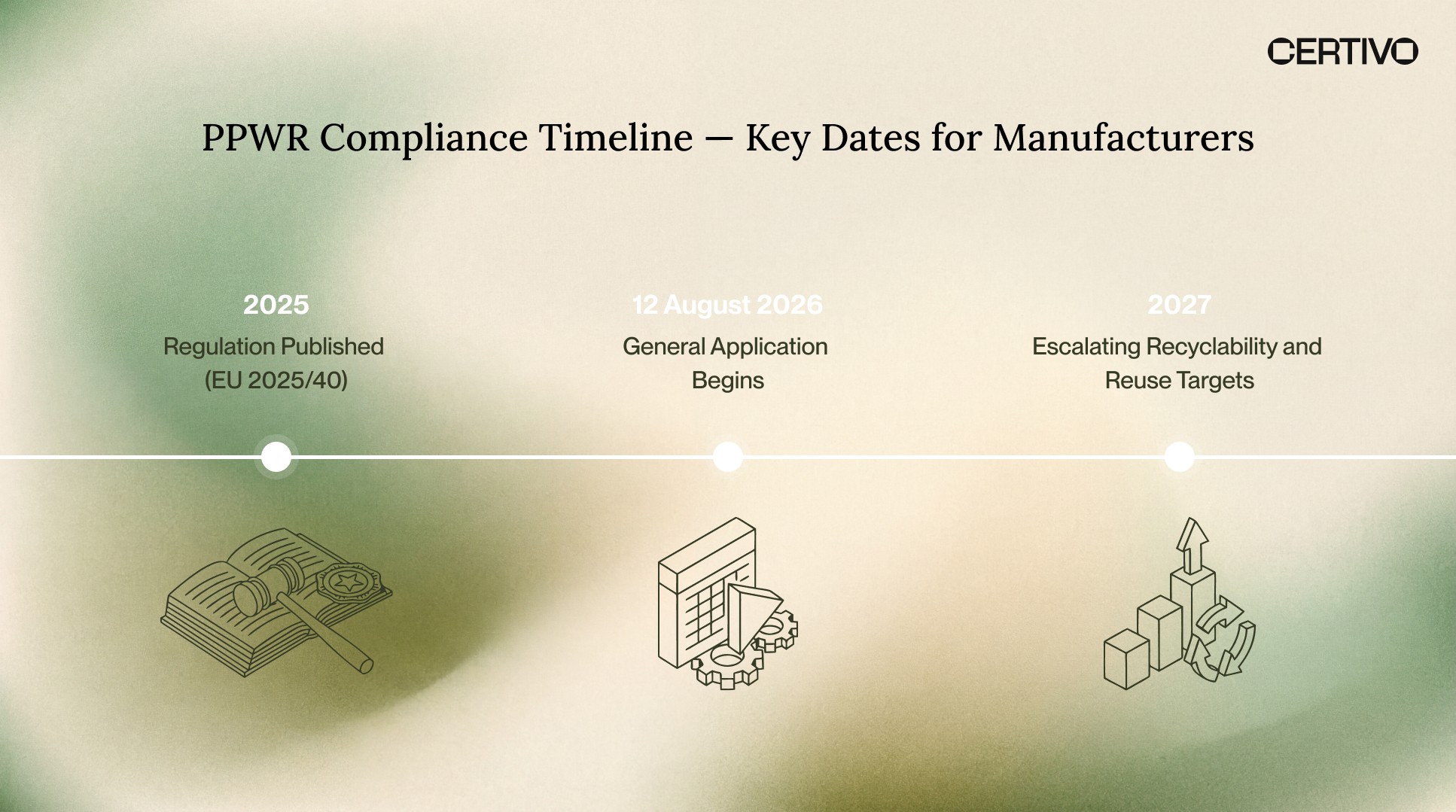
EU packaging waste regulation PPWR compliance timeline 2026 for manufacturers
Click on image to view full
PPWR Compliance Timeline and Enforcement Outlook
Date | Milestone |
|---|---|
2025 | Regulation (EU) 2025/40 published |
12 August 2026 | General application begins |
2027–2030 | Escalating recyclability targets and reuse obligations phased in |
Ongoing | EPR fee modulation based on recyclability performance |
Based on currently available regulatory guidance, the European Commission's packaging waste page is the authoritative source for implementation timelines and delegated acts.
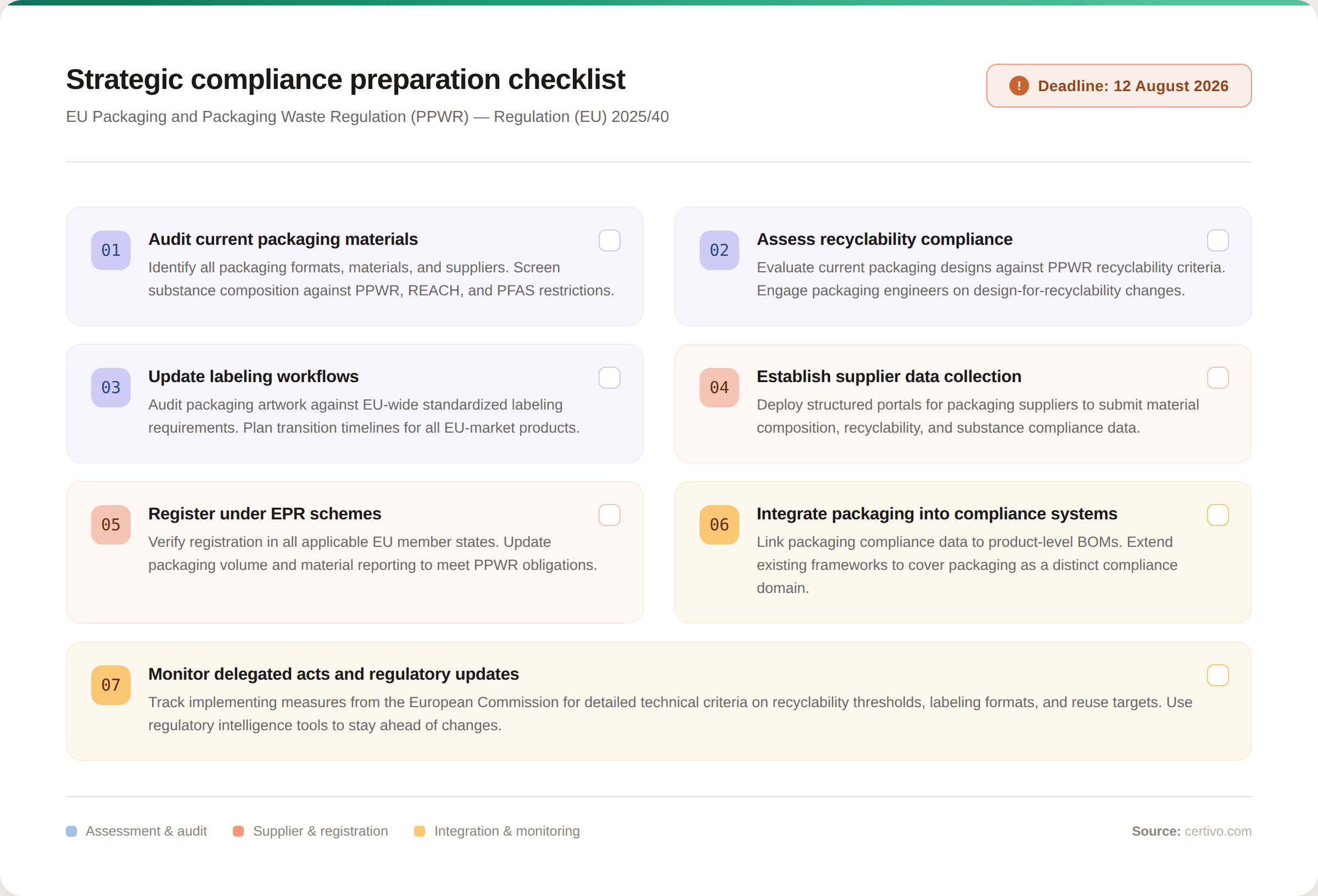
Manufacturers should not wait for delegated act finalization to begin preparation. The core requirements — substance restrictions, recyclability design, labeling, and EPR registration — are clear and actionable now.
Strategic Compliance Preparation Checklist
How Can AI Help Manufacturers Manage PPWR Compliance at Scale?
Manual tracking of packaging compliance across hundreds of products, packaging formats, suppliers, and EU markets is operationally unsustainable. AI-native compliance automation addresses the scale challenges PPWR creates.
Automated Supplier Data Collection
Certivo's supplier self-service portals enable packaging suppliers to submit material composition declarations, recyclability documentation, and substance compliance data in structured, validated formats — eliminating email-based data collection.
AI Document Parsing and Certificate Validation
CORA-powered regulatory intelligence automates extraction and validation of packaging supplier documentation. CORA identifies incomplete fields, flags substance-of-concern declarations, and cross-references submissions against PPWR, REACH, and PFAS restriction lists.
Regulatory Intelligence and Horizon Scanning
CORA's regulatory intelligence layer monitors PPWR delegated acts, implementing measures, and related regulatory developments — alerting compliance teams before changes take effect. This supports a shift from reactive compliance toward continuous compliance monitoring and audit readiness.
Centralized Multi-Framework Compliance
PPWR does not exist in isolation. Packaging materials may simultaneously trigger obligations under REACH, PFAS restrictions, EPR schemes, and Digital Product Passport requirements. Certivo provides a centralized compliance data backbone that normalizes data across frameworks and links packaging compliance to product-level records.
For a broader perspective on AI in compliance management, see AI Tools for Compliance Management: The Complete Guide.
Conclusion
The EU Packaging and Packaging Waste Regulation represents a fundamental shift in how packaging compliance is governed across the European Union. With general application beginning 12 August 2026, manufacturers face binding requirements on recyclability, reuse, hazardous substance restrictions, labeling, and Extended Producer Responsibility — enforced uniformly across all member states.
For compliance leaders at global manufacturers, the operational impact is immediate: packaging materials must be audited for substance compliance, recyclability criteria must be evaluated at the design stage, labeling workflows must be updated, and supplier data collection must be structured and automated.
Organizations that integrate EU packaging waste regulation compliance into existing product compliance workflows — rather than treating it as a standalone effort — will absorb these requirements more efficiently and reduce long-term audit risk.
📌 Book a demo to see how Certivo automates packaging and product compliance across your supply chain — or map your regulatory exposure in 60 seconds to evaluate your current PPWR readiness.
FAQs
1. Does PPWR apply to packaging imported into the EU from non-EU countries?
Yes. PPWR applies to all packaging placed on the EU market, regardless of where it was manufactured. Importers bear responsibility for ensuring packaging meets recyclability, substance restriction, and labeling requirements. Certivo's CORA intelligence helps importers validate packaging compliance data from global suppliers through centralized portals.
2. How does PPWR interact with existing REACH substance restrictions on packaging?
PPWR reinforces and builds upon existing chemical safety frameworks. Packaging materials containing SVHCs or substances restricted under REACH Annex XVII may face additional obligations under PPWR. Certivo's centralized compliance data backbone links PPWR packaging data with REACH substance tracking to prevent gaps.
3. What are the PPWR recyclability requirements manufacturers must meet by 2026?
Based on currently available regulatory guidance, PPWR mandates that all packaging meet defined recyclability criteria, with escalating thresholds phased in over subsequent years. Specific technical criteria will be detailed in delegated acts. CORA-driven compliance intelligence monitors these developments and alerts teams when new criteria are published.
4. How should manufacturers handle PPWR labeling when selling across multiple EU markets?
PPWR standardizes labeling requirements across all EU member states, replacing the previous patchwork of national schemes. Manufacturers should update packaging artwork to the unified EU format. Certivo supports region-specific labeling tracking and documentation management to ensure consistent compliance.
5. What data do packaging suppliers need to provide for PPWR compliance?
Suppliers must provide material composition data, substance declarations, recyclability documentation, and EPR-relevant volume information. Many suppliers will need structured submission mechanisms. Certivo's supplier self-service compliance portals enable packaging suppliers to submit validated data directly, reducing manual follow-up and error rates.
Lavanya
Lavanya is an accomplished Product Compliance Engineer with over four years of expertise in global environmental and regulatory frameworks, including REACH, RoHS, Proposition 65, POPs, TSCA, PFAS, CMRT, FMD, and IMDS. A graduate in Chemical Engineering from the KLE Institute, she combines strong technical knowledge with practical compliance management skills across diverse and complex product portfolios.