

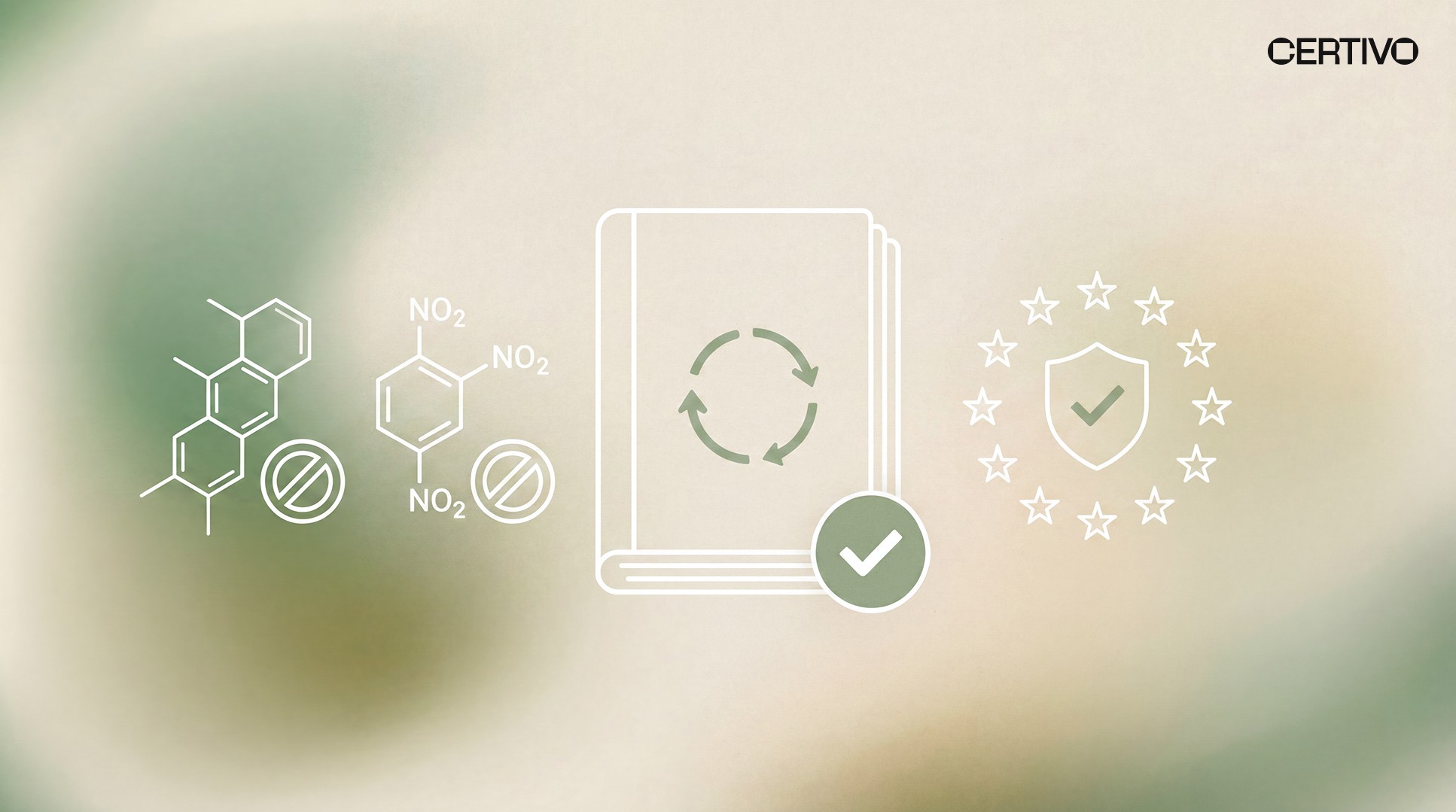
The European Chemicals Agency (ECHA) has confirmed updates to EU REACH Annex XVII introducing new restrictions on PFHxA-related substances and 2,4-Dinitrotoluene (2,4-DNT). These EU REACH Annex XVII restriction updates carry direct compliance obligations for manufacturers, importers, and distributors placing products on the European Union market.
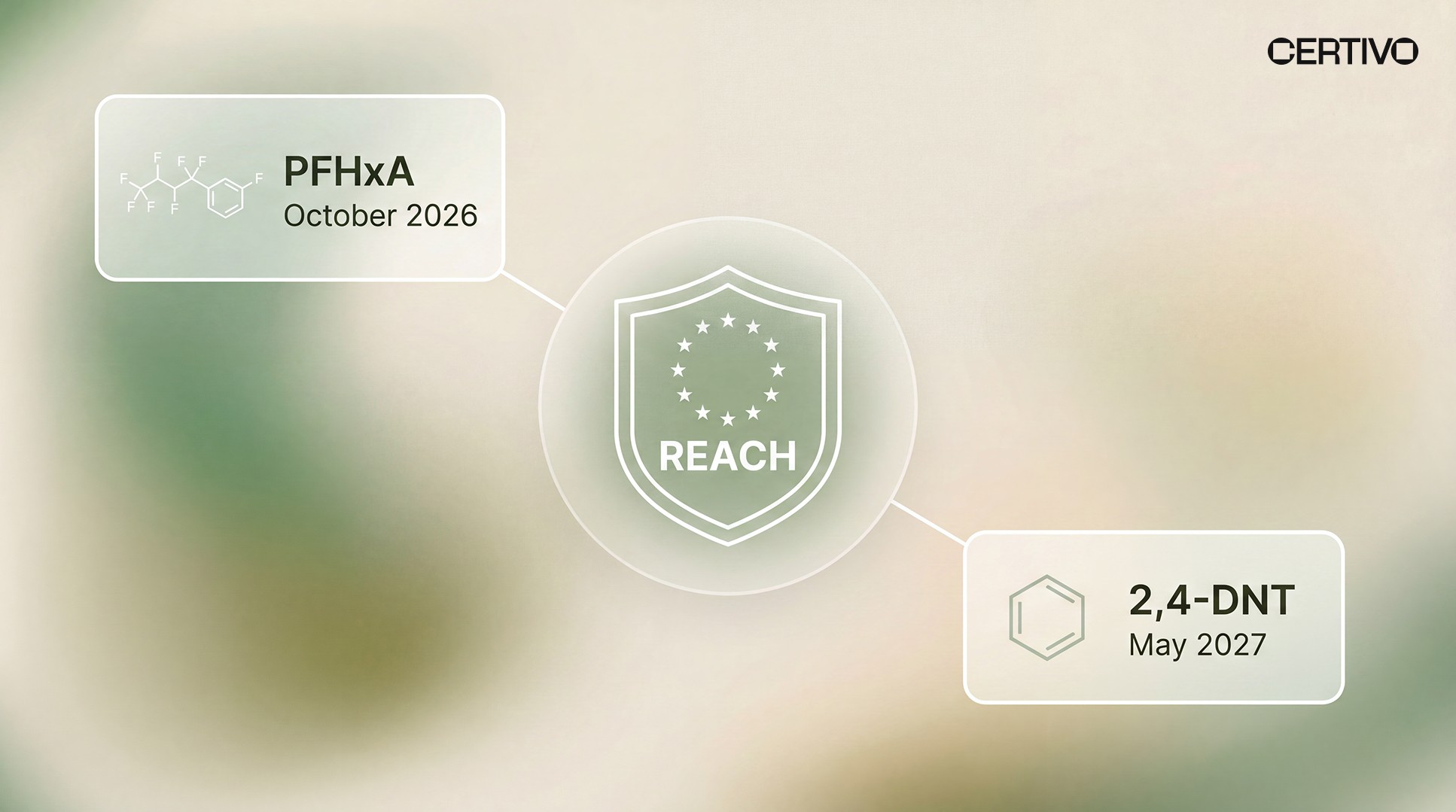
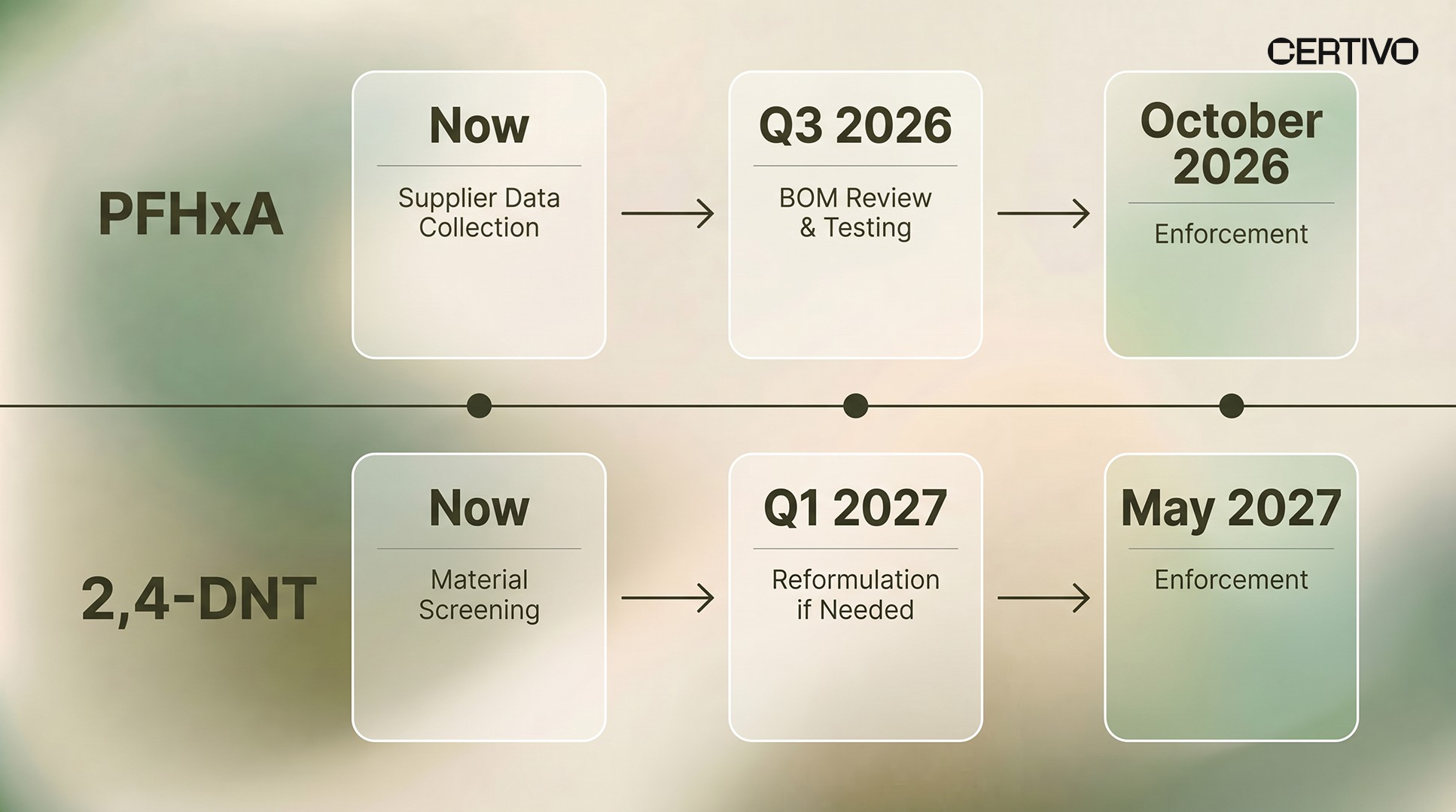
The PFHxA restriction takes effect October 2026. The 2,4-DNT restriction takes effect May 10, 2027. Both require immediate action on material composition reviews, supplier declarations, and BOM-level substance tracking.
📌 Book a free compliance risk assessment to evaluate your current REACH Annex XVII exposure across products and supply chains.
What Are the New EU REACH Annex XVII Restrictions on PFHxA and 2,4-DNT
REACH Annex XVII is the EU's primary regulatory instrument for restricting the manufacture, placing on the market, and use of hazardous chemical substances. When ECHA adds a new entry to Annex XVII, it creates legally binding obligations across the entire EU market — affecting every entity in the supply chain from raw material producers to finished goods importers.
The latest EU REACH Annex XVII restriction updates target two distinct substance groups:
✓ PFHxA (Perfluorohexanoic acid), its salts, and related substances — a PFAS-class restriction driven by environmental persistence and human exposure concerns
✓ 2,4-DNT (2,4-Dinitrotoluene) — a hazardous aromatic compound subject to additional use and market placement controls
These are not voluntary guidelines. They are enforceable restrictions that carry penalties for non-compliance, including product withdrawal from the EU market.
For organizations already managing REACH compliance programs, these updates require immediate gap analysis against current material declarations and supplier data.
Chemicals Affected: PFHxA and 2,4-DNT Substance Profiles
Chemical | CAS Number | Category | Restriction Type |
|---|---|---|---|
PFHxA and related substances | 307-24-4 | PFAS (fluorinated) | New Annex XVII entry — use and market restrictions |
2,4-Dinitrotoluene | 121-14-2 | Aromatic compound | New Annex XVII entry — additional controls |
PFHxA: A Critical PFAS Restriction
PFHxA belongs to the broader PFAS family — the same class of persistent chemicals driving regulatory action globally under PFAS frameworks. PFHxA and its related substances are used in surface treatments, coatings, and water-resistant applications across electronics, textiles, automotive, and packaging sectors.
⚠ This restriction is separate from — but closely related to — the broader EU PFAS universal restriction proposal under REACH. Manufacturers must track both the PFHxA-specific Annex XVII entry and the evolving EU REACH PFAS restriction proposal.
2,4-DNT: Hazardous Substance Controls
2,4-Dinitrotoluene is classified as a carcinogenic, mutagenic, and reprotoxic (CMR) substance. The new Annex XVII entry introduces additional controls on its use and market placement within the EU.
EU REACH Annex XVII restriction updates PFHxA 2,4-DNT compliance 2026
Click on image to view full
Compliance Deadlines and Enforcement Timeline
Milestone | Date | Action Required |
|---|---|---|
PFHxA restriction effective | October 2026 | Products on EU market must comply; non-conforming products subject to enforcement |
2,4-DNT restriction effective | May 10, 2027 | Additional controls on use and market placement enforceable |
Ongoing | Post-enforcement | Market surveillance, ECHA compliance checks, import controls |
These are hard enforcement dates. There are no voluntary transition periods once restrictions take effect. Products already on the market at the enforcement date may be subject to withdrawal if they contain restricted substances above applicable thresholds.
Organizations relying on regulatory intelligence and horizon scanning capabilities should have flagged these restrictions during the ECHA opinion and adoption phases. For those identifying this exposure now, the compliance window is narrowing.
Which Industries and Products Are Affected
The EU REACH Annex XVII restriction updates on PFHxA and 2,4-DNT affect multiple manufacturing sectors:
📊 Electronics & Electrical Equipment — PFHxA-related substances in coatings, insulation materials, and surface treatments. Electronics manufacturers must review material compositions across PCBs, connectors, and enclosures.
📊 Automotive & Aerospace — High-performance fluorinated coatings and chemical applications. Automotive manufacturers and aerospace suppliers using PFHxA-containing materials face direct reformulation obligations.
📊 Consumer Goods & Textiles — Water-resistant, stain-resistant, and soil-resistant product treatments. Brands selling into the EU must verify supplier material declarations for PFHxA content.
📊 Chemicals & Manufacturing — Chemical producers and formulators using PFHxA-related substances or 2,4-DNT in production processes.
📊 Packaging & Industrial Applications — Specialty coatings and fluorinated materials used in food contact packaging and industrial applications.
📊 Importers & Distributors — All entities placing affected products on the EU market carry compliance obligations regardless of where manufacturing occurs.
For a comprehensive view of PFAS regulatory exposure across sectors, see The Global PFAS Reckoning on Certivo.
Key Compliance Requirements and Thresholds
Based on currently available regulatory guidance, the EU REACH Annex XVII restriction updates impose the following compliance obligations:
Substance Disclosure and Material Data Collection
✓ Suppliers across the value chain must provide substance-level declarations confirming presence or absence of PFHxA-related substances and 2,4-DNT in materials and finished goods
✓ Full Material Declarations (FMDs) and supplier questionnaires must be updated to capture these substances explicitly
BOM and Product Composition Review
✓ Manufacturers must review bills of materials for any components, coatings, or treatments containing PFHxA or 2,4-DNT
✓ BOM substance and threshold management programs must include concentration verification against Annex XVII limits
Testing and Concentration Verification
✓ Where supplier declarations are insufficient, analytical testing may be required to verify substance concentrations below applicable thresholds
✓ Concentration thresholds for PFHxA-related substances should be monitored as ECHA publishes detailed implementation guidance
Product Reformulation Assessment
✓ Products containing PFHxA above restricted thresholds may require material substitution or reformulation before enforcement dates
⚠ Organizations that have not yet mapped PFHxA exposure across their product portfolios face the most significant compliance risk. The October 2026 deadline for PFHxA leaves limited time for reformulation cycles in complex manufactured products.
EU REACH Annex XVII PFHxA 2,4-DNT compliance deadline timeline for manufacturers
Click on image to view full
How These Restrictions Affect Supply Chain Operations
Upstream Impact
Tier 1 suppliers must cascade data requests to sub-tier suppliers for PFHxA and 2,4-DNT declarations
Chemical suppliers and formulators must provide updated Safety Data Sheets (SDS) and substance composition data
Smaller suppliers with limited compliance resources may struggle to complete updated substance declarations
Downstream Impact
Manufacturers must update customer-facing compliance documentation and customer trust centers with PFHxA and 2,4-DNT status
OEM customers — particularly in automotive and electronics — will cascade these requirements into supplier scorecards and audit criteria
Importers and distributors placing goods on the EU market bear direct regulatory liability
For manufacturers managing multi-tier supply chain transparency programs, these restrictions add two more substance groups to an already growing list of monitored chemicals under REACH.
📌 Managing supplier substance data for REACH Annex XVII? See how Certivo automates this → Book a Demo
Reporting, Documentation, and Audit Readiness Challenges
The EU REACH Annex XVII restriction updates create specific documentation and audit readiness challenges:
Evidence Chain Integrity
Every substance declaration must answer three questions:
Who provided the evidence (supplier name, authorized signatory)
When it was provided (time-stamped declaration date)
With what authority (testing lab accreditation, supplier certification scope)
Without this evidence chain, declarations cannot withstand regulatory inspection or customer audit scrutiny.
Historic State Tracking
REACH compliance is not a point-in-time event. Manufacturers must maintain continuous audit-ready documentation that supports:
Immutable audit logs showing compliance status at any point in time
Time-stamped supplier declarations linked to specific product versions
Point-in-time queries for regulatory inspections and customer audits
This is fundamentally a data versioning problem. Organizations using spreadsheet-based tracking cannot maintain the historic state integrity that ECHA market surveillance and OEM customer audits require.
Audit Types to Prepare For
⚠ Regulatory inspections — ECHA market surveillance and national enforcement authorities can request compliance evidence at any time post-enforcement
⚠ Customer audits — OEM-driven supply chain audits (automotive, electronics) will incorporate PFHxA and 2,4-DNT into supplier qualification criteria
⚠ Certification audits — ISO 14001 and IATF 16949 auditors may reference REACH Annex XVII obligations during environmental management system reviews
No software eliminates audit findings. The objective is to reduce surprises and response time — measured in hours-to-audit-pack rather than weeks.
For a deeper look at compliance documentation systems, see What Tools Support End-to-End Product Compliance.
Compliance Risks, Penalties, and Enforcement Exposure
Non-compliance with EU REACH Annex XVII restrictions carries consequences across multiple dimensions:
✓ Product withdrawal from the EU market — Non-conforming products can be ordered removed from sale by national enforcement authorities
✓ Financial penalties — REACH enforcement penalties vary by EU member state but can be substantial, particularly for repeat violations
✓ Supply chain disqualification — OEMs and brand customers may remove non-compliant suppliers from approved vendor lists
✓ Reputational damage — ECHA publishes enforcement actions, and investor ESG screening increasingly includes chemical compliance performance
✓ Import refusal — Customs authorities may refuse entry of products identified as containing restricted substances above Annex XVII thresholds
Organizations maintaining proactive compliance risk management programs are better positioned to avoid these outcomes.
Strategic Compliance Preparation Checklist
How AI Automates REACH Annex XVII Compliance at Scale
Manual compliance management cannot keep pace with the frequency of REACH Annex XVII updates, the volume of supplier data required, and the granularity of BOM-level substance tracking.
Automated Supplier Data Collection
Certivo's supplier self-service compliance portals enable suppliers to submit updated substance declarations directly. Built-in validation ensures that PFHxA and 2,4-DNT data fields are complete before acceptance — eliminating manual follow-up cycles.
AI Document Parsing and Certificate Validation
CORA-powered regulatory intelligence extracts substance data from Safety Data Sheets, Full Material Declarations, and test reports at intake. CORA identifies missing PFHxA and 2,4-DNT fields, flags inconsistencies, and cross-references against REACH Annex XVII thresholds automatically.
BOM-Level Compliance Intelligence
Certivo maps supplier substance declarations to product-level BOMs, enabling compliance teams to answer the critical question: Which of our finished products contain PFHxA or 2,4-DNT above restricted thresholds? This BOM-level compliance intelligence is essential for prioritizing reformulation and customer communication.
Regulatory Intelligence and Horizon Scanning
CORA's regulatory intelligence layer monitors ECHA publications, Annex XVII amendments, and related PFAS regulatory developments — alerting compliance teams before changes take effect. This shifts organizations from reactive firefighting to continuous compliance readiness.
For a complete overview of AI in compliance, see AI Tools for Compliance Management.
Executive Conclusion
The EU REACH Annex XVII restriction updates on PFHxA and 2,4-DNT represent the continued tightening of chemical substance controls in the European market. With the PFHxA restriction effective October 2026 and the 2,4-DNT restriction effective May 10, 2027, manufacturers and importers have a defined — and narrowing — compliance window.
These are not isolated regulatory events. They are part of a broader pattern: ECHA is systematically expanding REACH Annex XVII to address PFAS persistence, CMR substance exposure, and supply chain transparency gaps. Organizations that invest in centralized compliance data backbone infrastructure, automated supplier data collection, and CORA-driven compliance intelligence will absorb these and future REACH updates without proportional increases in manual effort.
📌 Book a demo to see how Certivo automates REACH Annex XVII compliance across your product portfolio and multi-tier supply chain.
FAQs
1. What is the PFHxA restriction under REACH Annex XVII and when does it take effect?
The PFHxA restriction adds Perfluorohexanoic acid, its salts, and related substances to REACH Annex XVII, effective October 2026. It restricts the use and market placement of products containing these PFAS-class substances in the EU. Certivo's CORA intelligence automates substance screening and supplier data collection for PFHxA compliance.
2. How does the 2,4-DNT restriction impact manufacturers selling into the EU?
The 2,4-DNT restriction, effective May 10, 2027, introduces additional controls on this carcinogenic aromatic compound under REACH Annex XVII. Manufacturers must verify that products and materials do not contain 2,4-DNT above applicable thresholds. BOM-level material mapping through Certivo identifies affected components across product portfolios.
3. What supplier data is required to demonstrate compliance with the new REACH Annex XVII entries?
Manufacturers need updated Full Material Declarations, substance-specific declarations for PFHxA and 2,4-DNT, and where necessary, analytical test reports verifying concentrations below restricted thresholds. Certivo's supplier self-service portals collect and validate this data at scale.
4. How can manufacturers track PFHxA exposure across complex multi-tier supply chains?
Tracking PFHxA across multiple supplier tiers requires automated data collection, substance-level BOM mapping, and continuous monitoring of supplier declarations. CORA-powered regulatory intelligence links supplier substance data to specific products, enabling compliance teams to identify exposure at the finished-goods level.
5. Are these PFHxA restrictions related to the broader EU PFAS universal restriction proposal?
The PFHxA Annex XVII entry is a standalone restriction that is separate from but related to the broader EU PFAS universal restriction proposal currently under ECHA review. Manufacturers should track both regulatory tracks simultaneously. Certivo's regulatory intelligence and horizon scanning capabilities monitor both the PFHxA-specific restriction and the evolving universal PFAS proposal.
Lavanya
Lavanya is an accomplished Product Compliance Engineer with over four years of expertise in global environmental and regulatory frameworks, including REACH, RoHS, Proposition 65, POPs, TSCA, PFAS, CMRT, FMD, and IMDS. A graduate in Chemical Engineering from the KLE Institute, she combines strong technical knowledge with practical compliance management skills across diverse and complex product portfolios.
She has extensive experience in product compliance engineering, ensuring that materials, components, and finished goods consistently meet evolving international regulatory requirements. Her expertise spans BOM analysis, material risk assessments, supplier declaration management, and test report validation to guarantee conformity. Lavanya also plays a key role in design-for-compliance initiatives, guiding engineering teams on regulatory considerations early in the product lifecycle to reduce risks and streamline market access.