


The Massachusetts Department of Environmental Protection (MassDEP) has updated its 2026 Intended Use Plans, ending the availability of 0% interest loans previously offered for PFAS remediation projects. This Massachusetts PFAS remediation funding shift affects municipalities, water utilities, wastewater treatment facilities, environmental remediation contractors, and industrial manufacturers managing PFAS contamination risks across the state.
For compliance leaders and environmental directors at manufacturing organizations with Massachusetts operations, this change demands immediate reassessment of PFAS remediation budgets, project timelines, and long-term treatment strategies. MassDEP is transitioning toward alternative funding mechanisms and loan forgiveness programs — but the operational window between the old program's closure and the new program's availability creates planning uncertainty.
📌 Book a free compliance assessment to map your PFAS remediation exposure and funding strategy across products and facilities.
What Changed in MassDEP's 2026 PFAS Funding Programs
MassDEP's 2026 Intended Use Plans reflect a significant structural change to how the state supports PFAS remediation activities. The key updates include:
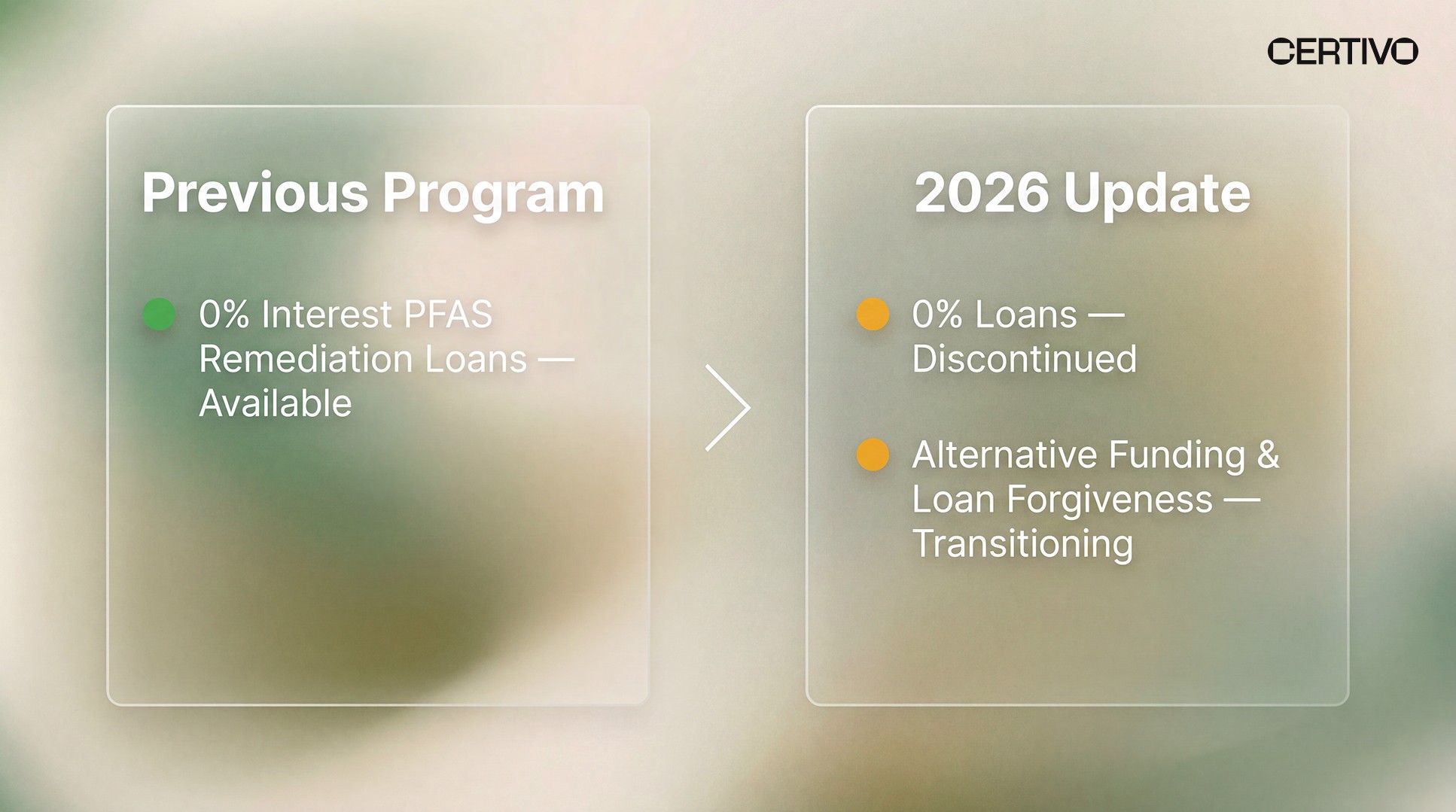
✓ Discontinuation of 0% interest PFAS remediation loans — Previously, eligible entities could access zero-interest financing for PFAS treatment infrastructure, cleanup projects, and drinking water compliance initiatives. This program is no longer available under the current Intended Use Plans.
✓ Transition to alternative funding and loan forgiveness — MassDEP is shifting toward new funding mechanisms, including potential loan forgiveness programs, to continue supporting Massachusetts PFAS remediation efforts. Specific program details and eligibility criteria are expected to be published as part of ongoing state environmental budget processes.
✓ Continued monitoring requirements — Organizations pursuing PFAS treatment and cleanup must continue meeting all existing MassDEP environmental compliance obligations regardless of funding availability.
Based on currently available regulatory guidance, the transition timeline between the discontinued loan program and the availability of replacement funding mechanisms has not been finalized. This creates a gap that manufacturers and utilities must plan around.
For organizations tracking PFAS compliance obligations across multiple states, the Massachusetts funding change adds another variable to an already complex compliance landscape.
Massachusetts PFAS remediation funding program update 2026 compliance overview
Click on image to view full

Why the 0% Interest Loan Discontinuation Matters
Zero-interest PFAS remediation loans significantly reduced the financial barrier for municipalities and industrial facilities undertaking treatment projects. PFAS remediation is capital-intensive — granular activated carbon systems, ion exchange treatment, reverse osmosis installations, and long-term monitoring programs require substantial upfront investment.
The loss of 0% financing means:
⚠ Higher borrowing costs — Entities that previously relied on zero-interest state loans must now budget for interest expenses on PFAS treatment infrastructure, directly increasing project total cost of ownership.
⚠ Delayed project initiation — Organizations in early planning stages may defer PFAS remediation projects while waiting for clarity on alternative funding, creating compliance timeline risk.
⚠ Budget reallocation pressure — Manufacturers with active PFAS contamination management programs may need to redirect capital from other environmental or operational priorities.
⚠ Competitive disadvantage for smaller entities — Municipal water systems and smaller manufacturers that lack access to commercial financing face disproportionate impact.
This is particularly significant in the context of PFAS compliance requirements tightening across multiple US states. Massachusetts is one of several states with aggressive PFAS action plans, and the funding mechanism change does not reduce compliance obligations — it only changes how those obligations are financed.
Industries and Organizations Affected
The MassDEP funding update impacts a specific but broad set of stakeholders:
📊 Water Utilities & Drinking Water Systems — Municipal and private water suppliers conducting PFAS treatment upgrades to meet state and federal maximum contaminant levels. These entities were primary beneficiaries of the previous 0% loan program.
📊 Environmental Remediation Services — Contractors and consultants managing PFAS contamination cleanup projects at industrial sites, landfills, and former military installations across Massachusetts.
📊 Wastewater Treatment Facilities — Public and private wastewater operators implementing PFAS monitoring and treatment programs, particularly those discharging to surface waters subject to state effluent limits.
📊 Municipalities & Public Infrastructure — Cities, towns, and regional water districts managing state-funded environmental compliance capital projects.
📊 Industrial Manufacturing — Facilities with historical or current PFAS use, storage, or contamination exposure, including electronics manufacturers, chemical manufacturers, and consumer goods companies with Massachusetts operations.
For manufacturers specifically, the intersection of site remediation obligations and product-level PFAS compliance creates a dual burden — facility cleanup costs are rising at the same time that product reformulation and supply chain PFAS documentation requirements are intensifying.
How This Impacts PFAS Remediation Project Planning
The practical impact of MassDEP's funding transition depends on where an organization sits in its PFAS remediation lifecycle:
Organizations with Active Projects
Entities that secured 0% loans before the discontinuation should verify whether existing loan terms are honored through project completion. Based on currently available regulatory guidance, organizations should contact MassDEP directly to confirm the status of previously approved funding.
Organizations in Planning Stages
Those that had not yet applied face the most immediate disruption. Project financial models built around zero-interest assumptions must be revised. Key planning actions include:
✓ Re-evaluating total project costs with market-rate or subsidized interest scenarios ✓ Monitoring MassDEP announcements for loan forgiveness program eligibility criteria ✓ Assessing whether federal funding sources (EPA PFAS grants, Bipartisan Infrastructure Law allocations) can offset the state funding gap ✓ Adjusting compliance timelines to account for potential project delays
Organizations Not Yet Scoping Remediation
Manufacturers and utilities that have identified PFAS contamination but have not begun remediation scoping should factor the funding change into their compliance risk assessments. Deferring action may appear financially rational in the short term, but enforcement exposure and long-term liability costs increase with delay.
📌 Need to reassess your PFAS compliance exposure? Get a compliance risk assessment to understand your current position across products, facilities, and jurisdictions.
Massachusetts PFAS remediation loan program 2026 before and after comparison
Click on image to view full
What Alternative Funding Mechanisms Are Available
While MassDEP has signaled a transition to alternative mechanisms, specific program details remain under development. Based on currently available regulatory guidance, organizations should monitor the following:
✓ MassDEP Loan Forgiveness Programs — The state has indicated loan forgiveness as a replacement pathway. Eligibility criteria, application timelines, and maximum funding amounts have not yet been finalized.
✓ Federal EPA PFAS Funding — The EPA's Bipartisan Infrastructure Law allocates funding for PFAS treatment in drinking water and wastewater systems. Massachusetts entities may be eligible for federal grants administered through the state revolving fund.
✓ State Revolving Fund (SRF) Programs — Massachusetts Clean Water and Drinking Water SRF programs may offer below-market-rate financing for PFAS projects, though terms will differ from the discontinued 0% program.
✓ Municipal and Regional Partnerships — Smaller entities may benefit from regionalized treatment approaches that distribute capital costs across multiple communities.
Organizations managing PFAS compliance across multiple US states should track funding availability state by state, as remediation financing programs vary significantly by jurisdiction.
Compliance Risks and Enforcement Considerations
The discontinuation of favorable financing does not reduce compliance obligations. MassDEP's environmental enforcement authority remains unchanged, and PFAS-related requirements continue to tighten.
⚠ No enforcement relief — Entities with identified PFAS contamination remain subject to cleanup orders, consent decrees, and compliance schedules regardless of funding availability.
⚠ Increased cost of non-compliance — Without subsidized financing, the financial incentive to remediate proactively is weaker, but enforcement penalties and third-party liability exposure remain. Deferral increases total long-term costs.
⚠ Documentation burden — Organizations must maintain continuous audit-ready documentation of PFAS monitoring, treatment actions, and remediation progress. This documentation must demonstrate due diligence in the event of regulatory inspection or litigation.
⚠ Evidence chain integrity matters — For any remediation activity, compliance teams should maintain records that clearly establish who provided the evidence, when it was provided, and with what authority. Immutable audit logs and time-stamped declarations protect organizations during enforcement actions.
For manufacturers also navigating TSCA PFAS reporting requirements, the Massachusetts funding change compounds the operational complexity of managing PFAS obligations at both the product and facility level.
What Digital Solutions Help Manufacturers Comply with Emerging PFAS Restrictions
Managing PFAS compliance across remediation, product composition, and supply chain documentation requires a centralized compliance data backbone that connects regulatory obligations to operational data.
Key capabilities to evaluate:
✓ Regulatory intelligence and horizon scanning — Tracking PFAS regulatory changes across federal, state, and international jurisdictions, including funding program updates like MassDEP's 2026 transition.
✓ PFAS and chemicals risk management — Mapping PFAS presence across product BOMs, raw materials, and manufacturing processes to identify exposure before it becomes an enforcement issue.
✓ Automated supplier data collection — Collecting PFAS-related declarations from suppliers through centralized supplier self-service portals rather than email-based manual processes.
✓ AI document parsing and certificate validation — Extracting compliance-relevant data from supplier certificates, test reports, and environmental records using CORA-powered regulatory intelligence to reduce manual review time.
✓ Multi-jurisdiction EHS and ESG management — Consolidating PFAS compliance data across Massachusetts and other states into a single platform that supports both site-level remediation tracking and product-level substance reporting.
No software eliminates audit findings. The objective is to reduce surprises, accelerate response time, and maintain an evidence chain that withstands regulatory scrutiny.
Strategic Compliance Preparation Checklist
How AI-Powered Compliance Platforms Support PFAS Program Management
For manufacturers managing PFAS obligations at both the facility and product level, the complexity exceeds what manual processes can sustain. CORA-driven compliance intelligence within Certivo enables:
✓ Automated tracking of PFAS regulatory changes across Massachusetts and 50+ other jurisdictions, so compliance teams are alerted before deadlines — not after.
✓ Substance-level reporting that maps PFAS presence across product BOMs and supplier materials, supporting both product compliance and environmental remediation data needs.
✓ Supplier risk scoring and due diligence — Identifying which suppliers present PFAS exposure risk based on materials, geography, and documentation completeness through automated supplier data collection portals.
✓ Point-in-time compliance queries — Retrieving the exact compliance state of any product, facility, or supplier at any historical date, maintaining immutable audit logs that support enforcement defense and customer audit response.
The shift from reactive compliance to continuous compliance monitoring and audit readiness is especially critical when funding structures change. Organizations that maintain real-time visibility into their PFAS exposure can make faster, better-informed decisions about remediation investment and regulatory response.
Executive Conclusion
MassDEP's decision to discontinue 0% interest Massachusetts PFAS remediation loans in 2026 removes a significant financial tool from the compliance toolkit — but does not reduce the underlying regulatory obligations. Manufacturers, water utilities, and municipalities with PFAS exposure in Massachusetts must now plan for higher-cost remediation financing while monitoring the state's transition to alternative funding and loan forgiveness mechanisms.
The organizations best positioned to navigate this shift are those with centralized PFAS compliance data, automated regulatory tracking, and audit-ready documentation that supports both environmental remediation and product-level substance reporting. Treating PFAS as a siloed facility problem or a siloed product problem is no longer sustainable — it requires an integrated compliance strategy.
📌 Book a demo to see how Certivo supports Massachusetts PFAS remediation compliance tracking and enterprise-wide PFAS program management across products, facilities, and supply chains.
FAQs
1. What triggered MassDEP's decision to end 0% PFAS remediation loans?
MassDEP updated its 2026 Intended Use Plans and discontinued the 0% interest loan program for PFAS remediation projects. The state is transitioning to alternative funding mechanisms and loan forgiveness programs. Specific details on replacement programs are expected to be published as part of ongoing state environmental budget processes.
2. Are existing 0% PFAS remediation loans in Massachusetts still valid?
Based on currently available regulatory guidance, organizations with previously approved loans should verify the status of their funding directly with MassDEP. Whether existing terms are honored through project completion has not been broadly confirmed in public communications.
3. How does this funding change affect PFAS compliance deadlines in Massachusetts?
The funding program change does not alter any existing PFAS compliance deadlines or remediation obligations. MassDEP enforcement authority remains unchanged. Organizations must continue meeting all environmental monitoring, treatment, and reporting requirements regardless of financing availability.
4. Can manufacturers access federal funding to offset the loss of Massachusetts PFAS loans?
Federal EPA grants under the Bipartisan Infrastructure Law and state revolving fund programs may provide alternative financing for PFAS treatment projects. Eligibility varies by entity type and project scope. Certivo's CORA-powered regulatory intelligence tracks funding program changes across jurisdictions to support planning.
5. How should compliance teams track PFAS remediation and product obligations together?
Organizations should centralize PFAS data — including facility remediation records, product-level substance declarations, and supplier documentation — in a single compliance platform. This integrated approach supports both environmental compliance and product-level reporting through tools like BOM-level material mapping and automated supplier data collection.
Lavanya
Lavanya is an accomplished Product Compliance Engineer with over four years of expertise in global environmental and regulatory frameworks, including REACH, RoHS, Proposition 65, POPs, TSCA, PFAS, CMRT, FMD, and IMDS. A graduate in Chemical Engineering from the KLE Institute, she combines strong technical knowledge with practical compliance management skills across diverse and complex product portfolios.
She has extensive experience in product compliance engineering, ensuring that materials, components, and finished goods consistently meet evolving international regulatory requirements. Her expertise spans BOM analysis, material risk assessments, supplier declaration management, and test report validation to guarantee conformity. Lavanya also plays a key role in design-for-compliance initiatives, guiding engineering teams on regulatory considerations early in the product lifecycle to reduce risks and streamline market access.