


Minnesota PFAS reporting is now the most time-sensitive state chemical disclosure obligation in the United States. Under Amara's Law (Minn. Stat. § 116.943), manufacturers of products containing intentionally added PFAS that are sold, offered for sale, or distributed in Minnesota must file a report through the state's PRISM system and pay a fee. The initial reporting deadline is September 15, 2026, and the practical work of collecting supplier data takes far longer than most teams expect.
This guide explains who must report, what PRISM requires, how the $800 fee works, how to secure an extension, and how to file defensibly when supplier data is incomplete. It is written for compliance owners who need a filing plan, not a summary.
If you want a structured starting point, you can book a compliance risk assessment to map your PFAS exposure across products and jurisdictions before you begin data collection.
Key Takeaways
⏳ The initial Minnesota PFAS reporting deadline is September 15, 2026. A one-time 90-day extension to December 14, 2026 is available, but the extension request and fee must be postmarked by August 16, 2026.
📌 Reporting applies only to products that meet all three conditions: manufactured after July 1, 2023; sold, offered for sale, or distributed in Minnesota; and containing intentionally added PFAS. This includes online sales into the state.
📊 The fee is a flat $800 per manufacturer for the initial filing, not per product. Large portfolios pay the same as single-product filers.
⚠️ Most submitted data becomes publicly accessible after a review period, except approved trade secrets. Companies should plan for public disclosure of product-to-PFAS associations.
🔗 The largest challenge is supply chain data. MPCA has stated it will treat a manufacturer as compliant if it reports all available information on time and documents its due diligence efforts.
🏭 Scope is broad and includes fluoropolymers such as PTFE. Very few manufacturers selling into Minnesota are fully out of scope.
🤖 A pending bill (HF4257/SF5092) could postpone the deadline to July 1, 2027, but it remains in committee. Plan for September 15, 2026 until the law actually changes.
Why Minnesota PFAS Reporting Matters Now
Minnesota's PFAS in products law is the first broad, mandatory PFAS disclosure regime of its kind in the United States. It is not a narrow ban on a handful of product categories. It requires disclosure of intentionally added PFAS across nearly all product types, backed by a dedicated reporting platform and public disclosure of most submitted data.
The reason it matters for compliance planning right now is timing. The initial deadline has already moved twice, from January 1, 2026 to July 1, 2026, and then to September 15, 2026. Each extension reflects how hard the underlying task is: collecting substance-level PFAS data across multi-tier supply chains. Teams that read the extensions as breathing room, rather than as evidence of difficulty, tend to start too late.
Minnesota's approach also functions as a template for other states, which raises the stakes of getting your data foundation right the first time. For related context, see Certivo's PFAS framework overview and the 2026 PFAS compliance guide on why out-of-scope no longer exists.
Minnesota PFAS reporting deadline timeline showing PRISM filing dates for 2026
Click on image to view full

Who Must Report Under Amara's Law
Reporting is triggered when a product meets three conditions together. The product must have been manufactured after July 1, 2023. It must be sold, offered for sale, or distributed in Minnesota. And it must contain intentionally added PFAS. Products manufactured on or before July 1, 2023 were excluded by a May 2026 amendment, which narrowed the original scope.
"Intentionally added" means PFAS deliberately used to serve a function, such as water resistance, chemical stability, or surface performance. Incidental or trace contamination from environmental sources is treated differently from deliberate use.
Does This Apply If You Only Sell Online Into Minnesota?
Yes. The obligation attaches to products sold, offered for sale, or distributed in the state, and Minnesota's rule confirms this includes online sales. If you ship a qualifying product to a Minnesota address, the reporting obligation can apply even without a physical presence in the state. This is a common gap for direct-to-consumer brands and B2B sellers who assume state chemical rules require local operations.
Is the Scope Really That Broad?
For most manufacturers, yes. The scope includes fluoropolymers such as PTFE, which appear in coatings, seals, gaskets, wiring, and countless industrial and consumer components. Because of this, very few manufacturers selling into Minnesota can assume they are fully out of scope without verifying material content at the BOM level. This is where BOM-level material mapping becomes the practical foundation of a defensible filing.
What PRISM Requires and the $800 Fee
Reports are submitted through the PFAS Reporting Information System for Manufacturers (PRISM), Minnesota's centralized reporting platform. PRISM is modeled on the state's existing High Priority Chemicals Data System, which many manufacturers already recognize.
For each covered product or product component containing intentionally added PFAS, the report must include:
Required Element | What to Prepare |
|---|---|
Product description or category | Product identity, and product grouping where similar items can be combined |
PFAS chemicals used | The specific PFAS present in the product or its components |
Amount or concentration | Exact amount, or a concentration range where allowed |
Function of the PFAS | The purpose PFAS serves, such as water resistance or stability |
Manufacturer and contact information | Filer identity and contact details |
The rules allow useful flexibility. You can group similar products, report concentration ranges rather than exact amounts, and authorize a group of manufacturers or a representative to report on your behalf.
How the Fee Works
The fee is a flat $800 per manufacturer for the initial filing, regardless of how many products you report. It is not charged per product. For organizations with large portfolios, this makes comprehensive, single-submission reporting the most cost-efficient approach, because the reporting cost sits in data collection and preparation, not in the filing fee itself.
Managing that data collection across many suppliers and products is exactly the problem a centralized compliance data backbone is built to solve. If supplier data collection is your bottleneck, you can request a compliance review to see how automated portals and AI document parsing reduce the manual effort.
The September 15 Deadline and the Extension Path
The initial reporting deadline is September 15, 2026. Annual updates are due each February 1 when required, for new or changed products.
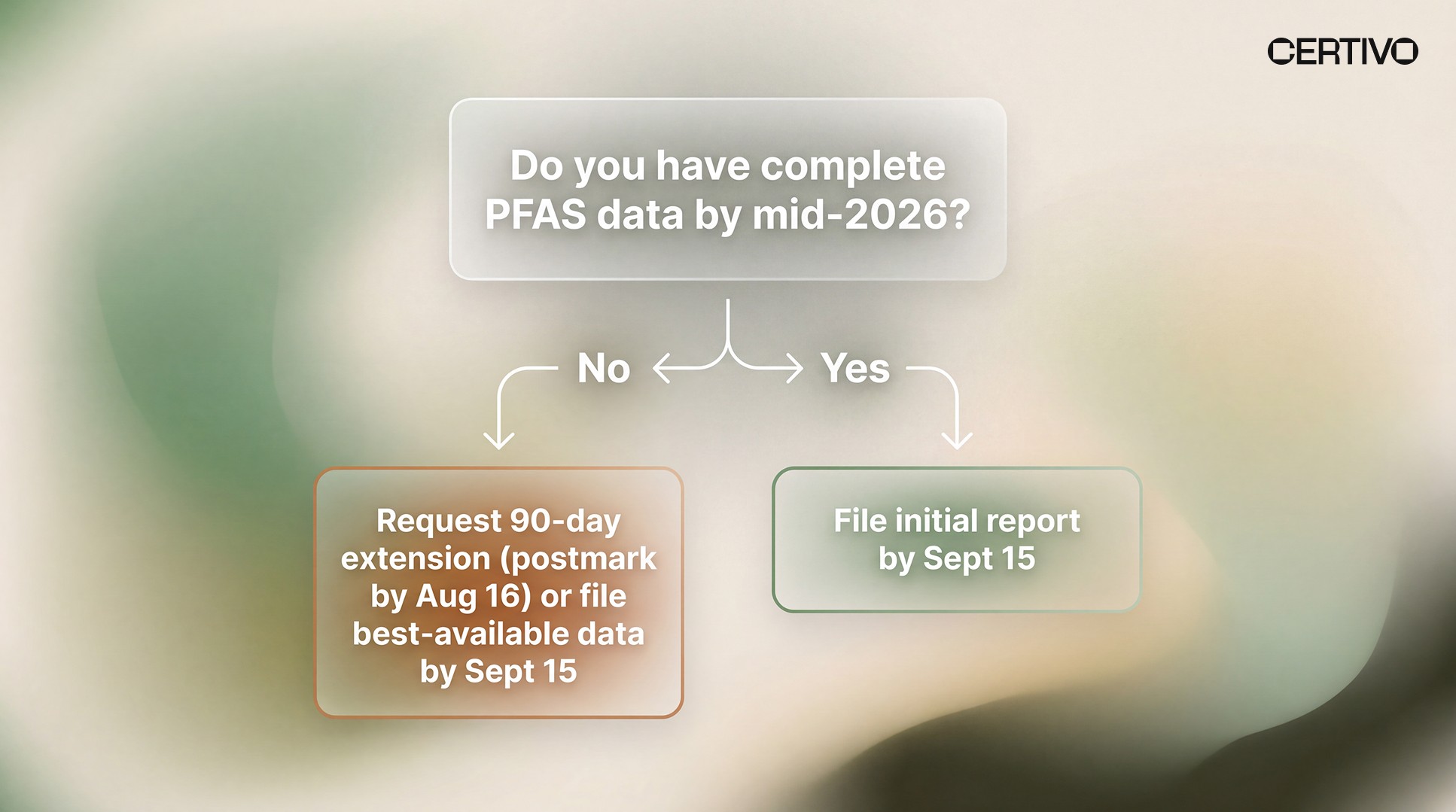
If you cannot meet the initial deadline, you may apply for a single one-time 90-day extension, which moves your reporting deadline to December 14, 2026. The critical detail for planning is the request timing: the extension request form, along with the applicable fee, must be postmarked by August 16, 2026. Miss that postmark date and the extension path closes.
What Does an Extension Request Require?
MPCA has said extension requests should be brief and do not require extensive supporting documentation. In practice, the form asks you to describe the circumstances preventing timely reporting, such as incomplete supplier disclosures, complex multi-tier supply chains, or overseas suppliers; the due diligence conducted to date; and a plan to report within the extension period. If an extension request is denied, a report is generally due within a short window after the denial notice.
There is also a separate waiver path for products already covered by publicly available, verifiable information that is substantially equivalent to the required reporting elements. Waiver requests share the same August 16, 2026 postmark deadline.
PRISM filing decision path for Minnesota PFAS reporting deadline compliance
Click on image to view full
How to Gather PFAS Data From Suppliers Fast
The reporting fields look manageable on paper. The difficulty is that most manufacturers do not hold PFAS presence, identity, and concentration data at the component level. That data lives with suppliers, often several tiers deep, and it is inconsistent, incomplete, or missing.
A workable data collection sequence looks like this:
Scope your product portfolio. Identify which products are in scope using the three-condition test, and map likely PFAS-containing components at the BOM level.
Prioritize by risk. Focus first on components with a high likelihood of intentionally added PFAS, such as fluoropolymer seals, coatings, and treated textiles.
Standardize supplier outreach. Send a consistent, structured request rather than ad hoc emails. Standardized supplier questionnaire frameworks raise response quality and reduce rework.
Automate follow-up. Non-response is the norm, not the exception. Automated supplier data collection and self-service portals keep outreach moving without manual chasing.
Validate what comes back. Parse certificates and declarations, check them against known PFAS lists, and flag gaps. AI document parsing and certificate validation makes this scalable across thousands of parts.
What If Suppliers Will Not Respond in Time?
This is the most common concern, and Minnesota has addressed it directly. MPCA has stated it will consider a manufacturer compliant with the initial reporting requirements if the manufacturer reports all available PFAS information on time, retains due diligence documentation, and provides that documentation on request. In other words, unresponsive suppliers do not excuse you from filing, but a documented good-faith effort supports your position. This is covered further in Certivo's guide on automating PFAS compliance across multi-tier supply chains.
Filing With Best-Available Data
Because complete data is unrealistic for many portfolios by September 2026, the defensible strategy is to file with best-available data and document the gaps. Three practices matter here.
First, keep an evidence trail. Record who provided each piece of supplier data, when it was provided, and with what authority. That chain of evidence is what turns a filing into a defensible one during any later inquiry.
Second, treat your submission as a point-in-time record. Data will change as suppliers respond after the deadline. Maintaining time-stamped declarations and historic state tracking lets you show what you knew and reported at the moment of filing, and how your data matured afterward.
Third, keep the due diligence documentation MPCA expects. Supplier outreach logs, follow-up records, and gap notes are the artifacts that support a good-faith compliance position. This is the same discipline behind continuous audit-ready documentation, and it applies across internal audits, customer audits, and regulatory inquiries alike. No software eliminates the possibility of a finding. The realistic objective is to reduce surprises and shorten your response time when a question arrives.
Public Disclosure and Trade Secret Protection
Most information submitted through PRISM becomes publicly accessible after a review period, including product details, PFAS functions, and concentration ranges. The association between specific products and PFAS will, in most cases, be public.
Trade secret protection is available, but requests must meet strict criteria and approval is not guaranteed. Companies should decide in advance which data genuinely warrants a trade secret request and prepare that justification carefully, rather than assuming broad confidentiality. Planning for public disclosure of product-to-PFAS associations is the safer default assumption.
Reusing Your Dataset as Other States Adopt PRISM
The strongest strategic reason to build this dataset properly is that Minnesota is not the end of the work. PRISM was intentionally designed so that other states can adopt it, which means the data you assemble for Minnesota can carry forward. Several states, including Maine, Connecticut, Washington, and New Mexico, have PFAS reporting or labeling obligations advancing on their own timelines.
A structured, centralized PFAS dataset mapped to your BOMs becomes reusable regulatory infrastructure rather than a one-time filing exercise. Teams that treat Minnesota as a project rebuild the same work state by state. Teams that treat it as a data foundation file the next state's report far faster. This is the difference between reactive filing and continuous compliance monitoring.
Centralized PFAS dataset reused across multiple state reporting requirements
Click on image to view full

Pending Legislation: What Could Change
Compliance planning should account for one open variable. A bill, HF4257/SF5092, would postpone the initial reporting date to July 1, 2027, narrow scope for certain complex manufactured goods, and designate some uses as currently unavoidable by statute. As of now, both the House and Senate versions remain in committee and are not law.
The practical guidance is straightforward. Plan and prepare for September 15, 2026 until a change is actually enacted. Legislative proposals frequently stall or change form, and the cost of being ready early is low compared to the cost of being caught unprepared if the current deadline holds. Continue collecting data and documenting due diligence regardless of the bill's status. For ongoing tracking of shifts like this, regulatory intelligence and horizon scanning is what keeps a compliance team from being surprised.
How Certivo Supports Minnesota PFAS Reporting
Minnesota PFAS reporting is fundamentally a supply chain data problem wrapped in a filing deadline. The filing itself is not the hard part. Assembling accurate, defensible, substance-level data across hundreds or thousands of components is.
Certivo functions as a compliance data backbone for exactly this work. It centralizes product and supplier compliance data, maps PFAS obligations to your BOMs, and automates supplier outreach through self-service portals so your team is not chasing declarations by hand. Certivo's CORA-powered regulatory intelligence parses incoming certificates and declarations, validates them against known PFAS substances, and flags gaps for follow-up, which is where most manual programs lose weeks.
Just as important, Certivo maintains the time-stamped, versioned evidence trail that supports a best-available-data filing: who submitted what, when, and under what authority. That is the documentation MPCA expects if it asks how you reached your reported figures, and it is the same foundation that keeps you audit-ready as other states adopt PRISM.
If you are planning your Minnesota filing, speak with a compliance specialist to see how Certivo automates PFAS data collection across your product portfolio, or book a compliance risk assessment to understand your current PFAS exposure across products and jurisdictions before the deadline.
Kunal Chopra
Kunal Chopra is the CEO of Certivo, an AI-driven compliance management platform revolutionizing how manufacturers navigate regulatory challenges. With a career spanning over two decades, Kunal is a seasoned technology leader, 3x tech CEO, product innovator, and board member with a passion for driving transformative growth and innovation.
Before leading Certivo, Kunal spearheaded successful transformations at renowned companies like Beckett Collectibles, Kaspien, Amazon, and Microsoft. His strategic vision and operational excellence have led to achievements such as a 25x EBITDA valuation increase at Beckett Collectibles and a 450% shareholder return at Kaspien. He has a track record of turning challenges into opportunities, delivering operational efficiencies, and driving market expansions.