


Article importers face an unprecedented PFAS data collection challenge. With federal EPA TSCA Section 8(a)(7) reporting deadlines approaching in October 2026 and multiple state-level PFAS regulations already in force, companies must collect substance-level declarations from hundreds or thousands of suppliers across global supply chains. The scale of this task—tracking 12,000+ PFAS compounds across articles, components, and raw materials—exceeds the capacity of manual processes.
PFAS compliance in 2026 requires automated supplier data collection infrastructure that operates continuously, validates declarations against regulatory thresholds, and maintains audit-ready documentation. Without centralized systems, importers risk non-compliance, supply chain disruptions, and regulatory penalties that can reach $50,000 per violation per day under TSCA enforcement actions.
This article examines how article importers can implement automated PFAS supplier data collection through structured portals, AI-powered validation, and continuous compliance monitoring systems.
Table of Contents
Why Manual PFAS Supplier Data Collection Fails at Scale
Regulatory Drivers for Automated PFAS Data Collection
Key Data Requirements Under EPA TSCA Section 8(a)(7)
Multi-Jurisdiction PFAS Reporting Complexity
How Automated Supplier Portals Solve Collection Challenges
AI-Powered Document Parsing for PFAS Declarations
BOM-Level PFAS Substance Tracking
Supplier Risk Scoring and Due Diligence
Continuous Compliance Monitoring Infrastructure
Integration with PLM and ERP Systems
Implementation Strategy for Article Importers
FAQ Section
Why Manual PFAS Supplier Data Collection Fails at Scale
Article importers typically manage 200 to 2,000+ suppliers depending on product complexity and manufacturing footprint. Traditional PFAS data collection through email requests, spreadsheets, and manual document review cannot operate at this scale within regulatory timelines.
Manual collection processes encounter systematic failures:
📊 Response Rate Collapse: Email-based supplier requests achieve 30-50% response rates within initial deadlines, requiring multiple follow-up cycles that consume compliance team capacity.
⚠️ Data Quality Inconsistency: Suppliers submit PFAS declarations in non-standardized formats—PDFs, scanned images, proprietary templates—that cannot be aggregated or validated systematically.
📌 Version Control Breakdown: When suppliers update material formulations or PFAS content, importers receive ad-hoc notifications through email, creating gaps in compliance records.
Automated Supplier Data Collection & Portals eliminate these failure points by establishing structured submission workflows, standardized data formats, and continuous update mechanisms that maintain compliance without manual intervention.
The complete guide to product compliance management demonstrates that companies managing 500+ suppliers reduce data collection time by 70-80% through portal-based automation.
Regulatory Drivers for Automated PFAS Data Collection
Federal and state PFAS regulations impose substance-level reporting requirements that mandate systematic supplier data collection infrastructure.
EPA TSCA Section 8(a)(7) Requirements
The EPA's TSCA PFAS reporting rule requires article importers to report PFAS presence, quantities, and uses for articles manufactured or imported since January 2011. Compliance requires collecting:
✓ Chemical identities (CAS numbers) for all PFAS substances
✓ Maximum concentration levels in articles
✓ Manufacturing dates and import volumes
✓ Processing and use descriptions
✓ Worker exposure information
These data points must be collected from suppliers who manufactured articles, requiring standardized questionnaires and validation processes.
State-Level PFAS Reporting
Multiple states have enacted PFAS reporting and disclosure requirements with overlapping but distinct thresholds:
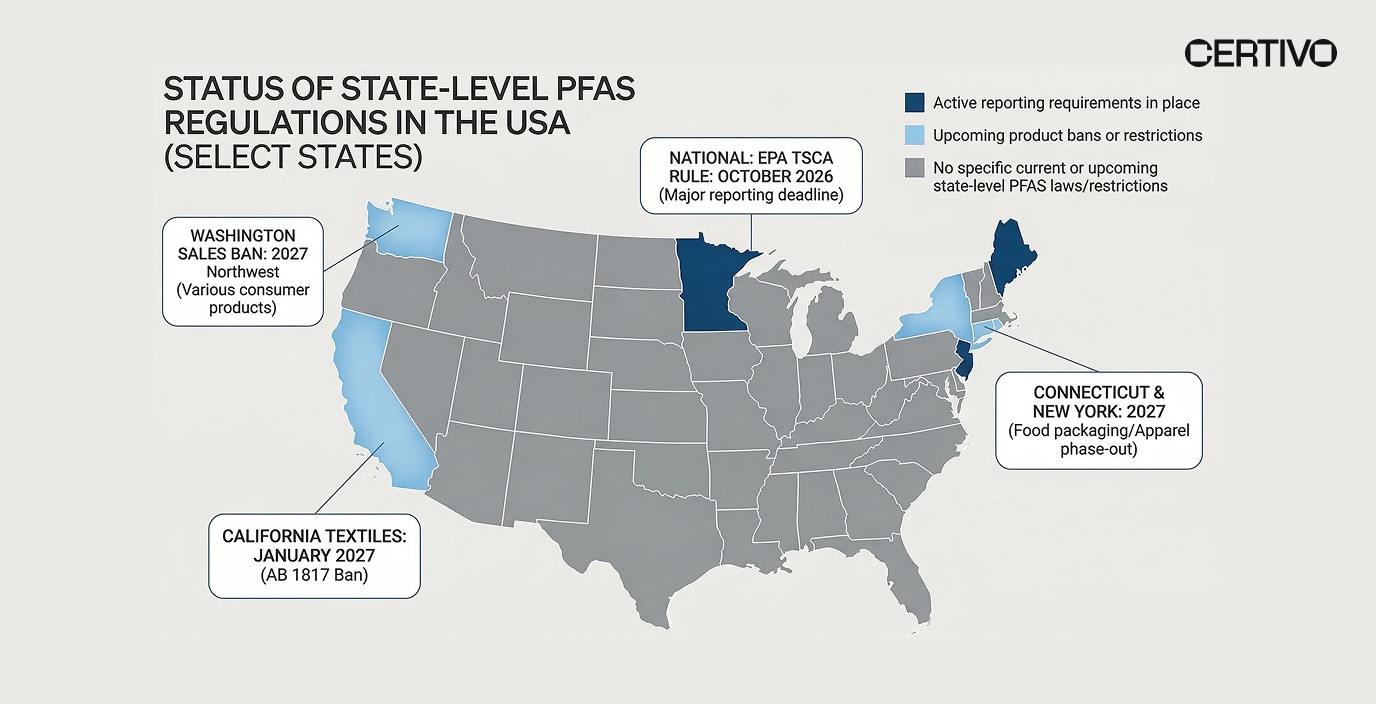
Minnesota PFAS reporting requirements mandate product-level declarations by July 2026, including intentionally added PFAS and substances present as contaminants.
California AB 1817 prohibits PFAS in textiles starting January 2027, requiring importers to validate supplier declarations before market entry.
Washington State PFAS regulations restrict PFAS sales in priority product categories, requiring ongoing supplier attestations.
Multi-Jurisdiction EHS & ESG Management systems must track these overlapping requirements simultaneously, mapping supplier data to specific state thresholds and reporting formats.
Key Data Requirements Under EPA TSCA Section 8(a)(7)
Article importers must collect specific data elements from suppliers to satisfy EPA reporting obligations. The EPA TSCA PFAS reporting rule defines mandatory fields:
Required Supplier Information
Chemical Identity Data:
CAS Registry Number for each PFAS substance
Chemical name and molecular formula
Percentage concentration by weight
Function or technical use in article
Manufacturing and Import Data:
Manufacturing site locations
Import volumes (annual quantities)
Production year ranges (2011-2026)
Processing descriptions
Exposure and Use Information:
Worker categories with potential exposure
Number of workers exposed
Commercial and consumer use descriptions
Environmental release pathways
Specialized Substance Reporting Solutions structure these data requirements into standardized supplier questionnaires that map directly to EPA reporting formats, reducing transcription errors and validation time.
Threshold Management Complexity
Different PFAS regulations apply distinct concentration thresholds. BOM Substance & Threshold Management systems must track:
📊 EPA TSCA: Reports required regardless of concentration
📊 State bans: Typically 100 ppm intentionally added threshold
📊 EU REACH restrictions: 25 ppm for specific PFAS groups
📊 Product-specific limits: Vary by application and jurisdiction
Suppliers must provide concentration data precise enough to determine compliance across all applicable thresholds simultaneously.
Multi-Jurisdiction PFAS Reporting Complexity
Article importers selling into multiple markets face compounding PFAS reporting obligations. The global PFAS regulations compliance guide identifies overlapping requirements across:
Federal vs. State Reporting
Companies must reconcile EPA federal reporting with state-specific requirements:
Connecticut requires annual PFAS reports for intentionally added PFAS with labeling obligations starting July 2026.
Maine mandates product-level PFAS reporting with detailed use justifications and safer alternative analyses.
New York has enacted PFAS restrictions in specific product categories with ongoing legislative expansion.
State PFAS regulations in 2026 create compliance matrices where single articles must satisfy 5-10 distinct reporting frameworks.
International PFAS Restrictions
Importers selling globally must track:
EU PFAS Restrictions: The France PFAS restrictions and broader EU proposals target thousands of PFAS substances with sector-specific phase-out timelines.
UK REACH: The UK REACH PFAS firefighting foam ban represents the UK's independent PFAS regulatory approach post-Brexit.
New Zealand: Has implemented PFAS cosmetics bans with import restrictions.
Regulatory Intelligence & Horizon Scanning capabilities track these evolving requirements, automatically mapping new regulations to affected product categories and suppliers.
How Automated Supplier Portals Solve Collection Challenges
Centralized Supplier Self-Service Portals address the structural limitations of manual data collection by establishing persistent digital interfaces between importers and suppliers.
Core Portal Capabilities
Modern supplier collaboration platforms provide:
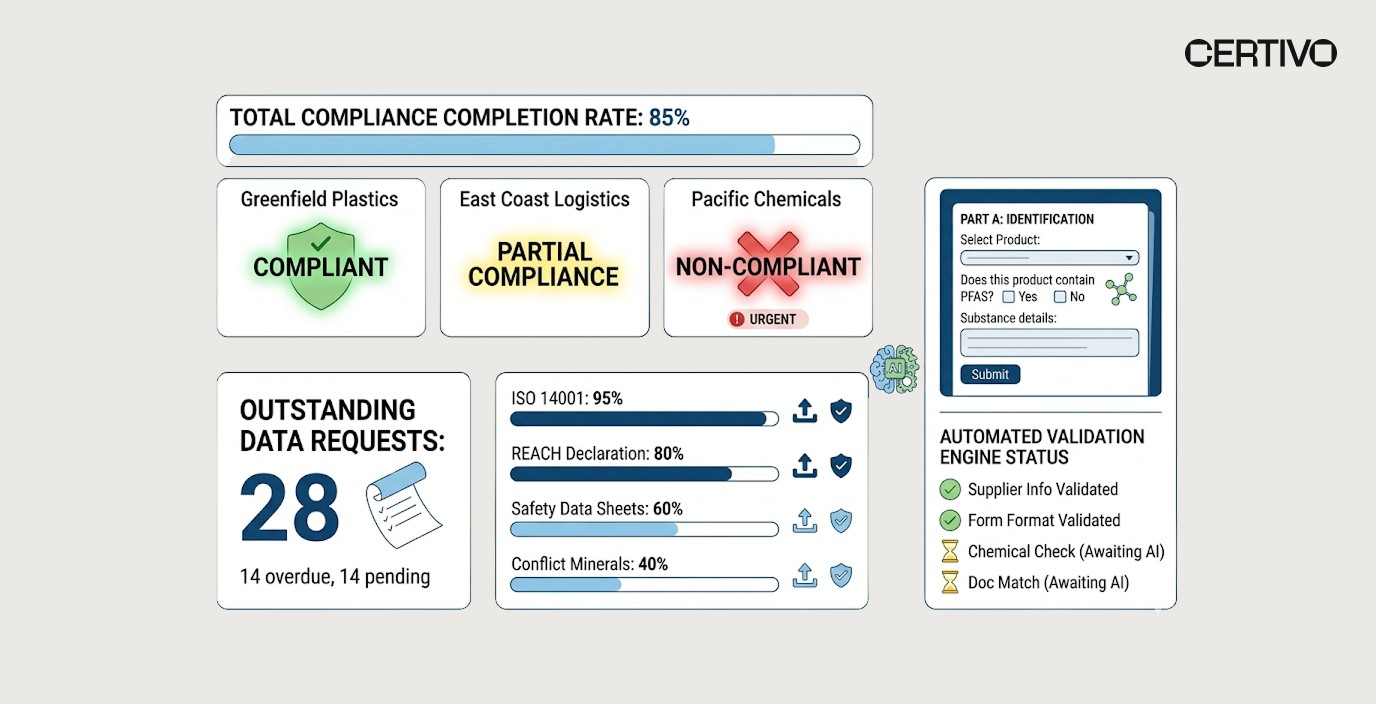
✓ Standardized Data Entry Forms: Structured questionnaires based on regulatory requirements eliminate format inconsistencies and ensure completeness.
✓ Document Upload and Management: Centralized repositories for SDSs, test reports, compliance certificates, and third-party verifications maintain organized documentation.
✓ Automated Validation Rules: Real-time checks verify data completeness, format correctness, and logical consistency before submission acceptance.
✓ Version Control and Update Tracking: Suppliers update declarations when formulations change, with automatic notifications to compliance teams.
✓ Multi-Language Support: Portal interfaces in supplier native languages reduce communication barriers and improve response quality.
Response Rate Optimization
Portal-based collection achieves 85-95% supplier response rates through:
📌 Task Management Integration: Suppliers receive automated reminders with clear deadlines and completion status tracking.
📌 Progress Transparency: Real-time dashboards show completion status, outstanding items, and data quality scores.
📌 Self-Service Capability: Suppliers access portals at convenient times, reducing dependency on email exchanges and time zone coordination.
The supplier self-service compliance portal approach transforms supplier engagement from reactive request-response cycles to proactive data maintenance.
AI-Powered Document Parsing for PFAS Declarations
Suppliers submit PFAS information in diverse formats: proprietary material declarations, third-party test reports, safety data sheets, and compliance certificates. AI Document Parsing & Certificate Validation automates extraction of structured data from unstructured documents.
Document Intelligence Capabilities
CORA-powered regulatory intelligence applies natural language processing and machine learning to:
📊 Extract Chemical Identities: Identify CAS numbers, chemical names, and PFAS classifications from complex technical documents.
📊 Parse Concentration Data: Extract percentage values, PPM measurements, and threshold comparisons from test reports.
📊 Validate Test Methods: Verify analytical procedures, detection limits, and laboratory accreditations against regulatory requirements.
📊 Cross-Reference Standards: Match supplier declarations against known PFAS databases, REACH SVHC lists, and state restriction inventories.
The AI-powered document parsing capability processes hundreds of supplier documents simultaneously, extracting substance data with 95%+ accuracy and flagging discrepancies for human review.
Certificate Validation Automation
Third-party compliance certificates require verification of:
✓ Laboratory accreditation status
✓ Test method alignment with regulatory requirements
✓ Certificate validity dates and scope
✓ Chain of custody documentation
CORA intelligence automates certificate validation by cross-referencing laboratory accreditations, tracking certificate expiration dates, and identifying scope mismatches that require additional testing.
BOM-Level PFAS Substance Tracking
Article importers must map PFAS data from supplier declarations to specific components within bill of materials structures. BOM-Level Compliance Intelligence connects supplier substance data to finished articles through hierarchical mapping.
Component-Level Substance Mapping
Complex articles contain 100-1,000+ components sourced from multiple suppliers. BOM-Level Material Mapping systems:
📌 Link Supplier Data to Components: Associate PFAS declarations with specific part numbers, materials, and suppliers in BOM structures.
📌 Roll Up Substance Content: Calculate article-level PFAS concentrations by aggregating component data weighted by mass.
📌 Track Multi-Tier Supply Chains: Maintain substance traceability through subassemblies and sub-tier suppliers.
📌 Identify Threshold Exceedances: Automatically flag when component PFAS content causes article-level threshold violations.
The BOM-level compliance tracking approach ensures that substance declarations from hundreds of suppliers integrate into accurate article-level compliance determinations.
Material Change Impact Analysis
When suppliers update PFAS declarations due to formulation changes, CORA-driven compliance intelligence automatically:
✓ Identifies affected articles and SKUs
✓ Recalculates article-level PFAS concentrations
✓ Determines compliance status changes
✓ Triggers notifications to compliance and product management teams
This continuous monitoring prevents compliance gaps when supplier materials change.
Supplier Risk Scoring and Due Diligence
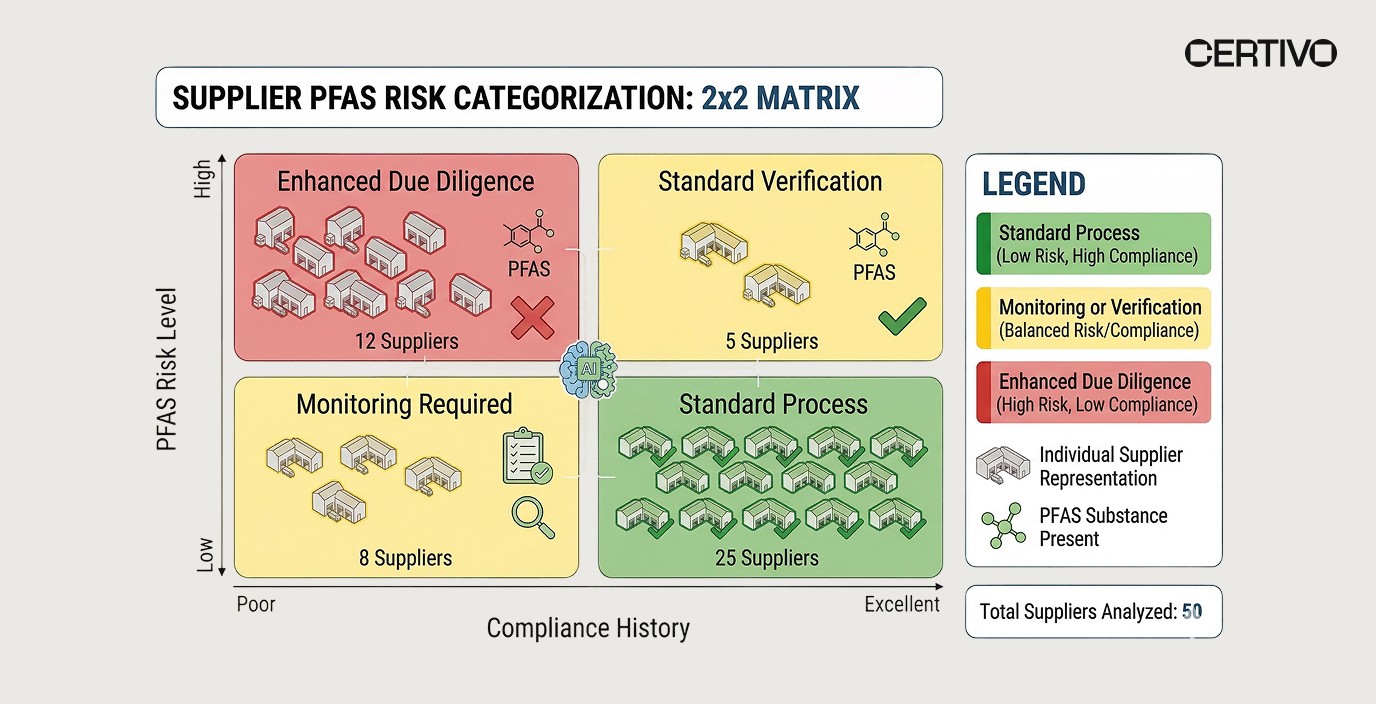
Not all suppliers present equal PFAS compliance risk. Supplier Risk Scoring & Due Diligence systems prioritize collection efforts and validation intensity based on risk factors.
Risk Scoring Methodology
Supplier Risk Scoring & ESG Ratings evaluate:
⚠️ Industry Sector Risk: Suppliers in high-PFAS industries (textiles, coatings, firefighting equipment) receive elevated risk scores.
⚠️ Geographic Risk: Suppliers in jurisdictions with limited PFAS regulations may lack internal compliance infrastructure.
⚠️ Historical Compliance Performance: Track record of declaration accuracy, response timeliness, and documentation quality.
⚠️ Material Category Risk: Components containing fluoropolymers, water-resistant treatments, or non-stick coatings require enhanced scrutiny.
⚠️ Third-Party Verification Status: Suppliers with independent PFAS testing receive lower risk scores than self-declared data.
Prioritized Collection Strategies
Risk scoring enables targeted resource allocation:
High-risk suppliers: Require third-party testing, on-site audits, and enhanced documentation.
Medium-risk suppliers: Receive detailed questionnaires with spot-check verification sampling.
Low-risk suppliers: Complete standard declarations with periodic validation cycles.
The proactive compliance risk management approach optimizes compliance team capacity while maintaining comprehensive coverage.
Continuous Compliance Monitoring Infrastructure
PFAS compliance is not a point-in-time achievement but an ongoing operational requirement. Continuous Compliance Monitoring & Audit Readiness systems maintain real-time compliance status across regulatory frameworks.
Real-Time Compliance Status
Centralized Compliance Data Backbone platforms provide:
📊 Regulatory Change Monitoring: Track federal, state, and international PFAS regulation updates and automatically map changes to affected products.
📊 Threshold Tracking: Monitor articles approaching PFAS concentration thresholds requiring reformulation or restriction compliance.
📊 Reporting Deadline Management: Maintain calendars of EPA TSCA, state reporting, and international filing deadlines with automated task generation.
📊 Audit Trail Documentation: Create immutable records of supplier declarations, validation steps, and compliance determinations for regulatory inspection readiness.
The audit-ready compliance systems approach ensures that documentation requirements are satisfied continuously rather than assembled reactively during enforcement actions.
Regulatory Horizon Scanning
Regulatory Intelligence & Horizon Scanning capabilities identify emerging PFAS restrictions before enforcement:
✓ Monitor EPA proposed rules and state legislative activity
✓ Track international regulatory developments in EU, UK, Canada, Australia
✓ Identify product categories subject to future restrictions
✓ Calculate impact on current product portfolios and supplier relationships
Early warning systems enable proactive supplier engagement and reformulation planning rather than reactive crisis management.
Integration with PLM and ERP Systems
PFAS data collection must integrate with existing product lifecycle management and enterprise resource planning systems to support operational decisions. Integrated PLM ERP Compliance Thread connects substance data to design, procurement, and manufacturing workflows.
PLM Integration Benefits
Connecting PFAS compliance data to Design-For-Compliance PLM Workflows enables:
✓ Design-Phase PFAS Screening: Engineers evaluate PFAS content during component selection, preventing non-compliant designs.
✓ Alternative Material Identification: Systems recommend PFAS-free alternatives based on regulatory requirements and performance specifications.
✓ Change Management Integration: Material changes trigger automatic PFAS reassessment and compliance reverification.
ERP and Procurement Integration
Connecting substance data to procurement systems:
📌 Supplier Selection Criteria: PFAS compliance status becomes a procurement qualification factor.
📌 Purchase Order Automation: Compliance requirements flow automatically into supplier purchase orders and contracts.
📌 Inventory Management: Track PFAS-containing materials separately for restricted market segregation.
📌 Cost Impact Analysis: Calculate financial implications of PFAS reformulation and alternative sourcing.
The end-to-end product compliance approach embeds PFAS requirements into daily operational workflows rather than treating compliance as a separate process.
Implementation Strategy for Article Importers
Deploying automated PFAS supplier data collection requires structured implementation across technical, operational, and supplier engagement dimensions.
Phase 1: System Configuration and Supplier Segmentation (Weeks 1-4)
Technical Setup:
Configure centralized supplier self-service portals with standardized PFAS questionnaires
Establish document repositories and validation workflows
Integrate with existing PLM, ERP, and compliance management systems
Supplier Segmentation:
Categorize suppliers by risk score using Supplier Risk Scoring & Due Diligence methodology
Prioritize high-volume and high-risk suppliers for initial rollout
Develop tailored communication strategies based on supplier sophistication levels
Phase 2: Pilot Program with Priority Suppliers (Weeks 5-12)
Supplier Onboarding:
Launch portal access for 50-100 priority suppliers
Provide training webinars and technical support resources
Monitor response rates and data quality metrics
Process Refinement:
Validate AI Document Parsing & Certificate Validation accuracy
Adjust questionnaire complexity based on supplier feedback
Establish escalation procedures for non-responsive suppliers
Phase 3: Full-Scale Deployment (Months 4-6)
Comprehensive Rollout:
Extend portal access to complete supplier base
Implement Continuous Compliance Monitoring & Audit Readiness workflows
Activate automated regulatory change notifications
Performance Optimization:
Track key metrics: response rates, data completeness, validation accuracy
Conduct quarterly supplier performance reviews
Refine risk scoring algorithms based on collected data
Phase 4: Continuous Operations and Reporting (Ongoing)
Operational Maintenance:
Execute EPA TSCA reporting using collected data
Maintain state-level reporting compliance across jurisdictions
Update supplier data in response to formulation changes
Strategic Planning:
Use PFAS & Chemicals Risk Management data for reformulation prioritization
Evaluate alternative materials and supplier diversification options
Support faster market expansion through pre-validated compliance data
Companies implementing this structured approach reduce time-to-compliance by 60-70% compared to manual collection methods while establishing scalable infrastructure for future regulatory expansion.
How Certivo Automates PFAS Supplier Data Collection
Article importers managing global supply chains require integrated platforms that combine supplier engagement, AI-powered validation, and continuous monitoring. Certivo provides AI-Native Compliance Automation purpose-built for multi-framework substance management.
Certivo's Supplier Data Collection Infrastructure
Automated Supplier Data Collection & Portals: Certivo's supplier portal infrastructure enables manufacturers to streamline supplier documentation through standardized questionnaires, automated reminders, and real-time validation.
CORA-Powered Document Intelligence: CORA's AI capabilities parse complex supplier documents, extract substance data, and validate declarations against regulatory databases covering 12,000+ PFAS compounds.
BOM-Level Substance Intelligence: Certivo maps supplier PFAS data to component-level BOMs, automatically calculating article-level concentrations and identifying threshold exceedances across multiple regulatory frameworks.
Multi-Framework Coverage: Single platform manages PFAS compliance, REACH SVHC reporting, RoHS substance restrictions, and conflict minerals disclosure simultaneously.
Regulatory Intelligence: CORA intelligence continuously monitors EPA, state, and international PFAS regulatory changes, automatically mapping updates to affected products and suppliers.
Compliance Outcomes
Organizations using Certivo for materials and environmental compliance achieve:
✓ 70-80% reduction in supplier data collection time
✓ 95%+ supplier response rates within 60-day cycles
✓ Continuous audit-ready documentation
✓ Real-time compliance status across all regulatory frameworks
Replace spreadsheets with a scalable system designed for enterprise-scale substance management and regulatory complexity.
Ready to automate PFAS supplier data collection and eliminate manual compliance processes? Certivo provides the integrated platform and AI intelligence that global article importers need to achieve continuous PFAS compliance across federal and state requirements. Contact Certivo to see how automated supplier portals and CORA-powered validation can transform your compliance operations before the October 2026 EPA TSCA deadline.
Frequently Asked Questions
Q: What tools help track PFAS regulations and ensure product compliance across regions?
Certivo provides multi-jurisdiction PFAS tracking through CORA-powered regulatory intelligence that monitors EPA TSCA, state-level bans, and international restrictions. The platform automatically maps regulatory changes to affected products and suppliers, maintaining compliance across overlapping frameworks.
Q: What digital solutions help manufacturers comply with emerging PFAS restrictions?
Automated supplier portals, AI document parsing, and BOM-level substance tracking enable manufacturers to manage PFAS compliance at scale. These solutions replace manual spreadsheet processes with centralized platforms that validate supplier declarations and maintain audit-ready documentation.
Q: How can systems support ongoing due diligence for supply-chain chemical compliance?
Continuous compliance monitoring infrastructure tracks supplier material changes, regulatory updates, and threshold exceedances in real time. Supplier risk scoring and due diligence capabilities prioritize validation efforts and identify high-risk suppliers requiring enhanced verification.
Q: What methods validate supplier material declarations against regulatory risk lists?
AI-powered certificate validation cross-references supplier declarations against PFAS databases, REACH SVHC lists, state restriction inventories, and product-specific thresholds. CORA intelligence automatically flags discrepancies, expired certificates, and scope mismatches requiring additional documentation.
Q: Which platforms support multi-tier supply chain transparency for material content?
BOM-level compliance systems map supplier substance data through component hierarchies, tracking PFAS content from raw materials through subassemblies to finished articles. Multi-tier supply chain transparency enables accurate article-level compliance determinations and material change impact analysis.
Conclusion
Article importers cannot meet October 2026 EPA TSCA PFAS reporting deadlines and ongoing state compliance obligations through manual supplier data collection. The scale challenge—tracking 12,000+ PFAS compounds across hundreds of suppliers and thousands of articles—requires automated infrastructure.
Automated PFAS supplier data collection through centralized portals, AI-powered document parsing, and BOM-level substance tracking transforms compliance from reactive crisis management to continuous operational readiness. Organizations implementing these systems achieve 70-80% time reduction, 95%+ supplier response rates, and audit-ready documentation across multiple regulatory frameworks.
The regulatory complexity of PFAS compliance will continue expanding as states enact additional restrictions and international jurisdictions implement bans. Article importers establishing scalable supplier data collection infrastructure now position themselves for long-term compliance success across evolving requirements.
Certivo provides the integrated platform, AI intelligence, and regulatory coverage that global manufacturers need to automate PFAS supplier engagement and maintain continuous compliance. Companies seeking to standardize compliance across plants and regions while reducing manual workload should evaluate automated solutions before regulatory deadlines force reactive implementation.
Hari Prasanth
Hariprasanth is a Chemical Compliance Specialist with nearly four years of experience, underpinned by a degree in Chemical Engineering. He brings in-depth expertise in global product compliance, working across key regulations such as REACH, RoHS, TSCA, Proposition 65, POPs, FMD, and PFCMRT.
Hariprasanth specializes in reviewing technical documentation, validating supplier inputs, and ensuring that products consistently meet regulatory standards. He works closely with cross-functional teams and suppliers to collect accurate material data and deliver clear, audit-ready compliance reports that stand up to scrutiny.
Through his strong analytical skills and regulatory insight, Hariprasanth enables organizations to navigate evolving compliance challenges while aligning with sustainability initiatives in an increasingly dynamic regulatory environment.