


The New Jersey Department of Environmental Protection (NJDEP) has released its mandated 2026 report evaluating the feasibility of establishing maximum contaminant levels (MCLs) for per- and polyfluoroalkyl substances (PFAS) as a broad chemical class — including subclasses and mixtures — in drinking water. This marks a significant regulatory signal: New Jersey is moving beyond individual PFAS compound limits toward cumulative, class-based drinking water standards that could reshape compliance obligations for manufacturers, water utilities, and industrial facilities operating in or discharging into the state.
For compliance leaders managing PFAS regulatory exposure across products and supply chains, this report is not a regulation — it is the regulatory foundation on which future enforceable standards will be built. The distinction matters, but the preparation timeline starts now.
📌 Book a free compliance risk assessment to evaluate your organization's PFAS exposure across products, supply chains, and discharge pathways.
What the NJDEP 2026 PFAS Drinking Water Report Covers
The NJDEP Division of Science and Research produced this report as a mandated assessment — not a proposed rule. Its scope includes:
✓ Feasibility of establishing MCLs for PFAS as a class rather than individual substances
✓ Evaluation of PFAS subclasses and mixtures in drinking water systems
✓ Assessment of cumulative PFAS exposure risks to public health
✓ Review of analytical methods, treatment technologies, and monitoring capabilities
✓ Consideration of future regulatory development pathways for class-based standards
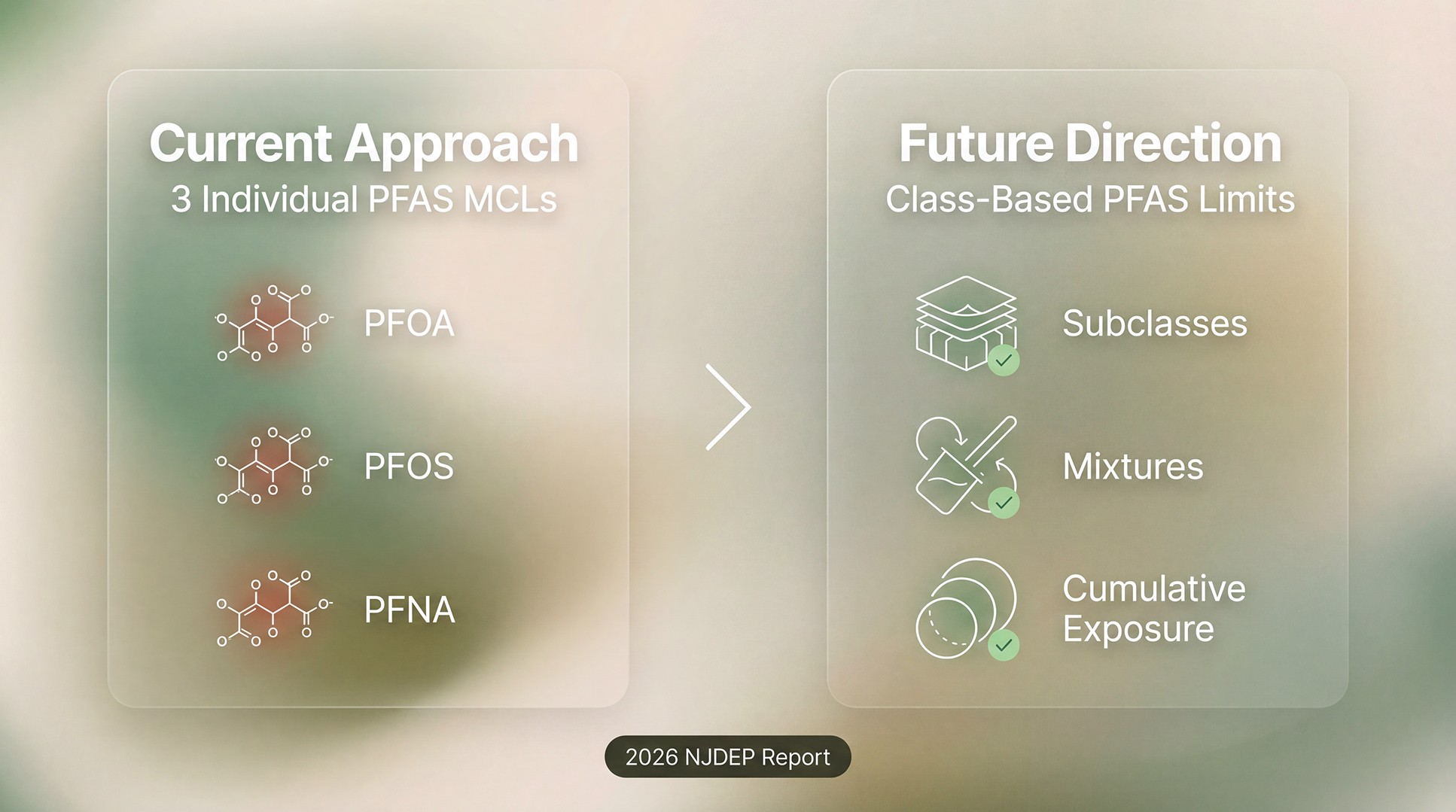
This report follows New Jersey's existing position as one of the most aggressive US states on PFAS regulation. The state already enforces individual MCLs for PFOA, PFOS, and PFNA — standards that are stricter than current federal EPA limits.
For organizations tracking PFAS regulations across the US and EU, the NJDEP report signals the next phase: regulation that treats PFAS as a class problem, not a substance-by-substance exercise.
New Jersey PFAS drinking water report 2026 compliance overview for manufacturers
Click on image to view full

priority. Must render cleanly at both desktop banner and mobile card dimensions.
Why Class-Based PFAS MCLs Represent a Regulatory Shift
Historically, PFAS regulation has targeted individual compounds. New Jersey's existing MCLs apply to three specific PFAS substances: PFOA (14 ppt), PFOS (13 ppt), and PFNA (13 ppt). The federal EPA finalized MCLs for six individual PFAS in 2024.
The NJDEP 2026 report evaluates a fundamentally different approach: regulating PFAS as a class or by subclass groupings, including mixtures. This shift carries several implications:
⚠ Scope expansion — Instead of monitoring and treating for a handful of named substances, facilities would need to address the broader family of thousands of PFAS compounds
⚠ Cumulative exposure — Class-based limits account for the combined toxicological effects of multiple PFAS present simultaneously, not just individual concentrations
⚠ Analytical complexity — Measuring total PFAS or PFAS subclass concentrations requires different methodologies than single-compound testing
⚠ Treatment technology gaps — Current treatment systems optimized for specific PFAS may not adequately address the full class
For manufacturers already managing PFAS compliance across multi-tier supply chains, this shift reinforces the need for substance-level tracking that can accommodate evolving regulatory definitions — not just today's named compounds.
Current New Jersey PFAS Drinking Water Standards
Before evaluating the 2026 report's future implications, it is important to understand the existing baseline:
Substance | NJ MCL | Federal EPA MCL (2024) |
|---|---|---|
PFOA | 14 ppt | 4 ppt |
PFOS | 13 ppt | 4 ppt |
PFNA | 13 ppt | No federal MCL |
New Jersey was among the first US states to establish enforceable PFAS drinking water limits. The 2026 report builds on this foundation by exploring whether these individual limits should be supplemented — or eventually replaced — by class-based standards that capture a wider range of PFAS compounds.
This is directly relevant to manufacturers managing state-level PFAS bans and labeling requirements, where the regulatory patchwork continues to expand in scope and complexity.
Key Findings and Compliance Implications
Based on currently available regulatory guidance, the NJDEP 2026 report identifies several areas with direct compliance relevance:
📊 Potential future expansion of PFAS drinking water regulations — The report assesses pathways to broader MCLs that go beyond the three currently regulated PFAS substances in New Jersey
📊 Increased PFAS monitoring and testing expectations — Utilities and industrial dischargers may face expanded testing requirements as analytical capabilities for total PFAS measurement improve
📊 Evaluation of PFAS subclasses and mixtures — Rather than only regulating individual compounds, future standards may address PFAS groupings based on chemical structure, chain length, or functional characteristics
📊 Possible future remediation and treatment obligations — Facilities operating near or discharging into drinking water sources may face new cleanup or treatment mandates
📊 Increased focus on cumulative PFAS exposure assessment — Risk assessments may shift from single-substance evaluation to aggregate exposure modeling
For compliance directors managing continuous compliance monitoring across jurisdictions, these findings represent early indicators of regulatory direction — exactly the type of signal that regulatory intelligence and horizon scanning systems should be capturing.
New Jersey PFAS drinking water regulation shift from individual MCLs to class-based limits
Click on image to view full
Industries and Operations Affected
The NJDEP report's implications extend across multiple sectors:
✓ Drinking Water Utilities — Expanded PFAS monitoring programs and potential treatment system upgrades for class-based or mixture-based limits
✓ Wastewater Treatment Facilities — PFAS discharge management and remediation obligations tied to drinking water source protection
✓ Environmental Remediation Services — PFAS contamination assessment and cleanup scope may broaden under class-based frameworks
✓ Chemical and Industrial Manufacturing — Facilities identified as potential PFAS contributors to water systems face increased scrutiny. Manufacturers managing chemical and hazmat compliance should evaluate discharge pathways
✓ Consumer Products and Packaging — Indirect supply chain impacts from water quality regulations that trace PFAS contamination upstream to product manufacturing and disposal
✓ Food and Agriculture — Potential impacts from water quality standards that affect irrigation sources, food processing water, and agricultural supply chains
Organizations across these sectors can use Certivo's compliance risk assessment tools to map PFAS exposure across products, operations, and supply chains before regulatory requirements formalize.
How PFAS Class-Based Limits Could Affect Manufacturers
For manufacturers, the NJDEP report's significance lies not in immediate compliance obligations but in the regulatory trajectory it confirms. Class-based PFAS regulation affects manufacturers through several channels:
Product Compliance
Products containing PFAS — or manufactured using PFAS-containing processes — face growing scrutiny. If class-based drinking water limits drive upstream source identification, manufacturers may need to demonstrate that their products and processes do not contribute PFAS to drinking water systems. This requires BOM-level material mapping that tracks PFAS presence across components and materials.
Supply Chain Documentation
Suppliers providing materials, coatings, or chemicals to New Jersey-based facilities — or facilities discharging into New Jersey watersheds — may face new documentation requirements. Automated supplier data collection becomes critical when the scope of reportable PFAS substances expands from a handful to a full chemical class.
Multi-Jurisdiction Complexity
New Jersey's class-based approach, if adopted, would create divergence from federal EPA standards and other state-level PFAS limits. Manufacturers operating across multiple states already face a patchwork of PFAS compliance requirements — adding class-based frameworks to the mix increases the need for a centralized compliance data backbone that normalizes requirements across jurisdictions.
📌 Managing PFAS compliance across multiple US states and the EU? Get a compliance risk assessment to identify gaps before class-based requirements take effect.
Monitoring, Testing, and Data Challenges
Class-based PFAS regulation introduces data challenges that compliance teams must anticipate:
⚠ Total PFAS measurement — Analytical methods for measuring total organic fluorine or total PFAS concentrations are less mature than methods for individual named compounds. Results carry higher uncertainty.
⚠ Subclass categorization — Defining which PFAS subclasses trigger regulatory thresholds requires clear chemical categorization frameworks. Regulatory definitions may vary between jurisdictions.
⚠ Data versioning and evidence integrity — As PFAS testing expands, maintaining immutable audit logs with time-stamped declarations becomes essential. Evidence chain integrity — documenting who provided data, when, and with what authority — determines whether compliance records withstand regulatory inspection.
⚠ Historic state tracking — Regulators and customers may request point-in-time queries showing PFAS compliance status at specific dates. This is fundamentally a data versioning problem requiring continuous audit-ready documentation rather than periodic snapshots.
No software eliminates audit findings. The objective is to reduce surprises and response time when regulators, OEM customers, or certification auditors request PFAS-related evidence.
Timeline and Future Enforcement Outlook
Milestone | Status |
|---|---|
NJDEP 2026 PFAS Feasibility Report | Published |
Potential proposed rulemaking for class-based MCLs | Based on currently available regulatory guidance, timeline is not yet defined |
Federal EPA PFAS MCL enforcement | Ongoing (6 individual PFAS) |
State-level PFAS product bans and reporting deadlines | Expanding (multiple states through 2027–2028) |
The NJDEP report is a feasibility assessment, not a proposed rule. However, New Jersey's track record demonstrates that feasibility studies precede regulatory action. Compliance leaders should treat this report as a 12–24 month advance signal.
For a comprehensive view of upcoming PFAS deadlines, see the Global PFAS Regulations Master Guide on Certivo.
How AI Helps Manage PFAS Compliance Across Jurisdictions
The expanding patchwork of PFAS regulations — from New Jersey's class-based approach to state-level product bans to federal EPA MCLs — creates a compliance management problem that manual methods cannot scale to address.
CORA-powered regulatory intelligence within Certivo enables compliance teams to:
✓ Monitor PFAS regulatory developments across all 50 US states and the EU through automated regulatory intelligence and horizon scanning
✓ Map PFAS-containing materials and substances across BOMs using BOM-level compliance intelligence
✓ Collect PFAS declarations from suppliers at scale through centralized supplier self-service portals
✓ Validate supplier certificates and test reports using AI document parsing and certificate validation — identifying incomplete or inconsistent data at intake
✓ Generate point-in-time compliance snapshots for audit response, maintaining immutable records of who provided evidence, when, and under what authority
This is the operational infrastructure that distinguishes audit-ready organizations from those that scramble when a new PFAS standard takes effect.
Strategic Preparation Checklist
Executive Conclusion
The NJDEP 2026 PFAS drinking water report is not an enforceable regulation — but it is the clearest signal yet that class-based PFAS limits are on the regulatory horizon for drinking water systems in New Jersey and potentially beyond. For manufacturers, water utilities, and industrial facilities, the compliance implication is straightforward: substance-by-substance PFAS management is no longer sufficient as a long-term strategy.
Organizations that invest now in PFAS and chemicals risk management infrastructure — including class-level material mapping, automated supplier data collection, and continuous regulatory monitoring — will be positioned to absorb future NJ PFAS drinking water standards without operational disruption.
📌 Book a demo to see how Certivo automates PFAS compliance tracking across products, supply chains, and jurisdictions — from individual compound limits to class-based regulatory frameworks.
FAQs
1. Is the NJDEP 2026 PFAS report an enforceable regulation?
No. The report is a mandated feasibility assessment evaluating whether class-based or mixture-based PFAS MCLs can be established for New Jersey drinking water. It is not a proposed rule or enforceable standard. However, it signals the regulatory direction NJDEP is likely to pursue.
2. How do New Jersey's existing PFAS drinking water limits compare to federal EPA standards?
New Jersey enforces MCLs for PFOA (14 ppt), PFOS (13 ppt), and PFNA (13 ppt). The federal EPA finalized MCLs for six individual PFAS in 2024, including PFOA and PFOS at 4 ppt. New Jersey also regulates PFNA, which has no federal MCL. The 2026 report explores expanding beyond these individual limits.
3. What should manufacturers do now if they operate in or supply products to New Jersey?
Manufacturers should inventory PFAS-containing materials across their product portfolio, evaluate discharge pathways to NJ drinking water sources, and update supplier data collection to capture class-level PFAS information. Certivo's CORA intelligence automates this process across multi-tier supply chains.
4. How does class-based PFAS regulation differ from individual compound limits?
Individual MCLs regulate specific named substances. Class-based limits regulate PFAS as a chemical family — including subclasses and mixtures — based on cumulative exposure. This dramatically expands the scope of substances that must be monitored, tested, and reported.
5. Which other states are pursuing similar class-based PFAS drinking water approaches?
Based on currently available regulatory guidance, New Jersey's 2026 report is among the most advanced state-level assessments of class-based PFAS MCL feasibility. Several states have enacted product-level PFAS bans and reporting requirements, but class-based drinking water standards remain an emerging area. Certivo's regulatory intelligence tracks these developments across all jurisdictions.
Lavanya
Lavanya is an accomplished Product Compliance Engineer with over four years of expertise in global environmental and regulatory frameworks, including REACH, RoHS, Proposition 65, POPs, TSCA, PFAS, CMRT, FMD, and IMDS. A graduate in Chemical Engineering from the KLE Institute, she combines strong technical knowledge with practical compliance management skills across diverse and complex product portfolios.
She has extensive experience in product compliance engineering, ensuring that materials, components, and finished goods consistently meet evolving international regulatory requirements. Her expertise spans BOM analysis, material risk assessments, supplier declaration management, and test report validation to guarantee conformity. Lavanya also plays a key role in design-for-compliance initiatives, guiding engineering teams on regulatory considerations early in the product lifecycle to reduce risks and streamline market access.