

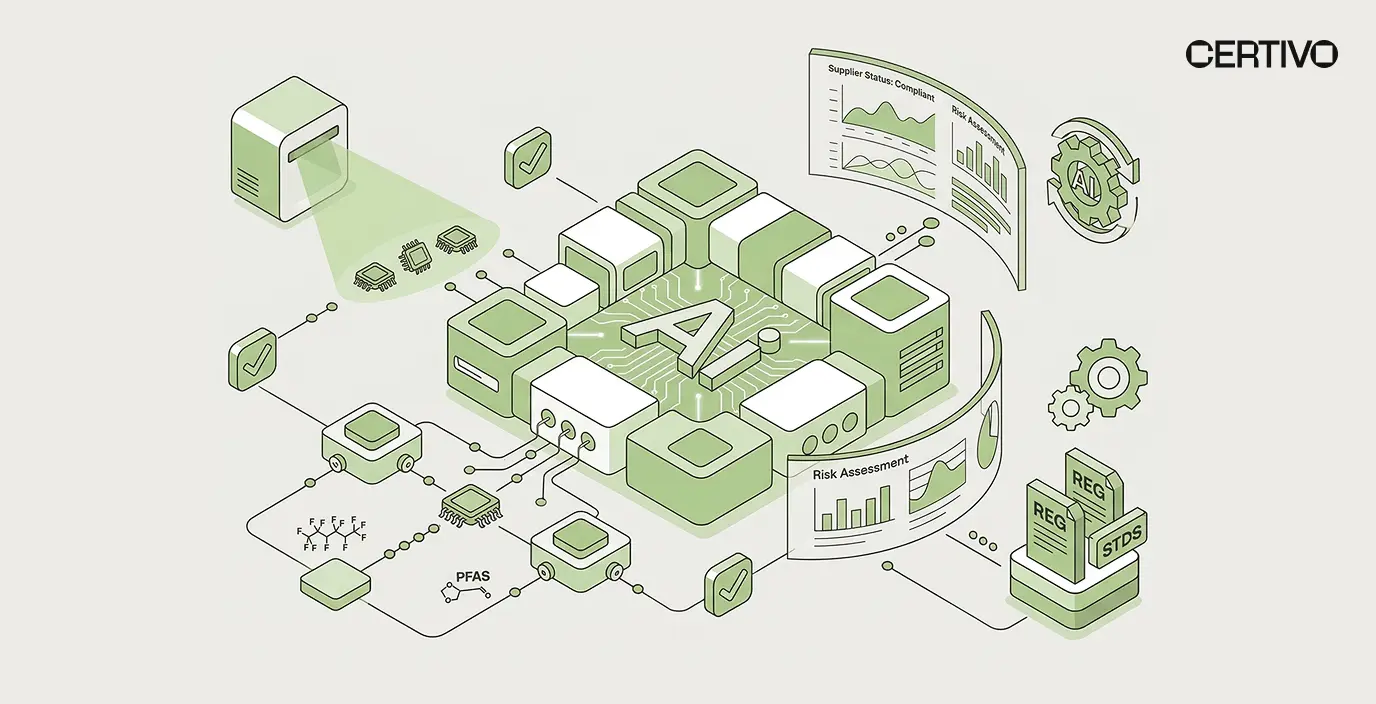
The electronics manufacturing industry faces unprecedented regulatory pressure as global PFAS restrictions tighten across multiple jurisdictions. Unlike broader chemical compliance frameworks, PFAS compliance in 2026 requires manufacturers to track thousands of per- and polyfluoroalkyl substances at the supplier level, across complex multi-tier supply chains, and within Bill of Materials (BOM) structures that often contain hundreds or thousands of components.
For electronics manufacturers, the compliance challenge extends beyond internal material selection. Circuit boards, semiconductors, connectors, coatings, and packaging materials may contain PFAS intentionally added for heat resistance, chemical stability, or moisture protection. Without supplier-level compliance tracking, manufacturers face regulatory reporting failures, audit exposure, and market access restrictions across the EU, US states, and emerging Asia-Pacific jurisdictions.
Book a free compliance assessment to understand your PFAS exposure across products and supply chains.
Table of Contents
Why PFAS Compliance Is a Supplier-Level Problem in Electronics
Regulatory Scope: Which PFAS Rules Apply to Electronics Manufacturers?
Where PFAS Appears in Electronics Components and Assemblies
Supplier Data Challenges: Why Traditional Methods Fail
What Systems Support Multi-Tier Supply Chain Transparency for Material Content?
BOM-Level PFAS Tracking: Requirements and Best Practices
Automated Supplier Data Collection for PFAS Declarations
Compliance Risks and Enforcement Exposure for Electronics Manufacturers
Timeline: Key PFAS Deadlines for Electronics Supply Chains
How AI Automates PFAS Compliance Across Electronics Supply Chains
Strategic Preparation: Building Audit-Ready PFAS Documentation
FAQ
Why PFAS Compliance Is a Supplier-Level Problem in Electronics
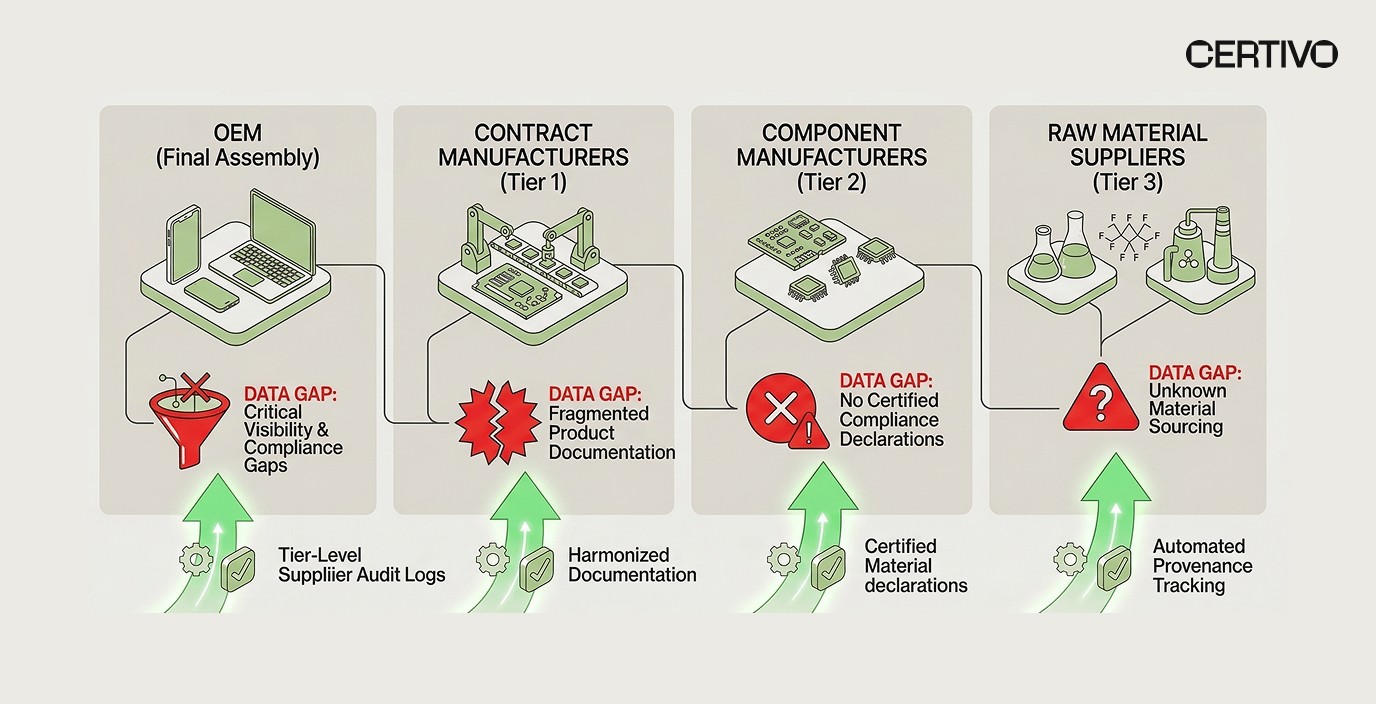
Electronics manufacturing operates through deeply layered supply chains. A single printed circuit board assembly (PCBA) may source components from 50+ direct suppliers, each managing their own material sourcing networks. PFAS can enter the supply chain through:
Component manufacturing processes (solder masks, flux, coatings)
Raw material treatments (heat stabilizers, surface treatments)
Packaging materials (moisture barriers, anti-static films)
Processing aids (etching solutions, cleaning agents)
Most manufacturers do not have direct visibility into Tier 2 or Tier 3 material composition. Supplier declarations often arrive in inconsistent formats—PDFs, spreadsheets, emails—or reference outdated material safety data sheets (MSDS) that predate PFAS disclosure requirements.
Electronics manufacturing compliance now requires verifiable, substance-level traceability. Regulatory authorities expect manufacturers to demonstrate due diligence across the entire supply chain, not just direct suppliers. Without multi-tier supply chain transparency, compliance claims become unverifiable and audit risk escalates.
Regulatory Scope: Which PFAS Rules Apply to Electronics Manufacturers?
Electronics manufacturers face PFAS compliance obligations under multiple regulatory frameworks:
EU REACH and Proposed PFAS Restriction
The European Chemicals Agency (ECHA) is advancing a broad PFAS restriction proposal under REACH Annex XVII. If adopted, the restriction would ban intentional PFAS use in most articles, with limited derogations for critical applications. Electronics manufacturers must:
✓ Identify PFAS in product BOMs
✓ Assess eligibility for derogations
✓ Prepare substitution roadmaps
✓ Maintain audit-ready documentation
REACH compliance also requires SVHC disclosure when PFAS substances exceed 0.1% weight-by-weight thresholds in articles.
US EPA TSCA Section 8(a)(7) Reporting
The EPA's PFAS reporting rule under TSCA Section 8(a)(7) requires manufacturers and importers to report known or reasonably ascertainable PFAS use in articles since 2011. Electronics importers face:
⚠ Reporting deadlines: July 2025 (large manufacturers), January 2026 (small manufacturers)
⚠ Article-level reporting: Each imported product with PFAS triggers disclosure
⚠ Supplier certification: Manufacturers must obtain PFAS declarations from suppliers
US State-Level PFAS Restrictions
Multiple US states have enacted product-specific PFAS bans and reporting requirements:
📌 Maine PFAS reporting requires annual declarations
📌 Minnesota PFAS law mandates supplier certification
📌 California AB 1817 restricts PFAS in textiles and consumer goods
Managing multi-jurisdiction compliance requires centralized tracking systems that map product BOMs to jurisdiction-specific thresholds and reporting formats.
Where PFAS Appears in Electronics Components and Assemblies
Electronics manufacturers must identify PFAS across multiple component categories and manufacturing processes:
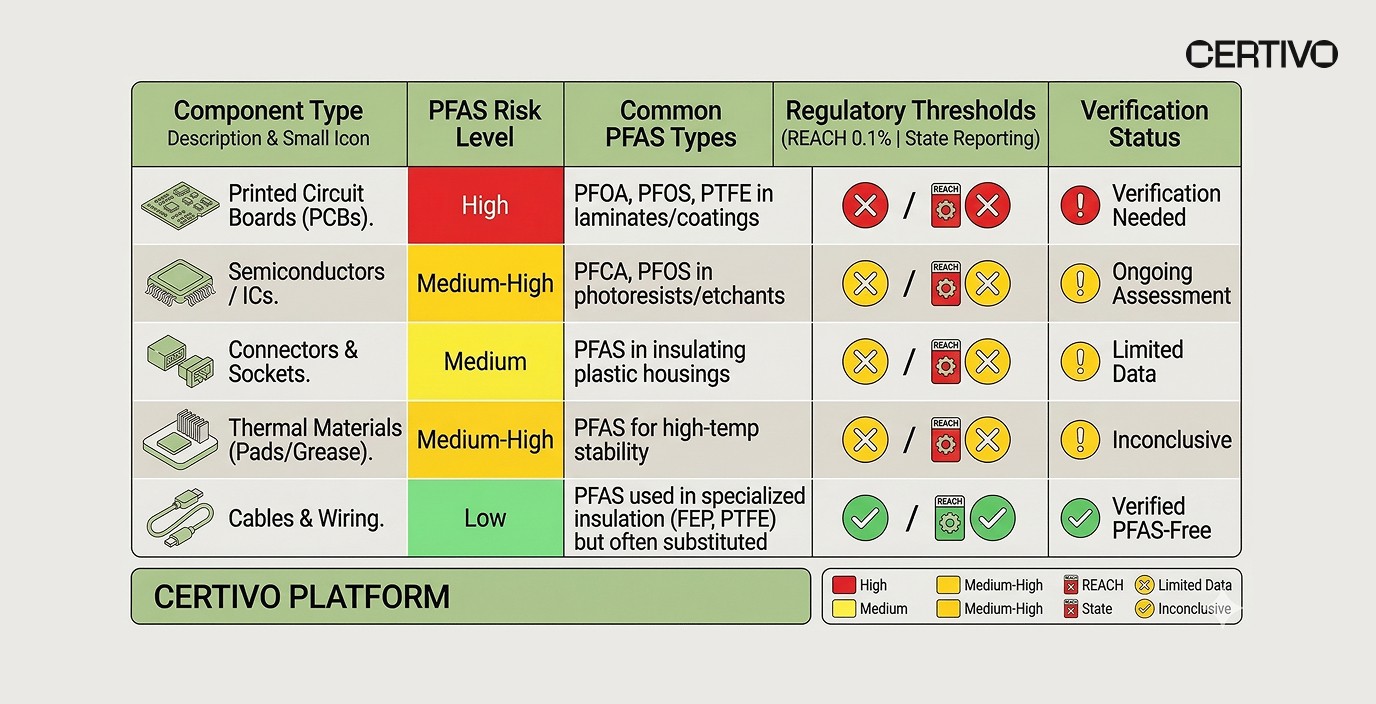
Printed Circuit Boards (PCBs)
🔹 Solder masks: PFAS-based polymers provide heat and chemical resistance
🔹 Surface finishes: PFAS may appear in electroless nickel immersion gold (ENIG) processes
🔹 Laminates: PTFE and other fluoropolymers used in high-frequency PCBs
Semiconductors and Integrated Circuits
🔹 Photoresists: PFAS-containing chemicals used in lithography
🔹 Etching solutions: Fluorinated compounds in semiconductor processing
🔹 Passivation layers: PFAS-based coatings for moisture protection
Connectors and Cable Assemblies
🔹 Wire insulation: Fluoropolymers in high-temperature applications
🔹 Connector housings: PFAS additives for flame retardancy
🔹 Cable jackets: PFAS coatings for chemical resistance
Thermal Management Materials
🔹 Thermal interface materials (TIMs): PFAS-based compounds for heat dissipation
🔹 Heat sinks: Surface treatments containing PFAS
🔹 Cooling fluids: Fluorinated heat transfer fluids in specialized applications
BOM-level compliance intelligence enables manufacturers to identify PFAS presence within specific part numbers, material codes, and supplier certifications.
Supplier Data Challenges: Why Traditional Methods Fail
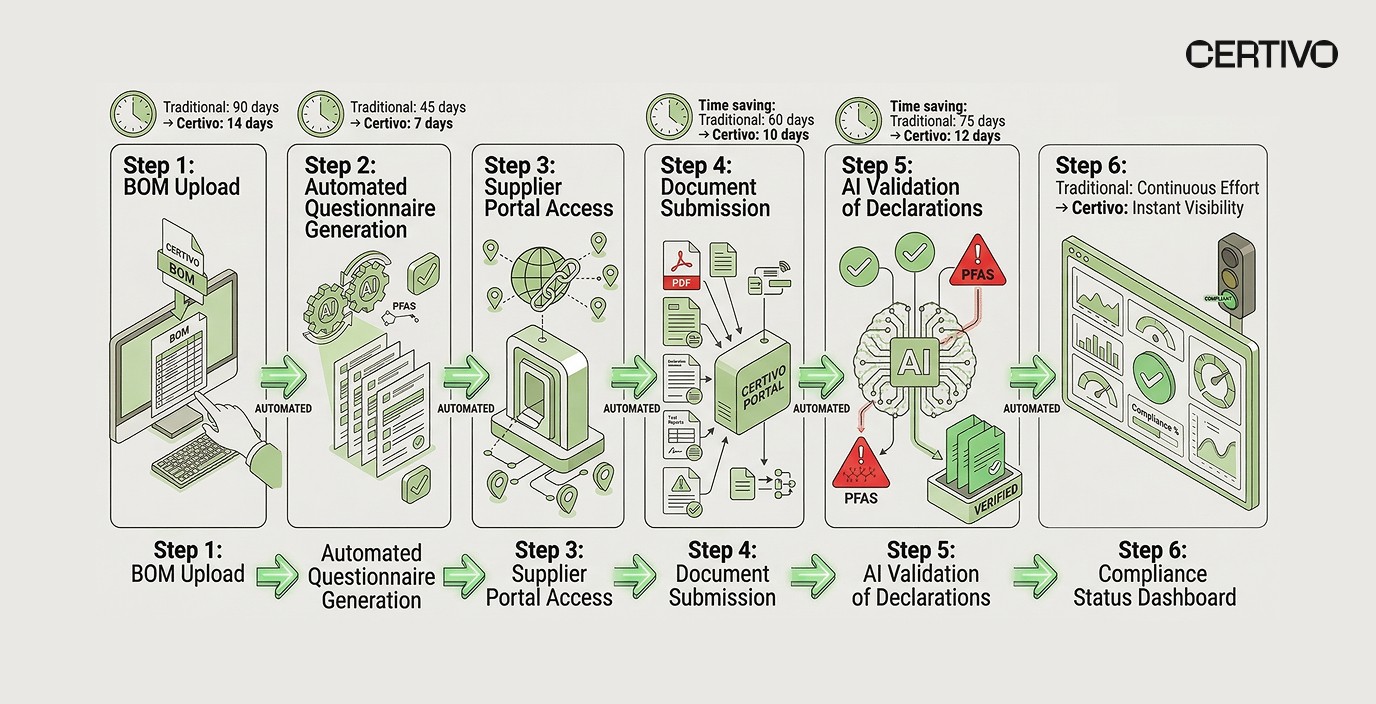
Electronics manufacturers attempting PFAS compliance through traditional supplier data collection methods encounter systematic failures:
Data Collection Bottlenecks
⚠ Email-based requests: Manual supplier outreach generates low response rates (often <40%)
⚠ Spreadsheet chaos: Inconsistent formats prevent aggregation and analysis
⚠ Declaration delays: Suppliers take 30-90 days to respond, blocking product launches
Data Quality and Verification Issues
⚠ Generic declarations: Suppliers provide company-level statements instead of part-specific data
⚠ Outdated certificates: Material safety data sheets (MSDS) may not reflect current PFAS regulations
⚠ Threshold confusion: Suppliers misinterpret 0.1% REACH thresholds vs. state-level reporting triggers
Multi-Tier Visibility Gaps
⚠ Tier 2+ opacity: Direct suppliers cannot verify sub-supplier material content
⚠ Change management failures: Material substitutions occur without notification
⚠ Regional variations: Same part number may have different formulations by manufacturing location
Automated supplier data collection portals eliminate manual bottlenecks by providing standardized questionnaire frameworks and supplier self-service compliance portals that integrate directly with product BOMs.
What Systems Support Multi-Tier Supply Chain Transparency for Material Content?
Effective PFAS compliance in electronics requires systems that connect BOM structures to supplier declarations and regulatory thresholds. Traditional ERP and PLM systems lack substance-level intelligence and cannot automate supplier data validation.
Centralized Compliance Data Backbone
Enterprise compliance platforms serve as the centralized compliance data backbone by:
✓ Linking BOMs to supplier declarations: Each part number connects to verified material content
✓ Tracking substance thresholds: Automated flagging when PFAS levels approach regulatory limits
✓ Version control: Historical tracking of material changes and supplier certifications
✓ Audit trail maintenance: Complete documentation chain for regulatory inquiries
Supplier Self-Service Portals
Supplier self-service compliance portals accelerate data collection through:
✓ Standardized questionnaires: Pre-populated fields reduce supplier confusion
✓ Document upload workflows: Automated validation of certificates and test reports
✓ Real-time status tracking: Visibility into outstanding supplier requests
✓ Multilingual support: Regional language options improve response rates
Certivo's supplier management solution provides automated supplier data collection infrastructure that scales across thousands of suppliers without increasing compliance team headcount.
BOM-Level PFAS Tracking: Requirements and Best Practices
Electronics manufacturers must establish BOM-level compliance intelligence that maps PFAS presence to individual part numbers and assemblies. Regulatory authorities increasingly require part-level documentation during audits.
BOM Structure and Substance Mapping
Effective PFAS tracking requires:
✓ Part-level granularity: PFAS declarations linked to specific part numbers, not product families
✓ Material composition data: Weight percentages for each PFAS substance within components
✓ Supplier certification dates: Timestamps showing when declarations were issued
✓ Change notification triggers: Alerts when suppliers modify material formulations
Threshold Management
BOM substance and threshold management must account for:
📊 0.1% REACH SVHC threshold: Article-level calculation
📊 State reporting triggers: Varied thresholds across Maine, Minnesota, Washington
📊 Customer specifications: OEM-specific PFAS restrictions below regulatory limits
Rollup Calculations
Complex assemblies require automated rollup calculations:
Component-level PFAS content aggregates to assembly-level totals
Weighted averages account for component masses within assemblies
Threshold breach alerts trigger when assembled products exceed limits
Tracking compliance by BOM enables manufacturers to generate product-specific compliance reports within minutes rather than weeks of manual data aggregation.
Automated Supplier Data Collection for PFAS Declarations
Manual PFAS data collection does not scale. Electronics manufacturers managing 500+ suppliers and 10,000+ active part numbers require automated supplier data collection portals that eliminate spreadsheet chaos and email bottlenecks.
Standardized Supplier Questionnaire Frameworks
Standardized supplier questionnaire frameworks ensure consistency:
✓ Pre-configured PFAS substance lists (OECD definitions, EPA reporting lists)
✓ Jurisdiction-specific disclosure requirements
✓ Part number mapping fields
✓ Certificate upload workflows
AI Document Parsing and Certificate Validation
AI document parsing and certificate validation automates:
✓ Extraction of substance data from supplier PDFs and test reports
✓ CAS number validation against regulatory lists
✓ Threshold calculation from concentration data
✓ Expiration date tracking for time-limited certifications
Certivo's CORA-powered regulatory intelligence extracts PFAS data from unstructured supplier documents and maps findings to BOM part numbers automatically.
Supplier Risk Scoring and Due Diligence
Supplier risk scoring and due diligence features prioritize follow-up:
⚠ High-risk suppliers: Incomplete declarations or expired certifications
⚠ Medium-risk suppliers: Generic statements requiring verification
⚠ Low-risk suppliers: Validated, part-specific declarations with recent test reports
Compliance Risks and Enforcement Exposure for Electronics Manufacturers
Non-compliance with PFAS regulations exposes electronics manufacturers to multiple enforcement risks:
Regulatory Penalties
⚠ US EPA TSCA violations: Up to $50,332 per violation per day
⚠ EU REACH non-compliance: Market access restrictions and product recalls
⚠ State-level penalties: Fines ranging from $5,000 to $100,000+ depending on jurisdiction
Market Access and Customer Requirements
📌 OEM de-listing: Major electronics customers require verified PFAS declarations before purchase orders
📌 Tender exclusion: Public sector procurement increasingly requires PFAS-free certifications
📌 Export restrictions: EU market entry blocked without compliant substance disclosure
Managing compliance risk proactively requires continuous compliance monitoring and audit readiness rather than reactive responses to customer inquiries or regulatory notices.
Supply Chain Disruption
⚠ Supplier disqualification: Suppliers unable to provide PFAS declarations face removal from approved vendor lists
⚠ Material substitution delays: Identifying PFAS-free alternatives extends product development cycles
⚠ Inventory obsolescence: Existing stock becomes unsellable if regulatory thresholds tighten
Timeline: Key PFAS Deadlines for Electronics Supply Chains
Electronics manufacturers face cascading PFAS compliance deadlines across multiple jurisdictions:
2025 Deadlines
📅 July 2025: EPA TSCA Section 8(a)(7) reporting (large manufacturers)
📅 October 2025: California Proposition 65 PFAS warning requirements
2026 Deadlines
📅 January 2026: EPA TSCA Section 8(a)(7) reporting (small manufacturers)
📅 July 2026: Minnesota PFAS reporting (priority products)
📅 Q4 2026: EU REACH PFAS restriction proposal expected adoption
2027-2028 Enforcement
📅 2027: Washington State PFAS sales ban implementation
📅 2028: EU REACH PFAS restriction enforcement begins (estimated)
PFAS compliance in 2026 requires proactive preparation, as regulatory enforcement will intensify before many manufacturers have established compliant processes. Regulatory intelligence and horizon scanning capabilities help compliance teams anticipate changing requirements.
How AI Automates PFAS Compliance Across Electronics Supply Chains
Manual PFAS tracking cannot keep pace with the scope and complexity of modern electronics supply chains. AI-native compliance automation transforms reactive compliance into continuous audit-ready documentation.
CORA-Powered Regulatory Intelligence
CORA intelligence within Certivo provides:
✓ Automatic regulatory updates: New PFAS restrictions mapped to affected products
✓ Substance list synchronization: OECD, EPA, ECHA lists updated without manual intervention
✓ Threshold change alerts: Notifications when regulatory limits tighten
AI Document Parsing at Scale
AI document parsing and certificate validation enables:
✓ Bulk processing: Hundreds of supplier certificates analyzed simultaneously
✓ Data extraction accuracy: CAS numbers, concentrations, and test methods captured automatically
✓ Validation against regulatory lists: Cross-referencing extracted substances with current compliance requirements
BOM-Level Material Mapping
BOM-level material mapping connects:
✓ Supplier declarations → Part numbers → Assemblies → Finished products
✓ Automated rollup calculations across BOM hierarchies
✓ Real-time compliance status for each SKU
How AI automates TSCA PFAS reporting demonstrates how CORA-driven compliance intelligence manages 12,000+ PFAS compounds across thousands of product BOMs without manual data entry.
Strategic Preparation: Building Audit-Ready PFAS Documentation
Electronics manufacturers preparing for PFAS compliance must establish infrastructure that supports both current reporting obligations and future regulatory expansion.
Phase 1: Supply Chain Data Collection
✓ Deploy supplier self-service compliance portals
✓ Issue PFAS questionnaires to all direct suppliers
✓ Establish response deadlines and escalation protocols
✓ Build centralized compliance data backbone linking BOMs to declarations
Phase 2: BOM-Level Analysis
✓ Map supplier declarations to specific part numbers
✓ Calculate PFAS content at component and assembly levels
✓ Identify high-risk components requiring substitution
✓ Generate continuous audit-ready documentation for regulatory inquiries
Phase 3: Continuous Monitoring
✓ Activate continuous compliance monitoring and audit readiness workflows
✓ Configure alerts for supplier material changes
✓ Schedule periodic recertification requests
✓ Maintain version control of all supplier declarations
Staying audit-ready across frameworks requires integrated systems that support PFAS alongside RoHS, REACH, and conflict minerals compliance.
Executive Conclusion: From Reactive Compliance to Continuous Readiness
PFAS compliance in electronics manufacturing cannot be managed through spreadsheets, email requests, or periodic supplier audits. The regulatory scope spans federal, state, and international jurisdictions, each with distinct substance lists, thresholds, and reporting formats. The technical scope requires substance-level traceability across multi-tier supply chains containing thousands of components.
Electronics manufacturers who establish supplier-level compliance tracking infrastructure now will avoid market access disruptions, customer de-listings, and regulatory penalties in 2026 and beyond. Those relying on manual processes face systematic compliance failures as reporting obligations expand.
Certivo's platform provides the centralized compliance data backbone that connects BOM structures to supplier declarations, automates regulatory mapping through CORA intelligence, and maintains continuous audit-ready documentation across PFAS and all other substance compliance frameworks.
Book a demo to see how Certivo automates PFAS compliance across your product portfolio and supply chain—or get a free compliance risk assessment to understand your current PFAS exposure across products and jurisdictions.
FAQ
What tools help track PFAS regulations and ensure product compliance across regions?
Compliance platforms with regulatory intelligence and horizon scanning capabilities automatically track federal, state, and international PFAS restrictions and map them to affected product BOMs. Certivo's CORA-powered regulatory intelligence updates substance lists, thresholds, and reporting requirements without manual monitoring.
What digital solutions help manufacturers comply with emerging PFAS restrictions?
AI-native compliance automation platforms combine automated supplier data collection portals, BOM-level compliance intelligence, and AI document parsing to manage PFAS declarations across multi-tier supply chains. These systems replace spreadsheet-based tracking with continuous compliance monitoring and audit readiness.
What systems support ongoing due diligence for supply-chain chemical compliance?
Enterprise compliance platforms establish a centralized compliance data backbone that links supplier certifications to part numbers and assemblies. Supplier risk scoring and due diligence features prioritize follow-up on incomplete declarations while continuous audit-ready documentation maintains regulatory compliance proof.
How can manufacturers validate supplier material declarations against known risk lists?
AI document parsing and certificate validation tools extract substance data from supplier documents and cross-reference CAS numbers against regulatory lists (OECD PFAS definitions, EPA reporting lists, REACH SVHC). Automated validation identifies declaration gaps and threshold exceedances requiring supplier follow-up.
What platforms enable end-to-end PFAS compliance from design through production?
Integrated compliance platforms connect PLM and ERP systems through BOM-level material mapping and design-for-compliance PLM workflows. This enables engineers to assess PFAS exposure during product design while procurement teams manage supplier self-service compliance portals for ongoing certification collection and validation.
Vasanth
Vasanth is a skilled Compliance Engineer with over five years of experience specializing in global environmental regulations, including REACH, RoHS, Proposition 65, POPs, TSCA, PFAS, CMRT, EMRT, FMD, and IMDS. With a strong academic foundation in Chemical Engineering from Anna University, he brings a deep technical understanding to compliance processes across complex product lines.
Vasanth excels in analyzing Bills of Materials (BOMs), evaluating supplier declarations, and ensuring regulatory conformity through meticulous review and risk assessment. He is highly proficient in supplier engagement, adept at interpreting material disclosures, and experienced in preparing customer-ready compliance documentation tailored to diverse global standards.
Known for his attention to detail, up-to-date regulatory knowledge, and proactive communication style, Vasanth plays a critical role in maintaining product compliance and advancing sustainability goals within fast-paced, globally integrated manufacturing environments.