


The EU Packaging and Packaging Waste Regulation (PPWR) introduces material-level data obligations that fundamentally change how manufacturers document, source, and report on packaging. Unlike previous packaging directives, PPWR demands granular substance-level transparency—including recycled content percentages, material composition declarations, and restricted substance verification—at the packaging BOM level. For compliance engineers, supply chain leaders, and regulatory directors at global manufacturers, the August 2026 enforcement timeline means that supplier data collection must begin now.
Organizations still relying on spreadsheets and email to manage packaging compliance documentation face a structural gap. PPWR requires centralized compliance data that links packaging material declarations to specific products, suppliers, and regulatory thresholds across the EU.
📌 Book a free compliance assessment to evaluate your PPWR packaging data readiness across products and supply chains.
What Is PPWR and Why Does It Affect Packaging BOMs?
The PPWR (Packaging and Packaging Waste Regulation) replaces the existing EU Packaging and Packaging Waste Directive (94/62/EC) with a directly applicable regulation across all EU member states. This shift from directive to regulation eliminates national transposition variations—creating a single, enforceable standard for packaging placed on the EU market.
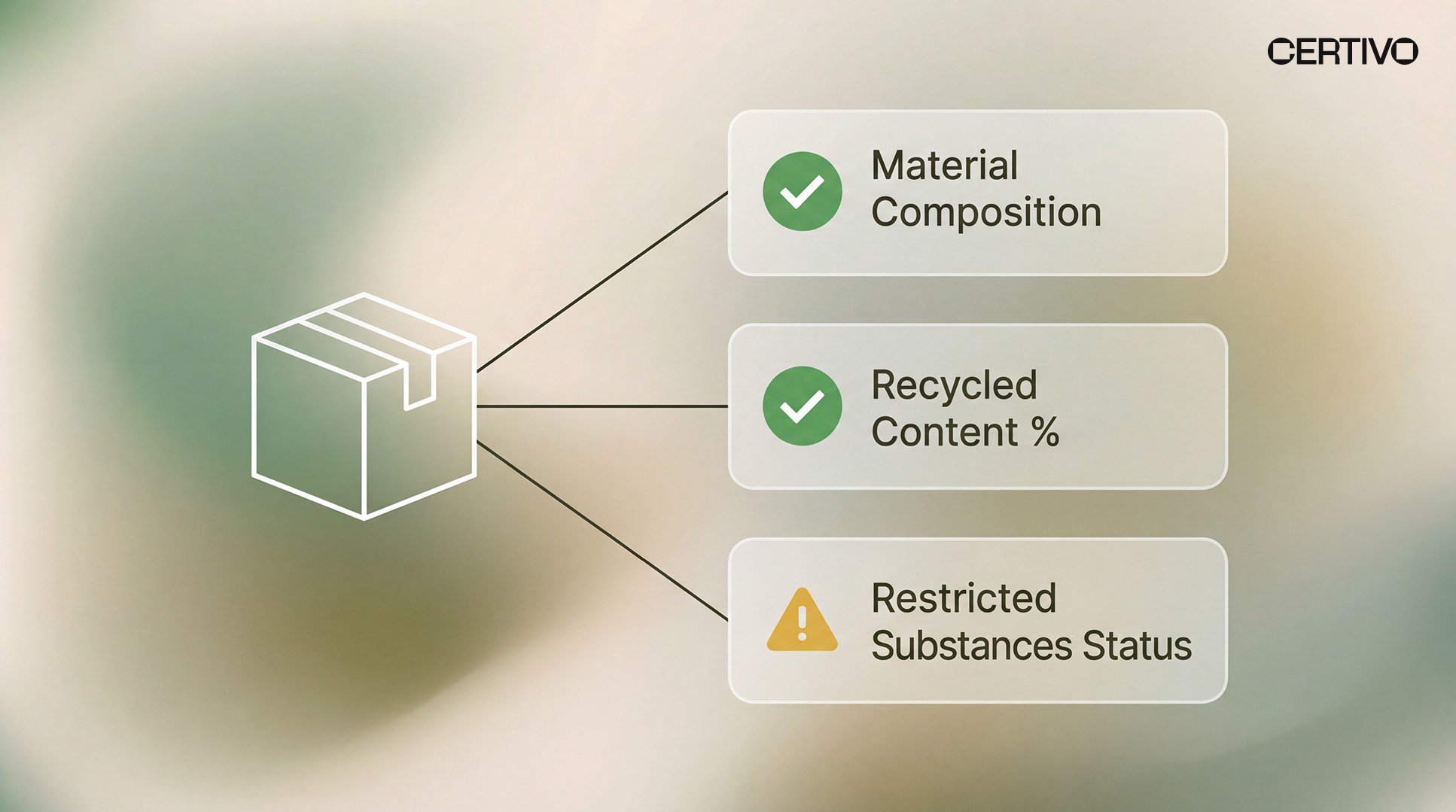
For manufacturers, the most operationally significant change is the requirement to document packaging material composition at a level of granularity that most organizations have never tracked. PPWR mandates:
✓ Recycled content declarations by packaging unit
✓ Substance-level verification against restricted chemicals lists (including PFAS restrictions)
✓ Recyclability classification and labeling per packaging component
✓ Minimum recycled content thresholds by material type and deadline
This is not a labeling exercise. It is a BOM-level material mapping obligation that requires verifiable supplier data for every packaging component—primary, secondary, and tertiary.
Companies that have built robust processes for materials and environmental compliance under REACH and RoHS will find PPWR familiar in structure but different in scope: it applies to packaging materials, not just product materials.
PPWR supplier data requirements for packaging BOM compliance manufacturers
Click on image to view full
Key PPWR Supplier Data Requirements for Manufacturers
PPWR introduces specific data obligations that manufacturers must collect from packaging suppliers. Based on currently available regulatory guidance, the core requirements include:
Recycled Content Declarations
Material Type | Minimum Recycled Content | Enforcement Date |
|---|---|---|
Contact-sensitive plastic | 10% | 2030 |
Single-use plastic bottles (PET) | 30% | 2030 |
All plastic packaging | 35% | 2030 |
Contact-sensitive plastic | 50% | 2040 |
Single-use plastic bottles | 65% | 2040 |
⚠ Manufacturers must begin collecting recycled content data from packaging suppliers now to establish baselines and identify gaps before enforcement begins.
Substance Restrictions in Packaging
PPWR restricts intentionally added PFAS in food-contact packaging and sets concentration limits for heavy metals (lead, cadmium, mercury, hexavalent chromium) across all packaging types. This directly intersects with PFAS and chemicals risk management programs that many manufacturers are already building.
Recyclability and Labeling Requirements
Every packaging unit placed on the EU market must be classified for recyclability and carry standardized labeling. This requires material-level data that most supplier declarations do not currently capture.
Digital Product Passport Readiness
PPWR aligns with the EU's broader Digital Product Passport framework. Packaging data must be structured, machine-readable, and traceable—requiring digital passport and traceability systems that connect packaging BOMs to product-level compliance records.
What Does a PPWR-Compliant Packaging BOM Look Like?
A PPWR-compliant packaging BOM is not a traditional bill of materials. It must include data fields that go well beyond component names and quantities:
📊 Material identification — Polymer type, alloy, paper grade, or composite breakdown for each packaging component
📊 Recycled content percentage — Verified post-consumer and pre-consumer recycled content per component, supported by supplier certificates or third-party verification
📊 Substance declarations — Confirmation that restricted substances (PFAS, heavy metals) are below regulatory thresholds, with supporting test data or declarations of conformity
📊 Recyclability classification — Each component classified per EU recyclability criteria, including material compatibility and disassembly requirements
📊 Supplier traceability — Each data point linked to a specific supplier, batch, and date of declaration
This is where BOM-level compliance intelligence becomes essential. Manufacturers need systems that can ingest supplier packaging data, map it against PPWR thresholds, and flag non-conformances before products reach market.
For organizations managing BOM substance and threshold management under REACH or RoHS, the PPWR packaging BOM extends the same discipline to packaging materials—often involving different supplier networks and data formats.
Which Industries and Product Categories Are Affected?
PPWR applies to all packaging placed on the EU market, regardless of origin. This means any manufacturer—whether EU-based or exporting into the EU—must comply. The industries facing the most immediate impact include:
✓ Consumer goods — Primary and secondary packaging for FMCG, personal care, and household products
✓ Electronics manufacturing — Protective packaging, blister packs, anti-static materials, and foam inserts
✓ Automotive manufacturing — Parts packaging, transport packaging, and returnable container programs
✓ Chemical manufacturing — Hazmat-rated packaging with dual compliance under PPWR and ADR/IMDG
✓ Medical devices and equipment — Sterile barrier packaging with unique recyclability challenges
📌 Need to understand your PPWR exposure across product lines? Use Certivo's Rapid Risk Assessment Tool to map your regulatory exposure in 60 seconds.
How Can Manufacturers Collect Packaging Material Data from Suppliers at Scale?
This is the operational crux of PPWR compliance. Most packaging suppliers—particularly sub-tier converters, film manufacturers, and ink suppliers—are not accustomed to providing the level of material data that PPWR requires. Compliance teams face:
⚠ Inconsistent data formats — Suppliers submit data in PDFs, spreadsheets, emails, and certificates with no standardized structure
⚠ Incomplete declarations — Many suppliers cannot provide recycled content percentages or substance-level test data for packaging materials
⚠ Volume challenges — A single product may involve 5–10 packaging components from different suppliers, each requiring separate data collection
⚠ Version control — Packaging specifications change frequently; maintaining current data across hundreds of products requires automated tracking
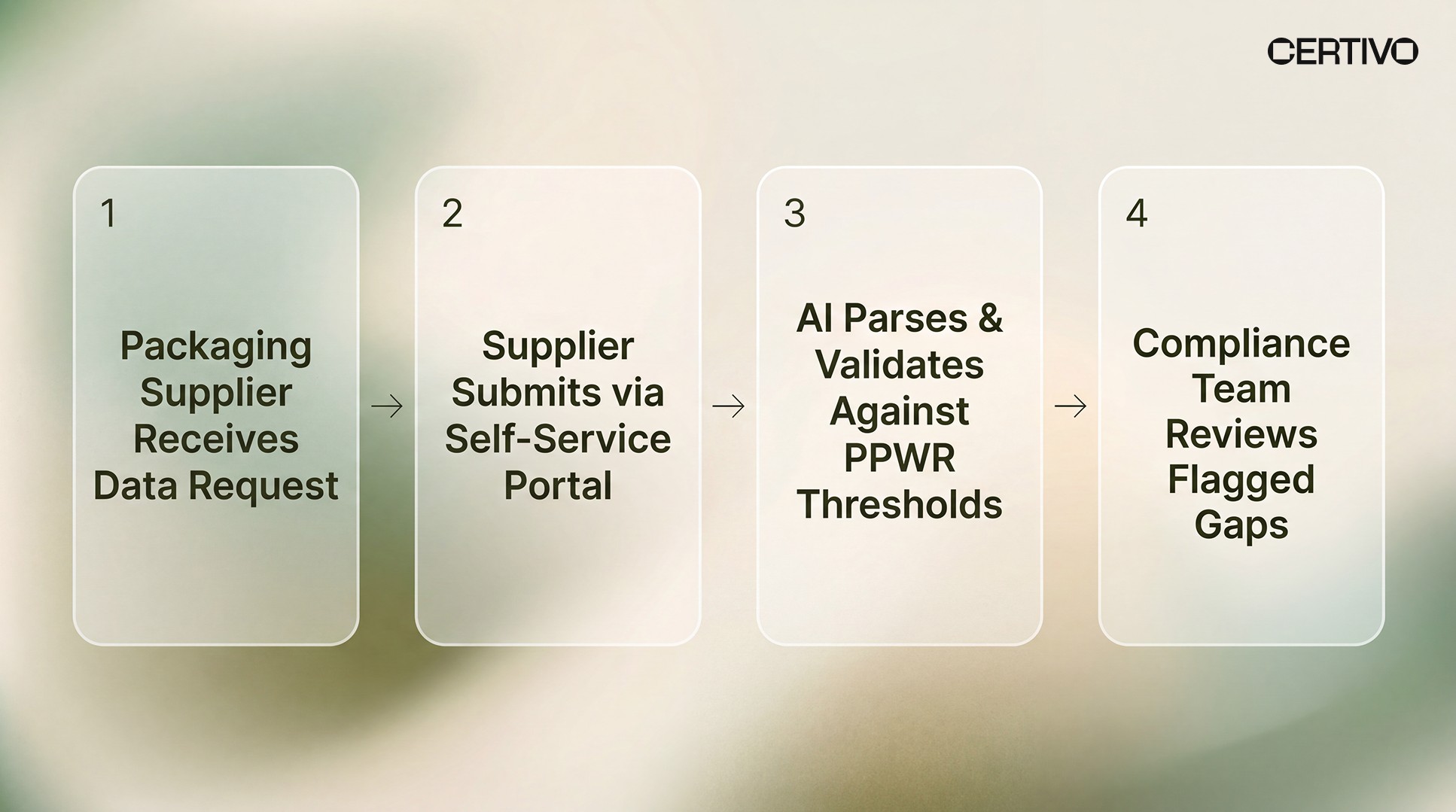
Manual collection via email and spreadsheets cannot scale. Organizations that have implemented automated supplier data collection portals for product compliance can extend the same infrastructure to packaging data. Standardized supplier questionnaire frameworks reduce the back-and-forth that delays data collection.
Centralized supplier self-service portals allow packaging suppliers to submit material declarations, recycled content certificates, and test reports directly into a structured system—eliminating manual data entry and enabling AI document parsing and certificate validation at intake.
PPWR packaging supplier data collection workflow for manufacturer compliance
Click on image to view full
Compliance Risks and Penalties for Missing PPWR Deadlines
PPWR is a regulation, not a directive. This means enforcement is uniform across EU member states, with penalties determined at the national level but guided by EU-level obligations. Based on currently available regulatory guidance, non-compliance risks include:
⚠ Market access restrictions — Packaging that does not meet PPWR requirements cannot legally be placed on the EU market
⚠ Product holds and shipment delays — Missing or incomplete packaging documentation triggers customs and market surveillance actions
⚠ Financial penalties — Member states will set fines proportional to the infringement; precedent from REACH and RoHS enforcement suggests significant financial exposure for repeat violations
⚠ Customer and retailer rejection — Major EU retailers and OEMs are already building PPWR compliance into procurement requirements; non-compliant suppliers risk disqualification
⚠ Reputational damage — Packaging sustainability is increasingly visible to consumers, investors, and ESG rating agencies
Maintaining continuous audit-ready documentation for packaging ensures that compliance data is available on demand—for regulators, customers, and internal audits.
Supply Chain and Operational Impact
PPWR's supply chain impact extends beyond packaging suppliers to every function that touches packaging decisions:
Procurement must add PPWR compliance criteria to packaging sourcing specifications and vendor qualification processes. Supplier risk scoring and due diligence programs should incorporate packaging material data completeness as a scoring factor.
Engineering and design teams must consider recyclability classifications and material restrictions during packaging design—creating a need for design-for-compliance PLM workflows that integrate packaging constraints alongside product compliance.
Regulatory and compliance teams must manage PPWR alongside existing frameworks (REACH, RoHS, PFAS regulations) without creating parallel data silos. This is where a centralized compliance data backbone delivers operational efficiency—linking packaging data to the same platform that manages product-level compliance.
Quality teams must verify that incoming packaging materials match declared specifications, especially for recycled content claims that are difficult to verify without structured documentation.
For manufacturers operating across multiple jurisdictions, PPWR adds another layer to multi-jurisdiction EHS and ESG management programs that already track varying packaging requirements in the US, Asia, and other regions.
PPWR Timeline: What Must Be Ready Before August 2026
Date | Milestone |
|---|---|
November 2024 | PPWR entered into force |
August 2025 | Extended Producer Responsibility (EPR) modulated fee structures begin taking effect |
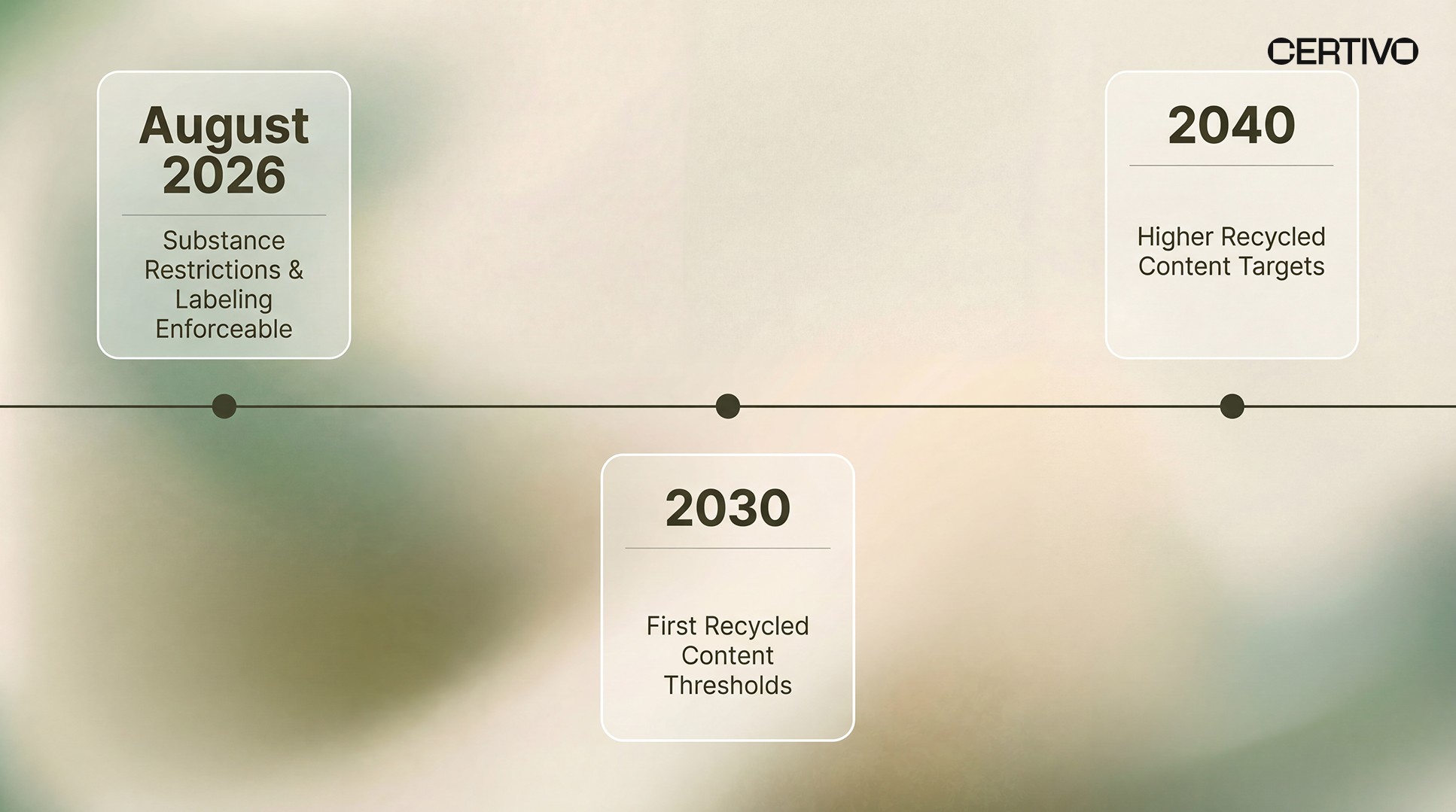
August 2026 | Key substance restrictions (PFAS in food-contact packaging), labeling requirements, and recyclability obligations become enforceable |
2030 | First recycled content thresholds enforced |
2040 | Higher recycled content thresholds enforced |
⚠ The August 2026 deadline is the immediate action trigger. Manufacturers must have packaging BOMs documented, supplier data collected, and substance declarations verified before this date.
Regulatory intelligence and horizon scanning capabilities help compliance teams track PPWR implementing acts and delegated regulations as they are published—ensuring that preparation is based on the latest regulatory guidance, not outdated assumptions.
How AI Automates PPWR Packaging Compliance Across Supply Chains
Manual packaging compliance programs built on email, spreadsheets, and ad hoc tracking cannot meet PPWR's data granularity and timeline requirements. AI-native compliance automation addresses the structural gaps.
Automated Data Collection and Validation
Certivo's supplier self-service compliance portals enable packaging suppliers to submit recycled content certificates, substance declarations, and material test reports directly. CORA-powered regulatory intelligence validates submitted data against PPWR thresholds at intake—flagging incomplete fields, missing substance declarations, and recycled content values that fall below regulatory minimums.
BOM-Level Packaging Compliance Mapping
Certivo maps packaging material data to specific products and BOM structures, enabling compliance teams to answer the question: "Is every packaging component on this product PPWR-compliant?" This BOM-level compliance intelligence capability is critical for manufacturers with hundreds or thousands of SKUs, each with unique packaging configurations.
Regulatory Horizon Scanning
CORA's regulatory intelligence layer monitors PPWR implementing acts, delegated regulations, and related EU packaging developments. When new requirements are published, CORA alerts affected compliance teams and maps regulatory changes to specific products and packaging components.
Multi-Framework Integration
PPWR compliance does not exist in isolation. Packaging materials may also trigger obligations under REACH, PFAS restrictions, Extended Producer Responsibility, and EU ESPR. Certivo manages all frameworks in a single platform, eliminating the duplication and data silos that multi-framework compliance creates.
For a broader perspective on AI-driven compliance management, see AI Tools for Compliance Management: The Complete Guide.
PPWR compliance timeline key deadlines for packaging manufacturers 2026 to 2040
Click on image to view full
Executive Conclusion
PPWR transforms packaging compliance from a labeling exercise into a material-level data obligation. The August 2026 enforcement deadline for substance restrictions, recyclability classification, and labeling requirements means manufacturers cannot afford to wait. Collecting PPWR supplier data for packaging BOMs—including recycled content percentages, restricted substance declarations, and recyclability classifications—requires structured, scalable processes that manual methods cannot deliver.
Investing in AI-native compliance automation, centralized supplier self-service portals, and BOM-level material mapping is the most effective strategy for meeting PPWR supplier data requirements without proportional increases in headcount or compliance risk.
📌 Book a demo to see how Certivo automates PPWR packaging compliance across your product portfolio and multi-tier supply chain—or use the Rapid Risk Assessment Tool to map your PPWR exposure in 60 seconds.
FAQs
1. What packaging material data must manufacturers collect from suppliers under PPWR?
Manufacturers must collect material composition details, recycled content percentages (post-consumer and pre-consumer), restricted substance declarations (including PFAS and heavy metals), and recyclability classification data for every packaging component. Certivo's CORA intelligence automates this collection through centralized supplier portals.
2. How does PPWR differ from the previous EU Packaging Directive?
PPWR is a directly applicable regulation, not a directive—eliminating national transposition variations. It introduces mandatory recycled content thresholds, substance-level restrictions, recyclability requirements, and digital product passport alignment that the previous directive did not require. CORA-driven compliance intelligence tracks these changes automatically.
3. Which substances are restricted in packaging under PPWR?
Based on currently available regulatory guidance, PPWR restricts intentionally added PFAS in food-contact packaging and sets concentration limits for lead, cadmium, mercury, and hexavalent chromium across all packaging types. Certivo maps these restrictions against supplier declarations at the BOM level.
4. Can existing REACH and RoHS compliance systems handle PPWR requirements?
REACH and RoHS systems address product material compliance but typically do not cover packaging-specific requirements like recycled content verification, recyclability classification, and packaging-specific substance thresholds. Certivo manages all frameworks—PPWR, REACH, RoHS, PFAS—in a single platform to eliminate data silos.
5. What is the recommended timeline to begin PPWR supplier data collection?
Manufacturers should begin immediately. The August 2026 enforcement deadline for substance restrictions and labeling requires that packaging BOMs are documented, supplier data collected, and substance declarations verified well before enforcement begins. Certivo's automated supplier data collection portals accelerate this process at scale.
Kunal Chopra
Kunal Chopra is the CEO of Certivo, an AI-driven compliance management platform revolutionizing how manufacturers navigate regulatory challenges. With a career spanning over two decades, Kunal is a seasoned technology leader, 3x tech CEO, product innovator, and board member with a passion for driving transformative growth and innovation.
Before leading Certivo, Kunal spearheaded successful transformations at renowned companies like Beckett Collectibles, Kaspien, Amazon, and Microsoft. His strategic vision and operational excellence have led to achievements such as a 25x EBITDA valuation increase at Beckett Collectibles and a 450% shareholder return at Kaspien. He has a track record of turning challenges into opportunities, delivering operational efficiencies, and driving market expansions.